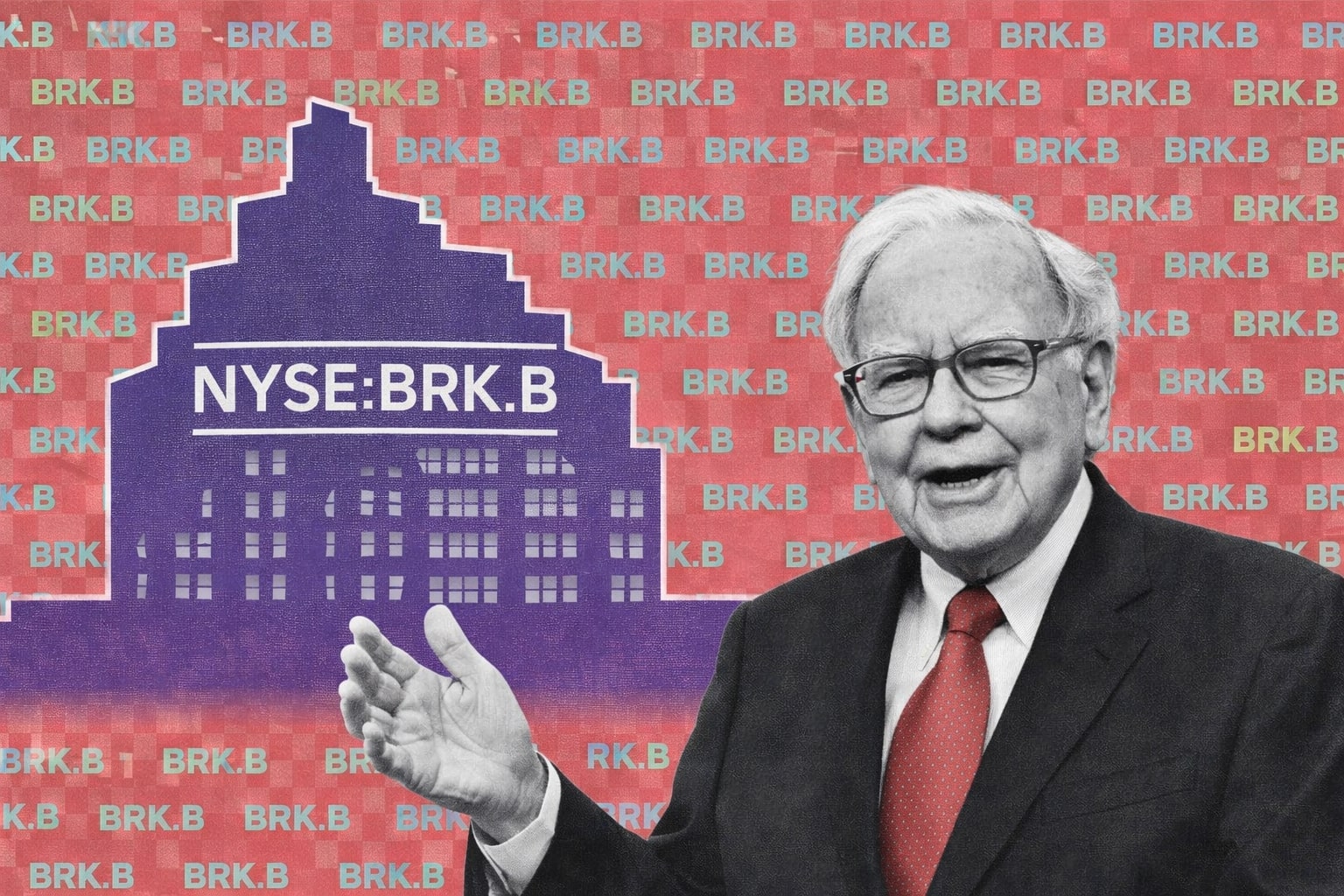
Berkshire Hathaway Stock Price Forecast BRK.B At $500: Can Berkshire Turn A $381.7B Cash Stack Into Double-Digit Upside?
Post-Buffett, Berkshire Hathaway leans on BNSF, BHE and industrial cash flows plus its record cash reserve to capture 2026 distress while cushioning downside for BRK.B holders | That's TradingNEWS
NYSE:BRK.B Stock Overview And Current Pricing
Berkshire Hathaway Inc. Class B (NYSE:BRK.B) trades around $500.31 today, up about $1.79 (+0.36%) on the session. The intraday range sits between $496.06 and $500.40, while the 52-week range stretches from $440.10 to $542.07. That puts the stock roughly 8% below its high and about 14% above the low. Market capitalization is around $1.08 trillion, with average daily volume near 4.74 million shares, so liquidity is not a constraint for institutional size.
On the income statement, Berkshire reported quarterly revenue of about $94.97 billion, up 2.13% year on year. Net income for the same period was $30.80 billion, up 17.31%, translating into a headline net margin of 32.43%, which expanded by 14.88 percentage points versus last year. Earnings per share of roughly $9.38k surged 33.51%. These numbers are distorted by mark-to-market swings in the equity portfolio, which is why the quoted P/E ratio of 0.01 is not a meaningful valuation signal. The core picture is simple: enormous revenue, very high reported profitability and strong earnings growth off an already huge base.
Market Scale, Balance Sheet Strength And Cash Generation
On the balance sheet, NYSE:BRK.B carries $1.23 trillion in total assets, up 6.86% year on year, against $525.52 billion of total liabilities, up 1.96%. Shareholders’ equity sits around $700.44 billion, which gives a very conservative leverage profile for a conglomerate that includes large insurance and financial operations.
The most important line for optionality is cash and short-term investments: $381.67 billion, growing 17.36% year on year. That war chest is bigger than the GDP of many countries and gives Berkshire the ability to act as a buyer of size in any stress scenario. Returns on that asset base are solid: return on assets stands at 8.17%, return on capital at 12.01%, which is strong for a company this large.
On the cash-flow side, net income of $30.80 billion converts into $13.79 billion of cash from operations in the reported period, a jump of 664.78% as working-capital swings normalize. Cash from investing is –$39.05 billion, a –900.31% change, showing aggressive deployment into securities and operating assets. Cash from financing is $835 million, up 127.24%. Net change in cash is –$24.12 billion as management purposely shrinks the cash pile after years of accumulation, while still producing $47.98 billion in free cash flow, up 73.65% year on year. The message is clear: Berkshire generates vast surplus cash, and even a heavy investment year still leaves tens of billions in free cash.
Insurance Float, Operating Businesses And Investment Portfolio
Strategically, NYSE:BRK.B is three engines under one roof. First, the insurance complex (GEICO, General Re, Berkshire reinsurance operations and others) produces underwriting profit and float. That float is effectively low-cost or even negative-cost capital that can be invested into equities, bonds or acquisitions. A disciplined underwriting culture, reinforced for decades, aims for combined ratios below 100% so float is a profit center, not a subsidy.
Second, wholly owned operating businesses span railroad (BNSF), utilities and energy (BHE), manufacturing, service and retailing. These businesses provide recurring, relatively predictable cash flow that is less volatile than the mark-to-market swings of the investment portfolio. Their earnings are the backbone of intrinsic value.
Third, the listed equity portfolio includes concentrated core positions in mega-caps and high-quality financials and industrials. Combined with the enormous T-bill and short-term investment stack of roughly $381.67 billion, this gives NYSE:BRK.B a hybrid profile: part operating company, part actively managed investment fund, part giant liquidity pool.
Industrial Backbone: BNSF And Manufacturing Inside NYSE:BRK.B
The industrial backbone of NYSE:BRK.B is BNSF Railway plus the manufacturing group. BNSF is a Class I railroad with a network that forms a practical duopoly in much of its footprint. It moves intermodal freight, industrial products, agricultural and energy cargo and coal. Recently, BNSF’s pre-tax earnings increased by around 3.5–3.6% year on year for the quarter and about 6.8% for the first nine months. After-tax earnings growth is even stronger, about 4.8% for the quarter and 10% year to date, driven by pricing, efficiency gains and a lower effective tax rate.
Freight data gives a high-resolution view of the real economy. Consumer products revenue sits around $2.1 billion for the quarter, flat year on year, with slightly higher volumes driven by stronger intermodal flows and automotive shipments offsetting lower revenue per unit. Industrial products show some softness, with nine-month volumes down 3.8%, but quarterly revenue of roughly $1.3 billion is flat year on year, which means pricing gains are compensating for weaker construction and petroleum product demand. Agricultural and energy products deliver about $1.6 billion in quarterly revenue, up 6.3%, helped by grain exports and firm pricing. Coal revenue is about $795 million for the quarter and $2.2 billion for nine months, with volumes down but pricing supported by higher natural-gas prices.
The key takeaway is that BNSF does not require strong volume growth to grow earnings. With a nearly irreplaceable network and rational industry structure, it can lift pre-tax profit through pricing discipline and operating leverage even in a late-cycle environment. On the liability side, BNSF has repaid about $900 million of debt while issuing $900 million maturing in 2056 at around 5.8%, indicating no balance-sheet stress and long-dated funding at acceptable rates.
Manufacturing is split into industrial products, building products and consumer products. Industrial products (Precision Castparts, Lubrizol, IMC, Marmon, CTB and others) produced about $9.5 billion of quarterly revenue and $28.1 billion year to date, up 5.8% and 3.5% respectively. Pre-tax earnings jumped 24.3% in the quarter and 11.7% year to date, which means margin expansion is real. This group captures demand for aerospace, industrial components, chemicals, tools and agriculture-related equipment. Even without a booming PMI, these businesses are lifting profitability through price, mix and efficiency.
Building products (Clayton Homes, Shaw, Johns Manville, Acme Brick, Benjamin Moore, MiTek) are facing a cooler housing market and pricing pressure. Quarterly sales declined by about $94 million (–1.4%) and year-to-date sales by $220 million (–1.1%). Yet pre-tax earnings still increased 7.6% in the quarter (+$81 million) and are down only 2.4% year to date (–$76 million). That is acceptable performance in a choppy construction cycle and shows the advantage of owning low-cost producers and diversified product lines rather than narrow, levered housing plays.
Consumer products (Forest River, Fruit of the Loom, Duracell, Brooks, Richline, Jazwares, Larson-Juhl and others) are more exposed to discretionary demand. Quarterly revenue fell by roughly $237 million (–6.2%), a faster decline than the –4% year-to-date trend, with weakness concentrated in Fruit of the Loom, Duracell and Jazwares. At the same time, Brooks, Forest River and Richline are growing. This segment adds cyclicality, but within Berkshire’s size it is manageable.
Service and retailing (NetJets, FlightSafety, Dairy Queen, McLane, auto dealerships, home furnishings, jewelry, See’s Candies and others) continue to show revenue and pre-tax profit growth across all four internal groupings. Pilot’s travel center and wholesale fuel business is under pressure year to date, but the rest of the group generates decent margins and smooths earnings.
Combined, BNSF and the manufacturing/service complex make NYSE:BRK.B a direct play on industrial throughput and US demand. The story today is not a boom; it is stabilization with pricing power and rising margins, which is exactly what you want in a world where industrial and utility earnings breadth may matter more than multiple expansion.
Regulated Utility Powerhouse: Berkshire Hathaway Energy (BHE)
Berkshire Hathaway Energy is the regulated utility and energy platform inside NYSE:BRK.B. It comprises electric and gas utilities such as PacifiCorp, MidAmerican Energy Company and NV Energy, along with large natural-gas pipelines and a major real-estate brokerage operation. It is not an upstream oil producer; it is a capital-intensive, regulated infrastructure business with allowed returns on a growing asset base.
Reported revenue at BHE declined slightly in the quarter, but that is primarily the result of higher operations and maintenance, depreciation and interest expense as the company invests heavily. The right metric to focus on is the electric utility margin, which reached roughly $2.6 billion in the quarter and $6.6 billion over nine months. That represents increases of about $163 million (+6.8%) in the quarter and $593 million (+9.9%) year to date. Drivers are higher allowed rates, modestly higher retail volumes (+2.7%, with MidAmerican up 9.8%), and firmer wholesale prices, even though weather conditions were not favorable.
BHE issued about $3.1 billion of long-term debt at around 6.4% with maturities between 2035 and 2055, while repaying $2.4 billion. Regulators typically enforce a roughly 50/50 equity-debt capital structure for utilities, and BHE’s allowed equity returns generally sit between 9% and 10.5%. A simple example illustrates the economics: if BHE invests $10 billion, with $5 billion equity and $5 billion debt, it is allowed to earn about 10% on the equity ($500 million) and pass through interest expense of roughly 6% on the debt ($300 million) in customer rates, before adding operating costs and depreciation. That produces about $800 million of recoverable cash flow from the asset base. When rates rise, BHE eventually files new rate cases and resets tariffs; it is not immune, but the impact is mainly timing.
Crucially, BHE pays no dividend up to Berkshire. It retains all earnings and reinvests them, which is exactly the compounding strategy Warren Buffett wanted. There is no public yield-seeking shareholder base demanding a high payout. Every dollar of earnings can be used to expand the regulated asset base, which increases future allowed returns. In other words, BHE is a reinvesting machine: its growth is driven by capex and regulatory approval rather than pure load growth.
Inside NYSE:BRK.B, BHE therefore acts like a high-quality, levered utility fund with embedded reinvestment at attractive regulated returns. In a world where many listed utilities are de-rated as “bond proxies” in a higher-rate environment, owning BHE via Berkshire gives you the benefit of regulated margins and long-duration cash flows without the usual dividend drag and with much better capital allocation discipline.
Read More
-
SCHD ETF at $31.62: Dividend Rotation Turns a 2025 Laggard into a 2026 Leader
11.02.2026 · TradingNEWS ArchiveStocks
-
XRP ETFs XRPI and XRPR Lag Price While Fresh XRPZ Inflows and $152M Bank Bets Test the Dip
11.02.2026 · TradingNEWS ArchiveCrypto
-
Natural Gas Futures Defend the $3.00 Floor After Collapse From Above $7.50
11.02.2026 · TradingNEWS ArchiveCommodities
-
USD/JPY Price Forecast - USDJPY=X Drops Below Key Averages as Yen Rally Targets 152–150 Zone
11.02.2026 · TradingNEWS ArchiveForex
Cash War Chest, Distress Cycle And Optionality For NYSE:BRK.B
The $381.67 billion in cash and short-term investments on Berkshire’s balance sheet is one of the central facts for NYSE:BRK.B over the next cycle. That cash position, up 17.36% year on year, gives the company enormous flexibility in a macro environment where high rates and sticky inflation are already pushing large US corporate bankruptcies toward levels not seen in about fifteen years.
The setup is straightforward. Policy rates are likely to stay restrictive, with central guidance implying perhaps a single 25 basis-point cut in 2026 at best. Inflation has drifted back toward 3%, and tariff effects will filter through with a lag, keeping pressure on input costs. Higher funding costs, elevated wage and materials inflation and slower revenue growth will continue to stress weaker balance sheets. That leads to more distressed sellers, forced recapitalizations and restructurings.
Berkshire has a proven playbook here. In prior crises, it deployed capital into structured deals and preferred equity at highly favorable terms, as it did with money-center banks during the Great Recession. The current $381.67 billion pool of cash and liquid instruments, plus $47.98 billion of annual free cash flow, positions NYSE:BRK.B as one of the only entities that can write truly large checks quickly without external financing.
Even if the timing of the next major opportunity is uncertain and slides from 2026 into 2027 or later, the optionality does not decay the way an option contract does. Operating earnings and free cash flow replenish the cash position every year. The downside scenario is simply “too much dry powder for a while,” not a liquidity squeeze. That is a comfortable position for long-term shareholders.
Leadership Transition After Buffett And Governance Quality
Warren Buffett stepped down as CEO at the end of 2025 after roughly sixty years in control, with NYSE:BRK.B and BRK.A having outperformed the S&P 500 by roughly 140× on a cumulative basis. He remains chairman. Greg Abel, who built his track record leading Berkshire Hathaway Energy, is now CEO. Market reaction to the formal handover was modestly negative, with Class B shares drifting lower by around 0.2% on the day, which reflects a rational but limited succession discount.
The real question for shareholders is how much of Berkshire’s edge was personality-driven and how much has been institutionalized. On that front, several points are important. Ajit Jain continues to run the insurance operations and has generated tens of billions in underwriting profit over his tenure. Ted Weschler, who famously converted $70,000 into $296 million in a Roth IRA, remains a key investment manager. The conglomerate still owns core strategic holdings in Coca-Cola, American Express, major Japanese trading houses and large technology names, selected under the assumption they would be held for decades.
There have been important departures, including longtime CFO Marc Hamburg and GEICO CEO Todd Combs. That is a non-trivial risk because losing deep institutional knowledge at the same time as a CEO transition increases the probability of missteps. However, the structural capital-allocation framework remains: conservative leverage, massive liquidity buffers, focus on free-cash-flow rich businesses with durable moats and avoidance of complex, leveraged financial engineering.
Buffett’s influence now runs through culture and process rather than day-to-day deal selection. The discipline around underwriting, the requirement that acquisitions be self-funding and cash-generative, and the refusal to stretch the balance sheet to chase growth are all embedded practices. For NYSE:BRK.B holders, the core question is not whether Greg Abel is “another Buffett” — nobody is — but whether he and the team can keep compounding capital at a high single-digit to low double-digit rate without taking existential risk. Based on the current structure, the answer looks credible.
Valuation Framework, Scenario Analysis And Return Potential
At roughly $500.31 per share, NYSE:BRK.B trades at about 1.5× book value and a normalized non-GAAP P/E multiple in the low-20s, around 22×, compared with a long-term average near 24.4×. Enterprise-value-to-sales and EV/EBITDA multiples are below many financial peers because Berkshire uses relatively little debt given the size and risk profile of its operations.
If you take a 2026 adjusted EPS estimate around $24.19 and apply the historical 24.4× non-GAAP P/E, you get a fair-value target near $590 for NYSE:BRK.B over the next 12–18 months. That implies upside of roughly 18% from the current ~$500 level. Even if you haircut that EPS by 5%, to $22.98, fair value is still around $560, implying about 12% upside. With a more conservative 10% EPS miss, to $21.77, a 24.4× multiple still yields roughly $530, around 6% above today’s price.
These valuations deliberately ignore the option-like value of the $381.67 billion cash and T-bill position in a rising distress environment. They attribute no premium to the possibility that Berkshire can repeat past crisis-era deals with equity-like upside and bond-like downside protection. If those opportunities materialize, realized returns could exceed the static multiple-based targets.
From a quality standpoint, the company’s 8.17% return on assets and 12.01% return on capital on a trillion-dollar balance sheet, combined with a reported net margin above 32% and free cash flow of $47.98 billion, justify a premium to average financials. A 22–24× multiple on normalized earnings and 1.4–1.6× book is reasonable pricing for that profile.
Final View On NYSE:BRK.B – Buy, Sell Or Hold
Combining the current price around $500.31, the underlying earnings and free-cash-flow power, the embedded industrial and utility exposure and the $381.67 billion liquidity position, NYSE:BRK.B remains a high-quality compounder with a rational entry point. Industrial and utility segments (BNSF, manufacturing, BHE) are showing stabilization with margin expansion rather than cyclical collapse. The insurance engine continues to generate float and profit. The equity portfolio and T-bill stack add both income and optionality.
Succession risk is real but controlled: Greg Abel inherits a robust framework and a bench of experienced operators. Even under conservative scenarios where 2026 earnings under-deliver by 5–10%, intrinsic value estimates are still above the current quote, giving a margin of safety that is backed by hard cash and real assets, not story telling.
On the data you provided, the risk-reward skew for NYSE:BRK.B is favorable. The stock is not a deep value bargain, but it offers a combination of quality, diversification, downside protection and embedded optionality that justifies a premium multiple. The verdict, based purely on these numbers and structures, is Buy, with expected high single-digit to low double-digit annualized returns plus significant upside if the coming distress cycle allows Berkshire to deploy its $381.67 billion cash position aggressively at attractive terms.