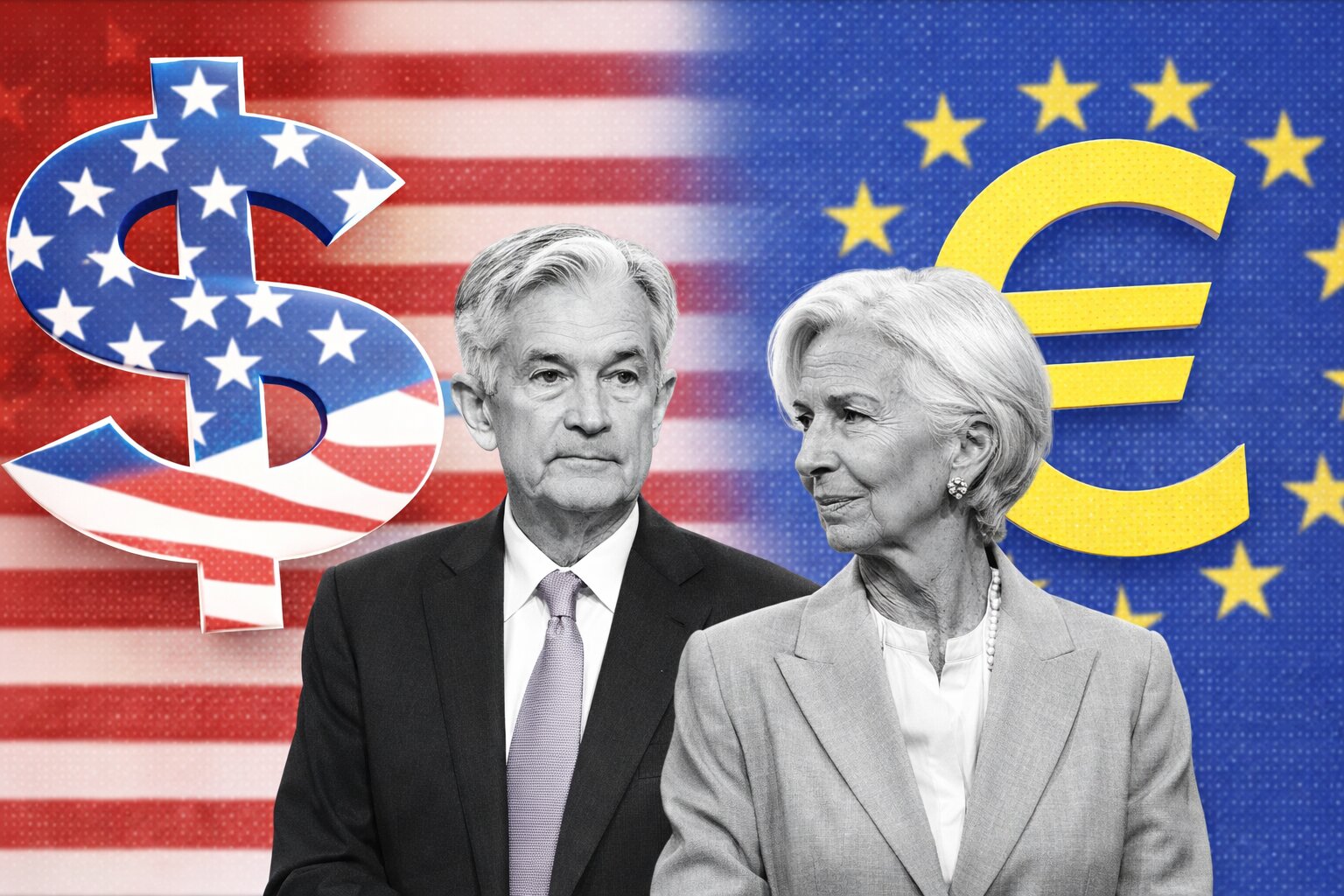
EUR/USD: 2026 Macro And Technical Roadmap
Current EUR/USD Structure Around 1.17–1.18
EUR/USD is trading around 1.1779–1.1800, sitting just under a short-term supply zone at 1.1800 after a steady grind higher from late November. Price is riding an ascending channel on the 2-hour chart, with former resistance at 1.1745–1.1750 now acting as demand and aligning with the intraday trend line. The pair holds above the 200-EMA around 1.1705, while the 50-EMA tracks directly under spot and confirms a bullish short-term bias. RSI has eased from overbought near 70 down toward roughly 55, which signals digestion rather than exhaustion. As long as EUR/USD trades above 1.1750, the market is treating this zone as consolidation inside an uptrend, not a topping pattern.
Fed Easing, Real Yields And The Dollar Headwind For USD
The decisive macro driver for EUR/USD into 2026 is the erosion of the U.S. real-rate advantage. The Federal Reserve cut rates in December 2025 into a 3.50–3.75% band and accepted higher uncertainty on inflation to protect growth and employment. Markets now price roughly two to three additional cuts through 2026, taking the policy rate toward 2.75–3.00%. With core PCE running close to 2.9% and unemployment at about 4.4%, real policy rates are barely positive. That is a clear downgrade from the 2022–2024 regime when elevated real yields underpinned USD. The US Dollar Index (DXY) sits near 97.95, contained in a descending channel since mid-November and pinned below both its 50-EMA and 200-EMA. Former support around 98.10 has flipped to resistance, while support at 97.70–97.75 keeps the structure weak. RSI around 45 on DXY reinforces a corrective, soft dollar backdrop. For EUR/USD, this combination naturally tilts flows toward the euro on any day that is not dominated by a U.S. upside data shock.
Trump Pressure And The Political Discount On USD
The policy story is not just about the Fed; it is also about politics. Throughout 2025, Trump openly demanded rates below 1%, far below the current 3.50–3.75% corridor, and repeatedly threatened to remove Powell even with the term close to expiry. That backdrop, layered on top of annual fiscal deficits of roughly $1.8–$1.9 trillion and total U.S. debt around $38 trillion, introduces a structural political discount on USD. When investors see intense political pressure for ultra-low rates while fiscal expansion continues, they question the long-term purchasing power of the dollar. The market started to price this aggressively in early 2025. The result was a sharp shift in EUR/USD: the pair stopped falling toward parity, respected a major Fibonacci support area after a 1,000-pip drop from the Q3 2024 high, built an ascending triangle and then broke higher as recession fears and cut expectations intensified. That was the first leg of the current regime where USD weakness rather than euro strength drove the trend.
ECB Near Terminal, Eurozone Growth Slowly Rebuilding EUR Support
On the European side, the ECB has already cut the deposit rate down to about 2.0% and now signals that policy is “in a good place,” which is central-bank code for being close to the floor unless the data deteriorate sharply. That diverges from the Fed, which is still expected to ease further in 2026. As Fed funds slip toward 2.75–3.00% and the ECB holds near 2.0%, the rate spread compresses in favor of EUR, especially once you adjust for inflation. Eurozone fundamentals are not spectacular, but they are improving. Germany’s €500 billion infrastructure program is designed to repair years of under-investment and support demand over several years. One large house projects eurozone growth rising from around 0.9% in 2025 to roughly 1.5% in 2026. That is enough to attract incremental capital when U.S. valuations are stretched, especially in tech and high-beta names, and when currency-adjusted returns for euro-based investors in U.S. equities show roughly −8% in 2025 after FX effects.
Street Targets Cluster Around 1.20–1.25 For EUR/USD
Institutional projections for EUR/USD into 2026 cluster in a relatively narrow band, and they all revolve around the same theme: structural USD softness and a modest improvement in the relative macro story for EUR. Goldman Sachs keeps a 1.25 year-end 2026 target, tying it to fading U.S. exceptionalism and ongoing diversification away from dollar assets. J.P. Morgan aims for 1.20–1.22, anchored in two Fed cuts in the first half of 2026 and gradual convergence in real yields. Morgan Stanley expects 1.23 in the spring followed by a pullback toward 1.16 by year-end once the easing cycle matures and U.S. data stabilizes. UBS trims its view to 1.20 because of French political risk but still assumes appreciation as U.S. numbers cool post-shutdown and the ECB stays on hold. Deutsche Bank positions at 1.25, banking on a rebound in global growth, a large German fiscal push and a recovery in Asian FX, especially the yen and yuan. Stripped of branding, all these cases imply EUR/USD spending most of 2026 above 1.20, with 1.25 a realistic extension if the dollar does not regain a strong yield premium.
Multi-Timeframe Technical Picture Keeps EUR/USD In A Buy-The-Dip Trend
Technically, EUR/USD has already completed the transition from a counter-trend bounce to a clear uptrend. On the daily chart, spot has traded above the 200-day moving average near 1.14965 since March 2025. The break back above the 50-day moving average around 1.16088 confirmed the change in behavior; that moving average now acts as dynamic support on pullbacks. The current high of the year at 1.19188 is the obvious upside magnet. On the weekly chart, EUR/USD sits well above the 52-week moving average near 1.12791, with a clean ascending base built from swing lows at 1.10649, 1.13916 and 1.14686. Each selloff has been absorbed higher than the last, which is exactly the pattern long-only macro funds look for when they scale into positions. Zooming out to the monthly chart, the 12-month moving average around 1.13115 has flipped from resistance to support, placing 1.19188 as the trigger for a possible acceleration toward the multi-year high near 1.23496 during 2026. Across timeframes, EUR/USD is no longer in repair mode; it is in a trend phase where the default stance is to buy dips.
Short-Term Map: 1.1750 Demand, 1.1800 Supply, 1.1850–1.1920 Resistance For EUR/USD
The short-term structure for EUR/USD around 1.1779 is straightforward. On the 2-hour chart, price tracks inside an ascending channel. The key demand band sits around 1.1750, where the former breakout area at 1.1745–1.1750 lines up with the channel support. The 200-EMA sits just below at 1.1705, while the 50-EMA is rising directly under spot. Sellers have marked 1.1800 as a supply zone, rejecting initial tests but without strong follow-through. Rejections are shallow, candle bodies are small and there is no impulsive bearish leg, which points to profit-taking rather than a structural top. A sustained move above 1.1800 would open a path toward 1.1820, then 1.1850, and from there the market will inevitably probe the high near 1.19188 if the dollar remains soft. As long as EUR/USD holds above 1.1750, the bias is to buy pullbacks. A break below 1.1715–1.1700 would signal a deeper correction but would not on its own invalidate the broader uptrend anchored around the 1.1496–1.1500 base.
Two Big EUR/USD Surprises From 2025 That Still Matter
The 2025 tape left two important surprises for EUR/USD, both of which still shape the 2026 outlook. The first was the failure of the parity narrative. Coming into early 2025, the pair had already dropped about 1,000 pips from its Q3 2024 high, U.S. Treasury yields were surging and a test of 1.0000 looked almost inevitable. Instead, a major Fibonacci level halted the slide, an ascending triangle formed through February and, in March, as U.S. recession fears grew and rate expectations sank, EUR/USD broke higher in a powerful move. The second surprise was the behavior in the second half of the year. After the rally, the pair hit a familiar Fibonacci resistance band in early Q3, matching the 76.4–78.6% retracement of the previous leg, and stalled there. Rather than blasting higher, EUR/USD spent months consolidating under that cap. Twice in November, the 1.1500 zone held firm as a floor. The message is that the first-half euro strength was driven primarily by USD repricing, while the second-half pause reflected the market waiting for confirmation that the growth story, not just the rates story, was shifting.
Why Growth, Not Central Banks, Drives EUR/USD In 2026
Central banks were the dominant narrative from 2020 through early 2025. That regime is fading. For 2026, EUR/USD is more about relative growth than about the next 25-basis-point move from the Fed or the ECB. Markets understand both policy frameworks. What they are now discounting is how the U.S. and euro area perform against those frameworks. If U.S. GDP steps down from the 4.3% annualized pace seen in Q3 2025 while core inflation stabilizes around 2.8–3.0% and unemployment stays near 4.4%, it becomes difficult to rebuild a powerful USD bull thesis. If the eurozone lifts from 0.9% growth toward roughly 1.5%, supported by fiscal initiatives in Germany and more balanced demand across the bloc, the relative story starts to favor Europe. That is the growth-driven logic behind EUR/USD targets in the 1.20–1.25 region. The key shift is that rate cuts themselves are no longer the main event; what matters is the path of growth and risk appetite after those cuts are already in the price.
Peripheral Drivers: DXY, GBP/USD And Japan Data Around EUR/USD
Peripheral drivers will continue to influence EUR/USD through the dollar channel and global risk sentiment. The DXY still trades near 97.95, under both its 50-EMA and 200-EMA, with resistance around 98.10 and support around 97.30–97.70. That configuration favors selling USD rallies rather than buying them. GBP/USD trades around 1.3501, also within an ascending channel, with support at 1.3470–1.3480 and upside room toward 1.3580, confirming that dollar softness is not just an euro story. Japanese data matter as well. Tokyo core CPI projected around 2.5% versus 2.8% previously, unemployment near 2.6%, industrial production down roughly 1.9% and retail sales rising only about 0.9% all point to a BoJ that will remain cautious. That keeps the yen cheap and supports carry trades, which typically pressure USD against higher-yielding peers. For EUR/USD, these cross-currents translate into an environment where dips caused by short bursts of risk-off demand for USD are more likely to be bought than to start new downtrends as long as macro conditions follow the baseline path.
Risk Scenarios That Can Break The Bullish EUR/USD Thesis
The constructive case for EUR/USD can fail, and the key risk scenarios are straightforward. The first risk is a sharp upside surprise in U.S. growth. If GDP re-accelerates well above current projections while inflation remains under control, the Fed could slow its easing path or hint that the neutral rate is higher than markets assume. That would preserve the USD yield premium and could drag EUR/USD back toward 1.15 or even 1.12 in more aggressive cases. The second risk is political stress inside the euro area. Prolonged instability in France, a major coalition breakdown in Germany or renewed fiscal tension in Italy could deter capital inflows. In that environment, even a weak dollar might not be enough to carry the pair into the 1.20–1.25 band, and downside scenarios from banks looking around 1.12 become more realistic. The third risk is a global shock that sparks a pure safety bid for USD. Trade escalation or geopolitical upheaval can still push investors back into dollar cash and Treasuries temporarily. In such a case, EUR/USD would struggle to hold above the 1.1496–1.1500 base despite the structural arguments.
Final Verdict: EUR/USD Bias Bullish, Buy Dips Toward 1.17–1.16 For 1.20–1.23, Stretch 1.25
Combining the macro and technical evidence, the balance of probabilities remains tilted in favor of euro strength against the dollar. Fed funds cutting from 3.50–3.75% toward 2.75–3.00%, DXY stuck under 98, eurozone growth edging from 0.9% toward roughly 1.5%, an ECB near terminal, and structural capital rotation away from expensive U.S. assets all support a higher EUR/USD equilibrium. The charts back that view: spot is above its 200-day, 52-week and 12-month moving averages, has built a rising base around 1.13–1.15, and is grinding higher inside an ascending channel with demand at 1.1750–1.1700 and resistance in the 1.1850–1.1919 zone. Based strictly on the data you provided, EUR/USD is best treated as a Buy on weakness. Dips into 1.1750–1.1700 and, for more patient swing traders, toward 1.1650–1.1600, are zones where the risk-reward skews in favor of adding long exposure, with medium-term targets in the 1.20–1.23 region and an extended upside case toward 1.25 if U.S. growth underperforms and euro-area politics do not deteriorate.
That's TradingNEWS