




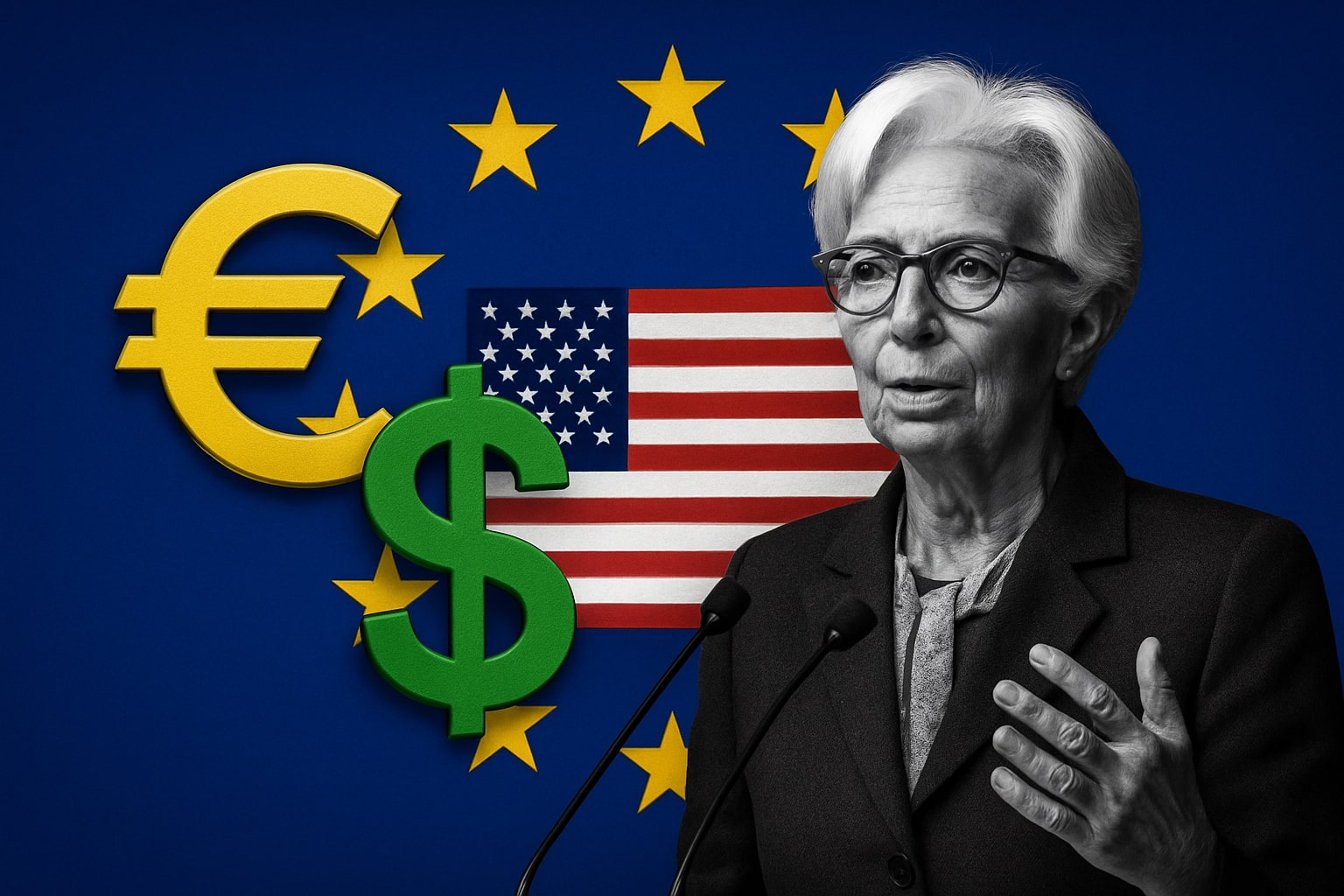
EUR/USD Price Forecast: Euro Holds 1.1670 as Fed Cut Odds Hit 89% Drives Push Toward 1.1800
The euro trades near five-week highs at 1.1670, supported by firm Eurozone PMI and a dovish U.S. dollar | That's TradingNEWS
EUR/USD Strengthens Toward 1.1700 As Fed Rate Cut Bets Intensify And ECB Holds Firm
The EUR/USD pair trades around 1.1672, advancing for an eighth straight session as the euro extends dominance amid widening policy divergence between the European Central Bank (ECB) and the Federal Reserve (Fed). The Dollar Index (DXY) slipped below 98.80, marking its weakest level since late October, after a series of soft U.S. economic readings reinforced expectations of monetary easing. The euro’s resilience near five-week highs reflects sustained buying interest anchored in relative macro stability across the euro area.
Weak U.S. Labor Market Data Pushes The Dollar To Two-Month Lows
The latest ADP Employment Report showed a contraction of 32,000 private-sector jobs in November, the largest decline in over two years, against expectations of a 5,000 gain. October’s figure was revised higher to 47,000, highlighting the abrupt deceleration. Combined with six consecutive months of contraction in the ISM Services Employment Index, this data reinforces the narrative of a slowing U.S. labor market. The CME FedWatch Tool now prices an 89% probability of a 25-basis-point rate cut at next week’s December 10 FOMC meeting, deepening downside pressure on the greenback.
Treasury yields have softened accordingly, with the 10-year yield hovering at 4.08%, down from 4.31% last week. The move signals a shift toward risk assets as markets anticipate policy easing. The DXY, trading at 98.81, has broken key support at 99.02, turning that level into resistance while maintaining a descending channel pattern. With the RSI near 27, the dollar remains oversold but without a clear reversal trigger.
ECB’s Steady Policy and Resilient Eurozone Data Strengthen Euro Outlook
Across Europe, the macro picture contrasts sharply with the U.S. narrative. The ECB maintains a neutral stance with 94% probability of unchanged rates at the December 16 meeting, reinforcing confidence in the euro’s yield advantage. President Christine Lagarde reiterated that inflation remains “consistent” around the 2% target, and that steady household spending and a firm labor market continue to support Eurozone growth.
Recent data corroborates that view: the Eurozone HCOB Services PMI for November rose to 53.6 from 53.1, marking the sixth consecutive month of expansion and the strongest reading since May 2023. Germany’s PMI was revised up to 53.1, and France’s to 51.4, both signaling ongoing recovery in services activity. Meanwhile, Eurozone Retail Sales for October remained flat month-on-month but advanced 1.5% year-on-year, beating forecasts of 1.4% and improving from 1.0% in September.
This macro divergence—a dovish Fed versus a steady ECB—is amplifying euro strength, pushing EUR/USD closer to the 1.1700 handle.
Technical Analysis: EUR/USD Retains Bullish Momentum Above 1.1650 Support
Technically, EUR/USD remains confined within a robust ascending channel that began in mid-November from 1.1480 lows. The pair trades above the 50-EMA at 1.1630 and the 200-EMA at 1.1593, maintaining a strong upward bias. Immediate resistance sits at 1.1688, followed by 1.1730 (October 17 high) and 1.1778 (October 1 high). A sustained close above 1.1688 would likely confirm a breakout toward 1.1800.
On the downside, the first line of defense lies at 1.1650, coinciding with prior breakout levels, while secondary support rests near 1.1615 trendline support. Momentum indicators remain constructive but stretched: RSI (69) indicates firm buying momentum approaching overbought territory, while MACD remains above zero, confirming bullish control. A minor retracement toward 1.1652 would relieve pressure before another upward push.
Short-Term Trading Dynamics and Key Event Risks
Market focus now turns to upcoming U.S. Jobless Claims, expected at 220,000 versus 216,000 previously, alongside Challenger Job Cuts and the crucial PCE Inflation Index due Friday. The PCE print will serve as the final inflation cue ahead of next week’s FOMC meeting. A softer reading below 2.7% YoY would validate expectations of rate cuts, likely driving EUR/USD above 1.17 and exposing 1.18 as the next resistance band.
Meanwhile, Euro traders will monitor Eurozone GDP revisions and German factory orders, which could either confirm momentum or introduce short-term consolidation.
Macro Correlation and Cross-Asset Flows
The euro’s strength has not been isolated. Against the Canadian Dollar, EUR gained 0.23%, and against AUD, 0.04%, underscoring broad-based outperformance. The only mild lag appeared versus JPY, where carry-trade unwinds pressured risk currencies temporarily. The heat map of major currencies shows the euro leading the G10 complex, fueled by declining U.S. yields and fading demand for defensive USD positioning.
The EUR/USD rally aligns with a broader pattern of capital rotation into European equities: the STOXX Europe 600 climbed 0.3%, while the DAX gained 0.4%, highlighting regional investor optimism despite soft retail growth.
Read More
-
SCHD ETF at $31.62: Dividend Rotation Turns a 2025 Laggard into a 2026 Leader
11.02.2026 · TradingNEWS ArchiveStocks
-
XRP ETFs XRPI and XRPR Lag Price While Fresh XRPZ Inflows and $152M Bank Bets Test the Dip
11.02.2026 · TradingNEWS ArchiveCrypto
-
Natural Gas Futures Defend the $3.00 Floor After Collapse From Above $7.50
11.02.2026 · TradingNEWS ArchiveCommodities
-
USD/JPY Price Forecast - USDJPY=X Drops Below Key Averages as Yen Rally Targets 152–150 Zone
11.02.2026 · TradingNEWS ArchiveForex
Fed-ECB Divergence: A Structural Turning Point for EUR/USD
The transatlantic policy gap remains the dominant narrative. Markets anticipate the Fed to deliver three cuts through 2026, while ECB pricing reflects a prolonged hold phase until at least mid-2026. This divergence compresses U.S.-Eurozone yield spreads—the 2-year differential has narrowed from 165 bps to 117 bps in one month, providing a mechanical tailwind to the euro.
Historically, when the Fed cuts ahead of the ECB, EUR/USD rallies by an average of 3.8% over three months, implying a potential medium-term target around 1.20 should current conditions persist.
Outlook and Strategic Positioning
With EUR/USD holding firm near 1.1670, momentum remains decisively bullish. The probability of a short-term retest of 1.1600–1.1615 exists, but the structure favors continuation higher into 1.1750–1.1800. The pair’s advance is underpinned by collapsing U.S. yields, softening inflation expectations, and robust European data.
Unless the Fed surprises markets with a hawkish tone next week, the euro’s appreciation path remains intact. Given current momentum, EUR/USD is a BUY, targeting 1.1800–1.1850 in the medium term, with 1.1600 as the critical support to maintain trend integrity.
The structural divergence between a cutting Fed and a steady ECB defines this rally—the euro is no longer reactive; it is leading the global FX narrative.