GBP/USD Price Forecast - Pound Tests 1.35 as BoE Caution Meets Soft US Dollar
Sterling trades around 1.3450 after UK PMI at 50.6, FTSE 100 near 10,000 and markets price 2026 Fed cuts | That's TradingNEWS
GBP/USD: 2026 Starts With Sterling Holding 1.34–1.35 After Its Best Run Since 2021
GBP/USD price action around 1.3450–1.3500
GBP/USD begins 2026 trading roughly between 1.3400 and 1.3500, with spot repeatedly gravitating toward 1.3450–1.3475. On the first sessions of the year the pair briefly pushed toward 1.3490–1.3500 before slipping back below 1.3450 after rejection near 1.3475. The latest bounce from the 1.3400 area keeps the short-term structure constructive: sellers are active near 1.3500, but they are not yet strong enough to push GBP/USD decisively back into the low-1.33s. That leaves a clear, tradable near-term range: support in the 1.3400–1.3420 band, resistance around 1.3475–1.3550.
2025 performance: from near-parity fear back to 1.35
The current GBP/USD level around 1.35 matters because it marks a full reversal of the panic phase that followed the 2022 UK mini-budget crisis. From levels close to parity in late 2022, sterling spent most of 2023–2024 rebuilding credibility and finally traded back to roughly 1.35 in late 2025. That puts GBP/USD back to late-2021 territory but still below the pre-Brexit zone near 1.50. Against the euro the pound has been less impressive: GBP/EUR has slipped from around 1.21 to near 1.15, showing that most of sterling’s recent strength has come from a softer USD, not an aggressively strong GBP.
Rate differentials: BoE at 3.75%, Fed shifting toward cuts
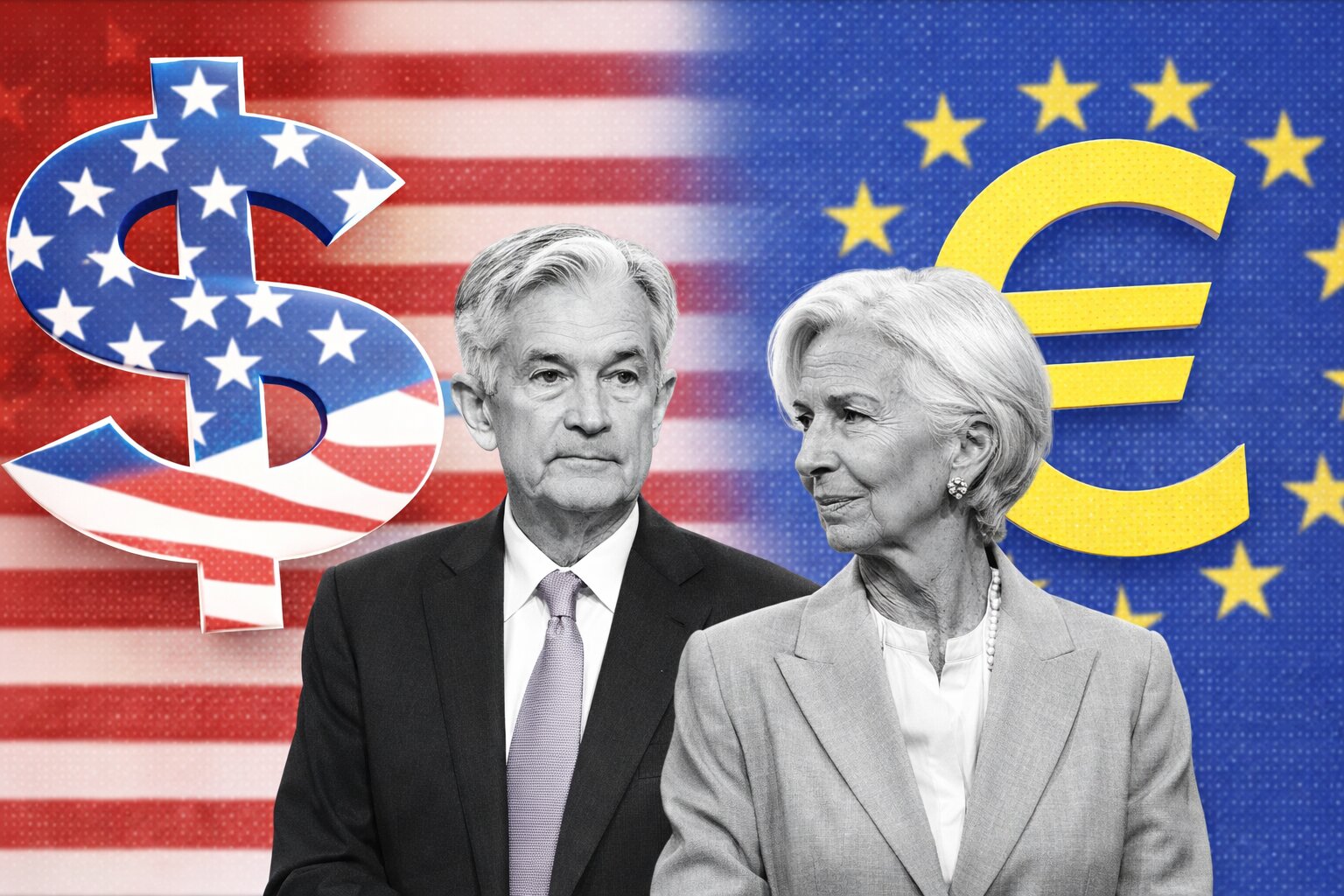
Monetary policy is the core driver. The Bank of England has cut rates four times in 2025, bringing the policy rate down to roughly 3.75%, and markets are pricing another two cuts in 2026, but there is no appetite for an aggressive easing cycle. UK inflation ended 2025 at about 3.5%, still above target, so the BoE is close to what it sees as a “neutral” or terminal area and will likely move slowly. In the United States, headline CPI cooled to around 2.8% in December 2025, and the Fed’s projections plus futures pricing point to at least two rate cuts by the end of Q2 2026. That relative stance — a Fed that is more clearly heading into an easing phase while the BoE remains cautious — is exactly what has pushed GBP/USD up toward 1.35 and kept the Dollar Index near 98.16. As long as the market believes the Fed will ease earlier and faster than the BoE, rate differentials support GBP/USD on dips.
Macro backdrop: UK resilience vs global risk appetite
The macro picture around GBP is not spectacular but it is no longer a crisis story. UK manufacturing PMI has climbed to 50.6, its highest level in about 15 months and above the 50.0 expansion line for two consecutive months, even if the final reading was revised down from 51.2. That move confirms a slow recovery in the tradable sector. At the index level, the FTSE 100 briefly crossed 10,039.05, breaking above the 10,000 mark for the first time before closing just under that level with a 0.2% gain and a roughly 21.5% rise over 2025. These numbers tell you foreign investors have regained some confidence in UK assets. On the other side of the cross, the United States is still growing but no longer in “exceptionalism” mode, and global risk sentiment at the start of 2026 is broadly constructive: gold trades around $4,320–$4,400, cryptocurrencies like Cardano are stabilizing above $0.36, and equity indices such as the S&P 500 at 6,858.47 and Nasdaq at 23,235.63 are near highs. A softer USD in a risk-on environment usually supports GBP/USD, and the current set-up fits that pattern.
Cross-checks from GBP/EUR and EUR/USD
Cross-rates confirm that the story is more about the dollar than about full-blown sterling strength. GBP/EUR is trading near 1.1477–1.1480, barely higher on the day. The euro has its own problems: Eurozone manufacturing PMI was revised down to 48.8, back in contraction, and growth in the bloc remains uneven. Even so, EUR/USD at about 1.1722–1.1750 and GBP/EUR near 1.15 show that the euro and pound are both benefitting from USD weakness. Analysts looking ahead into 2026 expect the pound to appreciate only around 1.5% against the dollar from current levels and see limited upside for the euro after a strong 2025 run. That implies GBP/USD is unlikely to explode higher but can still grind up if the Fed’s easing path comes through while the BoE stays more guarded.
Domestic UK factors: inflation, housing and growth mix
UK macro data are mixed but not disastrous. Inflation at 3.5% is higher than in the U.S., which keeps the real policy rate lower but still forces the BoE to move carefully; that supports GBP by preventing an overly dovish pivot. Manufacturing is recovering, but UK house prices fell 0.4% month-on-month in December 2025, leaving annual growth at just 0.6%, the weakest since April 2024. That cooling housing market tells you the consumer side is fragile and argues against a runaway tightening stance. Taken together, the data point to modest real growth, a gradual disinflation process and a central bank that will cut but not slash rates. For GBP/USD, that backdrop is consistent with a currency that can stay firm around 1.34–1.36 as long as the U.S. side of the cross continues to weaken.
BoE vs Fed communication: how guidance feeds GBP/USD
Communication matters as much as actual decisions. On the UK side, policymakers are signaling a cautious, data-dependent approach as they approach a “neutral” rate, which the market roughly interprets as the mid-3% area. That stance keeps rate-cut expectations contained to about two moves in 2026. In the U.S., the Fed’s December 2025 meeting and the inflation print at 2.8% have allowed traders to price in a more dovish path, with the first cut expected by the second quarter of 2026. Every time Fed officials validate that dovish narrative, the USD softens and GBP/USD pushes back toward the top of its range near 1.3500–1.3550. Conversely, any upside surprise in U.S. jobs or inflation that questions the timing of those cuts will strengthen the dollar and drag GBP/USD back toward 1.3350–1.3400.
Political risk premium in GBP
Politics is the counterweight to the rate-differential story. The UK’s Autumn Budget helped remove some of the “fiscal chaos” premium that was priced into GBP after 2022, but political risk has not disappeared. The prime minister has already faced at least two internal revolts inside the ruling party, and local elections in May 2026 could trigger a formal leadership challenge. A scenario in which a less fiscally conservative leadership team replaces the current mix at Downing Street and the Treasury would reintroduce a risk premium into GBP/USD, especially if markets fear looser fiscal policy at the same time as the BoE is cutting. That risk is not fully priced, but part of it is already reflected in the way GBP/USD repeatedly fails ahead of 1.3550 and how GBP/EUR struggles to break sustainably above 1.15–1.16. If leadership speculation intensifies, 1.3550 becomes even harder to clear and downside tests of 1.3300–1.3350 become more likely.
Short-term trading drivers: PMIs, CPI, NFP and jobs data
The near-term calendar reinforces the idea that GBP/USD is sitting in front of a volatility spike, not the end of a move. On the Eurozone side, softer inflation and a weak manufacturing PMI at 48.8 weigh on the euro, but the bigger immediate catalysts are U.S. labor data and upcoming consumer-price releases. Markets are watching the next U.S. jobs report as a binary event: a strong print above roughly 200,000 jobs would challenge the rate-cut narrative and push USD higher; a weak number below around 150,000 would lock in expectations for early cuts and keep the dollar on the back foot. With the Dollar Index at 98.16, EUR/USD around 1.1750 and GBP/USD near 1.3450–1.3500, positioning is already skewed toward a softer dollar. That means a strong upside surprise in U.S. data could produce a sharp correction lower in GBP/USD back toward 1.3300–1.3350, whereas a soft report would likely fuel a break toward 1.3550 and potentially the high-1.36s.
Technical picture: levels that matter in GBP/USD
From a pure price-action perspective, the structure in GBP/USD is constructive but stretched. On the downside, 1.3400 has already acted as a floor several times, with additional support in the 1.3350–1.3360 region and then deeper, more strategic support around 1.3200–1.3220. On the topside, 1.3475 is the first intraday pivot that has repeatedly capped rallies, followed by a more important resistance band around 1.3550, flagged by several desks as the key level that halted earlier advances when the BoE–Fed divergence theme last dominated the market. A clean daily close above 1.3550 would open room toward 1.3650–1.3700, while a failure there — especially if accompanied by stronger U.S. data — would keep the pair locked in a broad 1.3200–1.3550 trading corridor.
Cross-asset confirmation: equities, gold and crypto
Cross-asset signals line up with a mildly weaker USD and a moderately stronger GBP/USD. Global equities are firm, with the Dow Jones at 48,382.39 (+0.66%), the S&P 500 at 6,858.47 (+0.19%) and European indices such as Germany’s DAX and France’s CAC 40 in positive territory. UK assets are participating: the FTSE 100 briefly exceeded 10,000 and ended 2025 up more than 21%. Gold, though volatile between $4,400 and $4,320, is holding at elevated levels, reflecting both dovish Fed expectations and ongoing geopolitical tension. Even alt-risk assets like Cardano above $0.36 point to a market that is comfortable taking risk. That environment tends to compress USD risk premia and support higher-beta currencies like GBP, reinforcing a bias for GBP/USD to trade closer to 1.35 than to 1.30 while this regime persists.
Read More
-
SCHD ETF at $31.62: Dividend Rotation Turns a 2025 Laggard into a 2026 Leader
11.02.2026 · TradingNEWS ArchiveStocks
-
XRP ETFs XRPI and XRPR Lag Price While Fresh XRPZ Inflows and $152M Bank Bets Test the Dip
11.02.2026 · TradingNEWS ArchiveCrypto
-
Natural Gas Futures Defend the $3.00 Floor After Collapse From Above $7.50
11.02.2026 · TradingNEWS ArchiveCommodities
-
USD/JPY Price Forecast - USDJPY=X Drops Below Key Averages as Yen Rally Targets 152–150 Zone
11.02.2026 · TradingNEWS ArchiveForex
Market positioning and options: what derivatives are signaling
Options and strategy commentary highlight that implied volatility around GBP/USD is not fully reflecting the binary risk of upcoming U.S. macro events and UK politics. Desks are discussing call structures on GBP/USD out to late February or March as ways to play potential upside driven by a dovish Fed path and continued BoE caution. There is also interest in straddles and strangles on the broader USD complex — especially EUR/USD — around U.S. jobs and CPI data, which indirectly matters for GBP/USD because a broad USD move rarely spares sterling. The key point is that the market is prepared for movement, but pricing still assumes a relatively contained range. If the Fed surprises more dovishly or UK data surprise to the upside, the resulting break above 1.3550 in GBP/USD could be sharper than current vols imply. Conversely, any hawkish repricing of Fed expectations combined with renewed UK political stress would pressure the pair back into the low-1.33s faster than many short-term longs are positioned for.
Strategic stance on GBP/USD: bias, direction and rating
Putting the macro, rate, political and technical pieces together, GBP/USD around 1.3450–1.3500 screens as a moderately bullish story for sterling against the dollar, not a euphoric one. The Fed is closer to cutting than the BoE, U.S. inflation is already near 2.8% while UK inflation at 3.5% keeps the BoE cautious, and UK assets have survived a stress-test period that pushed the pound to near parity in 2022. Manufacturing PMI at 50.6, the FTSE 100 around 10,000 and the fading fiscal risk premium support a stronger currency than the one priced into 2022–2023 panic. At the same time, political risk around the UK leadership and the risk of a global data-driven USD squeeze cap upside beyond the mid-1.30s unless the Fed delivers faster or deeper cuts than already expected.
On balance, the data justify a Buy bias on GBP/USD on dips rather than at breakouts. Pullbacks into the 1.3350–1.3400 zone look attractive for medium-term longs targeting 1.3650–1.3800 over the course of 2026, with the bullish view only clearly invalidated on a sustained move below roughly 1.3200. Until the Fed’s path or UK politics break decisively one way or the other, GBP/USD remains a buy-on-weakness, range-trading market with a slight upside tilt for sterling.