




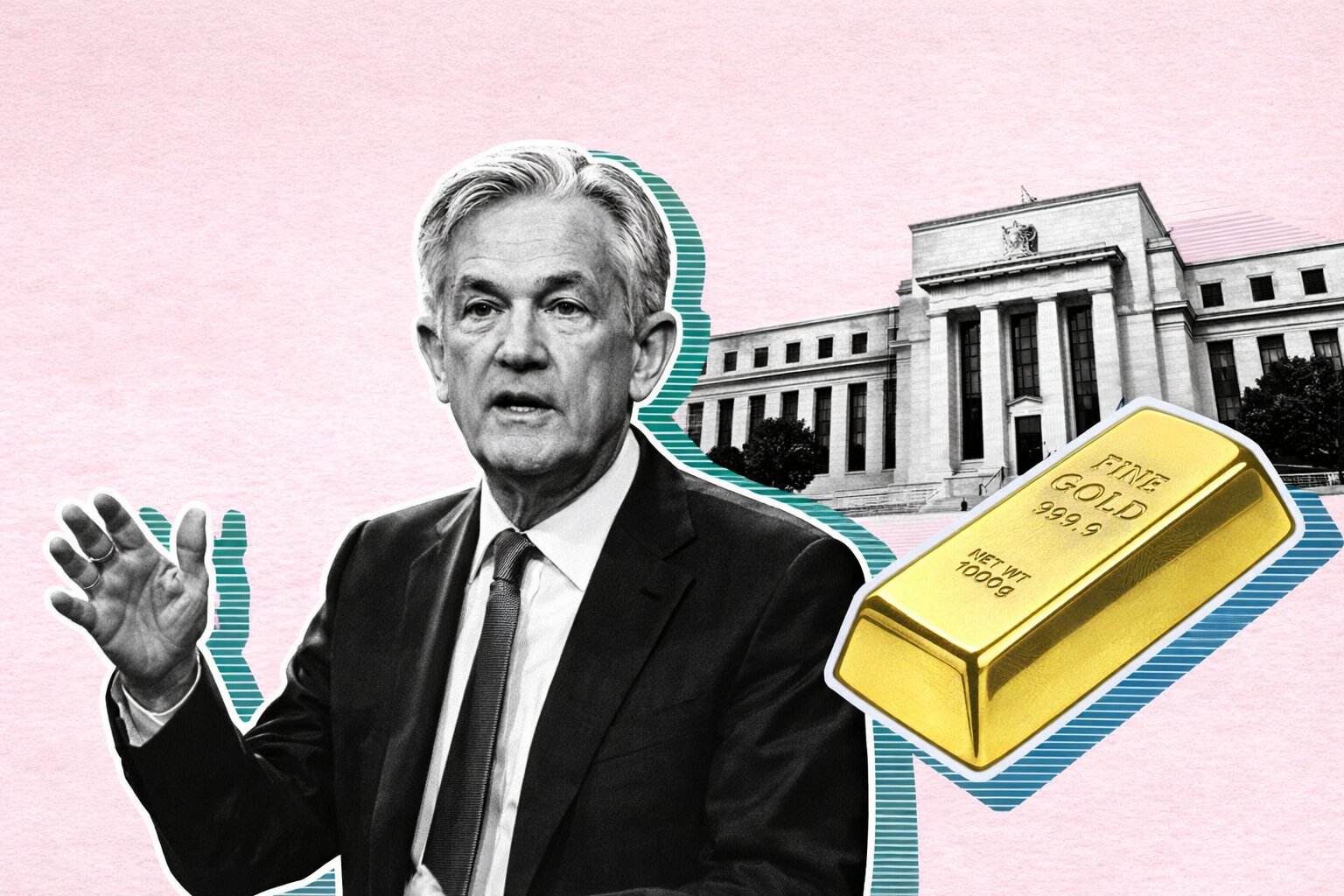
Gold Price Forecast: (XAU/USD) Futures Hit $5,234 After Scorching PPI and Failed Iran Talks
January core PPI spikes 0.8%, doubling forecasts; 10-year Treasury yield breaks below 4% as flight to safety accelerates; central bank survey shows 95% expect gold reserves to grow | That's TradingNEWS
Gold (XAU/USD) Price Forecast: Futures Climb Past $5,234 as Failed Iran Talks and Scorching PPI Fuel Safe-Haven Demand — JPMorgan Targets $6,300, Bernstein Sees $6,100 by 2030
Gold is doing exactly what it's supposed to do. While equities crumbled on Friday — the Dow shedding 715 points, the Nasdaq dropping 1.08%, and the S&P 500 losing nearly 1% — the yellow metal surged roughly 1% to $5,234.25 an ounce, pushing toward four-week highs and confirming its status as the ultimate crisis asset in a world drowning in inflation uncertainty, geopolitical risk, and AI-driven labor destruction. April gold futures on COMEX settled near $5,245, silver ripped 6% higher to $92.70, and the entire precious metals complex signaled something that equity markets are only beginning to digest: the macro environment is structurally bullish for hard assets, and it's not even close to over. Gold has gained approximately 20% year-to-date, sits within striking distance of its January 29th all-time high at $5,594.82, and every major Wall Street house is raising targets. After a 64%-plus surge in 2025 and a continuation rally into 2026, the question isn't whether gold goes higher — it's how high and how fast.
Friday's PPI Print Obliterated the Rate Cut Narrative — XAU/USD Responds Immediately
January's producer price index landed like a bomb on fixed income desks and instantly reshuffled the rate calculus for the Federal Reserve. Headline PPI rose 0.5% month-over-month, well above the 0.3% consensus expectation and an acceleration from December's already-warm 0.4% reading. The core figure — stripping out food and energy — came in at a staggering 0.8%, more than doubling the 0.3% forecast. On a trailing twelve-month basis, wholesale prices climbed 2.9%.
Under normal circumstances, hotter inflation would punish gold by lifting real yields and strengthening the dollar. That didn't happen Friday. The 10-year Treasury yield actually dropped below 4% for the first time since November, settling at 3.978%. The U.S. dollar index barely moved at 97.83. What the bond market is telling you is more important than what the inflation data says: growth fears are overwhelming inflation fears, and capital is fleeing to safety. Gold thrives in precisely this environment — when the inflation backdrop is too hot for the Fed to cut, but the economy is too fragile for the Fed to hike. That policy paralysis is the single most powerful macro tailwind for precious metals, and Friday's session proved it in real time.
Peter Grant at Zaner Metals characterized the environment as deeply "uncertain," noting that futures markets still price in two Federal Reserve rate cuts before year-end despite the hot upstream data. That tension — between persistent inflation and embedded rate cut expectations — creates a floor under gold that is extraordinarily difficult to break. Every time yields rally on inflation fear, they quickly retreat on recession fear. Gold wins both ways.
U.S.-Iran Nuclear Talks Collapse — Geopolitical Premium Surges Back Into XAU/USD
The third round of indirect U.S.-Iran negotiations in Geneva concluded without an agreement on Thursday, and oil markets responded with a 4% spike in WTI crude to $67.70 per barrel. Brent climbed 2.91% to $72.90. The failed diplomatic outcome reintroduced a layer of geopolitical risk premium into every safe-haven asset, and gold was the primary beneficiary.
The Iran situation matters for gold on two levels. Directly, a breakdown in nuclear talks raises the probability of escalated sanctions, regional military confrontation, and disrupted energy supply chains — all of which amplify haven demand. Indirectly, higher oil prices feed directly into pipeline inflation, further complicating the Fed's ability to ease monetary policy and reinforcing the "policy paralysis" dynamic that structurally supports gold. TD Securities' Bart Melek, global head of commodity strategy, framed it precisely: the tariff regime and elevated crude prices create a compounding inflationary impact that makes gold an increasingly rational portfolio allocation.
The geopolitical premium in gold isn't just about Iran. Since last Friday, when the Supreme Court overturned previous emergency tariffs, Washington has imposed a 10% global tariff that was subsequently raised to 15%. Trade policy chaos, combined with Middle Eastern tensions and persistent U.S.-China friction, has created a multi-layered geopolitical support structure under precious metals. A framework agreement from Geneva could temporarily strip some of that premium — but so far, diplomacy has produced nothing, and every failed round adds to the underlying bid.
JPMorgan's $6,300 Year-End Target and Bernstein's $6,100 Decade Forecast
The institutional consensus on gold is moving aggressively higher. JPMorgan raised its long-term gold forecast to $4,500 as a floor while maintaining a year-end 2026 target of $6,300 per ounce, citing a dual engine of central bank accumulation and investor demand. Given that spot gold has already surged approximately 20% year-to-date and achieved an all-time high of $5,594.82 on January 29th — after gaining more than 64% in 2025 — JPMorgan's $6,300 target implies roughly 20% additional upside from current levels. That's a remarkably bullish call from one of the world's largest commodity trading desks.
Bernstein went even further on the timeline. The brokerage overhauled its gold price framework, lifting forecasts to $4,800 per ounce for 2026 and $6,100 per ounce by 2030. The new model explicitly links gold prices to net demand from central banks and ETF flows, combined with the cumulative impact of U.S. rate cuts. Bernstein's analysis quantified what the market already senses: central bank purchasing — elevated since 2022 when Russia was severed from the SWIFT system — has become a structural demand force that isn't going away, while ETF flows act as a cyclical swing factor tied to movements in real interest rates.
Other research desks have outlined mid-cycle targets in the $6,500 to $6,750 range, deriving those numbers from the interplay of falling real interest rates, structurally high safe-haven demand, and ongoing central bank buying. That "second wave" narrative — where the initial record-breaking phase gives way to a more sustained and potentially accelerated rally — is gaining traction among allocators who believe the gold bull market is still in its middle innings, not its final act.
Newmont (NEM) Upgraded — Bernstein Sees $157 as Gold Leverage Play
Bernstein's upgraded gold outlook had immediate implications for the mining sector. The brokerage lifted Newmont Corporation (NYSE: NEM) to Outperform from Market-Perform and raised its price target to $157 from $121 — implying substantial upside from current levels. The upgrade was driven entirely by the higher gold price deck: Bernstein increased its EBITDA forecast for Newmont by 26% to $21.9 billion and raised its valuation multiple to 6.75x EV/EBITDA from 6.50x, applied against its 2027 estimates.
Beyond the price deck, Bernstein flagged several company-specific catalysts: a new chief executive and her 2026 strategic agenda, production guidance that builds in room to beat expectations on a high-single-digit managed output decline, and the potential for an improved relationship with Newmont's largest joint venture partner. NEM was trading 1.87% higher on Friday, outperforming the broader equity selloff and confirming that gold miners offer leveraged exposure to the underlying commodity's uptrend. Buy NEM — it's the cleanest way to express a bullish gold thesis through equities, with institutional-grade scale, improving operational catalysts, and 26% EBITDA upside baked into a rising gold price environment.
Central Bank Accumulation — The Structural Floor That Keeps Rising
Central bank gold purchasing has been the single most important demand driver of the current bull cycle, and the numbers explain why every major forecast keeps getting revised higher. In 2025, net central bank purchases totaled hundreds of tons and remained at historically elevated levels. Individual institutions — Poland, Uzbekistan, Kazakhstan, and others — have significantly increased their reserves over recent quarters.
A 2025 survey of 73 central banks, cited by Bernstein, delivered extraordinary results: 95% of respondents expect global gold reserves to increase over the next year, and 43% indicated their own holdings would grow. Over a five-year horizon, 76% expect gold to command a larger share of total reserves, while 73% foresee a reduced allocation to U.S. dollar reserves. That last statistic is the key. De-dollarization isn't a fringe theory — it's the stated expectation of three-quarters of the world's central banks. Every percentage point shift from dollar reserves to gold creates massive structural demand at a time when mine supply is constrained and above-ground stocks are increasingly locked up in sovereign vaults.
There are signs that some central banks paused purchases during the rapid ascent above $5,000 and are waiting for consolidation phases to reload. That behavior actually supports the bull case — it means the buying isn't impulsive, it's strategic and programmatic. Every dip toward the $5,000-$5,100 zone attracts sovereign bids, establishing a rising floor under the market that private capital can lean against.
The $5,200-$5,300 Resistance Band — Technical Battleground for March
Gold's price structure entering March revolves around a narrow but critical resistance zone between $5,200 and $5,300 per ounce. Friday's session pushed XAU/USD above $5,200 — flirting with four-week highs — but the metal hasn't achieved a decisive daily close above $5,300. Market analyst Razan Hilal at FOREX.com noted that gold and silver have repeatedly attempted to break above their respective resistance ceilings at $5,200 and $90, but failed to sustain momentum above those levels. Resistance attracts sellers, and until the buyers overwhelm them with conviction, the sideways grind continues.
The broader technical picture shows gold consolidating between $5,100 and $5,200 after an extraordinary run. The January 29th all-time high at $5,594.82 was followed by a sharp correction to the $4,400 zone in early February — a gut-wrenching 21% drawdown that shook out leveraged longs and reset positioning. Since then, the recovery has been steady: gold reclaimed the psychologically critical $5,000 mark and has built a base of higher lows through the second half of February.
Over a twelve-month period, gold is still up 70-75% — a trajectory consistent with a mature but far from exhausted bull market. The consolidation pattern around $5,100-$5,200 is exactly what healthy trends produce: a pause that digests gains, resets momentum indicators, and builds the launchpad for the next leg higher. A daily close above $5,300 on firm volume would signal the resumption of the primary uptrend and open the path toward a retest of the $5,594 all-time high. Failure to clear $5,300 — repeated rejections with lower highs — raises the probability of another dip toward $5,000 or potentially the $4,800 zone before the next sustained advance.
Silver (XAG/USD) Explodes 6% — Industrial and Speculative Demand Converge at $92.70
Silver stole the spotlight on Friday with a 6% surge to $92.70 per ounce — an outsized move that dwarfed gold's 1% gain and signaled a potential shift in the gold-silver ratio dynamics. The move came after a weak Thursday session where spot silver had dropped 2.4% to $87.25. The V-shaped reversal from $87 to $92 in less than 24 hours reflects the kind of volatile, momentum-driven trading that characterizes silver during inflection points in the precious metals cycle.
Silver's dual role as both a monetary metal and an industrial commodity gives it unique characteristics. The hot PPI print supports the inflation-hedge narrative, while ongoing demand from solar panel manufacturing, electronics, and electric vehicle production provides a structural demand floor. When gold breaks out, silver tends to follow with amplified moves — and the gold-silver ratio compression from recent weeks suggests silver is beginning to catch up to gold's year-to-date gains. Platinum slipped 1.5% to $2,252.28 and palladium dropped 2.1% to $1,757.75 during Thursday's session — the PGMs remain laggards in this cycle, with auto-sector demand uncertainty weighing on the complex.
Vietnam's Retail Gold Market Cracks — Domestic Premium Compresses to 19.8 Million VND
An overlooked but telling signal emerged from Vietnam's gold market. On February 26th — the culturally significant God of Wealth day, traditionally the strongest retail demand period of the year — SJC gold prices dropped sharply, defying expectations for a holiday-driven bid. The domestic-global premium compressed to approximately 19.8 million VND per tael, a significant narrowing that signals stress in local pricing and fading retail momentum.
Vietnam's gold market operates with unique dynamics: brand premiums, import constraints, and concentrated holiday demand create conditions where local prices can diverge dramatically from international benchmarks. When global gold stalls near resistance but local selling picks up, the premium compresses rapidly — and that's exactly what happened. Thin post-holiday liquidity amplified the move. For cross-border positioning, the narrowing gap signals caution on physical inventory and hedging requirements in Asian retail channels. It also suggests that the retail bid, at least in Southeast Asia, is exhausted at current price levels — meaning the next leg higher, if it comes, will need to be driven by institutional and sovereign buyers rather than consumer jewelry demand.
Philippines Gold Dips to 9,599 PHP Per Gram — Currency Effects Complicate Regional Pricing
Gold prices in the Philippines edged lower on Friday to 9,599.88 PHP per gram, down from 9,616.38 PHP the prior day. Per tola, the price declined to 111,971.10 PHP from 112,163.50 PHP. The troy ounce translated to 298,589.90 PHP. These moves are largely a function of USD/PHP currency dynamics layered on top of dollar-denominated gold movements. For yen-based and regional Asian allocators, the interplay between dollar gold and local currency fluctuations creates both risk and opportunity — a declining dollar can lift local-currency gold prices even when dollar spot is flat, while a strengthening greenback can suppress returns despite a rising underlying commodity.
Read More
-
FTEC ETF Price at $216.55 — Nvidia's $34.9 Billion Quarterly Free Cash Flow
27.02.2026 · TradingNEWS ArchiveStocks
-
XRP ETF Forecast: XRPI at $7.70, XRPR at $11.09 — $1.24 Billion in Cumulative Inflows, 50% Share of Altcoin ETF Capital
27.02.2026 · TradingNEWS ArchiveCrypto
-
Natural Gas Futures Price Forecast: $2.84 as 108.7 Bcf/d Production Overwhelms Demand
27.02.2026 · TradingNEWS ArchiveCommodities
-
USD/JPY Price Forecast: Pair at ¥155.97 as Scorching 0.8% Core PPI Collides With BoJ Tightening
27.02.2026 · TradingNEWS ArchiveForex
The Macro Trifecta: Tariffs, Yields, and the Dollar Index at 97.83
Three macro forces are currently intersecting in a configuration that overwhelmingly favors gold. First, the tariff regime: a 15% global tariff introduces direct inflationary pressure on imported goods, raising producer costs and consumer prices simultaneously. That tariff-driven inflation makes it harder for the Fed to cut rates — but it also makes gold more attractive as an inflation hedge, creating a self-reinforcing demand loop.
Second, real yields are declining. Despite the hot PPI print, the 10-year Treasury yield fell to 3.978% — below the psychologically important 4% threshold. With headline PPI running at 2.9% year-over-year and the 10-year at 3.98%, real yields are compressing toward levels where gold historically accelerates. Bernstein's framework explicitly links gold prices to changes in real interest rates, and the direction is unambiguous: lower real yields mean higher gold prices.
Third, the U.S. dollar index at 97.83 continues to weaken. UBS flagged "asymmetric structural downside risks" for the greenback, forecasting EUR/USD at $1.22 by end of Q1 2026. The MSCI World ex-US index has gained roughly 8% year-to-date while the S&P 500 sits flat — capital is rotating overseas, and dollar weakness is a direct tailwind for dollar-denominated commodities. Gold priced in dollars becomes cheaper for non-U.S. buyers when the greenback declines, expanding the global demand pool.
U.S. initial jobless claims ticked up 4,000 to 212,000 for the week ended February 21st — a labor market characterized as "low-hire, low-fire." That steady-but-soft employment backdrop reinforces the growth concern without triggering outright panic, keeping the Fed locked in a holding pattern. Two rate cuts are still priced for 2026. Every week those cuts remain on the table without materializing, gold benefits from the expectation of eventual easing while simultaneously profiting from the uncertainty about timing.
Bull Case vs. Bear Case — $6,750 Mega-Move or a Correction to $4,800?
The Path to $6,500-$6,750
The bullish scenario treats the current $5,100-$5,200 consolidation as nothing more than an intermediate pause in a mid-cycle bull market. If the Fed and other major central banks deliver further rate cuts in coming quarters — driven by economic fragility and historically elevated sovereign debt burdens — real interest rates will decline further, structurally strengthening gold's appeal as a zero-yield asset that outperforms when the opportunity cost of holding it shrinks. Persistent geopolitical tensions from Middle Eastern conflicts to trade wars maintain safe-haven demand at elevated levels. Central bank purchases resume after the post-record pause. Under this scenario, the $6,500-$6,750 range becomes achievable — representing roughly 25-30% upside from current levels and consistent with Bernstein's decade-end $6,100 target arrived at ahead of schedule.
The Pain Trade — Overextension Risk Below $5,000
The bearish counterargument has merit. The 64% surge in 2025 followed by the breakout above $5,000 in 2026 has drawn substantial speculative capital into the market. The early February plunge from $5,594 to $4,400 — a 21% crash in a matter of days — demonstrated how violent the unwinding of crowded positioning can be. If speculative longs built during the record chase are forced to liquidate during another risk-off episode, gold could retest $5,000 or even the $4,800 zone. A hawkish surprise from the Fed — if inflation data continues running hot and the central bank explicitly takes cuts off the table — would push real yields higher and the dollar stronger, creating a double headwind for bullion.
However, every dip since the bull market began has been met by central bank and institutional buying. The $4,400 low in February lasted approximately 48 hours before sovereign bids lifted the price back above $5,000. That V-shaped recovery pattern strongly suggests the floor is rising, and any correction from here would be shallower and shorter-lived than the one that already occurred.
The Verdict — XAU/USD Is a Buy With Staggered Entries Below $5,200
The weight of evidence is overwhelmingly bullish. Central bank demand is structural and programmatic — 95% of surveyed institutions expect global reserves to grow. ETF flows remain a powerful swing factor tied to real interest rate movements that are trending in gold's favor. JPMorgan's $6,300 year-end target and Bernstein's $6,100 decade forecast represent well-researched institutional conviction, not retail hype. The macro trifecta of tariff-driven inflation, declining real yields, and dollar weakness creates a textbook environment for gold outperformance. Geopolitical risk from failed Iran talks to trade policy chaos provides a persistent premium bid. And silver's 6% explosion to $92.70 signals that the broader precious metals complex is strengthening, not weakening.
The risk sits in the $5,200-$5,300 resistance band. A failure to clear $5,300 decisively would keep gold range-bound and expose it to a pullback toward $5,000 if macro sentiment shifts. The correct approach mirrors the central bank playbook: stagger entries across the $5,000-$5,200 zone rather than deploying capital all at once against resistance, add on a confirmed daily close above $5,300 with volume, and maintain core positions through any volatility toward $4,800 as a buying opportunity, not an exit signal. Buy gold. Buy Newmont (NEM). Treat silver as a leveraged complement. The $6,300 target is the base case, the $6,750 mid-cycle thesis is the upside, and the risk of permanent capital loss at these levels — with central banks providing a structural floor that rises with each passing quarter — is as low as it has been at any point during this cycle. This is one of the cleanest macro trades available anywhere in global markets right now.