Gold (XAU/USD) After a 65% Year: From Record Highs to a Volatile Plateau
From $4,560 Peaks to the $4,300–$4,400 Trading Band
Gold futures (GC=F) and spot XAU/USD are finishing 2025 after one of the strongest annual moves in modern history. Front-month gold futures opened near $4,353 per troy ounce, about 0.8% below the previous close around $4,386.30, after recently printing all-time highs in the $4,560–$4,584 area. Even after the latest pullback, gold is still up roughly 65% in 2025, with the one-year gain near +66.9%, a performance matched only by the late-1970s episodes. On a shorter horizon, price action shows a weekly change of around -3.3% and a monthly gain of about +4.6%, confirming that the market has transitioned from a smooth uptrend into a high-volatility consolidation at elevated levels. Since 2017, gold has recorded only three negative calendar years, with the largest loss around -5.9% in 2021; all other years delivered double-digit gains. The 2025 spike is not an isolated anomaly but the latest step in a multi-year re-rating of gold’s role in portfolios.
Macro Drivers Repricing Gold (XAU/USD): Tariffs, Inflation Risk and Policy Regime Shift
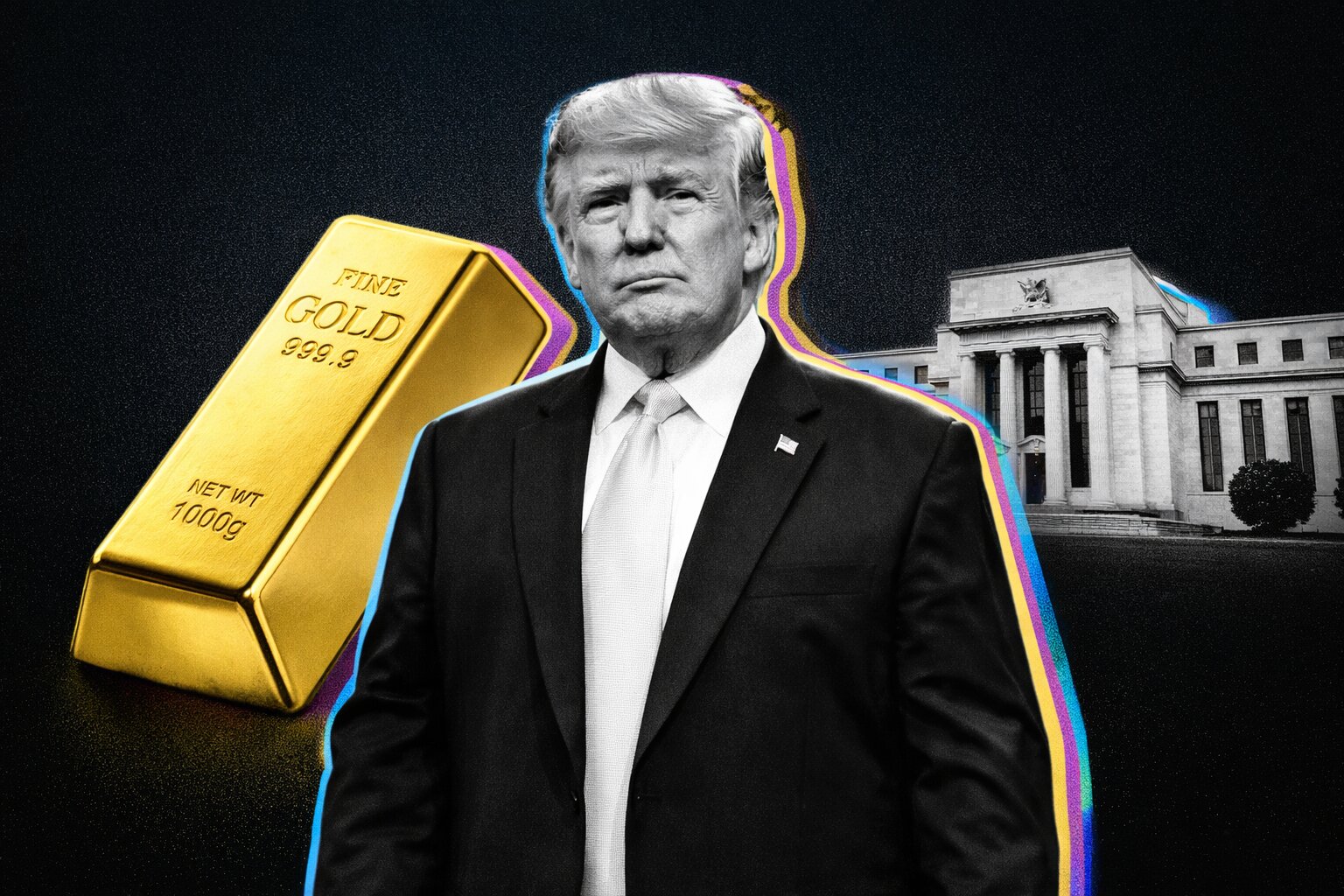
The fundamental backdrop for Gold / XAU/USD in 2025 has been dominated by policy shocks and geopolitical stress. Tariff policy under Donald Trump revived medium-term inflation and trade-fragmentation fears, pushing investors toward hard assets instead of fiat. Wars in Ukraine and the Middle East kept global risk premia elevated and structurally supported safe-haven demand. At the same time, the Federal Reserve shifted from aggressive tightening to rate cuts, with markets expecting further easing in 2026. Lower real yields reduce the opportunity cost of holding gold, which pays no coupon but protects purchasing power. This was reinforced by a weaker U.S. dollar, with broad dollar indices down roughly 8–10% over the year, the sharpest retreat in nearly a decade. A softer dollar made gold cheaper in other currencies and encouraged reserve managers to diversify away from the greenback. Add elevated sovereign debt, a prolonged U.S. government shutdown and concerns around fiscal sustainability, and the result is a powerful macro case for XAU/USD as insurance against both inflation and policy mis-steps.
ETF Flows, Central Banks and the Structural Bid Under Gold (XAU/USD)
Beneath the headline price, the structure of demand for Gold / XAU/USD has shifted decisively from tactical to strategic. Global gold ETFs holding physical bullion have posted six consecutive months of inflows as of November, taking combined assets to slightly above $0.5 trillion, on track for the strongest calendar year of net additions on record. This is not just speculative money chasing momentum; it reflects formal allocation decisions by asset managers and institutions. Central banks reinforce this picture. Survey data show roughly 95% of central banks intend to increase gold reserves over the next year, signalling explicit diversification away from fiat and particularly from the U.S. dollar. Gold is being treated less as a short-term inflation hedge and more as a strategic reserve asset with permanent portfolio weight. That structural demand is slow-moving, relatively insensitive to short-term volatility and acts as a durable floor under XAU/USD, even when speculative futures positioning washes in and out.
Whipsaw Volatility in GC=F: CME Margin Hikes and a Late-Stage Bull Tape
The cost of this repricing has been extreme intraday volatility in GC=F and XAU/USD. After breaking to record highs above $4,560–$4,584, February gold futures have swung sharply, recently quoted around $4,441.90, down $44.40 on the day and marking a three-week low. The derivatives infrastructure has responded with risk-control measures. CME Group has raised margin requirements on gold, silver, platinum and palladium futures twice in one week, explicitly citing elevated volatility and the need for stronger collateral coverage. The tape shows repeated patterns of large ranges, long wicks and aggressive intraday reversals, which are typical of a late-stage bull market where leveraged longs and shorts are both being forced to liquidate. Other commodity traders are watching the precious-metals futures complex as a stress point because the whipsaw action can trigger cross-asset de-risking when margin calls hit.
Technical Picture for Gold (XAU/USD): Trend Still Bullish, Risk Per Dollar Higher
Technically, Gold / XAU/USD remains in a bullish structure, but the risk profile has changed. February GC=F still shows a pattern of higher highs and higher lows anchored by the contract high at $4,584, which defines the upper boundary of the current regime. Immediate resistance sits in the $4,384.90–$4,400 zone, with the record high band above as the key ceiling. On the downside, first support lies near $4,284–$4,300, followed by $4,250 and then major structural support around $4,200. A sustained break below $4,200 would be the first clear technical signal that the bull phase is giving way to a deeper correction, opening room back toward the high-$3,000s where the latest acceleration started. In Wyckoff terms, the market still carries a 7.0 / 10 rating, consistent with a primary uptrend, but the pattern of sharp two-way swings indicates that each incremental dollar of upside now comes with a much higher variance than earlier in the move.
Silver’s Parallel Surge: What $71–$84 Silver Implies for the Gold Complex
Silver’s behaviour adds important context to the Gold / XAU/USD story. Silver has traded around $71 per ounce after touching record territory near $83–$84, significantly outpacing most traditional asset classes and even many cryptocurrencies. March silver futures have recently dropped more than $6 in a single session to about $71.78, producing a classic bearish key reversal and a large exhaustion tail where bulls lost control intraday. Technically, resistance is defined by the record high around $82.67, with interim upside reference levels at $73 and $74, and support zones at $70, $69 and $67.50. Fundamentally, silver is also constrained by industrial supply tightness, including export restrictions out of China, one of the largest producers. That mix of monetary and industrial drivers has pushed both gold and silver to simultaneous records. When the entire precious-metals complex trades at or near all-time highs, it confirms that the move in XAU/USD is part of a broad regime shift rather than an isolated hedge trade.
Macro Outlook for XAU/USD in 2026: Fed Path, Sovereign Debt and China’s Growth
Looking ahead, the macro setup into 2026 remains supportive for Gold / XAU/USD, but with clear two-sided risk. Market expectations point to further Fed rate cuts, and the likely appointment of a new Fed Chair aligned with looser policy and lower real yields is, by construction, positive for gold. Sovereign-debt risk is rising as public debt levels in the U.S. and other developed economies stay high, and some strategists explicitly identify a sovereign-debt event as a potential “black swan” that would drive gold significantly higher. China, a critical source of both physical demand and macro signalling, is guiding to around 5% GDP growth with a manufacturing PMI just above 50.1, implying modest expansion with an emphasis on “quality” over raw speed. That backdrop does not threaten gold demand and continues to support robust consumption in Asia. The dollar’s ~8.1% annual decline leaves it vulnerable to further weakness if U.S. policy stays looser than peers, which would remain a tailwind for XAU/USD.
Scenario Ranges for Gold (XAU/USD): How Institutions Frame $4,000–$5,000
Institutional scenario work around Gold / XAU/USD converges on a broad but structured range. One major investment bank targets $4,900 per ounce for 2026, explicitly highlighting “significant upside” if large asset owners accelerate rotation from conventional equity-bond allocations into gold ETFs. A large asset manager anchors its base range at $4,000–$4,500, but concedes that strategic reallocations and geopolitical shocks could push prices to $5,000. The World Gold Council’s scenario matrix shows only one clearly bearish path: above-trend global growth, renewed inflation pressures that force the Fed back into tightening and a stronger U.S. dollar. In contrast, a material global slowdown is modelled as adding another 15–30% upside, which would place XAU/USD in the $4,900–$5,700 band. Between these extremes, the most probable outcome is a high-volatility range where gold is flat to modestly higher from today’s levels, rather than a clean linear trend.
Flow Dynamics, Liquidity Risk and Why XAU/USD Can Overshoot Both Ways
Short-term behaviour in Gold / XAU/USD will be driven as much by market structure as by macro headlines. CME margin hikes increase the cost of leveraged exposure and force weaker accounts to reduce positions, concentrating the market in larger, better-capitalised hands. Thin liquidity at times of stress means that identical order sizes can produce larger price moves than usual, which explains the recent violent swings around key levels. There is also a cross-asset angle. After a ~65% year, gold and silver are prime candidates for profit-taking if investors need to raise cash during equity or credit drawdowns. That is the main near-term risk: not a collapse in the fundamental case for gold, but forced selling from portfolios that need liquidity. Set against that is the slow, sticky demand from ETFs and central banks, which is insensitive to short-term noise and continues to provide a structural floor beneath XAU/USD as long as the high-debt, low-real-yield regime persists.
Medium-Term Levels and Stance on Gold (XAU/USD): Strategic Hold With Buy-the-Dip Bias
Combining fundamentals, flows and technicals, the medium-term map for Gold / XAU/USD is clear. The probable floor under current conditions sits around $4,000 per ounce, where structural buyers are likely to defend aggressively unless global growth surprises sharply to the upside and the dollar embarks on a meaningful rally. The base-case band implied by institutional targets clusters between $4,000 and $4,900, with volatility inside that zone driven by data, policy rhetoric and periodic de-risking. A genuine global slowdown or a sovereign-debt scare could justify a 15–30% extension from current prices, taking gold into a $5,000+ environment as a tail scenario. In that context, the rational stance is a strategic HOLD on core XAU/USD exposure with a bullish bias and a buy-the-dip approach. Existing allocations remain justified; fresh entries are more attractive on corrections into the $4,250–$4,000 area than on momentum buys above $4,500–$4,600. Only a decisive break below $4,200, combined with a stronger dollar and a hawkish shift in global policy, would justify flipping this view from bullish-hold to outright bearish.
That's TradingNEWS