Intel (NASDAQ:INTC) – Government-Backed Re-Rating At The Top Of Its Range
Trump, Lip-Bu Tan And The 10% U.S. Stake In NASDAQ:INTC
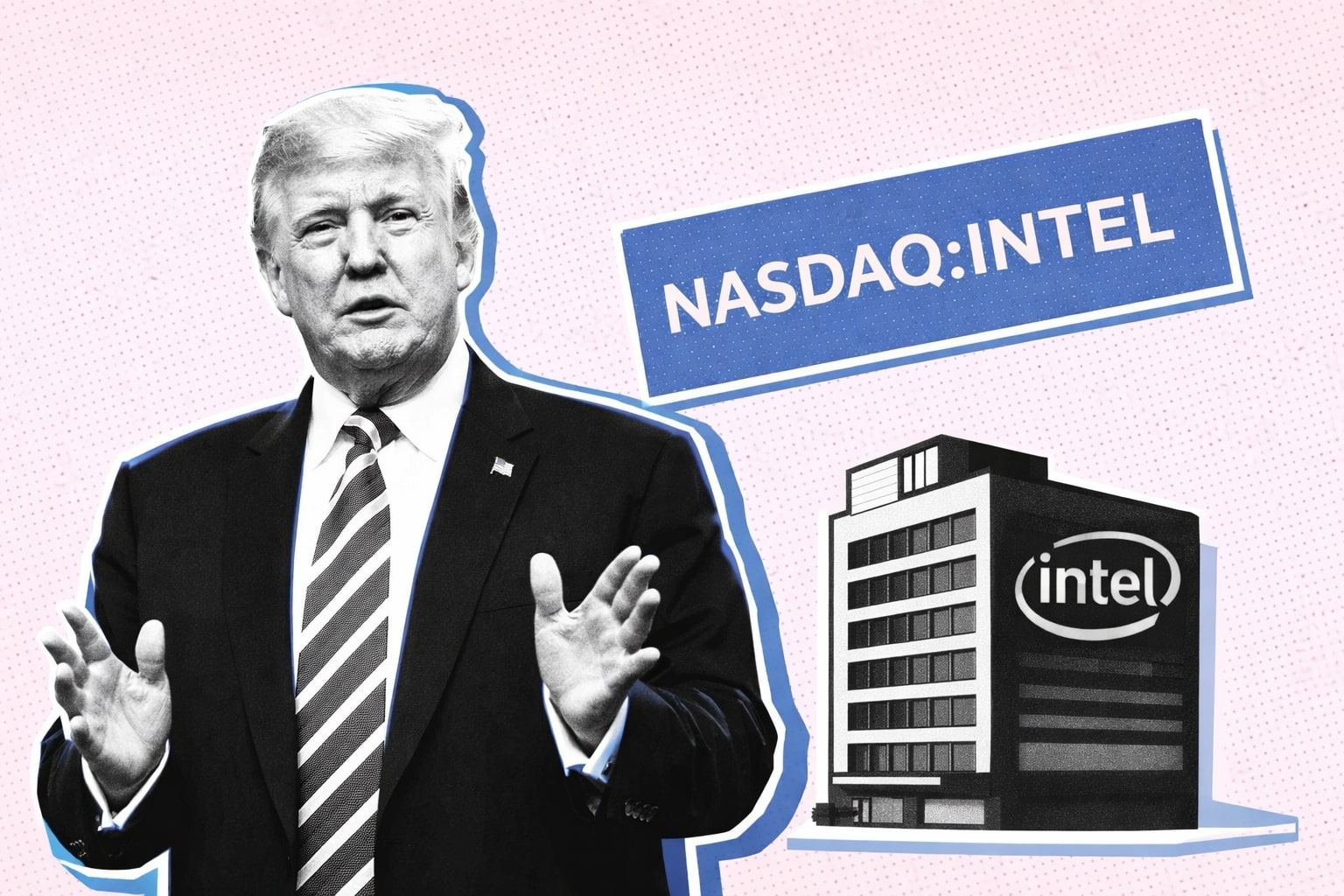
The core of the current story around NASDAQ:INTC is political and financial at the same time. In August 2025 the U.S. administration converted CHIPS Act support into equity, putting about $8.9 billion into Intel at $20.47 per share and taking roughly a 9.9%–10% stake, around 433.3 million shares. At the latest close near $45.55, that block is now worth roughly $19.7 billion, turning an $8.9 billion outlay into a gain of about $10.8 billion in a few months. Trump is publicly framing this as “tens of billions” for taxpayers and repeatedly calling the government a “proud” shareholder. The key shift is not just the money; months earlier, in early August 2025, Trump was demanding Lip-Bu Tan’s resignation over historic China-linked investments. That has flipped into a visible alliance, with the President praising Tan as “very successful” and highlighting Intel’s new sub-2-nanometer CPU “designed, built and packaged” in the U.S. The result is simple: Intel has become the flagship vehicle for U.S. advanced chip sovereignty, and the White House now has a direct interest in the NASDAQ:INTC share price.
How The U.S. Position Turned An $8.9 Billion Deal Into Nearly $20 Billion
The mechanics of the stake explain why the market is reacting so aggressively. At $20.47 per share for 433.3 million shares, the state’s cost basis is around $8.9 billion. With NASDAQ:INTC closing at $45.55 and touching an intraday high of $45.73, that position is now worth about $19.74 billion. On paper the U.S. has already extracted more than 100% return in roughly four months. The message to investors is that the same upside that doubled the government’s stake is available to private holders, but with an additional tailwind: political capital will not allow Intel’s strategic value to be undermined easily. The deal structure, where grants under the CHIPS Act were effectively converted into equity, also tells you that future support is likely to keep coming as long as Intel keeps delivering on U.S. manufacturing and leading-edge nodes.
INTC Share Price, Trading Range And Valuation Snapshot
On the tape, NASDAQ:INTC has completely changed character. The stock closed at $45.55, up $4.44 in a single session, a 10.80% daily gain. Intraday trading ranged between $41.57 and $45.73, and the high marked a fresh 52-week top, versus a 52-week low of $17.67. The stock has therefore climbed more than 150% from the low to the high over twelve months and more than doubled since the government stake was negotiated. The market cap sits around $217.27 billion, with average daily volume of 78.43 million shares and this latest session printing far above that level as institutions leaned into the move. On standard valuation screens the P/E ratio shows 4,293.12, a figure that looks ridiculous at first glance but is distorted by depressed trailing earnings and one-off items; the more relevant metric right now is the price-to-book ratio of about 1.84x, off total equity of $116.73 billion and total assets of $204.51 billion.
Income Statement – Margin Repair And Profitability Inflection At NASDAQ:INTC
The most recent quarter, September 2025, confirms that this is not only a political story. Quarterly revenue reached $13.65 billion, up 2.78% year-on-year, reversing previous declines. Operating expenses fell sharply to $4.36 billion, a 19.73% YoY reduction, reflecting the restructuring and cost cuts under Lip-Bu Tan. That cost discipline pushed net income up to $4.06 billion, a massive 124.42% increase versus the prior year. The net profit margin jumped to 29.76%, improving by 123.76% in percentage-point terms, and earnings per share rose to $0.23, up 150% YoY. EBITDA printed at $3.51 billion, a 54.28% YoY increase, signaling real operating leverage. An effective tax rate of 6.65% reflects the benefit of incentives linked to U.S. fab investments and credits. Those numbers show that Intel is not just relying on subsidies; it is actually rebuilding profitability and margins.
Balance Sheet Strength, Liquidity And Leverage For NASDAQ:INTC
On the balance sheet, NASDAQ:INTC is entering this capex super-cycle from a position of clear strength. Cash and short-term investments stand at $30.94 billion, up 28.44% YoY, giving substantial buffer against any cyclical shock. Total assets are $204.51 billion, up 5.67% YoY, while total liabilities are $87.78 billion, actually down 1.01% YoY. That leaves total equity at $116.73 billion across 4.77 billion shares outstanding, which translates into the 1.84x price-to-book multiple seen in the quote data. Return on assets sits at 1.08% and return on capital at 1.34%, still modest but trending up as profitability recovers. The key point: leverage is manageable, liquidity is high, and Intel can support an aggressive capital-expenditure plan without stressing the balance sheet. Investors can also track governance and insider behavior via the full stock profile and insider-transaction history, which will matter as the share price re-rates.
Cash Flow, Capex Cycle And Free Cash For NASDAQ:INTC
The cash-flow statement shows exactly how Intel is funding its transformation. Net income of $4.06 billion translated into cash from operations of $2.55 billion, which is down 37.20% YoY, indicating less favorable working-capital dynamics and the timing of receivables and inventory. At the same time cash used in investing was -$6.25 billion, down by another 126.12%, an explicit sign of accelerating spending on fabs, process nodes like 18A and 14A, and advanced packaging. Cash from financing was +$5.15 billion, up 235.86% YoY, reflecting new funding sources, likely a mix of debt issuance, equity-linked structures, and the impact of government support. Despite heavy capex, net change in cash was a positive $1.45 billion, up 157.87% YoY, and free cash flow reached $4.08 billion, exploding 2,200.14% higher compared to the prior year. The message is clear: Intel is in the middle of a capital-intensive build-out, but it is not burning the business to the ground to pay for it. It is generating positive free cash while it invests, something you do not see in a distressed turnaround.
Foundry Strategy, 18A To 14A And The NVDA AAPL AMD Angle
The market is now starting to price NASDAQ:INTC less as a legacy PC CPU vendor and more as a strategic foundry asset. Under Lip-Bu Tan, Intel is pushing a roadmap where Intel 18A underpins its own products, like the Core Ultra Series 3 CPUs now shipping, while 14A is positioned as a more customer-tuned node aimed at external clients. There is already a $5 billion equity stake in Intel from Nvidia, and discussions in the market center around the prospect that Nvidia and Apple could route some chip production onto Intel’s 14A node by 2028–2029. Even AMD, a direct CPU rival, may have incentives to allocate some future manufacturing to Intel in order to gain political credit by supporting the only domestic foundry for leading-edge chips. The CEO is now seen as a bridge between political power and the AI ecosystem, with Trump, Commerce officials and leading chip CEOs aligned on making Intel a central node in U.S. semiconductor infrastructure.
Comparison To TSMC And The Book-Value Re-Rating Case For NASDAQ:INTC
The valuation gap versus the main global foundry competitor is at the heart of the bull case. At around 1.84x book value, NASDAQ:INTC trades at a tiny fraction of TSMC’s roughly 10.3x book. A major research house just shifted its stance on Intel from neutral to positive, locking in a $50 price target, roughly 10% upside from the $45.55 close. That target is explicitly based on a move to around 2x book, still a deep discount to Taiwan’s champion. The argument is straightforward: as Intel proves it can deliver on 14A, signs large third-party deals, and keeps the political backing intact, equity markets will be forced to move the multiple from “embattled laggard” toward “strategic national asset.” If book value grows with the capex program and the multiple moves even modestly higher, the market-cap potential extends well beyond the current $217 billion.
Macro Backdrop, Trump’s Second Term And What 2026 Volatility Means For INTC
The macro overlay for 2026 is more complicated. Statistical history on the second year of a presidential term shows that U.S. equities typically deliver weaker returns in that phase of the cycle. Since 1940, the S&P 500 has gained about 4.2% on average in second years, versus roughly 9% annualized over the full period. Strategists are flagging a year-end 2026 S&P target near 7,100, implying a roughly 4% gain, far below the 16% rise investors just saw in 2025. There is also open talk that 2026 could go down as a “Year of the Bubble” on Wall Street, reflecting stretched valuations across AI leaders, mega-caps and speculative pockets. Index levels support that narrative: the Dow around 49,504, S&P 500 near 6,966, Nasdaq above 23,600, Bitcoin close to 90,861, gold near $4,518, oil around $58.78 and a VIX at 14.49 with the 10-year yield at about 4.175% together describe a market that is simultaneously expensive and complacent. For NASDAQ:INTC, which has already doubled and is now one of the stronger names in the S&P 500, this means the stock is exposed to any broad de-risking move, even if its fundamentals are improving.
Risk Map – What Can Derail The NASDAQ:INTC Bull Story
The risk set for NASDAQ:INTC is not about survival; it is about execution, cyclicality and politics. First, the 14A node has to land on time and at competitive power, performance and yield. A slip of six to twelve months or a meaningful performance shortfall would immediately compress the foundry premium the market is starting to assign. Second, the capex cycle embedded in the -$6.25 billion investing cash flow will continue; if the macro slows or PC and data-center demand rolls over, free cash flow could be pressured and investors may begin to worry about returns on that investment. Third, a 10% government shareholder is both a shield and a constraint; policy goals such as domestic employment, national security and geopolitical leverage could, at some point, conflict with pure return-on-equity optimization. Finally, if the presidential cycle pattern plays out and 2026 delivers muted index returns or a correction from “bubble” levels, high-beta semis that rallied hardest can suffer the sharpest pullbacks, and INTC, now at a 52-week high of $45.73, is clearly in that cohort.
Buy, Sell Or Hold – Clear Verdict For NASDAQ:INTC
Putting the numbers and the context together, the setup is asymmetric. You have Intel at $45.55, fresh off a 10.80% daily jump, near a $45.73 yearly high and far above the $17.67 low. You have a 10% U.S. state stake that turned $8.9 billion at $20.47 into roughly $19.7 billion, a doubling in value that the administration is publicly celebrating. You have quarterly revenue of $13.65 billion growing again, net income of $4.06 billion up 124.42%, a net margin of 29.76%, EPS at $0.23 up 150%, EBITDA of $3.51 billion up 54.28%, and free cash flow of $4.08 billion exploding more than 2,200%. You have $30.94 billion in cash, liabilities of $87.78 billion, equity of $116.73 billion, and a stock trading at only 1.84x book while the leading global foundry peer sits above 10x book. On top of that you have a credible path for 14A to attract NVDA, AAPL, AMD and U.S. defense and hyperscale clients by 2028–2029, plus a major analyst upgrade with a $50 price target anchored explicitly on an initial move to 2x book. Against that, the risks are clear but manageable: execution on process technology, a heavy but funded capex cycle, political interference, and macro volatility in a potentially weaker second presidential-term year. The balance of those factors points in one direction. On a 3–5-year horizon, with the understanding that volatility and sharp corrections are part of the entry price, Intel Corp (NASDAQ:INTC) is a BUY, not a hold and not a short.
That's TradingNEWS