



Natural Gas Futures Prices Explode 46% as Qatar Shuts Down LNG Production — Strait of Hormuz Closure Puts 20% of Global Supply at Risk
TTF hits €46/MWh, Asian LNG surges 39%, EU storage dangerously below 31% | That's TradingNEWS
Natural Gas Prices Explode 46% as Qatar Shuts Down LNG Production — Strait of Hormuz Closure Puts 20% of Global Supply at Risk
European TTF benchmark hits €46/MWh, Asian spot LNG surges 39%, EU storage sits dangerously below 31%.
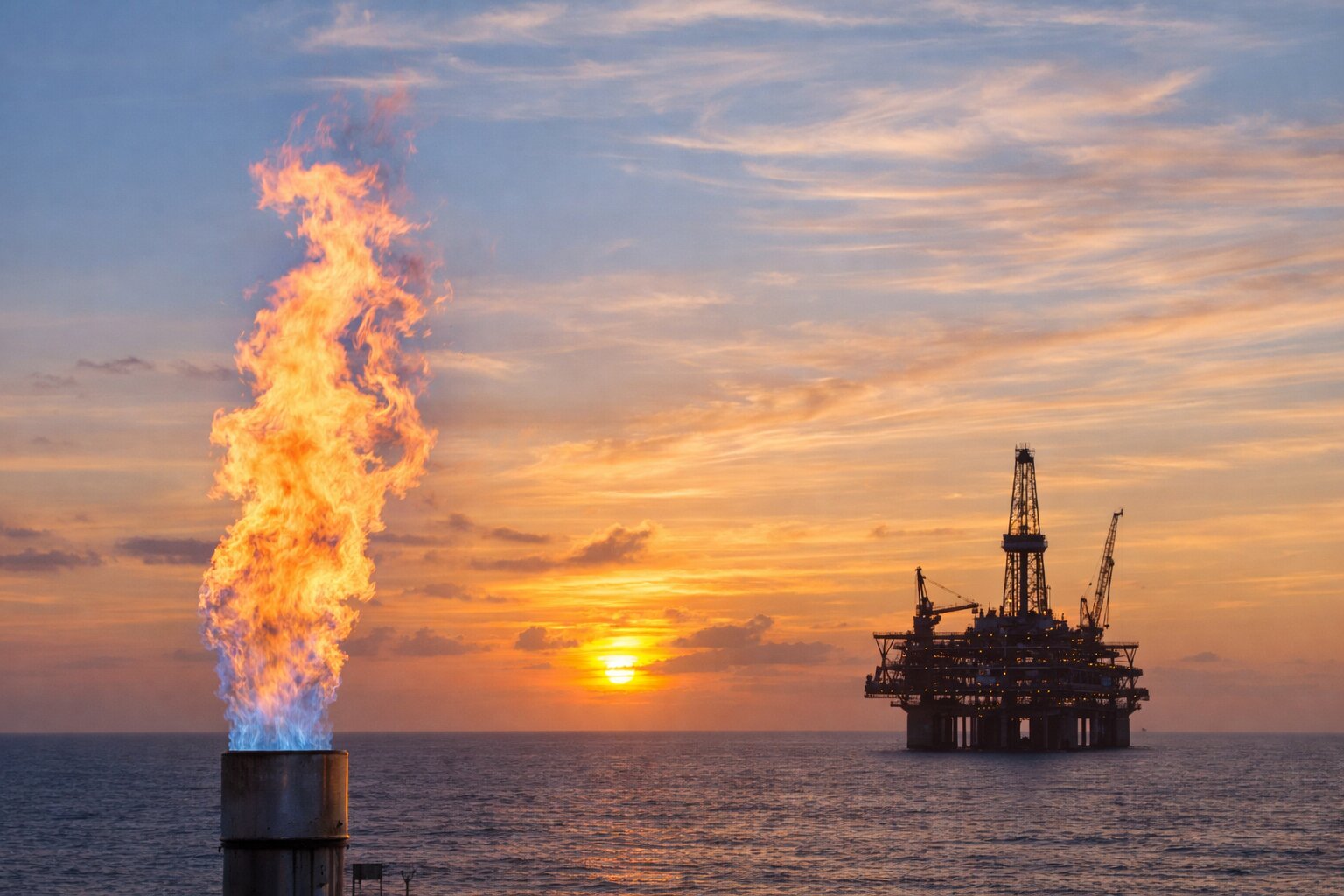
Natural gas prices detonated on Monday, March 2, 2026, posting their most violent single-session move since the early days of the Russia-Ukraine energy crisis. The benchmark European gas price — the Dutch front-month contract traded on the TTF hub — surged as much as 46% to approximately €46 per megawatt-hour by early afternoon, with intraday swings exceeding 50% at the session's most volatile point. UK natural gas prices on the NBP benchmark climbed in lockstep. Asian spot LNG prices spiked 39% in morning trading. The catalyst is existential for global energy markets: QatarEnergy, the world's third-largest LNG exporter behind the United States and Australia, halted all liquefied natural gas production linked to its giant North Field reservoir after Iranian drone strikes hit facilities inside the sprawling Ras Laffan Industrial City complex — the single most important LNG processing hub on the planet.
QatarEnergy Halts Production: 20% of Global LNG Supply Goes Dark
Qatari LNG production is equivalent to roughly 20% of the world's total supply. That output doesn't just balance one market — it anchors both Asian and European demand simultaneously, with 82% of QatarEnergy's contracted volumes flowing to Asian buyers and the remainder supporting European import needs that have become critical since Russia's invasion of Ukraine in 2022 forced the continent to abandon pipeline gas from Moscow.
The Iranian drone attacks struck the Ras Laffan complex, home to Qatar's gas trains — massive processing units that supercool natural gas into liquid form for tanker export. A second wave of drones hit the Mesaieed industrial zone in Qatar's south, which sits far from the gas fields but houses petrochemical and manufacturing facilities. QatarEnergy moved to declare force majeure on its LNG shipments, a legal mechanism that suspends contractual delivery obligations due to circumstances beyond the company's control. The declaration confirms that this isn't a brief operational pause — it's a sustained supply disruption with no clear timeline for resolution.
Qatar's role as a swing supplier became even more important after 2022, when European countries scrambled to replace Russian gas. Qatar now supplies between 12% and 14% of Europe's LNG imports directly, and its influence on pricing extends far beyond those contractual volumes. When Qatari cargoes disappear from the market, Asian buyers — Japan, South Korea, China, India — are forced to compete for alternative supply from the United States and Australia, tightening the global LNG balance and pulling prices higher everywhere. That competition is already playing out in real time.
The Strait of Hormuz Is Effectively Closed — And That Changes Everything for Natural Gas
Even before Qatar's production shutdown, the natural gas market was already pricing in severe disruption. The Strait of Hormuz — the narrow maritime passage between Iran and Oman through which approximately 20% of global oil and 20% of global LNG trade transits — has been rendered impassable. Iran's Islamic Revolutionary Guard Corps declared the waterway closed following the U.S.-Israeli military offensive that killed Supreme Leader Ayatollah Ali Khamenei. Satellite data confirmed that oil and LNG tanker traffic through the strait virtually halted over the weekend. More than 200 vessels were reported waiting outside the chokepoint as of Monday morning. Several ships have been struck — at least three oil tankers hit by Iranian missiles, and drone boats have attacked additional vessels near the strait's southern approach.
Shipping companies aren't waiting for clearer signals. Maersk suspended all crossings. Other carriers began rerouting away from the passage entirely. Marine insurance premiums for Gulf transit spiked to levels that make commercial passage economically unviable even if physically possible. Maurizio Carulli, global energy analyst at Quilter Cheviot, noted that the strait has never been actually closed in modern history, though temporary slowdowns have occurred. He does not expect shipping companies to send vessels through until the military situation de-escalates, citing ship damage risk, seizure risk, and the temporary unavailability of insurance coverage.
The 20% of global LNG trade figure is critical. That volume includes not just Qatari exports but also cargoes from other Gulf producers that transit the strait. With both the production source (Qatar's Ras Laffan) and the transit route (Hormuz) simultaneously disabled, the supply shock is multiplicative rather than additive.
Read More
-
IVV ETF Price Forecast: S&P 500 Survives Iran War Monday at $689 as Dip Buyers Swarm — De-Escalation Could Send It Back to $700
02.03.2026 · TradingNEWS ArchiveStocks
-
XRP ETF Price Forecast: XRPI Bounces to $7.94, XRPR Hits $11.49, Bitwise XRP Climbs to $15.63
02.03.2026 · TradingNEWS ArchiveCrypto
-
Oil Price Forecast: Brent Blasts Through $80, WTI Surges on Hormuz Supply Shock
02.03.2026 · TradingNEWS ArchiveCommodities
-
USD/JPY Price Forecast: Yen at 157.50 as Iran War Overrides Bank of Japan Rate Hike Bets — Dollar Dominance Targets 162
02.03.2026 · TradingNEWS ArchiveForex
Saudi Arabia, Iraq, Israel — The Cascade of Shutdowns Across the Middle East
Qatar's LNG halt is the most consequential energy disruption, but it's far from the only one. The conflict has triggered a cascade of precautionary shutdowns across the region's oil and gas infrastructure that compounds the natural gas supply picture.
Saudi Aramco's Ras Tanura refinery — a 550,000 barrel-per-day facility and part of a critical export terminal complex on the kingdom's Gulf coast — was shut after an Iranian drone strike. Two drones were intercepted at the facility, with debris causing a limited fire. Saudi authorities insisted supply to domestic markets was unaffected, but the attack itself represents a dramatic escalation: Gulf energy infrastructure is now squarely in Iran's targeting matrix. Torbjorn Soltvedt, principal Middle East analyst at Verisk Maplecroft, called the Ras Tanura strike a significant escalation and warned it could push Saudi Arabia and neighboring Gulf states closer to joining U.S. and Israeli military operations — which would widen the conflict further and extend the disruption timeline.
In Iraqi Kurdistan, which exported 200,000 barrels of oil per day via pipeline to Turkey's Ceyhan port in February, companies including DNO, Gulf Keystone Petroleum, Dana Gas, and HKN Energy stopped output at their fields as a precaution. No damage was reported, but the shutdowns remove additional hydrocarbon supply from the market.
Offshore Israel, the government instructed Chevron to temporarily shut down the giant Leviathan gas field, which is in the process of expanding capacity to around 21 billion cubic meters per year as part of a $35 billion export deal to Egypt. Chevron, which also operates the Tamar gas field, confirmed its facilities were safe but offline. Energean shut down its production vessel serving smaller Israeli gas fields. These shutdowns throttle gas exports to Egypt and further tighten the Eastern Mediterranean gas balance.
In Iran itself, explosions were heard on Kharg Island, which processes 90% of Iran's crude exports. Iran pumps roughly 3.3 million barrels per day of crude plus 1.3 million bpd of condensate and other liquids — about 4.5% of global oil supply. The extent of damage to Kharg Island facilities remains unclear, but any sustained impact would remove significant volumes from a market that is already hemorrhaging supply from every direction.
European Natural Gas Storage: Below 31% and Dangerously Exposed
The timing of this crisis could not be worse for European gas consumers. EU gas storage facilities are currently below 31% capacity as the winter heating season draws to a close — compared with approximately 40% at the same point last year. That 9-percentage-point deficit represents hundreds of terawatt-hours of cushion that simply doesn't exist.
Germany and France — the bloc's two largest economies and its biggest gas consumers — are among the most vulnerable. German storage facilities were 20.5% full as of Saturday. France stood at 21%. Those levels are perilously low heading into the spring refill season, which typically runs from April through October. Under normal market conditions, refilling from 20% to the EU's 90% storage target by November 1 is already an expensive and logistically demanding exercise. With Qatari LNG offline, the Strait of Hormuz closed, and global LNG competition intensifying, the cost of refilling European storage this year could be multiples of last year's levels.
The low storage position amplifies every supply disruption. When inventories are high, a temporary production halt or transit blockage can be absorbed by drawing on reserves. At 20–30% fullness, there is no buffer. Every missing cargo translates directly into price spikes, demand rationing, or both. Monday's 46% price surge is the market pricing this vulnerability in real time.
Goldman Sachs Warning: Natural Gas Prices Could Double if Hormuz Stays Shut
Goldman Sachs has issued a stark assessment: if the Strait of Hormuz remains closed for one month, European natural gas prices could double from pre-crisis levels. Given that TTF was trading around €26–€28/MWh before the conflict erupted, a doubling would push the benchmark toward €50–€56/MWh — a range that the market briefly touched during Monday's intraday spike before settling back. If the closure extends beyond a month, or if Qatari production remains offline even after the strait reopens, prices could push toward the €60–€70/MWh levels last seen during the worst of the 2022 Russian gas crisis.
The mechanism is straightforward. With Qatari supply offline and Hormuz transit frozen, Asian buyers — who absorb 82% of Qatar's contracted volumes — will aggressively bid for alternative LNG cargoes from the United States, Australia, and West Africa. That competition pulls U.S. LNG exports toward Asia, reducing the volume available for European delivery. European buyers then have to outbid Asian counterparts to attract replacement cargoes, driving TTF and NBP prices higher in a self-reinforcing spiral. The global LNG market is a zero-sum game when supply is constrained: every cargo diverted to Asia is a cargo Europe doesn't receive.
Oil's Surge Compounds the Natural Gas Picture
Crude oil's parallel spike reinforces the natural gas thesis. Brent crude surged as much as 13% intraday to above $82 per barrel — the highest since January 2025 — before settling around $79. WTI jumped above $75 before easing to roughly $72. Both benchmarks remain well above pre-conflict levels, with the Strait of Hormuz closure threatening 20% of global oil supply in addition to LNG flows.
Oil and natural gas prices are linked through several transmission channels. Many power generation systems can switch between gas and oil-fired generation, so when gas prices spike, demand for oil-based alternatives rises, pushing crude higher — and vice versa. LNG contracts in Asia are often indexed to oil prices, so Brent's surge directly feeds into Asian LNG spot prices. And the inflationary pass-through from higher energy costs — economists estimate a sustained move toward $100 oil could add 0.6 to 0.7 percentage points to global inflation — further complicates the monetary policy outlook and keeps central banks from easing, which in turn supports the dollar and pressures commodity-importing economies.
WTI faces technical resistance at the June 2025 peaks around $77.10–$77.57. Above that, the psychological $80 barrier comes into play. Support sits at $72.22–$72.36 (October 2024 and April 2025 highs) and $71.38–$71.47 (November-to-December 2024 range). The short-term oil outlook is bullish above Monday's $69.20 low, and the medium-term is bullish above the February 26 low at $63.60. As long as oil remains elevated, natural gas has a floor beneath it — the energy complex moves as a unit when geopolitical supply disruptions are the driver.
U.S. Natural Gas: Domestic Market Gets an Indirect Boost
U.S. natural gas futures also rallied on Monday, gaining over 3.5% as the conflict reverberated across the Atlantic. The mechanism for U.S. price support is indirect but powerful: with European and Asian LNG prices spiking, the incentive to export U.S. LNG increases dramatically. Higher export pull means more domestic gas molecules flowing to liquefaction terminals on the Gulf Coast — Cheniere's Sabine Pass, Freeport LNG, Cameron LNG, and the soon-to-be-operational Golden Pass (a joint venture between ExxonMobil and QatarEnergy, ironically positioned to benefit from Qatar's own production shutdown).
Increased LNG export demand tightens the domestic U.S. gas balance, supporting Henry Hub prices. If European TTF sustains above €40/MWh and Asian JKM spot prices remain elevated, the netback for U.S. LNG exporters makes full-capacity operations highly profitable, drawing down domestic supply that would otherwise serve U.S. power generation and industrial demand. The result: higher prices across the entire natural gas complex, from TTF in Amsterdam to Henry Hub in Louisiana.
The Broader Equity and Macro Impact of the Natural Gas Spike
Equity markets are already pricing the damage. S&P 500 futures fell over 1% Monday. European futures declined sharply, with the Stoxx 600 opening down 1.8%. Japan's Nikkei 225 dropped more than 2.5%. The VIX spiked 7.25% to 21.30. Safe-haven flows pushed gold up 2.5% to above $5,400 per ounce, while the U.S. Dollar Index surged 0.89% to 98.43 — a five-week high driven by capital fleeing into the greenback.
10-year U.S. Treasury yields hovered near an 11-month low around 3.9% early Monday on flight-to-safety demand, though they bounced back above 4.0% as inflationary implications from sustained energy price increases began to override the haven bid. The Dow fell 155.76 points (-0.32%) to 48,822.16, the S&P 500 shed 18.30 points (-0.27%) to 6,860.58, and the Nasdaq dipped 67.78 points (-0.30%) to 22,600.43.
For the Eurozone specifically, the natural gas spike is the most acute economic threat. European industry runs on gas — for power generation, heating, chemical feedstock, and manufacturing process heat. A sustained move above €40/MWh reawakens the industrial recession that plagued Germany and Italy throughout 2022–2023, when Russian gas disruptions pushed TTF above €300/MWh at the peak. Current levels are nowhere near that extreme, but the direction of travel is concerning, and the storage deficit means Europe has less ability to absorb shocks than it did even last year.
Verdict: Strongly Bullish on Natural Gas — TTF, NBP, Henry Hub All Pointed Higher
The setup for natural gas prices is overwhelmingly bullish across every relevant benchmark. QatarEnergy — responsible for 20% of global LNG supply — has halted production and declared force majeure. The Strait of Hormuz — through which 20% of all LNG trade transits — is effectively closed, with 200+ tankers stationary and shipping companies refusing to send vessels through. Saudi Aramco's Ras Tanura refinery is shut. Israeli gas fields including Leviathan and Tamar are offline. Iraqi Kurdistan has suspended 200,000 bpd of oil production. EU gas storage sits at 20.5% in Germany and 21% in France — dangerously below the 40% level seen at this point last year. Goldman Sachs projects prices could double if Hormuz stays shut for a month.
The TTF front-month at €46/MWh has room to run toward €55–€60 if the conflict persists through mid-March. Asian JKM spot prices will remain elevated as long as Qatari cargoes are absent. U.S. Henry Hub benefits from increased export pull and will grind higher alongside global benchmarks. The only scenario that reverses this trade is a rapid ceasefire, reopening of Hormuz, and resumption of Qatari LNG production — an outcome that has no visible pathway given that President Trump has described a four-to-five week military timeline with regime change as the stated objective.
Long natural gas is the highest-conviction energy trade available right now. The supply destruction is real, the storage deficit is measurable, the transit blockage is physical, and the geopolitical escalation is accelerating. Prices are going higher until something fundamental changes — and nothing fundamental is changing today, tomorrow, or likely this month.