




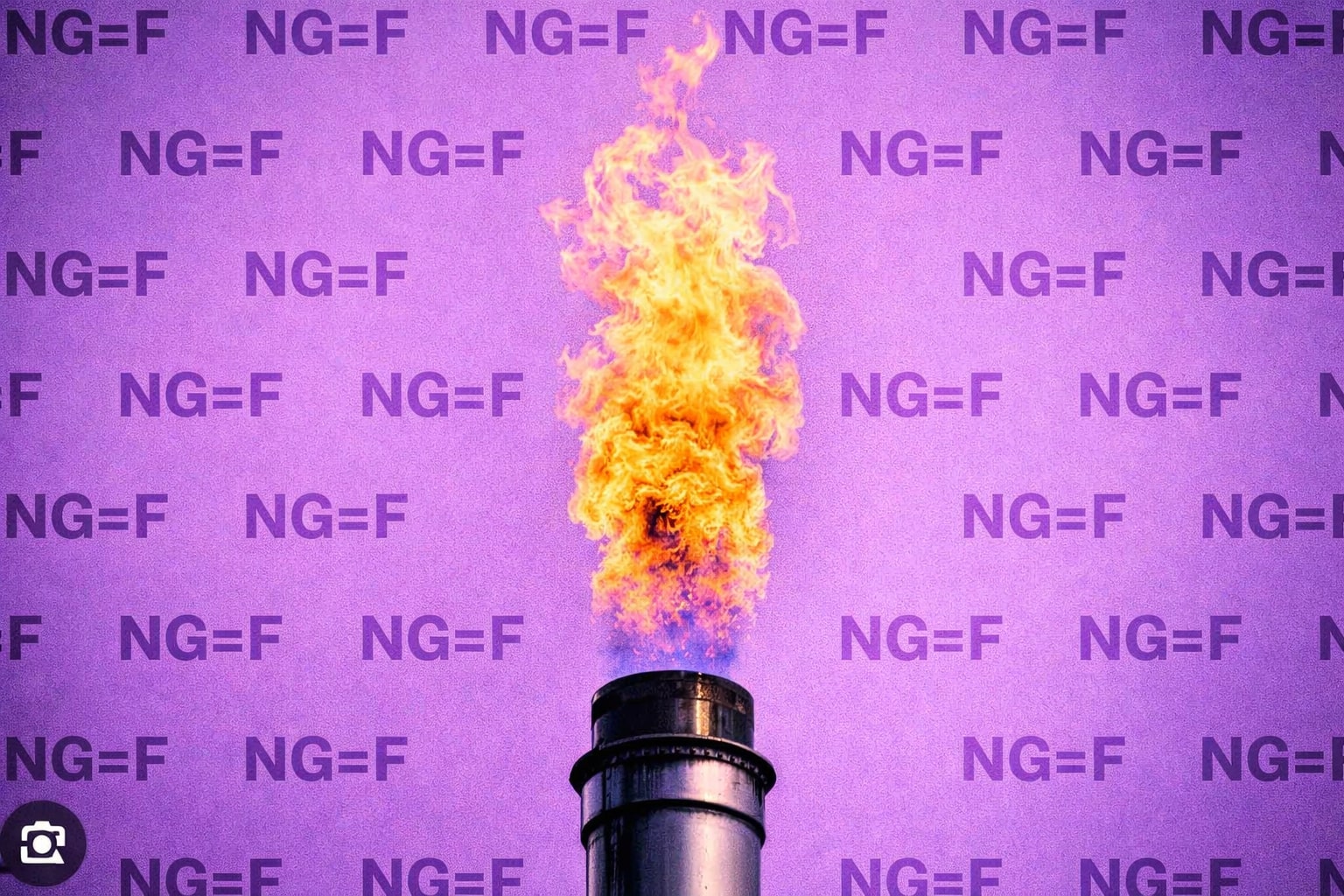
Natural Gas Price Forecast: NG=F Holds Around $4 as Record LNG Feedgas Anchors Winter Range
Henry Hub hovers near $4.26 per MMBtu while record LNG exports, comfortable storage, soft TTF near €27 and the $3.90–$5.00 band drive the next move | That's TradingNEWS
Natural Gas (NG=F) price today: front-month pinned near $4 in a violent winter band
U.S. Henry Hub January 2026 futures NG=F are trading in the low-to-mid-$4s after a sharp December round-trip that pushed the contract above $5.20, then flushed it below $4.00, and pulled it back into the $4.20–$4.30 zone. The latest tape shows January around $4.26 per MMBtu, down roughly 3% on the day, with intraday ranges clustering between about $4.18 and $4.59 after a prior settle in the $4.29–$4.41 area.
This is classic late-December behavior: thin Christmas liquidity, a contract expiring on 29 December, and every small shift in weather models forcing traders to repeatedly reprice winter risk rather than trending cleanly in one direction.
Record LNG feedgas keeps a structural bid under U.S. Natural Gas (NG=F)
The most important bullish anchor for Natural Gas (NG=F) is export demand. Feedgas deliveries to U.S. LNG terminals are hovering near record levels, around the high-18 bcfd area in December, as facilities like Cameron, Freeport and Calcasieu Pass run close to capacity. That means north of 15% of Lower-48 output is effectively “pulled off” the domestic grid and turned into cargoes heading to Europe and Asia.
Recent EIA and shipping data confirm how aggressive this flow is: roughly thirty-plus LNG vessels with a combined capacity above 120 Bcf left U.S. ports in the latest reported week, underlining that Henry Hub is now directly wired into global demand rather than just U.S. heating and power burn.
This is why sub-$3 pricing has vanished for now. As long as LNG stays near these levels, the floor under NG=F is materially higher than in prior warm winters, even if upside still depends on weather, storage and risk sentiment.
Supply and storage: record U.S. output caps Natural Gas (NG=F) spikes
The bearish counterweight is straightforward: U.S. producers are delivering record volumes. Lower-48 dry gas output is running around 111 bcfd, a new high, despite rig counts that are still below last year. Efficiency gains and associated gas from oil drilling are keeping supply heavy even after earlier capex cuts.
Underground storage is comfortable rather than tight. The latest EIA report shows a 167 Bcf withdrawal for the week ending 12 December and working gas at 3,579 Bcf, about 32 Bcf above the five-year average and 61 Bcf below last year.
That storage profile justifies a winter premium but does not support panic pricing. Every time NG=F presses toward the high-$4s and flirts with $5.00, producers, utilities and structured desks use the opportunity to hedge, and that flow reliably knocks the market back into the $4-handle unless weather or export shocks overwhelm it.
Short-term technicals: Natural Gas (NG=F) boxed between $3.90 support and $4.60 resistance
Technically, January NG=F is locked in a tight but violent band. The market has repeatedly failed to sustain trades above roughly $4.60–$4.80, with the big 11% rally to a $4.4080 settle earlier this week meeting immediate selling as algorithms and discretionary traders took profits into thin volume.
On the downside, intraday research from economies-style desks puts $4.10 as the first pivot and $4.00–$3.90 as the real decision zone. A clean daily close under $3.90 opens up targets around $3.73 and $3.52, levels that align with earlier support clusters and options open interest.
Overlay that with the contract’s 29 December settlement, and you have a classic expiry battlefield: dip buyers defending anything near $4.00, systematic traders selling every approach to $4.60+, and large positions managing roll and margin into year-end.
North American forward curves and basis: Malin, AECO and the 2026–2028 Natural Gas (NG=F) glide path
Forward curves and basis markets show how professionals expect Natural Gas (NG=F) to behave once winter noise fades. NGI data for Malin basis in the Pacific Northwest illustrates deep structural discounts to Henry Hub through 2026, with basis near minus $1.00 early 2026, widening below minus $1.20 by mid-2026, then swinging positive in early 2027 and climbing above plus $0.20 by early 2028.
Canadian hubs like NOVA/AECO tell a similar story: strengthened from their worst prints but still persistently negative versus Henry Hub, reflecting ample Western Canadian supply, pipeline limits and the lag between new LNG projects and takeaway capacity.
The message is that North America still expects periodic regional gluts, but the long-dated curve is slowly repricing toward a tighter, export-linked system where NG=F cannot revert easily to the extreme sub-$2 crashes of previous cycles.
Europe: TTF softness contains Henry Hub, but winter risk still underpins Natural Gas (NG=F)
European benchmarks remain the key external driver for Natural Gas (NG=F). Dutch TTF front-month is trading in the high-€20s per MWh, with recent prints near €27–€31/MWh, roughly equivalent to the high-$9s per MMBtu.
EU storage sits around 66–67% full, well above the danger zone, while Norwegian pipeline nominations hover around 343–345 million cubic meters per day, offsetting the loss of Russian pipeline volumes and supporting a calmer curve structure.
As long as TTF trades in this relatively restrained band and inventories do not draw at a desperate pace, Europe does not need to outbid Asia aggressively for cargoes. That keeps a lid on the export-driven component of NG=F and allows Henry Hub to trade a blended story of U.S. weather, storage and LNG flows instead of being dragged into crisis pricing by European scarcity.
Asia spot LNG: Korea drives marginal demand while China keeps a lid on Natural Gas (NG=F) export premiums
In Asia, spot LNG for February delivery into Northeast Asia is quoted around $9.60 per MMBtu, slightly firmer than the prior week but still down roughly one-third since the start of 2025.
South Korea has re-emerged as a marginal buyer due to colder conditions and nuclear maintenance, with reports of cargoes being diverted from China toward Korean buyers. By contrast, Chinese buyers remain cautious, leaning on term contracts, domestic gas, coal and hydro rather than chasing the spot market.
For Natural Gas (NG=F) this configuration is ideal: Asian demand is strong enough to keep U.S. liquefaction terminals well-utilized and support feedgas near record highs, but not aggressive enough to ignite a bidding war that would force Henry Hub to reprice dramatically higher just to defend U.S. cargo flows.
Read More
-
SCHD ETF at $31.62: Dividend Rotation Turns a 2025 Laggard into a 2026 Leader
11.02.2026 · TradingNEWS ArchiveStocks
-
XRP ETFs XRPI and XRPR Lag Price While Fresh XRPZ Inflows and $152M Bank Bets Test the Dip
11.02.2026 · TradingNEWS ArchiveCrypto
-
Natural Gas Futures Defend the $3.00 Floor After Collapse From Above $7.50
11.02.2026 · TradingNEWS ArchiveCommodities
-
USD/JPY Price Forecast - USDJPY=X Drops Below Key Averages as Yen Rally Targets 152–150 Zone
11.02.2026 · TradingNEWS ArchiveForex
Geopolitics and infrastructure: regional shocks and LNG logistics around Natural Gas (NG=F)
Geopolitical and infrastructure news is adding background risk premium around Natural Gas (NG=F) without yet breaking the balance. Iraq’s electricity ministry has reported a halt in Iranian gas supplies, knocking out roughly 4,000–4,500 MW of power capacity.
The direct effect is local, but it reinforces a broader point: pipeline gas in politically unstable regions is fragile, and every such disruption pushes importers to value flexible LNG supply more highly, indirectly supporting the long-term LNG demand that props up Henry Hub.
At the same time, Russia has just taken delivery of its first domestically built Arc7 ice-class LNG tanker, with additional vessels scheduled for 2026.
Expanding ice-capable shipping gives Moscow more room to operate Arctic LNG projects despite sanctions and ship shortages, which matters for medium-term global gas balances and for how crowded the LNG export space becomes against U.S. volumes.
On the U.S. policy side, the suspension of leases for five offshore wind projects raises the probability that gas-fired power must carry more of the grid-reliability burden into the late 2020s. While the volumetric impact on Natural Gas (NG=F) demand will show up over years, not days, it reinforces the thesis that gas remains the default backup fuel as long as renewables and storage scale-up remain uneven.
2026 macro outlook: structurally tighter Natural Gas (NG=F), but not a one-way bull market
Official and private forecasts converge on the same broad picture for Natural Gas (NG=F): higher structural pricing than the last cycle, but with enough supply growth to prevent an uncontrolled squeeze barring extreme weather or geopolitical shocks.
The EIA’s Short-Term Energy Outlook has lifted its forecast winter Henry Hub average to roughly $4.30 per MMBtu for the 2025–2026 heating season, with an expectation that prices ease toward the $4.00 area as 2026 progresses and production continues to climb.
Consumer-focused projections, including cost-of-energy outlooks, point to natural gas prices rising by mid-teens percentages in 2026, citing stagnant production in some basins and persistent export growth as drivers.
In parallel, industry groups underline how quickly Henry Hub reacts to weather reversals: price collapses when warm, but spikes when storage draws run hotter than expected. The forward curve is effectively pricing that optionality, not a straight-line uptrend.
Trade and investment stance on Natural Gas (NG=F): tactical bullish bias, strategic HOLD with upside skew
With January NG=F near $4.25, record LNG feedgas, record U.S. production, comfortable storage and Europe and Asia both reasonably supplied, the market is finely balanced.
Short term, the setup favors a tactical bullish skew:
as long as $3.90 holds on a daily basis, dips into the low-$4s are attractive for traders targeting re-tests of $4.80–$5.00 if early-January weather runs pivot colder and the delayed 29 December EIA storage release prints a stronger-than-expected withdrawal.
Medium term, the label is a clear HOLD with upside skew. Structural LNG demand, coal retirements and gas’s role as a balancing fuel argue against deep, sustained price collapses, but record output and the constant risk of a warm winter argue against chasing every spike.
Position sizing, leverage and tenor need to match mandate and risk tolerance; the data justify a constructive view on Natural Gas (NG=F), but they do not justify ignoring the speed and violence with which this market can reprice when weather, exports or policy shift.