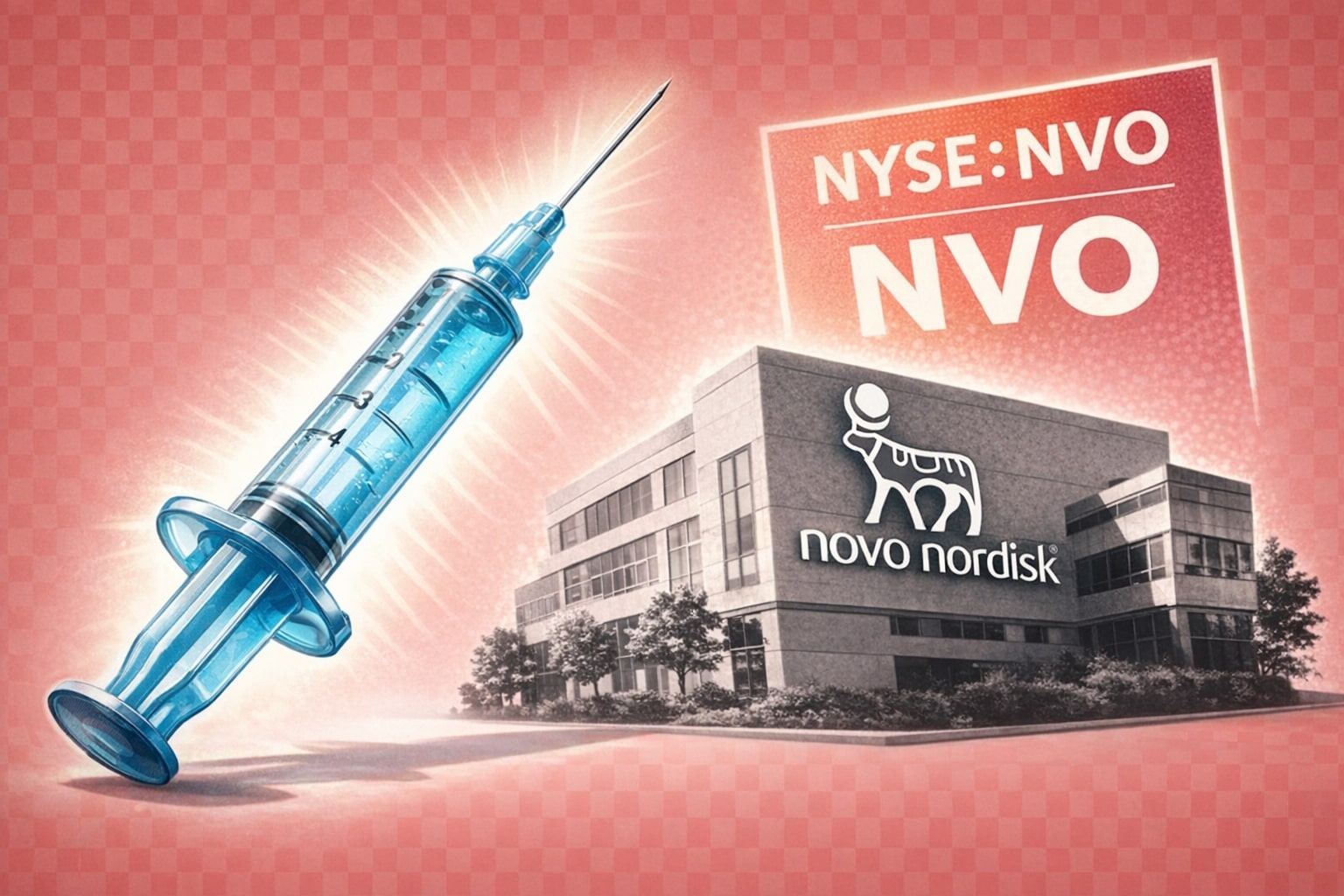
Novo Nordisk (NYSE:NVO): GLP-1 Leader Resetting At A Value Multiple
NYSE:NVO trades around $58.94, up 2.79% on the day, with the session range at $58.94–$60.64 and a 52-week span of $43.08–$93.80. Market cap is roughly $203.36B. On current numbers the stock sits at a P/E of 16.19 and a dividend yield of about 2.93%, in line with a broader framework that sees GAAP P/E around 14.8x, forward P/E near 14.4x and free-cash-flow yield ~4.6%. That is a value-style multiple attached to a company that has delivered around 23.6% revenue CAGR and 25.2% net income CAGR over three years, with gross margin of 83.44%, net margin of 32.88% and EBITDA margin above 47%. The market is clearly discounting a 2026 earnings air-pocket, patent roll-offs in several markets and pressure from Eli Lilly, and pricing NYSE:NVO as if the GLP-1 growth phase is fading rather than transitioning.
Oral Wegovy Pricing: $149 Entry Point And A Deliberate Volume Shock For NYSE:NVO
The Wegovy pill is the core short-term driver for NYSE:NVO. The oral version was approved by the FDA in late December and reached US pharmacies on January 5, 2026. In the OASIS-4 Phase 3 trial, patients on the 25 mg oral dose achieved 16.6% average weight loss over 64 weeks, almost identical to the 15–17% reduction seen with injectable Wegovy. Novo is launching with an aggressive cash strategy: $149/month for starter doses (1.5 mg and 4 mg) and $299/month for maintenance tablets. That sharply undercuts typical Zepbound injection costs in the $500–$1,000/month range and attacks the compounded semaglutide grey market that stripped an estimated $2–3B from potential revenues. The trade-off is mechanical: at a $149 sticker versus reimbursed injectables above $350, the obesity franchise needs more than 2x volume to hold revenue flat, and cannibalisation of existing injectable users is inevitable. There is also a higher active-ingredient load per pill compared with liquid doses. The strategic logic is that pills are cheaper to manufacture, ship and store than refrigerated pens; once scaled, the pill format should protect or expand margins, and the low entry price functions as customer acquisition cost for a base that could stay on therapy 5–10 years.
Pipeline Stack: Wegovy MASH Expansion, CagriSema And Amycretin Extending NYSE:NVO’s Moat
Beyond the initial pill launch, the medium-term upside for NYSE:NVO comes from a layered GLP-1 portfolio. Wegovy already secured a major MASH label expansion in late 2025, shifting it from “cosmetic” obesity into hard chronic hepatology where millions currently lack effective options. Competitors in this field are several years behind, so Novo is already billing insurers under a new indication and embedding Wegovy deeper into chronic care budgets. CagriSema follows as a heavyweight combination asset: the REDEFINE-1 trial delivered 22.7% mean weight loss, missing an internal 25% stretch target but practically matching Zepbound’s range. That sell-off on the headline ignores the fact that an Amylin component could help preserve lean muscle mass, giving Novo scope to position CagriSema as a premium quality weight-loss solution at higher pricing. With potential FDA approval in late 2026, CagriSema slots into the upper tier of the franchise while Wegovy pill locks down the lower end. Amycretin is the long-horizon “endgame” asset: a unimolecular dual agonist with Phase 2 data showing up to 22% weight loss at 36 weeks with no plateau, implying a realistic path toward 30% with longer treatment. The oral version matches Wegovy pill outcomes in half the time, suggesting much steeper response curves. Phase 3 starts now; success would anchor Novo’s franchise well into the 2030s.
Manufacturing, Catalent Integration And The End Of Shortages For NYSE:NVO
Capacity was the core operational failure that damaged the NYSE:NVO story. Demand for Ozempic/Wegovy outran supply, leaving space for compounders and rivals. That phase is being closed out. Novo acquired multiple Catalent manufacturing sites and has integrated them into its supply chain, with management guiding to a doubling of US supply capacity by mid-2026 relative to 2024. The cash-flow statement reflects that build-out. For the latest quarter (DKK): revenue 74.98B (+5.14% YoY), operating expenses 27.25B (+4.09%), EBITDA 36.49B (+1.81%), net income 20.01B (–26.72%), EPS 4.50 (–26.47%), net margin 26.68% (down 30.3% in relative terms). At the same time, cash from operations reached 46.11B (+5.15% YoY), cash used in investing hit –15.43B (up 26.21% as capex), cash from financing was –17.10B (outflows up 7.09%), and net cash increased 13.65B, a 225.21% jump. Free cash flow came in at 29.84B, up 16.56%. In other words, Novo is still expanding free cash flow and cash balances while building factories; as the Catalent sites move from drag to tailwind, the “out of stock” era should end and margins should benefit from insourced, pill-heavy production.
Core Economics Of NYSE:NVO: Slower Growth But Still Elite Margins And Returns
The latest income statement looks like a reset, not a collapse. With 74.98B DKK in quarterly revenue and 20.01B DKK net income, NYSE:NVO still prints a 26.68% net margin even after a 26.7% net income drop. Consensus sees obesity revenue growth shifting from >50% in the 2020–2024 build-out phase to 40%, then 20%, and now a –2% dip in 2026, because of lower pricing and cannibalisation from injectables into pills. Yet EBITDA margins are forecast to stay above 47%, and free cash flow is expected to exceed US$10B annually once the current capex bulge rolls off. On the balance sheet, total assets stand at 512.29B DKK (+28.90% YoY), total liabilities at 342.39B DKK (+23.64%), equity at 169.90B DKK, cash and short-term investments at 32.58B DKK (lower by 56.49% after acquisitions and capex). Price-to-book is roughly 1.50x. Returns remain strong: ROA 16.72% and return on capital 30.88%. With a 2.93% cash dividend and a free-cash-flow yield around 4.6%, Novo has room to keep funding R&D, maintain or grow dividends and buy back stock without stretching the balance sheet.
Patent Cliffs, China And Emerging Markets: Headwind But Not A Thesis Killer For NYSE:NVO
The cleanest negative driver is the semaglutide patent expiry in China and other emerging markets. China represents roughly 6.5% of Novo’s revenue. With patents rolling off in 2026, local GLP-1 competitors will inevitably compress prices and margins. Additional expiries in India, Brazil and Canada add more pressure. Even if China revenues were cut materially, say by half, the direct hit to group sales would still be in the 3–4% range; painful, but not fatal. The real risk is that this erosion coincides with US price pressure from the Inflation Reduction Act, especially as Ozempic enters formal price negotiations and faces deeper cuts from 2027. The mitigation path is clear: accelerate the transition from legacy diabetes injectables toward Wegovy pill, CagriSema, Amycretin and newly labelled chronic indications like MASH. If that pivot is executed on schedule, EM patent erosion remains a manageable drag rather than a structural break.
Competition With Eli Lilly: Pill Timing, Retatrutide And The Price-War Overhang For NYSE:NVO
The main competitive threat to NYSE:NVO is Eli Lilly. Current consensus seems to assume that Lilly’s obesity revenues can continue to grow 30%+ in 2026, while Novo’s US revenues flatten or decline, effectively ignoring Wegovy pill’s impact. That view is asymmetric. Novo has at least a nine-month first-mover advantage in oral GLP-1 versus Lilly’s Orfoglipron, a pill priced at $149 for entry that directly targets Zepbound and compounded users, and CagriSema emerging with 22.7% weight loss that matches Zepbound’s efficacy while potentially preserving more lean mass. Retatrutide’s trial data suggest 28–30% weight loss, and if rolled out broadly it could reset expectations, but that is unlikely to be fully commercial before 2027. A genuine price war is possible once Lilly’s pill is approved. If both companies push prices down aggressively, sector margins compress. Novo’s mitigation is structural: pill economics plus owned manufacturing via Catalent means a larger share of the value chain and lower unit costs. When the smoke clears after 2026–2027, the players with the best cost base usually reclaim margin, and Novo is positioning itself to be that player.
Valuation And Risk-Reward Profile For NYSE:NVO At ~$59
At about $58.94, with a P/E of 16.19, forward P/E near 14–15x, price-to-book at 1.5x, dividend yield close to 3% and free-cash-flow yield around 4.6%, NYSE:NVO is not priced like a GLP-1 growth leader. DCF work on the numbers you provided, using conservative assumptions, points to roughly 124% upside under base-case parameters, with an alternative scenario using a 7.6% WACC and 1.8% terminal growth still yielding a fair value around $105.4 per ADR. Another analyst framework applying a 15x cash-earnings multiple on mid-single-digit to high-single-digit growth and current margins leads to a more modest year-end 2026 target near $65. The risk map is straightforward: Wegovy pill uptake may disappoint; LLY’s pill plus Retatrutide could gain the upper hand; patent cliffs could hurt more than forecast; IRA negotiations could take a harsher cut; manufacturing execution could slip. None of those scenarios threaten solvency, but they would cap the upside and keep the stock stuck in a mid-teens multiple range. On the other hand, if oral Wegovy scales, CagriSema and Amycretin progress as planned and Catalent integration delivers margin expansion, the current pricing for NYSE:NVO underestimates both earnings power and duration.
That's TradingNEWS