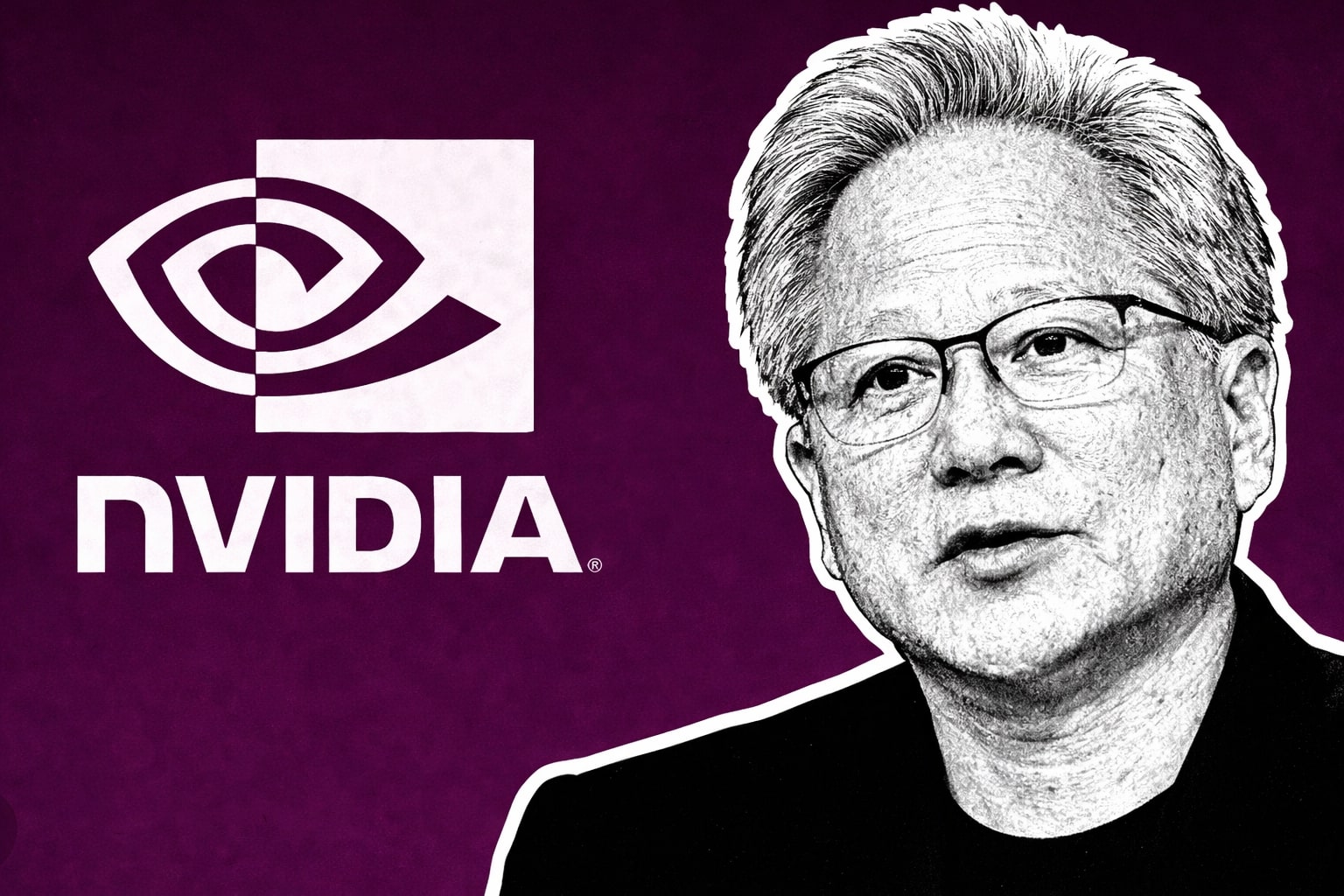
Nvidia Stock Price Forecast: NVDA at $175 Looks Mispriced for a $230 AI Supercycle
With NASDAQ:NVDA sitting near $175 after a sharp reset, $51.2B data center revenue, $65B Q4 guidance, 75% gross margin targets and a compressed forward multiple argue for a rerating toward $230 | That's TradingNEWS
NASDAQ:NVDA – AI Infrastructure King On Sale After Pullback
Where NASDAQ:NVDA Trades Now And How Big The Reset Really Is
NASDAQ:NVDA is back around $175.61 today, with an intraday range of $171.82–$176.15, versus a previous close of $170.94. The 52-week range runs from $86.62 at the low to $212.19 at the high, so the stock is roughly 17% below its peak while still more than 100% above the lows. Market value sits near $4.27T, with a trailing P/E around 43.5 and a token dividend yield of 0.02% on average daily volume above 200M shares. The weekly tape shows a drawdown of about 4–5% over the last week and roughly 14% from the late-October high near $200–$210, after a year where NVDA has still delivered around 23–32% total return, below its own ~48% long-run average but far from a collapse. Sentiment data from derivatives platforms remains one-sided: about 92% of active traders are long and only 8% short, and the short-interest ratio has compressed from roughly 1.34 three weeks ago to 1.21, showing that dip-buyers are still more aggressive than outright bears. Technically, spot NVDA has been oscillating between about $170 and $186 for more than four months, inside an ascending wedge that started back in April. The 100-day moving average was recently tested and briefly breached, but price has repeatedly found support around the low-170s and snapped back toward the mid-170s, with the 14-day RSI recovering from a pullback and curling higher again from neutral territory, not from deeply overbought levels.
Data-Center Engine: $57B Quarter, $51.2B From AI Infrastructure
The latest reported quarter, FY2026 Q3, was nowhere near a “growth is dead” print for NASDAQ:NVDA; it was a re-acceleration. Revenue came in around $57B, up roughly 62.5% year-over-year, faster than the ~56% clip in the prior quarter. Data-center revenue, which is the core AI business, hit about $51.2B, up 66% YoY, again faster than the 56% growth of the previous quarter. Within that, compute and networking both printed strong double-digit expansions as Blackwell-generation systems and high-speed interconnects scaled. Gaming, still the second-largest segment, was essentially flat sequentially at roughly $4.27B vs $4.29B in Q2, but that is a huge jump from about $2.88B a year ago, proving that legacy franchises are not collapsing while AI ramps. The company guided Q4 revenue to around $65B, up from $57B this quarter and about $39.33B a year earlier, implying another ~65% YoY jump. Around $55.7–55.8B of that Q4 figure is expected to come from data-center alone. That profile is not what you see in a business topping out; it is what you see when a new infrastructure layer is still being built at scale.
Multi-Generation AI Roadmap: Blackwell Today, Rubin Next, Feynman After
The justification for a multi-trillion-dollar valuation in NASDAQ:NVDA is not just one product cycle; it is a visible chain of architectures monetizing AI spend through 2028 and beyond. Blackwell and Blackwell Ultra GPUs, bundled into Grace Blackwell NVL72-type systems, are already the backbone of hyperscale AI clusters for training and inference. The next node, Rubin, is already defined and positioned as the next performance step for data-center accelerators. Beyond that, Feynman is lined up as the architecture for around 2028 and after, signaling that NVDA is not improvising year-to-year; it is engineering a multi-node roadmap that customers can build CAPEX plans around. Management has talked about “more than $500B” in confirmed AI chip and system orders over the coming years and a plan to ship up to $500B of AI servers over four years with TSMC as principal manufacturing partner. That order visibility, tied to named hyperscalers and major AI platforms, is what turns the current AI hype into recurring, contracted infrastructure revenue.
Who Pays For All This? Hyperscalers, Neoclouds And CAPEX Rotation
Bears are focused on slowing CAPEX at the megacaps, arguing that hyperscaler spending cannot grow 50%+ indefinitely. Market projections already show cloud CAPEX growth decelerating to roughly 24–30% into calendar 2026, compared with the explosive growth of the last two years. That macro stance is directionally reasonable but incomplete. Parallel to that slowdown, the neocloud segment — specialized providers renting NVDA-class GPU clusters and AI supercomputers — is projected to grow revenue at roughly 69% CAGR, with CAPEX likely compounding even faster as they accumulate inventory of high-end accelerators. The structure is simple: hyperscalers offload some CAPEX risk to neoclouds, leasing capacity or forming structured deals, while NASDAQ:NVDA sells full stacks (GPUs, systems, networking and software) into both sides. Recent deals show a pattern where neoclouds become a distribution arm for GPU compute, while big platforms preserve balance-sheet flexibility. This decouples NVDA’s growth from a straight-line relationship to a single CAPEX cycle at a handful of household-name clouds. Even if hyperscaler CAPEX growth normalizes into the mid-20s, the aggregate AI ecosystem — hyperscalers plus neoclouds plus enterprise — still supports double-digit to high-double-digit demand growth for accelerators.
China, H200 And Regulatory Noise: Upside Optionality, Not Core Thesis
China remains a volatile side story rather than the center of the NASDAQ:NVDA investment case. Export rules have been flexed to allow H200-class chips for Chinese customers under new specifications, and orders are starting to materialize, but Beijing is concurrently pushing local champions and may restrict some deployments in favor of domestic hardware. Practically, that means investors should treat China as incremental upside, not as a base-case pillar. The current revenue and guidance trajectory is being delivered primarily from the U.S., Europe, and other large cloud and enterprise regions. If China ramps, it adds to the story; if it stays constrained, it does not break the core numbers the market is already using.
Profitability: 70%+ Gross Margins On A Hyper-Scale Revenue Base
What separates NASDAQ:NVDA from a typical high-growth story is not just the speed of revenue expansion, but the quality of the margin profile. Last quarter’s gross margin landed around 73.4%, down about 140 basis points year-on-year, but less severe than the roughly 300-bp contraction seen in the prior quarter, signaling early stabilization. Management is guiding Q4 gross margin to roughly 75%, which implies renewed expansion as the Blackwell mix improves, software and networking attach rates rise and early cost pressure from high-bandwidth memory and advanced packaging starts to normalize. Operating expenses grew roughly 38%, far below the 62–65% revenue growth range, reflecting strict discipline on headcount and non-critical spend. The result was EPS around $1.30, up about 60% YoY, beating consensus by roughly $0.05 and pushing trailing twelve-month EPS from roughly $0.18 in early 2024 to about $4.06 now. That combination — 60%+ revenue growth, mid-70s gross margin and expanding EPS — is what justifies a premium multiple and demonstrates that incremental AI dollars are falling to the bottom line efficiently.
Valuation Versus Growth: P/E Compression Has Gone Further Than The Earnings Risk
On classic metrics, NASDAQ:NVDA is cheaper today relative to its own growth curve than it has been at any point in this AI cycle. The trailing P/E around 43–44 has fallen from levels above 50 when the stock briefly pushed over $200 and the market cap touched $5T. On a forward basis, the P/E has compressed to the mid-30s on next-twelve-month numbers and down toward 23–24x on FY2027 earnings if Street estimates prove accurate. Those estimates call for revenue around $316B in FY2027, up roughly 48%, and EPS growth of about 59% in that same period. Historically, the five-year average P/E sits near 65.6, with a median around 49. If you simply re-rate NVDA back to its own median multiple on current earnings, the implied upside is roughly 11–12% from the current price. If the market decides the stock deserves its five-year mean multiple again as the AI story strengthens, the upside stretches closer to 50%. Against megacap peers, NVDA at ~23–24x FY2027 EPS and nearly 60% projected EPS growth looks outright discounted. Several slower-growing “quality” names in consumer and staples trade on higher forward multiples with far less structural growth, and even within high-end semis, names like Broadcom command roughly 32x next-year earnings for mid-40s growth. The current discount reflects skepticism, not fundamentals.
Technical Structure And Positioning: Wedge Support, RSI Reset, Positioning Still Skewed Long
The daily chart for NASDAQ:NVDA is not flashing a topping pattern; it is flashing digestion. Price is traveling inside an ascending wedge that began in April, with repeated supports between $170–$172 and resistance reactions in the $185–$200 zone. The 100-day moving average has been probed, but not decisively lost, and the longer 200-day moving average remains well below spot and sloping higher, confirming the primary uptrend. Short-term candles have printed several downside probes that were bought aggressively, reflected in multiple intraday reversals from the low-170s back to the mid-170s. RSI pulled back from overbought levels, dipped toward neutral, and is now beginning to curl higher, which is characteristic of a strong trend pausing rather than rolling over. Positioning corroborates that interpretation. Retail-heavy client bases at major derivatives platforms still show more than 90% of active accounts long NVDA, and the short-interest ratio has fallen to roughly 1.21 from 1.34, showing little sign of aggressive structural shorting. The tape is not clean — volatility is high — but structurally, the market is still treating dips as opportunities, not as exit points.
Read More
-
SCHD ETF at $31.62: Dividend Rotation Turns a 2025 Laggard into a 2026 Leader
11.02.2026 · TradingNEWS ArchiveStocks
-
XRP ETFs XRPI and XRPR Lag Price While Fresh XRPZ Inflows and $152M Bank Bets Test the Dip
11.02.2026 · TradingNEWS ArchiveCrypto
-
Natural Gas Futures Defend the $3.00 Floor After Collapse From Above $7.50
11.02.2026 · TradingNEWS ArchiveCommodities
-
USD/JPY Price Forecast - USDJPY=X Drops Below Key Averages as Yen Rally Targets 152–150 Zone
11.02.2026 · TradingNEWS ArchiveForex
AI Competition, ASIC Risk And Why GPUs Still Dominate The Stack
One of the loudest bear narratives around NASDAQ:NVDA is the rise of custom accelerators, especially tensor processing units and other ASICs from mega-platforms and networking players. Recent headlines about large social platforms exploring more aggressive use of internal accelerators and ASIC-heavy clouds triggered sharp, short-term drops in NVDA stock as investors extrapolated a future where generic GPUs become commoditized. That narrative ignores both economics and flexibility. ASICs tend to be tightly optimized for specific frameworks and workloads; they are efficient but narrow. GPUs offer performance, generality and fungibility: the same inventory can be repurposed from training to inference, from one model family to another, or from a research cluster to a commercial cloud product with software updates. For a market moving at AI’s speed, that optionality has value. The practical outcome is likely not a winner-takes-all scenario but a shared ecosystem: ASICs dominate certain internal workloads, while NVDA-powered clusters remain the default for third-party developers, neoclouds and any workload where flexibility is crucial. That is consistent with current data: capacity is sold out on cloud GPUs, Blackwell demand is described as “off the charts,” and the main operational problem is supply, not demand.
Macro, AI Bubble Risk And What Has To Go Wrong To Break The Story
There are real risks, and they are not subtle. If AI demand growth collapses — either because enterprises conclude they over-invested in infrastructure, or regulators impose hard constraints, or end-user monetization fails — the entire AI spend stack would reset, and NASDAQ:NVDA would be hit harder than almost any other name. There is also the classic bubble risk: if forward orders are pulled in from years ahead and 2024–2026 prove to be peak CAPEX cycles, growth could decelerate sharply later in the decade. In that scenario, earnings estimates for FY2027 and beyond would be cut, and the current 23–24x forward multiple could compress toward 20x or lower during a risk-off phase, implying another 15–20% downside from current levels even before earnings revisions. There is also execution risk: production bottlenecks at TSMC or substrate suppliers, persistent HBM shortages, or delays in Rubin and Feynman could allow rivals to close the gap. These are not theoretical; they are the main reasons the stock is not trading at 60x. The point is that the current price already embeds meaningful skepticism: Street projections of roughly 48% FY2027 revenue growth and 59% EPS growth are being valued at a multiple that is lower than many slower-growing megacaps. To justify not owning NVDA here, you have to assume either a serious AI bust or a structural loss of leadership; simply “CAPEX slows a bit” is not enough.
Verdict On NASDAQ:NVDA – Strong Buy, AI Infrastructure Leader Still Mis-Priced
Putting all of this together, NASDAQ:NVDA is a case where price volatility and sentiment fatigue are masking how strong the fundamental setup still is. The stock is trading around $175–176, roughly 17% below its highs, after a year where revenue grew more than 60%, data-center sales jumped 66%, gross margins stabilized above 73% and are guided toward 75%, and EPS expanded about 60% with clear evidence of operating leverage. The roadmap from Blackwell to Rubin to Feynman is fully aligned with a multi-year AI CAPEX cycle that is shifting from pure hyperscaler budgets to a broader mix including high-growth neoclouds, while China remains upside optionality rather than the linchpin. Valuation has compressed from a trailing multiple above 50x to a forward framework where FY2027 earnings and 59% projected EPS growth are priced at 23–24x, cheaper than several slower-growing “quality” and tech peers. Technically, NVDA is consolidating in an ascending structure with buyers defending the $170 area and positioning still skewed long, not crowded short. With that backdrop, the risk-reward is asymmetric: if AI demand merely stays strong and the company executes on its guidance, there is 30–50% upside from a re-rating plus earnings growth; if the AI complex truly blows up, there is material downside, but that is not the base case implied by current orders, guidance, or CAPEX plans. On the numbers, the business, and the tape, NVDA is a Buy, with a clear bullish tilt, and the current pullback should be treated as an entry point for investors who are willing to accept volatility in exchange for exposure to the dominant AI infrastructure platform.