Occidental Petroleum Stock Price Forecast: Iran War Hands OXY the Catalyst It Needed — Buy at $54 With $65 Target
Brent crude tops $85, Strait of Hormuz blockaded, and OXY sits near 52-week highs When $5.8B in debt slashed | That's TradingNEWS
Occidental Petroleum Stock (NYSE: OXY) Forecast: The Iran War Just Handed OXY the Catalyst It Has Been Waiting For
Occidental Petroleum (NYSE: OXY) is trading at $54.12 on Tuesday morning, up 0.14% in a session where the Dow has crashed 1,100 points, the S&P 500 is bleeding 2%, and virtually every sector outside of energy is deep in the red. That relative strength alone tells you everything you need to know about how the market is repricing this name. While the broader tape is getting destroyed by the escalating U.S.-Iran military conflict, OXY is sitting comfortably near its 52-week high of $56.34, benefiting directly from a crude oil surge that has pushed Brent above $85 and WTI past $77 in just two trading sessions. The stock has rallied approximately 30% from its December lows, and the question now is whether the geopolitical tailwind has further to run or whether the easy money has already been made.
$85 Brent and a Blockaded Strait of Hormuz: OXY's Dream Scenario
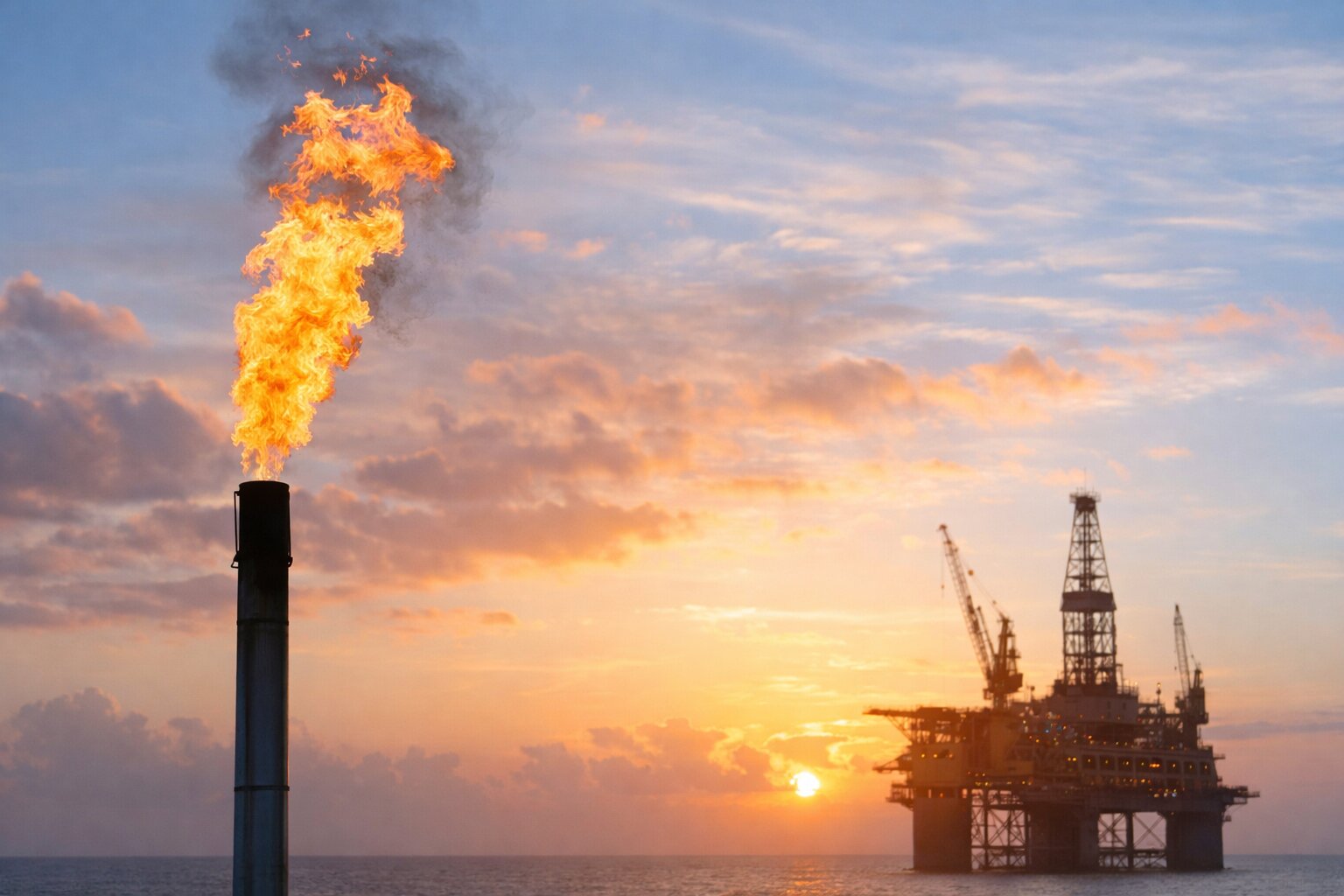
The macro setup for Occidental Petroleum could not be more favorable in the near term. Brent crude briefly topped $85 a barrel on Tuesday for the first time since July 2024, up roughly 14% over two sessions. WTI surged 8.24% to $77.10. The catalyst is unmistakable: Iran's Revolutionary Guard has declared the Strait of Hormuz effectively closed, threatening to incinerate any vessel attempting passage. Approximately one-third of the world's seaborne crude exports transit through that chokepoint. Over 100 tankers have already been stopped. Goldman Sachs has priced in an $18-per-barrel risk premium, and Wood Mackenzie warns oil could reach $100 if the blockade persists.
European natural-gas futures have exploded more than 70% in two days after Iran knocked out Qatar's Ras Laffan LNG facility, the world's largest. QatarEnergy subsequently halted downstream products including aluminum, urea, polymers, and methanol. President Trump has warned that military operations could continue four to five weeks or longer.
For a U.S.-based oil and gas producer like OXY, this environment is almost ideal. The United States is a net energy exporter, meaning domestic producers benefit from higher global prices without suffering the supply-chain disruptions hitting European and Asian competitors. While the rest of the market hemorrhages value, energy is the one sector in the green. Exxon Mobil (XOM), Chevron (CVX), Marathon Petroleum (MPC), and Phillips 66 (PSX) all posted gains for a second consecutive day alongside OXY.
The Balance Sheet Transformation: $5.8 Billion in Debt Wiped Out
The Iran conflict is a near-term catalyst, but the real story at Occidental Petroleum is the structural balance sheet improvement that has been underway for months. Following the all-cash OxyChem sale to Berkshire Hathaway, which closed on January 2, 2026, OXY has slashed its principal debt by $5.8 billion since mid-December 2025, bringing total debt down to approximately $15 billion. The company is targeting $14.3 billion in principal debt through $6.5 billion in planned debt repayments from the OxyChem proceeds, with another $1.5 billion retained as balance sheet cash.
In February 2026, Occidental launched cash tender offers to buy back multiple series of senior notes and debentures alongside consent solicitations, aggressively attacking the debt stack. The CFO estimated these repayments will generate approximately $365 million in annual interest savings in 2026, directly boosting free cash flow. Cash on the balance sheet remains solid at nearly $2 billion.
The OxyChem divestiture was not without trade-offs. The discontinued operations generated roughly $926 million in operating cash flow in 2025. After accounting for the interest savings and adjusting for OxyChem's capital expenditure requirements (which ran at $1.1 billion in 2025 and $685 million in 2024 due to the ongoing Battleground expansion), the net annual free cash flow impact is approximately negative $150 million. That is the price OXY is paying for a materially stronger balance sheet and increased financial flexibility. It is a defensible decision, though the optics are complicated by the fact that Berkshire Hathaway will enjoy the benefits of the Battleground expansion project that is expected to complete in 2026 after OXY paid the construction bill.
Dividend Hike and Shareholder Returns: The Payout Is Growing, But Slowly
Alongside the Q4 earnings release, OXY announced an 8% increase in its quarterly dividend to $0.26 per share, doubling the payout over the past four years. At the current share price of $54.12, that translates to a forward yield of approximately 1.92%. That is among the lowest yields in the energy sector, but context matters: the payout ratio sits below 25% based on free cash flow from continuing operations adjusted for working capital. There is substantial room for future increases.
The dividend growth trajectory is what matters here, not the absolute yield. Management is signaling confidence in the sustainability of cash flows even during cyclical weakness by raising the distribution while simultaneously paying down billions in debt. The combination suggests a company that is managing for long-term value creation rather than chasing headline yield numbers.
2025 Full-Year Results: Solid Execution in a Weak Price Environment
Occidental reported full-year 2025 revenues of approximately $22.08 billion and net income of $2.33 billion. Free cash flow from continuing operations came in at $3.18 billion (versus $4.26 billion in 2024), excluding discontinued operations, though that number was depressed by a negative $1.07 billion working capital impact. Q4 non-GAAP EPS beat market expectations.
The revenue and earnings decline year-over-year reflects weaker commodity prices through much of 2025, not operational deterioration. The Dallas Federal Reserve had been reporting six months of industry activity contraction, and there was notable criticism of the current administration's energy policy in the survey comments. That hostile operating environment — paradoxically — supports OXY's long-term thesis: industry shrinkage reduces future supply, setting the stage for stronger pricing during the next cyclical upswing.
Management expects an additional $500 million in annual cost savings in 2026, and projects a greater than $1.2 billion improvement in free cash flow compared to 2025. Capital expenditure is guided at $5.5 billion to $5.9 billion, with the majority directed toward Permian Basin operations. The 2026 production target stands at 1.45 million barrels of oil equivalent per day.
Breakeven Economics: 84% of the Portfolio Below $50
One of OXY's most compelling fundamental attributes is the resilience of its resource base. The company reports an average resource breakeven of approximately $38 per barrel, with roughly 84% of its portfolio coming in below $50 per barrel. At current WTI prices above $77, every barrel produced is generating substantial margin.
This breakeven structure provides a critical cushion against downside scenarios. JPMorgan has floated a bear-case projection where oil drops to the low $30s by 2027 under a severe oversupply scenario, with a base case of $54 WTI in 2026 and $53 in 2027. Even in that environment, OXY's core Permian operations remain cash-flow positive. The current geopolitical premium pushes pricing dramatically above these stress scenarios, but the breakeven floor matters because conflicts eventually end and prices normalize.
Read More
-
DGRO ETF Price Forecast; Dividend Stocks Replace Bonds - Strong Buy
03.03.2026 · TradingNEWS ArchiveStocks
-
XRP ETF Price Forecast: XRPI, XRPR, and Bitwise XRP All Down 50%+ From Highs
03.03.2026 · TradingNEWS ArchiveCrypto
-
Natural Gas Futures Price Forecast: Qatar LNG Shutdown and Hormuz Closure Drive 85% Surge
03.03.2026 · TradingNEWS ArchiveCommodities
-
GBP/USD Price Forecast: Pound Plunges to Three-Month Lows at 1.3300 as Oil Shock Kills BoE Rate-Cut Odds
03.03.2026 · TradingNEWS ArchiveForex
The Warren Buffett Factor: Holding at $54 When He Bought in the $60s
Perhaps the most psychologically important data point for OXY: the stock is currently trading below Warren Buffett's purchase levels. Berkshire Hathaway accumulated a massive position in Occidental Petroleum at prices that averaged in the $60 range. At $54.12, every share outstanding is available at a discount to what arguably the most successful capital allocator in history deemed fair value.
Buffett has stopped buying additional shares, which has prompted endless speculation. But what matters more than purchase activity is that he continues to hold the entire position. The OxyChem acquisition by Berkshire further deepens the relationship and alignment. Buffett understands long-term better than most — his track record in cyclical businesses spans decades and multiple cycles. The fact that he accumulated in the $60s and has not sold a single share in the $40s and $50s speaks volumes about his conviction in management's ability to execute over a full business cycle.
The contrarian setup is textbook. Large institutional positions acquired at higher prices, held through cyclical weakness, with the stock now at a discount to acquisition cost, combined with improving fundamentals and a suddenly favorable commodity backdrop. This is the kind of configuration that precedes significant long-term returns.
STRATOS and the Carbon Management Optionality
OXY's STRATOS direct air capture project represents optionality that the market is not pricing in at current levels. The project is expected to come online and contribute to the company's growth profile, adding a revenue stream tied to carbon removal credits rather than commodity prices. CEO Vicki Holub has positioned carbon management as a genuine long-term growth engine, not just an ESG checkbox.
The capital intensity of these projects is real and represents a key risk, but the potential reward is a differentiated business line that diversifies OXY away from pure commodity dependence over time. In a world where carbon pricing is likely to become more prevalent, early mover advantage matters. The market is currently assigning minimal value to this segment, which means any positive development represents pure upside.
Valuation: DCF Points to $65 Per Share With WTI at $65 Average
A discounted cash flow analysis starting from the $3.18 billion in 2025 free cash flow, adding back the $1.07 billion working capital hit, incorporating the $1.2 billion expected improvement and subtracting the $150 million net OxyChem/debt impact, yields a 2026 starting FCF of approximately $5.3 billion at an assumed average WTI of $65. Applying a 3.5% CAGR through 2030 (reflecting operational improvements, STRATOS contributions, and potential CAPEX reductions), stepping down to 3% through 2035, and using a 2.5% terminal growth rate with an 11% discount rate on approximately 1 billion diluted shares produces an intrinsic equity value of roughly $65.31 per share.
That $65 target is conservative — it assumes WTI averages only $65 across the entire projection period. With crude currently above $77 and geopolitical risk premiums likely to persist for weeks, the near-term cash flow generation is tracking well above that assumption. If WTI averages $70-$75 over the next 12 months (which seems increasingly plausible given the Hormuz disruption), the fair value estimate moves toward $70-$75 per share.
At the current price of $54.12, that implies 20% to 38% upside depending on the oil price scenario — and that is before accounting for any potential multiple expansion during the next cyclical peak.
Key Risk: Oil Price Volatility Remains the Dominant Variable
The obvious risk is that oil prices collapse if the Iran conflict resolves quickly, OPEC+ follows through on reported plans to raise output by 137,000 barrels per day starting April 2026, and global demand disappoints. The JPMorgan bear case of low-$30s Brent by 2027 would severely pressure OXY's earnings and likely send the stock back toward the low $40s.
Additionally, the Berkshire Hathaway relationship, while generally positive, creates governance complexity. The OxyChem sale — where OXY effectively paid for the Battleground expansion before selling the asset to Berkshire — raised legitimate questions about whether minority shareholders are getting fair treatment when Berkshire holds outsize influence.
OPEC+ dynamics remain unpredictable. Reports from days before the Iran strike indicated the cartel might begin raising output to meet summer demand. If they accelerate production increases while the war premium fades, the resulting price pressure could be significant.
OXY Stock Verdict: Buy — The Cycle Is Turning and the Balance Sheet Is Ready
Occidental Petroleum is a buy at $54.12 with a 12-month target range of $65-$70. The combination of a dramatically improved balance sheet ($5.8 billion in debt reduction), rising shareholder returns (8% dividend increase to $0.26 quarterly), a sub-$40 resource breakeven protecting the downside, and an exploding geopolitical premium lifting the topline creates a compelling risk-reward profile.
The stock is trading below Warren Buffett's purchase prices. Management has proven twice — first with the California Resources spin-off ahead of the 2015 crash, then with the Anadarko acquisition that led to record 2022 earnings — that they can execute transformative strategic moves. The current round of acquisitions and debt reduction sets the stage for a third proof point during the next cyclical upswing.
For position sizing: OXY deserves meaningful portfolio weight for anyone with a 12-to-24-month horizon. The $50-$52 zone represents the buy-more level on any pullback if oil prices moderate temporarily. Downside risk is manageable given the breakeven economics — even in a severe correction to $50 WTI, this company generates positive free cash flow.
The Iran war may or may not persist for five weeks. But the structural improvements at OXY — the debt reduction, the cost efficiencies, the Permian focus, the STRATOS optionality — persist regardless. The geopolitical premium is a bonus on top of a thesis that was already working. At $54, with a $65-plus fair value and oil above $77, the math speaks for itself.