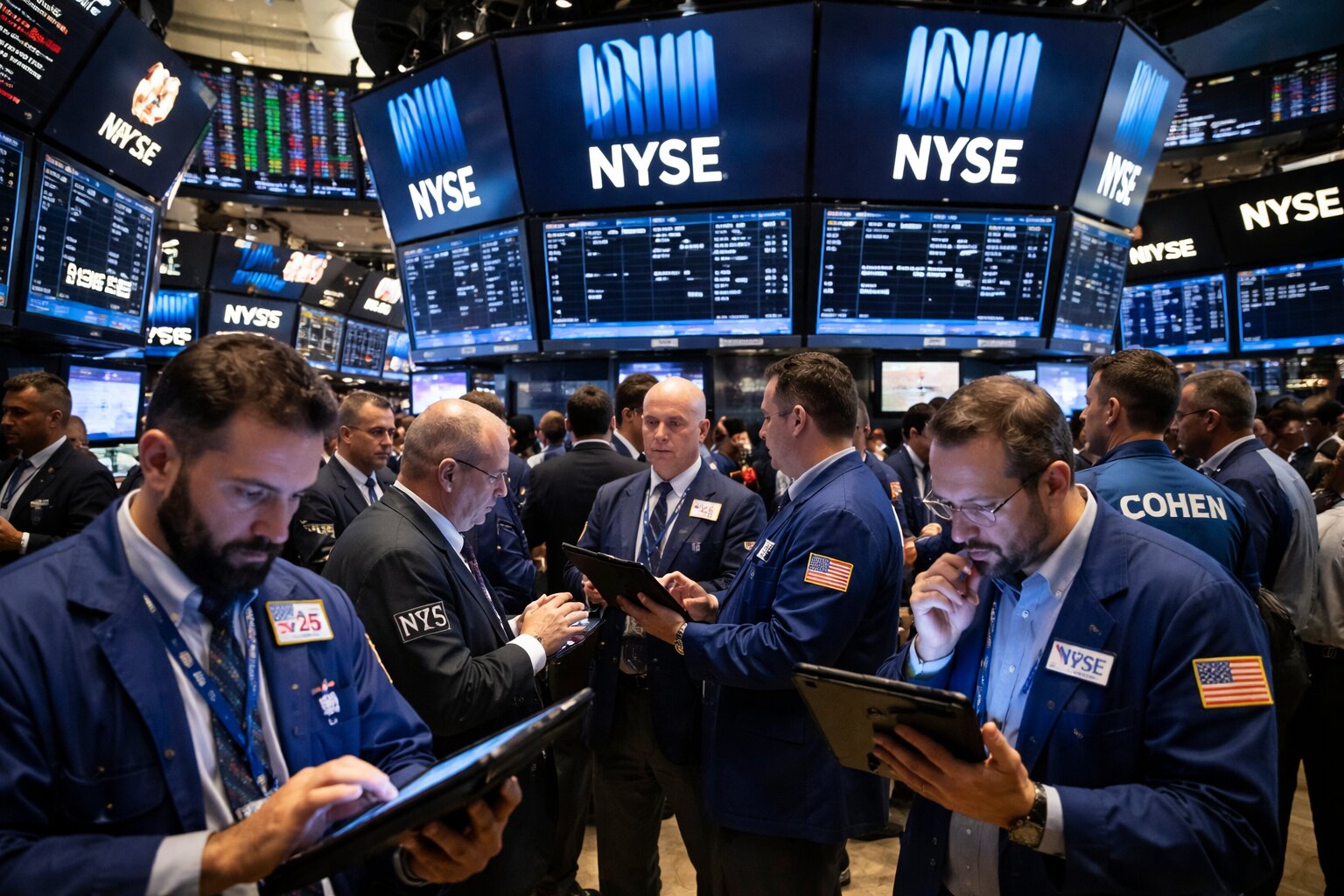
Stock Market Today: S&P 500, Dow Jones, Nasdaq Rally As AMZN, GOOGL, ETSY Jump On Tariff Shock
S&P 500 finished at 6,909.51, Dow at 49,625.97 and Nasdaq at 22,886.07, with AMZN, ETSY, EBAY, ANF and SWK among top gainers after the Supreme Court struck down Trump’s IEEPA tariffs and the White House moved to a 10% global tariff plan | That's TradingNEWS
Tariff Shock, Relief Rally, And A Long-Weekend Pause
Major Indices: Nasdaq, S&P 500, Dow Drive A Classic Relief Move
Wall Street closed Friday with a clean risk-on tone into the long weekend. S&P 500 (^GSPC) climbed 0.69% to 6,909.51, Dow Jones Industrial Average (^DJI) added 0.47% to 49,625.97, and Nasdaq Composite (^IXIC) outperformed with a 0.90% gain to 22,886.07. The advance was not a low-volume drift; tariff-sensitive names and high-beta tech led, confirming that the Supreme Court ruling was treated as a genuine macro shock, not background noise. Into the weekend, futures extended the positive bias, with S&P 500 futures around 6,924.75, Dow futures near 49,680.00, and Nasdaq futures around 25,077.50, signaling traders were willing to carry risk despite headline risk around the new tariff framework and refund battle.
Global Tape: Europe Firmer, China Diverges, Dollar And Yields Reprice
Outside the US, the reaction was more nuanced. Stoxx 600 sat near 630.56, up roughly 0.84%, echoing the US relief tone as investors priced in a softer long-run tariff profile. In contrast, SSE Index in Shanghai slipped to about 4,082.07, down 1.26%, reflecting China-specific growth and policy concerns rather than immediate US tariff relief. The US 10-year Treasury yield jumped toward the 4.09–4.11% area, reflecting both a shift in expected tariff revenue and renewed uncertainty around the new 10% global duty. The Dollar Index (DXY) eased to approximately 97.79 (-0.14%), balancing lower structural tariffs against a still-firm inflation backdrop. Crude oil traded around $66.49, only modestly higher, as the macro story was dominated by trade and growth rather than supply shocks. Bitcoin (BTC-USD) hovered near $68,423, up just over 1%, showing that crypto treated the legal and tariff headlines as noise rather than a structural regime change.
Supreme Court Ruling: IEEPA Tariffs Struck Down, Trade Architecture Redrawn
The turning point was the 6–3 Supreme Court decision formally rejecting the use of the International Emergency Economic Powers Act (IEEPA, 1977) as a legal basis for sweeping global tariffs. The court explicitly stated that IEEPA does not empower the president to impose broad tax-like measures without Congress. That ruling immediately invalidated the core of the second-term “Liberation Day” tariff architecture, including 20% tariffs on a wide range of Chinese exports and other global levies that had been introduced under emergency-powers logic. From a market perspective, this removes the most extreme, open-ended tariff instrument from the toolbox and forces any future escalation back into narrower, time-boxed, or congressionally anchored channels. That is why indices flipped from sideways trading to a synchronized move higher within the session once the decision crossed the tape.
Trump’s Counterpunch: 10% Global Tariff Under Section 122
The administration immediately pivoted to a new framework: a 10% “global tariff” built on Section 122 of the Trade Act of 1974. This statute allows tariffs of up to 15% for up to 150 days when addressing trade-balance issues, after which Congress must approve any extension. An executive order signed late Friday set implementation for Feb 24 at 12:01 a.m. Washington time, putting a very specific clock on the new duty. The critical distinction versus the IEEPA regime is structural: the new duty is lower (10% vs 20–50% on many lines), temporary by design, and much easier for a future Congress or court to block or reshape. For markets, that means a clear shift from “semi-permanent global tax” to “negotiable, time-limited surcharge”. Risk assets are comfortable with that trade-off, even if it temporarily lifts import prices.
Sections 232 And 301: National-Security Tariffs Stay In Force
While IEEPA tariffs were struck down, the administration stressed that Section 232 and Section 301 tariffs remain fully in place. That includes 50% levies on semi-finished copper products, 25% duties on certain imported semiconductors—specifically high-end chips relevant for NVIDIA (NVDA) hardware such as H-class accelerators—and elevated tariffs on autos, trucks, and select machinery. The result is a two-tier structure: broad IEEPA-based tariffs are gone, but targeted national-security and unfair-trade tariffs stay intact. For sectors, that means continued margin pressure for US manufacturers dependent on imported metals and components, while consumer-facing importers get meaningful relief from the rolled-back blanket duties.
Refund Overhang: Up To $170–$175 Billion At Stake
The ruling leaves a major financial question unresolved: what happens to the estimated $170–$175 billion already collected under the now-illegal IEEPA tariff regime. A large cohort of 1,500+ companies has already filed suits at the US Court of International Trade, effectively reserving a place in line for potential refunds. The Supreme Court decision sent the case back toward lower courts to hash out mechanics and eligibility. The majority opinion did not address refunds directly, but the dissent warned of a “mess” for the Treasury if large-scale repayments are ordered. For equity investors, this creates a hidden call option on tariff-exposed names—from Costco (COST) and Toyota (TM) to mid-cap retailers and manufacturers—that might reclaim substantial cash over the coming years. However, the president’s public comments that the issue will “get litigated for the next two years” indicate the process will be slow and contested.
Sector Rotation: Tariff-Sensitive Winners Lead The Tape
Within the S&P 500, the biggest winners were names that had been paying or passing through elevated import costs. E-commerce and retail platforms rallied: Wayfair (W), Amazon (AMZN), eBay (EBAY), and Etsy (ETSY) all climbed, with ETSY closing around $52.18, up 8.39% after an earnings beat. Apparel and consumer brands tied to Asian sourcing, such as Abercrombie & Fitch (ANF), saw outsized gains as the market priced in relief on landed costs and merchandise margins. Tool and industrial-exposure names like Stanley Black & Decker (SWK) followed the same pattern. The Dow Jones Transportation Average (^DJT) rose roughly 1%, reflecting lower expected fuel- and equipment-related cost pressure across trucking, airlines, and logistics. By contrast, metal-linked producers and some domestic suppliers that benefited from tariff shields now face stiffer price competition, tempering their upside.
Big Tech And AI: Alphabet And Micron Catch A Tailwind
Large-cap tech also participated. Alphabet (GOOGL) advanced more than 4%, helped by a mix of AI optimism and the broader risk-on move. Micron Technology (MU) climbed as traders leaned into the memory side of the AI build-out, even as Section-232 and Section-301 tariffs on semiconductors remain in force. The ruling matters for AI indirectly: anything that dampens imported hardware and infrastructure costs supports the multi-year capex plans behind cloud AI, edge computing, and high-performance data centers. A lower structural tariff ceiling reduces one line item in the cost stack for hyperscalers and large enterprises, even as dedicated semiconductor levies remain.
Macro Data: Slowing GDP Versus Sticky PCE Inflation
The trade shock arrived on top of an awkward macro mix. US Q4 2025 GDP grew 1.4%, down sharply from 4.4% in Q3 and well below 3% expectations. The sharp deceleration was tied largely to the prolonged government shutdown, which weighed on public-sector activity and confidence. At the same time, the PCE Price Index—the Fed’s preferred inflation gauge—accelerated from 2.8% to 2.9%, and Core PCE rose from 2.8% to 3.0%, overshooting the 2.9% consensus. That combination—slower growth and firmer inflation—is a mild stagflation signal. Yet equities shrugged, because the tariff ruling is inherently disinflationary over the medium term: rolling back broad import taxes offsets some of the PCE upside. The US Dollar Index closing near 97.79 and the 10-year yield near 4.1% captures that tension: inflation is not defeated, but the path of imported cost-push pressure has become less hostile than 24 hours earlier.
Japan: Inflation Drops To 1.5%, Nikkei Pulls Back From Highs
In Asia, Japan’s CPI fell from 2.1% to 1.5%, its lowest level since April 2022, with core inflation easing from 2.4% to 2.0%. That cooling gives the Bank of Japan fresh room to delay or soften any normalization, especially while fiscal policy remains expansionary. The Japanese yen firmed only marginally, to around 154.98 per dollar, while the Nikkei 225 dropped about 1.12% to 56,825, reflecting some profit-taking after a strong run rather than a loss of confidence. From a US-centric perspective, softer Japanese inflation and a still-accommodative BoJ translate into continued support for global risk and carry trades: borrowing in low-yield yen to buy higher-yield US assets remains attractive, even with US yields above 4%.
Bilateral Deals: Japan, Indonesia, Vietnam, Italy Show Trade Flow Resilience
Parallel to the court drama, the trade map continues to evolve through bilateral deals. Japan plans up to $36 billion in US oil, gas, and critical-mineral projects as part of a $550 billion broader trade agreement with Washington. A marquee project is a natural-gas facility in Ohio expected to generate 9.2 GW of power, with up to $33 billion from Japanese investors such as SoftBank Group’s SB Energy unit. That scale anchors long-term energy demand and reinforces US-Japan economic security links. Indonesia secured a reduction in US tariffs from 32% to 19% on certain goods, with critical exemptions for palm oil (about 9% of Indonesia’s exports), plus coffee, cocoa, rubber, and spices. That deal stabilizes flows and cushions one of the key emerging-market suppliers of agricultural commodities. Vietnam’s carriers signed roughly $30 billion in deals for 90 Boeing (BA) jets, including 50 737-8 aircraft in an $8.1 billion contract with Vietnam Airlines. Italian exports to the US still rose 7.2% in 2025 to €69.6 billion, despite 15% tariffs on most EU goods and looming threats to pasta and other staples. The message for US indices: even under aggressive tariffs, trade volumes proved resilient, and the removal of the harshest duties should relax some of the pricing pressure without killing cross-border flows that underpin revenues for BA, European industrials, and consumer names.
Healthcare And Manufacturing: Novartis Expansion Under Tariff Pressure
In pharma, Novartis (NVS) flagged plans to build or expand around 10–11 US facilities, anchored by a $23 billion capex plan announced after drug-import tariffs were threatened. Tariffs on Switzerland had been as high as 39%, later cut to 15%, yet the company still treats the US as a core manufacturing hub. The headline on tariffs is political, but the underlying trend is clear: high-value, IP-heavy manufacturing in healthcare is being repatriated or expanded in the US to hedge policy risk. For US equities, that supports long-run jobs and investment in states hosting these plants and gives a tailwind to industrials, construction firms, and specialized REITs that serve life-sciences campuses. NVS itself closed near $162.67 (-0.76%), with after-hours trading edging up to around $163.99, reflecting company-specific noise rather than a sharp tariff reaction.
Indonesia, US Deals And Commodities: Palm Oil, Soybeans, Copper
Indonesia’s trade package also featured more than $7 billion in corporate deals, including purchases of 1 million metric tons of US soybeans, 1.6 million tons of corn, 93,000 tons of cotton, and up to 5 million tons of wheat by 2030. Those flows matter directly for US agriculture equities and indirectly for transport names. On the metals side, COMEX copper (HG=F) around 5.839 (up 1.75% on the session) still reflects heavy stockpiling dynamics. Inventories tracked by major exchanges have been rising for 11 consecutive days, reaching their highest level since March as traders front-loaded shipments to the US ahead of anticipated tariffs. With IEEPA powers curtailed and more predictable tools in place, that pre-shipping behavior should normalize, removing one distortion from industrial-metal pricing but still leaving demand sensitive to China and global manufacturing.
Trump–China Axis: Trip To Beijing And National-Security Tariffs
On the geopolitical front, plans emerged for President Trump to visit China for talks with President Xi. Originally designed to extend a tariff truce, the agenda is now complicated by the Supreme Court ruling. The prior regime involved 20% tariffs under IEEPA on Chinese exports; those levies are now invalid, but Section 232 and 301 national-security tariffs, including 25% duties on many tech items and autos, remain. Beijing has already offered concessions—clampdowns on illicit fentanyl flows, easing of export restrictions on critical minerals—to stabilize relations. For investors in NVDA, EV makers, and industrial supply-chain names, the key question is whether the new 10% global tariff becomes a bargaining chip that is rolled back in exchange for further Chinese concessions, or whether it morphs into a recurring shock every 150 days.
Read More
-
XSMO ETF Price Around $80 as Small-Cap Momentum Starts to Lead in 2026
21.02.2026 · TradingNEWS ArchiveStocks
-
XRP ETF inflows stay positive while price struggles below the $1.50 ceiling
21.02.2026 · TradingNEWS ArchiveCrypto
-
Natural Gas Futures Price Rebound Toward $3.14 on Cold Snap and LNG Export Strength
21.02.2026 · TradingNEWS ArchiveCommodities
-
GBP/USD Price Forecast - Pound Clings to 1.34–1.35 Zone After Supreme Court Tariff Shock
21.02.2026 · TradingNEWS ArchiveForex
VTI And ETFs: Data-Feed Glitches Versus Real Market Risk
On the ETF side, Vanguard Total Stock Market ETF (VTI) illustrates how technical issues can create false signals. Daily snapshot pages for Feb 16 and Feb 19 showed blank bodies with placeholder titles, triggering search spikes for “VTI stock today” and speculation about hidden news. In reality, there was no change to VTI holdings or methodology; the missing posts were a content-pipeline or caching issue. A separate entry for Feb 20 displayed normal coverage, backing the view that this was a publication glitch. Recent reference data put VTI around $338.19, with a 52-week range between $236.42 and $344.42, a 50-day average near $338.92, and a 200-day average around $319.53. The trailing twelve-month distribution of $3.7566 implies about a 1.10% yield on that price, with a market cap near $582.49 billion across roughly 1.71 billion shares. Technicals are neutral: RSI ~52.24, ADX ~16.10, MACD histogram ~-0.26, Bollinger mid-band ~340.01, ATR ~4.00, and MFI ~35.71. That combination points to a broad US market that is neither stretched nor distressed, trading slightly below the upper end of its one-year range, and digesting the tariff and macro headlines rather than breaking trend.
US Stock Market Structure After The Ruling: Risk Premium Re-Priced
Taking the Friday close in context, the ruling does three things for the Nasdaq, S&P 500, Dow, and broader US benchmarks. First, it removes the scariest tool—unbounded IEEPA tariffs—from the arsenal, which compresses the equity risk premium tied to trade policy. Second, it replaces that with a smaller but more visible 10% global tariff that is capped at 150 days, which markets can model as a temporary tax that may be rolled over, modified, or blocked by Congress. Third, it sets up a multi-year legal and political fight over $170–$175 billion in potential refunds, which creates upside optionality for import-heavy companies even as it introduces modest fiscal uncertainty for the Treasury. Against a backdrop of 1.4% GDP and 3.0% core PCE, the indices are essentially pricing a path where inflation is managed partly through lower tariffs, growth slows but does not collapse, and corporate America continues to adapt supply chains through bilateral deals and on-shoring.
Forward View And Stance: Nasdaq, S&P 500, Dow – Buy, Sell, Or Hold
The immediate reaction—S&P 500 at 6,909.51 (+0.69%), Dow at 49,625.97 (+0.47%), Nasdaq at 22,886.07 (+0.90%)—shows that investors see the ruling as net positive for US risk assets despite the new 10% global duty and sticky 3.0% core PCE. The legal ceiling on tariff power reduces tail-risk, bilateral trade deals with Japan, Indonesia, and Vietnam anchor long-run demand, and the growth slowdown to 1.4% looks more like a policy-driven air pocket than a structural collapse. At the same time, yields above 4.0% and a PCE print near 3% argue against complacency. Net stance for broad US equities (VTI, ^GSPC, ^DJI, ^IXIC): Buy, with discipline. That means adding exposure on pullbacks toward the 50-day area, respecting the 200-day as a medium-term risk line, and focusing on segments that directly benefit from tariff relief—e-commerce, apparel, transports—alongside durable cash-flow compounders in tech and healthcare. The regime has shifted from open-ended trade aggression to legally constrained, negotiable tariffs; that is supportive for Nasdaq, S&P 500, Dow, and broad ETFs over the coming months, as long as earnings and macro data do not deteriorate meaningfully beyond the current 1.4% GDP / 3.0% core PCE mix.