
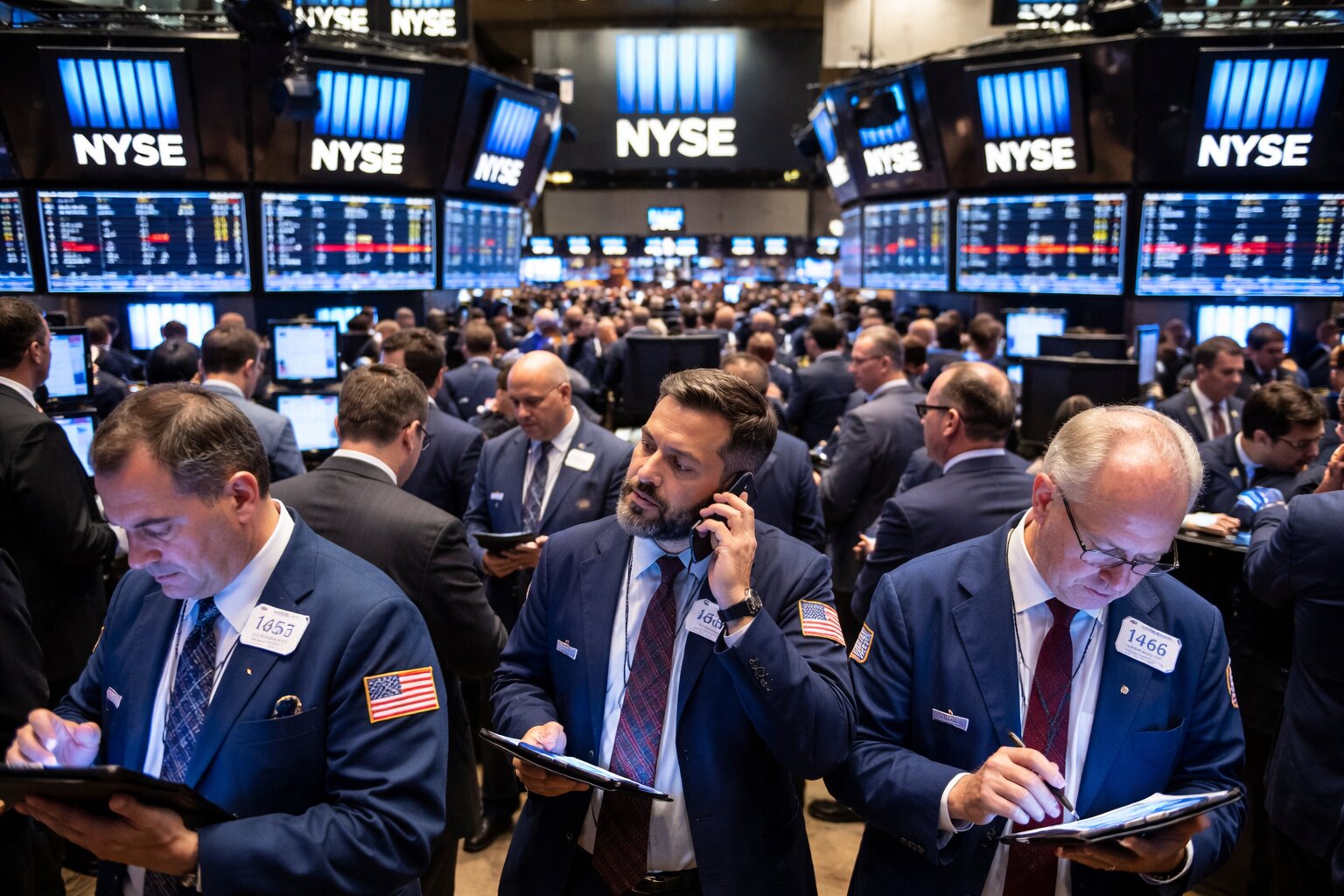
Stock Market Today: Dow Jones Closes at 47,501, S&P 500 at 6,740, Nasdaq at 22,387 as Oil Tops $90 and Jobs Report Delivers a Shock
The Dow shed 453 points, the S&P 500 fell 2% on the week and the Nasdaq lost 1.2% as WTI crude posted its biggest weekly rally since 1983 and 92,000 American jobs vanished in February against expectations of 55,000 added | That's TradingNEWS
The Closing Bell: ^DJI, ^GSPC, ^IXIC Cap a Brutal Week in the Red
Friday's session ended with no relief. The Dow Jones Industrial Average (^DJI) shed 453 points, or 0.95%, settling at 47,501.55. The S&P 500 (^GSPC) dropped 90.69 points to 6,740.02, a 1.33% decline. The Nasdaq Composite (^IXIC) slid another 1.59% to close at 22,387.68. At their intraday lows the damage was considerably worse — the Dow was off nearly 945 points before trimming into the close. Weekly losses compounded everything: the S&P 500 fell 2% on the week, the Dow bled 3%, and the Nasdaq lost 1.2%. All three major averages are now negative for the year. The Russell 2000 led the Friday decline at 2.3%, with smaller domestic companies taking the hardest hit given their direct exposure to rising borrowing costs and the weakening U.S. economy.
92,000 Jobs Gone: February's Payroll Number Scrambles the Fed's Calculus
The morning opened with a number that defined everything that followed. The Bureau of Labor Statistics reported the U.S. economy lost 92,000 nonfarm payroll jobs in February against consensus expectations of 50,000 to 55,000 jobs added. Unemployment climbed to 4.4% from 4.3%. The swing from January is staggering — January was revised down to 126,000 jobs added, making February's -92,000 print a 218,000-job reversal in a single month. The largest driver was healthcare, which subtracted 28,000 positions after adding 77,000 in January, largely attributed to a Kaiser Permanente labor strike. The Atlanta Fed's GDPNow model dropped its Q1 GDP estimate to 2.1% annualized by Friday, down from 3.0% on Monday. The economy is not in freefall — but its momentum is eroding with every data point.
Oil at $90 Rewrites the Inflation Equation
West Texas Intermediate (CL=F) closed at $90.90 per barrel, up 12.21% on the session and roughly 35% on the week — the largest single-week surge since oil futures trading began in 1983. Brent (BZ=F) settled at $92.69, briefly touching $94 intraday. The Strait of Hormuz remains effectively closed to commercial traffic, with more than 14 million barrels per day of global supply unable to move. Qatar's energy minister warned Gulf producers could call force majeure within days, potentially sending oil to $150 per barrel. Goldman Sachs flagged a scenario where prices top $100 if the disruption persists. The national average gasoline price hit $3.32 per gallon on Friday, up $0.34 in a single week. Jet fuel has doubled to over $4 per gallon from 2025's average of roughly $2.
DAL, UAL, JBLU, CCL: Fuel-Exposed Names Get Crushed
Delta Air Lines (DAL) fell 3.75% to $59.01, extending a weekly loss of 10%. United Airlines (UAL) ended the week down 13%, with CEO Scott Kirby warning fuel costs will have a meaningful impact on Q1 results. JetBlue (JBLU) was the week's worst airline, down roughly 20%. Southwest (LUV) dropped 5-6% Friday. Cruise operators were hit equally hard — Carnival (CCL) fell 5%, Norwegian (NCLH) dropped 6%, and Royal Caribbean (RCL) extended a 10%-plus weekly loss. Old Dominion Freight Line (ODFL) fell 7.9% on diesel exposure alone.
MRVL Surges 18.35% on AI Chip Beat
Marvell Technology (MRVL) was the week's standout earnings winner, closing up 18.35% at $89.57. Q4 adjusted EPS came in at $0.80 on revenue of $2.22 billion, both ahead of estimates. Q1 revenue of approximately $2.4 billion beat the $2.27 billion consensus by more than 5%. CEO Matt Murphy guided for accelerating year-over-year revenue growth through all of fiscal 2027, with data center bookings at a record pace. This follows Broadcom's projection of more than $100 billion in AI chip sales in fiscal 2027. MRVL is a strong buy — the stock pulled back slightly to $87.48 in after-hours, which is the better entry.
Read More
-
QQQ ETF Price at $599: The Nasdaq-100 Just Absorbed Its Biggest Outflow Reversal in History
07.03.2026 · TradingNEWS ArchiveStocks
-
XRP ETF (NASDAQ: XRPI) at $7.73 Drops 4% — While 44 Million XRP Leaves Binance, $1.2 Billion in ETF AUM Holds
07.03.2026 · TradingNEWS ArchiveCrypto
-
Natural Gas Futures Price Forecast: Futures at $3.186 After Qatar Force Majeure Wipes 20% of Global LNG Supply
07.03.2026 · TradingNEWS ArchiveCommodities
-
USD/JPY Price Forecast: Dollar-Yen at 158 as $90 Oil and a Closed Strait of Hormuz Rewrite the Rules of This Currency Pair
07.03.2026 · TradingNEWS ArchiveForex
GAP Falls 14%, BLK Drops 7%: Earnings and Liquidity Shocks
Gap (GAP) collapsed 14.41% to $23.28 on a one-penny EPS miss — reporting $0.45 against the $0.46 consensus on in-line revenue of $4.24 billion. A one-cent miss producing a 14% selloff signals the market is repricing something structural around consumer spending. Gap is a sell. BlackRock (BLK) fell 7% — its worst session since April 4 — after capping withdrawals from its HPS Corporate Lending Fund for the first time in four years. Investors requested to redeem 9.3% of shares; the fund honored only 5%, its minimum threshold. BLK is now down 9.9% year-to-date. When private credit redemption pressure exceeds floor commitments, it tends to become a broader sector signal rather than a company-specific event.
CRWD, NOW, INTU: Software Mean-Reversion Delivers the Week's Best Gains
The iShares Software ETF (IGV) posted its best weekly gain since last April, rising approximately 6%. CrowdStrike (CRWD) led with a 15% weekly advance. Intuit (INTU) and ServiceNow (NOW) each gained more than 13%. Palantir (PLTR) and Okta (OKTA) surged roughly 11% apiece. Year-to-date laggards becoming relative leaders is the week's defining rotation theme — quality software with recurring revenue attracted capital as macro conditions deteriorated. CRWD and NOW are legitimate longs with real earnings momentum behind them.
KBE, Banks, and the Stagflation Warning Hidden in the Yield Curve
Every one of the 101 bank stocks in the SPDR S&P Bank ETF (KBE) closed red Friday. The ETF fell 3.6% and broke below its 200-day moving average of $59.24 for the first time since November 2025. Western Alliance Bancorp (WAL) led losses at down 12-13%. The 2-year to 10-year Treasury spread widened to 57.1 basis points in a bear steepening that simultaneously compresses bank margins, raises credit risk, and suppresses loan demand. The 10-year yield (^TNX) ended near 4.14%, up from 3.97% just a week ago. Treasury bonds are heading for their worst weekly performance since April 2025 — not because of strong growth, but because surging oil is pricing in inflation that overrides any rate-cut logic from the weak jobs data. The Fed has no clean tool to address both problems at once. San Francisco Fed President Mary Daly acknowledged two-sided risks. Goldman's Jan Hatzius said the shocks are pointing toward stagflation, even if the U.S. is not there yet. The market is not waiting for confirmation.
VRT, LITE, COHR, SATS Join the S&P 500 on March 23
After Friday's close, Vertiv (VRT), Lumentum (LITE), Coherent (COHR), and EchoStar (SATS) were confirmed as S&P 500 additions effective March 23. All four rose in after-hours. Vertiv is the marquee name — a data center power and thermal management play embedded directly in the AI infrastructure buildout. Lumentum and Coherent are optical networking beneficiaries of the same capex cycle driving Ciena's Bank of America upgrade to a $355 price target. These are buys ahead of the inclusion date with passive fund demand guaranteed into March 23.
The Setup Into Monday
S&P 500 futures (ES=F), Dow futures (YM=F), and Nasdaq 100 futures (NQ=F) open Sunday evening with the weekend's Iran developments fully priced in. The jobs data, earnings, and Fed commentary are already in the tape. What happens at the Strait of Hormuz over the next 48 hours is the only variable that matters. No breakthrough means $100 oil arrives next week, according to Wharton's Jeremy Siegel. The Nasdaq and S&P 500 have not undercut Tuesday's lows, keeping their technical rally attempts technically alive — but that is thin comfort in this environment. The playbook: long energy (XOM, CVX, OXY), long fertilizers (CF, IPI) on dips, long data center infrastructure (MRVL, VRT, CIEN), and short or avoid airlines, banks, materials, and small-caps until the Hormuz situation resolves. Gold (GC=F) is the volatility hedge of choice. Cash is a legitimate position.