Stock Market Today - Dow Drops 500 Points as WTI Crude Hits $78 — AVGO Surges 7%, TTD Explodes 20%, Greg Abel Buys $15M in Stock
Iran strikes oil tanker sending 10-year Treasury yields to 4.134% and crushing broad markets | That's TradingNEWS
Stock Market Today — Dow Drops 500 Points as WTI Crude Surges 4.47% Above $78, Broadcom Jumps 7%, Trade Desk Explodes 20%, and the Iran War Enters Day Six With No End in Sight
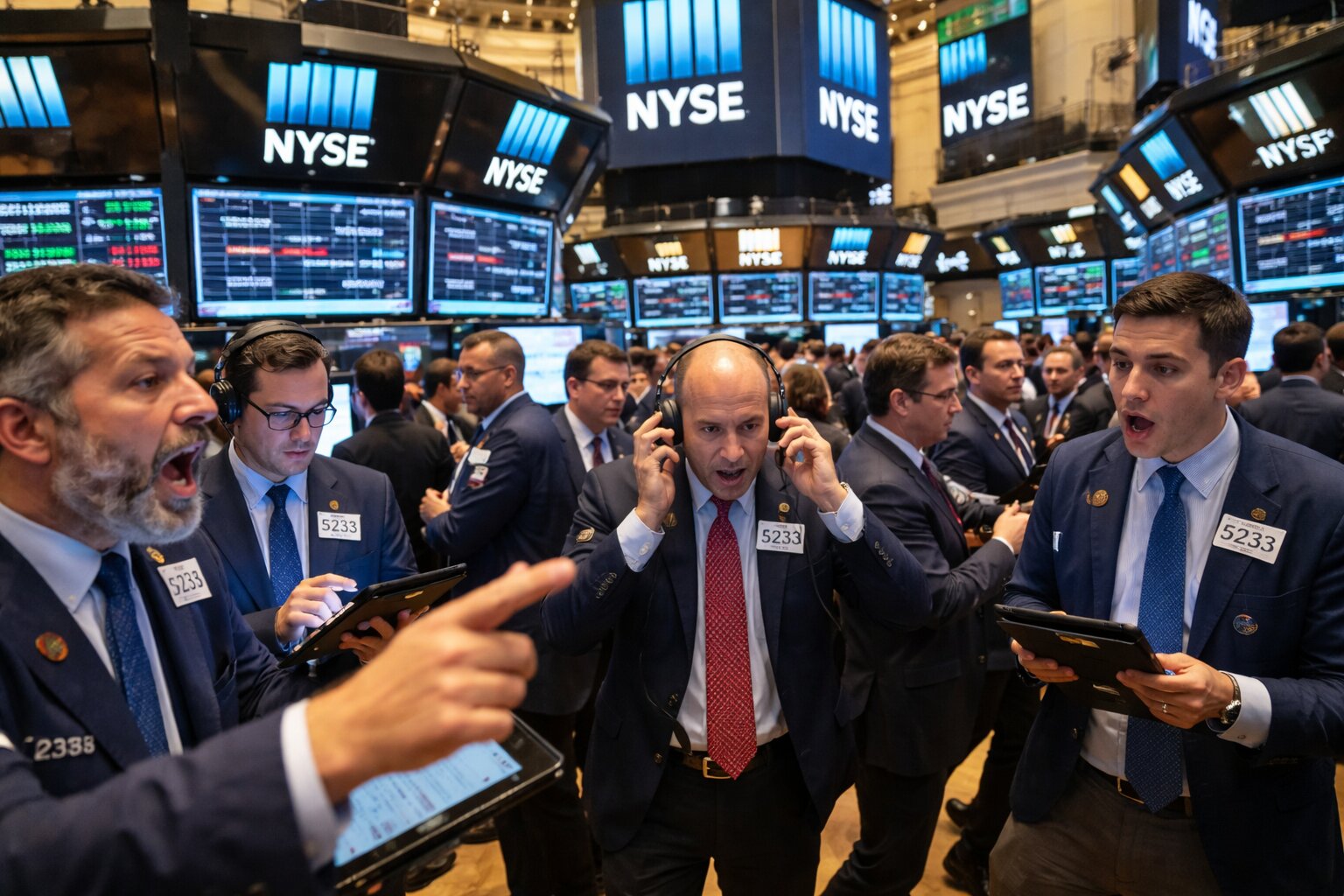
The Dow Jones Industrial Average (DJIA) is down 471 points, or 0.97%, to 48,267 Thursday morning — and the script is identical to every prior session since U.S.-Israeli strikes on Iran began on day one: crude oil surges, Treasury yields climb, and the index that carries the most energy-cost-sensitive industrial and financial names absorbs the punishment while software insulates the Nasdaq Composite (COMP) enough to keep it flat at 22,810. The S&P 500 (SPX) sits at 6,848 — down 0.30%, which sounds manageable until you understand that the S&P 500's energy sector is simultaneously up 0.98% on the day and nearly 25% year-to-date while the broader index is flat for the year, meaning the index's apparent resilience is entirely dependent on one sector running on geopolitical premium while everything else struggles to hold prior-week levels.
The intraday sequence tells the story precisely. Dow futures were off 300 points before the open. At the bell, the decline deepened to 350 points, then 400, then 500 — each leg lower tracking the WTI crude move step for step. U.S. crude oil futures (CL00) hit $78 per barrel during the session, up 4.47% — the highest level since June 2025 — after Iran announced it struck an oil tanker with a missile. Brent crude (BZ=F) at $83.03, up 3%, confirms the spread between U.S. domestic crude and globally traded Gulf crude remains elevated at approximately $5-$6 per barrel, reflecting the structural insulation of Permian Basin production from Hormuz disruption. The 10-year U.S. Treasury yield climbed 5 basis points to 4.134% — "oil is the catalyst," per Tom di Galoma at Mischler Financial Group — as the energy price surge reignites inflation expectations that the Fed cannot ignore regardless of how much the equity market wants rate cuts. With the 10-year at 4.134% and WTI above $78, the Fed's ability to cut rates in June — already reduced to 37% probability — is being further compressed in real time.
The CBOE Volatility Index, the U.S. Dollar, and Why Citi Is Calling the Oil Spike Mature
VIX (CBOE Volatility Index) stands at 21.82, up 3.17% on the session — elevated but not at the crisis levels that would signal systemic equity market stress. The VIX remaining below 25 despite Dow down 500 points and WTI up 4.47% reflects the specific character of the current selloff: it is oil-driven and geopolitically concentrated rather than broadly credit or liquidity-driven. When VIX spikes above 35-40, it signals deleveraging and margin call cascades. At 21.82, it signals elevated concern with continued risk management discipline — a market that is cautious but not panicking.
The U.S. Dollar Index (DXY) at 99.01, up 0.24%, confirms the dollar's persistent bid that has kept the greenback firm despite equity market weakness. Strong Q4 productivity data — up 2.8% against a 1.8% consensus forecast — and unit labor costs rising 2.8% against a 2.0% estimate both argue against imminent Fed easing, supporting dollar demand. Import prices rose only 0.2% against a 0.3% estimate — providing a mild inflation relief data point — while initial jobless claims of 213,000 came in below the 215,000 forecast, confirming the labor market remains firm enough to prevent the Fed from using employment deterioration as a rate cut justification.
Citi's Dirk Willer, global head of macro strategy, published a note Wednesday arguing the CBOE Crude Oil Volatility Index above 70 signals the oil spike is "mature" — that geopolitical oil spikes are "usually short-lived" and that "the day oil peaks, risk markets usually bottom." Willer's specific recommendation: buy the dip in Japan's Nikkei 225 (JP:NI225), which closed Thursday up 1.9% at 55,278. The Nikkei has now risen nearly 10% year-to-date despite the geopolitical volatility — a performance that reflects Japan's equity market benefiting from the weaker yen's positive impact on exporters even as energy import costs weigh on the macro picture. Citi's "volatility risk premium framework triggered" language is their quantitative signal that equity vol relative to realized vol has reached a level that has historically preceded equity market bottoms. If the oil volatility framework is correct and the spike is mature, the Dow's 500-point Thursday decline is the tail end of geopolitical repricing rather than the beginning of a new leg lower.
Broadcom (AVGO) Surges 7% After Earnings — 29% Revenue Growth and AI Infrastructure Thesis Confirmed
Broadcom (NASDAQ:AVGO) is the most important single-stock event Thursday for the technology sector. Shares jumped more than 7% in premarket and are trading at $332.63, up $15.10 or 4.76% during the session — a gain that represents approximately $34 billion in market cap creation from a single earnings print. The numbers justify every dollar of that advance: fiscal first-quarter revenue grew 29% year-over-year. Adjusted EPS of $2.05 beat the $2.03 consensus estimate. Revenue of $19.31 billion beat the $19.18 billion estimate. Revenue guidance for the current quarter surpassed expectations. Infrastructure software business growth is accelerating. The AI disruption narrative that briefly hammered AVGO — the same fictional threat that knocked 6% off Mastercard in a single session on a viral blog post — has been definitively refuted by actual revenue performance. Broadcom told the market directly: AI is not disrupting its software business, it is accelerating it. The stock responded by adding $15 per share in a single session on the day the Dow is down 500 points. That divergence from the broad market selloff is the most powerful confirmation of the underlying Broadcom thesis available.
Berkshire Hathaway (NYSE:BRK.A, NYSE:BRK.B) is the second-most significant equity story Thursday. Both Class A and Class B shares gained more than 1% after Berkshire disclosed it resumed repurchasing its own shares for the first time since 2024 — and simultaneously disclosed that new CEO Greg Abel personally purchased $15 million worth of stock. The buyback resumption is Berkshire's most direct signal since Warren Buffett's era that the company's leadership believes the share price is below intrinsic value. Abel's specific comment to CNBC's Squawk Box confirmed the consultation process: "I absolutely talked to Warren. How I approached it was obviously looking at the value, having a view of intrinsic value, consulted with Warren relative to the value and the timing." A $15 million personal stock purchase by the CEO of a company with Berkshire's scale is not a symbolic gesture — it is a commitment of personal capital at a specific price level that Abel, with full access to Berkshire's books, believes is below intrinsic value. The Class A and Class B shares gaining more than 1% on a day the Dow is down 500 points is the market correctly interpreting this insider purchase as a quality signal in exactly the way insider transaction analysis predicts.
Read More
-
BCX ETF Price at $12.41 — WTI Up 30% YTD, and a 6.55% Monthly Yield Sitting at a 5.34% Discount to $13.48 NAV
05.03.2026 · TradingNEWS ArchiveStocks
-
XRP-USD at $1.42 — XRPI at $8.07, XRPR at $11.49, Seven Straight ETF Inflow Days Hit $1.26B Cumulative as 7 Billion XRP Exit Exchanges and RLUSD Crosses $1.5B
05.03.2026 · TradingNEWS ArchiveCrypto
-
Natural Gas Futures Price Forecast: NG at $2.936 — Qatar's 77M Ton Terminal Offline, TTF Surges 70%
05.03.2026 · TradingNEWS ArchiveCommodities
-
USD/JPY Price Forecast: 157.68 Bearish Engulfing at 157.88 — Friday NFP Targets 159.45 or 155.64
05.03.2026 · TradingNEWS ArchiveForex
Trade Desk (TTD) Explodes 20% — OpenAI Ad Partnership Speculation and Jeff Green's $148 Million Personal Buy
Trade Desk (NASDAQ:TTD) is the single most dramatic individual equity move of Thursday's session: shares surged more than 20% to $30.30, up $5.13 or 20.38%, driven by two simultaneous catalysts. First, a report from The Information stated that OpenAI held early talks with Trade Desk about selling ads — a development that would transform the AI-native advertising thesis from theoretical to operational, positioning TTD as the programmatic infrastructure through which OpenAI's advertising monetization strategy would execute. Second, and more immediately credible as a valuation signal: co-founder and CEO Jeff Green spent approximately $148 million purchasing Trade Desk stock personally. A $148 million personal equity purchase by the founder-CEO of a $15 billion market cap company is not a routine insider transaction — it represents approximately 1% of the company's entire market cap deployed by the person with the most information about the company's revenue pipeline, competitive position, and strategic opportunities. Green's $148 million buy is the largest founder-CEO open-market purchase relative to company market cap in the technology sector in recent memory, and it is occurring simultaneously with the OpenAI ad partnership speculation — confirming that Green believes the stock is materially undervalued even at a level that already incorporates the 20% Thursday advance.
Veeva Systems (VEEV) Up 11%, Grocery Outlet (GO) Crashes 22%, Rigetti Computing (RGTI) Falls 8%
Veeva Systems (NYSE:VEEV) at $197.10, up $8.62 or 4.57% on the session — the premarket surge of 11% partially faded during trading — following a fiscal fourth-quarter earnings and revenue beat combined with strong billings guidance. Veeva's life sciences cloud infrastructure business is structurally resilient to macroeconomic volatility because pharmaceutical and biotech companies cannot delay clinical data management and regulatory compliance systems regardless of geopolitical conditions. The earnings beat confirms that the enterprise software demand for regulated industry vertical solutions continues to compound independent of the broader market weakness weighing on more cyclically exposed technology names.
Grocery Outlet (NASDAQ:GO) is the session's most painful equity story: shares collapsed to $6.85, down $1.94 or 22%. Fourth-quarter profits missed estimates and the 2026 full-year guidance was described as "badly-received" — which is analyst understatement for a guidance package that implies the business is facing sustained margin pressure from rising food costs, elevated energy prices from the Iran conflict transmitting into supply chain economics, and consumer trading-down dynamics that should theoretically benefit a discount grocer but are instead being offset by operational cost inflation. A 22% single-session decline on a retail stock with GO's market cap wipes out approximately $500 million in equity value and confirms that even discount retail is not immune to the margin compression that an energy price shock produces throughout the supply chain.
Rigetti Computing (NASDAQ:RGTI) fell 8.19% to $16.30 after fourth-quarter revenues declined 18% year-over-year. The revenue decline is the quantum computing sector's persistent challenge: the technology is advancing but commercial revenue generation remains elusive, with actual deployment timelines continuously pushing out relative to the speculative excitement that drove RGTI well above $20 in prior months. The company narrowed its losses — a positive operational signal — but 18% revenue decline in a quarter when AI infrastructure spending was broadly accelerating confirms that quantum computing remains a 2028-2030 commercial story, not a 2026 revenue event.
Okta (NASDAQ:OKTA) added approximately 2% in extended trading after reporting adjusted Q4 EPS of $0.90 per share on $761 million in revenue — beating the $0.85 EPS estimate and the $749 million revenue forecast. The identity security business is structurally benefiting from the same geopolitical environment that is creating Iranian cyberattack risk alongside kinetic military conflict: every escalation in the Iran war increases the probability of state-sponsored cyber operations targeting Western financial and infrastructure systems, directly expanding the addressable market for Okta's identity and access management solutions.
StubHub fell approximately 6% in extended trading after fourth-quarter revenue of $449 million missed the $484 million consensus estimate. EBITDA of $62.7 million came in roughly in line with estimates but the revenue shortfall on a quarter that included major live events signals that secondary ticketing market volumes are more price-sensitive than the primary market's post-COVID revenge spending cycle suggested during the peak enthusiasm period.
CrowdStrike (CRWD) +4%, Palo Alto Networks (PANW) +2% — Cybersecurity as the Geopolitical Beneficiary
CrowdStrike (NASDAQ:CRWD) gained 4% and Palo Alto Networks (NASDAQ:PANW) advanced 2% — both providing direct buffer against the Dow's 500-point decline and keeping the Nasdaq from turning significantly negative. The logic is not complex: Iran's military response to U.S.-Israeli strikes has historically included cyber operations alongside kinetic attacks. A conflict now in its sixth day with U.S. Defense Secretary Hegseth stating the U.S. is "winning decisively" while Treasury Secretary Bessent confirmed Trump's 15% global tariff will likely go into effect this week creates a dual geopolitical and macro stress environment in which cybersecurity spending is the most defensible technology budget line. CrowdStrike's 4% advance on a day the Dow drops 500 points is the market correctly pricing the Iran war cyber threat premium into the endpoint security category leader.
The iShares Expanded Tech-Software Sector ETF (IGV) rallied 2.6% — the software sector's outperformance driving the Nasdaq back to flat from -0.4% at the open. The divergence between software (+2.6% IGV) and the broader market (Dow -1%) is the most important intraday sectoral signal: capital is rotating within technology from hardware and semiconductors toward software, where revenue is recurring, margins are high, and there is no physical supply chain vulnerability to energy price shocks or Hormuz closure risk.
South Korea's KOSPI Rebounds 9.63% — Best Day Since 2008 After Worst Session on Record
The most dramatic global equity market event Thursday is the KOSPI (KR:180721) staging a 9.63% recovery to 5,583.90 — the best single-day performance since 2008 — following Wednesday's 12% collapse that was the worst single-session decline in the index's recorded history. The mechanical logic is straightforward: after a 12% single-day decline, circuit breakers triggered, forced selling was exhausted, and the Korea Investment Corporation alongside domestic institutional buyers stepped in with government-coordinated support to prevent a continued cascade. SK Hynix (KR:000660) surged 10.84% and Samsung Electronics (KR:005930) jumped 11.27% — the two names whose combined weight in the KOSPI drove both the crash and the recovery with near-equal amplitude in opposite directions.
Taiwan's TAIEX jumped more than 4%. Japan's Nikkei 225 rose 1.9% to 55,278. Hong Kong's Hang Seng was up 0.35%. China's CSI 300 rose 0.98% to 4,647.69 on the same day Beijing announced a 2026 GDP growth target of 4.5% to 5% — the lowest target on record going back to the early 1990s, reflecting persistent deflationary pressure and U.S.-China trade tensions. Australia's S&P/ASX 200 gained 0.44% to 8,940.
European markets provided no positive offset: the pan-European Stoxx 600 was 0.4% lower, London's FTSE 100 down 0.3%, Germany's DAX shed 0.6%, and France's CAC 40 fell 0.5%. Spain's IBEX dropped 0.4% following Trump's explicit threat to cut off all trade with Spain after Madrid refused to allow U.S. forces to use Spanish bases for strikes on Iran — adding a trade war dimension to the existing energy shock and geopolitical risk premium already embedded in European equity valuations.
Labor Market Data — Productivity Beats at 2.8%, Unit Labor Costs Beat at 2.8%, Claims Flat at 213,000
The macroeconomic data Thursday provides a precise picture of an economy that is simultaneously too strong for the Fed to cut rates and potentially vulnerable to energy-price-driven stagflation. Q4 productivity growth came in at 2.8% — beating the 1.8% forecast and matching the 2.8% annual rate. Unit labor costs also grew 2.8% — beating the 2.0% estimate and registering 1.3% on the 12-month basis. Initial jobless claims of 213,000 for the week ending February 28 came in below the 215,000 forecast and unchanged from the prior period. Continuing claims increased by 46,000 to 1.87 million.
Bank of America's February Employment Report added structural context that the headline numbers obscure: lower-income household after-tax wage growth was just 0.6% year-over-year while higher-income households grew wages 4.2% year-over-year. The K-shaped income divergence — 3.6 percentage points of differential between the bottom and top of the wage distribution — is the foundational consumer economic story that explains why discount retail is not performing as the Iran shock's energy cost transmission should theoretically make it attractive. Lower-income consumers facing 0.6% wage growth against energy prices up 15-25% in a month are not trading down to Grocery Outlet — they are cutting total consumption across all discretionary categories.
The AAII sentiment survey for the week ending Wednesday recorded only 33.1% of respondents as bearish on stocks over the next six months — investor bullishness at its lowest in 14 weeks. Bearish sentiment at 14-week lows during a period when the Dow has fallen multiple hundreds of points across consecutive sessions is historically a contrarian signal — the retail sentiment indicator tends to lag price action rather than lead it, meaning maximum bearishness frequently coincides with the price levels that produce the best forward returns.
Today's market verdict: Selective Buy in software and cybersecurity, Hold on broad indices pending Iran resolution, Avoid energy-cost-sensitive consumer discretionary. CrowdStrike (CRWD), Palo Alto Networks (PANW), and Broadcom (AVGO) are each demonstrating the precise quality characteristics that outperform in the current environment — high recurring revenue, geopolitical demand tailwinds, and earnings execution that defies the macro headwinds. Berkshire Hathaway's (BRK.B) buyback resumption combined with Greg Abel's $15 million personal purchase at current prices is the strongest insider signal of the week. Trade Desk's (TTD) 20% surge on $148 million founder buying and OpenAI ad speculation is speculative but supported by the credibility of the insider commitment. The Dow's 500-point decline, WTI above $78, the 10-year yield at 4.134%, and a U.K. official warning the Iran conflict "could last weeks and possibly months" confirm that the path of least resistance for broad indices remains lower until Hormuz reopens with verifiable tanker traffic data. Size positions in quality names accordingly.