
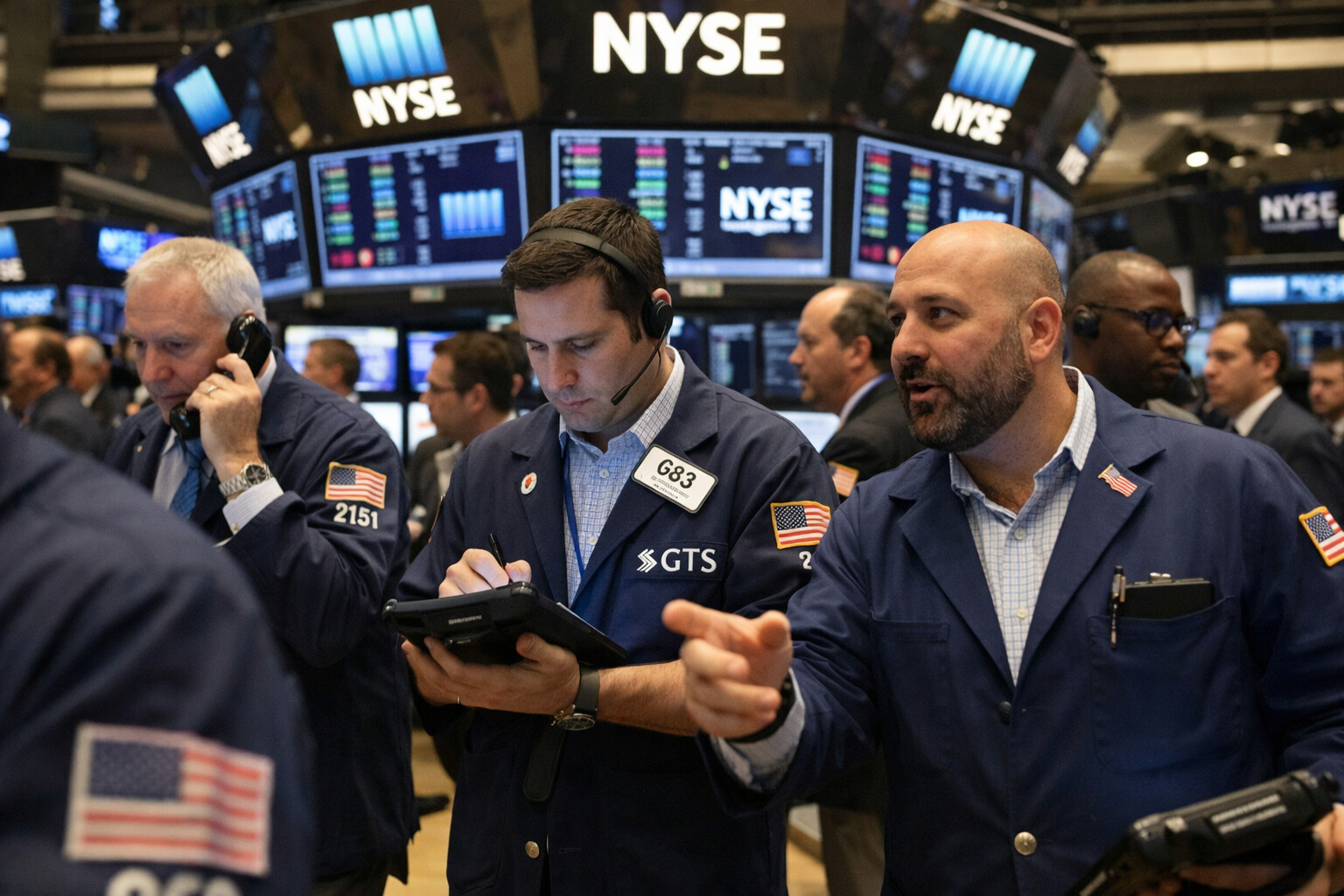
Stock Market Today: Dow Jones 49,321 and Nasdaq 23,353 Rally After Trump Scraps Greenland Tariffs
Relief buying pushes the S&P 500 to 6,900, natural gas above $5 and gold near $4,847, with Nvidia, Microsoft and Intel driving the AI-led rebound into a pivotal earnings test | That's TradingNEWS
Stock Market Today: Trump’s Greenland U-Turn Drives Global Risk-On Move
Major indices: Dow, S&P 500, Nasdaq and Russell 2000 extend rebound
US equities are adding to yesterday’s surge as tariff risk fades. The Dow Jones Industrial Average (DJIA) is up about 0.5% around 49,321. The S&P 500 is higher by roughly 0.3%–0.4% near 6,900. The Nasdaq Composite trades about 0.5%–0.6% firmer around 23,350. Small caps finally join the move, with the Russell 2000 close to 1% higher near 2,724. Volatility compresses again as the VIX drops toward 15.8, more than 6% lower, signaling that protection demand built during the tariff scare is being unwound. Sector-wise, financials and energy outperform in the S&P 500, while Big Tech leadership on the Nasdaq remains intact. The move is a classic relief rally after a policy shock rather than an irrational melt-up.
Greenland and tariffs: from 10% threat to “framework” and TACO narrative
The driver of the rebound is Trump’s reversal on Greenland-linked tariffs. Earlier in the week, the White House threatened 10% tariffs starting February 1 on imports from eight NATO allies, tied to US pressure for control over Greenland. That pushed indices into their worst session since October 10 and triggered a “Sell America” rotation into gold and safe havens. Now the tape has flipped. Trump publicly ruled out using force in Greenland, spoke in Davos about not seizing the island by military means, and then announced that he and NATO’s secretary general had formed a “framework of a future deal” over Greenland. The tariff plan has been pulled back for now. Denmark’s prime minister still refuses to negotiate sovereignty, and the EU has frozen trade talks while reviewing its anti-coercion tool set, so political risk is not gone. But the immediate threat of new US tariffs on Europe has disappeared. On trading desks, that fits the recurring “TACO” pattern – Trump Always Chickens Out once markets crack – and the result is the same: shorts cover, systematic selling stops, and indices retrace the drawdown.
Global indices: DAX, Stoxx 600, Kospi and banks move with Wall Street
The relief is global. In Europe, the pan-European Stoxx 600 is up around 1.1%, powered by sectors that were most exposed to tariff risk such as autos, industrials and financials. Germany’s DAX trades around 24,560, recovering ground lost during the Greenland shock. In Asia, AI optimism and the Greenland climbdown combine to push South Korea’s Kospi above 5,000 for the first time, helped by a strong move in Samsung Electronics. In the US, the KBW Nasdaq Bank Index trades near 169, up around 0.7%, as banks benefit from both a stronger growth backdrop and the pricing-out of an abrupt trade-war escalation. Broad commodities, tracked by the S&P GSCI index around 574, are slightly softer as the panic bid in hedges fades and capital rotates back into equities.
Macro backdrop: 4.4% GDP, 200k jobless claims and delayed PCE inflation
Underneath the politics, the US macro picture remains strong. Revised data show that third-quarter 2025 GDP grew at a 4.4% annualized rate, a step up from both the prior 4.3% estimate and the 3.8% pace in the second quarter. Consumer spending, which accounts for more than two-thirds of US activity, increased about 3.5%. Final sales to domestic purchasers, a clean demand proxy, accelerated to roughly 6.3%, the fastest since the third quarter of 2023. The labor market remains tight. Initial jobless claims last week were about 200,000, only 1,000 above the prior week and below consensus expectations, while continuing claims sit near 1.85 million. The four-week average of claims is roughly 201,500, the lowest trend in about two years, highlighting low layoff rates. In rates, the 10-year Treasury yield trades near 4.27%, up slightly from yesterday but below this week’s highs around 4.30%, a level consistent with firm but not crushing financial conditions. The next key macro catalyst is the delayed PCE price index for October and November, the Fed’s preferred inflation gauge. With the FOMC scheduled for January 27–28, that data will help determine whether markets can keep pricing a gradual, rather than aggressive, easing path. For equities, the combination of strong growth, still-contained inflation and lower geopolitical shock risk remains supportive.
Big Tech and AI: Nvidia, Microsoft and Meta still carry the growth trade
The AI complex continues to anchor the bull case for growth stocks. Nvidia and Microsoft are each about 1% higher, while Meta Platforms outperforms with gains around 3%. At the World Economic Forum in Davos, Nvidia’s CEO reinforced the capex story by talking about “trillions of dollars” in AI infrastructure demand over coming years. Trump’s Davos speech also emphasized building domestic power capacity and keeping energy plants open to support AI ambitions, a clear signal that policy is aligning around large-scale data-center expansion. Outside the US, the same theme is driving chips and indices. Samsung’s strong move to all-time highs helped push the Kospi beyond the 5,000 mark, and the Philadelphia Semiconductor Index has printed fresh records after a more than 3% gain. That backdrop tells you the AI trade is still underpinned by real earnings upgrades, not pure speculation. Valuations on Nvidia and the broader AI basket are demanding, but with revisions moving higher, the market is treating any policy scare as a chance to re-enter, not to abandon the theme. Directionally, the bias for AI mega caps remains bullish with the right risk management: buy on meaningful pullbacks, not on short-term spikes after already-strong days.
Intel focus: INTC rallies into a high-volatility earnings event
Intel is the main stock-specific catalyst on today’s calendar. The shares ripped nearly 12% yesterday, reaching their highest level since early 2022, after a series of positive analyst notes and optimism on AI server demand and the turnaround in its foundry business. The stock has rallied more than 160% since the current CEO’s appointment, with most of that performance since last autumn as chip shortages and government support reshaped expectations. Today, the stock is slightly lower, down about 1%, as investors trim into the report. The bull case hinges on stronger-than-expected data-center CPU sales, traction in advanced packaging for AI chips, and the potential to win big foundry customers such as Apple on top of existing links with Nvidia and US government programs. The bear case is that margins, capex, and execution risk are all high after such a rapid re-rating. At this price and after a double-digit gain in a single session, the skew is toward high volatility either way when numbers hit. Market stance on the tape, not personal advice: Intel into tonight’s print looks like a hold if you are already positioned, with better risk-reward in buying any orderly pullback that does not break the long-term AI and foundry thesis.
Natural gas shock: NG=F spikes above 5 dollars on extreme cold and demand squeeze
The most dramatic move in the commodity space is US natural gas. Front-month Henry Hub futures have surged from about 3 dollars per MMBtu at the start of the week to above 5 dollars, more than 75% higher over five sessions. The last two trading days alone delivered gains of roughly 60%, including around 12% today with prices near 5.49 dollars. The trigger is a major winter storm and Arctic cold blast expected to hit an area from New Mexico to Dallas up through the Northeast, with heavy snow, ice and sub-freezing temperatures forecast to affect roughly 150 million people. Nearly half of US households rely on natural gas as their primary heating source, and gas also accounts for a large share of power generation. Because gas moves predominantly through pipelines, supply cannot quickly be shifted like oil, so demand shocks translate into sharp price moves. Producers such as EQT Corporation and Antero Resources have extended Wednesday’s 4–6% gains, while pipeline operator Williams, which gained about 2.5% yesterday, is consolidating. On a short-term trading basis, the front contract now looks stretched after the biggest two-day rally on record, and the risk-reward skews toward a sharp correction once weather forecasts moderate. Structurally, quality gas producers remain supported by demand and the data-center power story, but the blow-off in NG=F is more bearish than bullish for the next leg.
Read More
-
SCHD ETF at $31.62: Dividend Rotation Turns a 2025 Laggard into a 2026 Leader
11.02.2026 · TradingNEWS ArchiveEnergy
-
Toyota Stock Price Forecast - TM Near $242 Re-Rates As New CEO Targets Profitability, Hybrids And Software Upside
11.02.2026 · TradingNEWS ArchiveStocks
-
XRP ETFs XRPI and XRPR Lag Price While Fresh XRPZ Inflows and $152M Bank Bets Test the Dip
11.02.2026 · TradingNEWS ArchiveCrypto
-
Natural Gas Futures Defend the $3.00 Floor After Collapse From Above $7.50
11.02.2026 · TradingNEWS ArchiveCommodities
-
USD/JPY Price Forecast - USDJPY=X Drops Below Key Averages as Yen Rally Targets 152–150 Zone
11.02.2026 · TradingNEWS ArchiveForex
Gold and dollar: GC=F digests record highs as Goldman lifts long-term target
Gold is consolidating just below fresh records. COMEX gold futures trade around 4,845–4,850 dollars per ounce, up about 0.2% on the day after briefly falling more than 1% overnight when tariff fears eased. On Wednesday, bullion hit a new all-time high above 4,888 dollars, capping a roughly 70% gain over the past year driven by central bank purchases, ETF inflows and private hedging against fiscal and geopolitical risk. A major US bank just raised its December 2026 gold target to 5,400 dollars from 4,900 dollars, arguing that hedges linked to structural worries about fiscal sustainability and policy credibility are stickier than previous event-driven trades around, for example, the 2024 US election. The Bloomberg Dollar Spot Index and the classic Dollar Index are each marginally softer, with the dollar index near 96.0 and down about 0.15%, removing a headwind for gold. With equities rallying and tariffs off the front burner, the fact that gold remains near its highs underscores how deeply embedded macro hedges still are in portfolios. From the market’s perspective, this tape reads as a pause within a bullish medium-term trend rather than the top of the move.
Crypto, oil and cross-asset: BTC, CL=F, DXY and GSCI show normalization, not euphoria
Crypto and broader commodities are confirming a controlled normalization rather than a new risk mania. Bitcoin trades around 89,000 dollars, off about 1% on the day after strong gains during the tariff scare. The move is consistent with flows rotating out of “doomsday” hedges back into equities and credit as the immediate policy shock disappears. West Texas Intermediate crude futures sit near 59.6 dollars per barrel, down around 1.5% despite the risk-on move in stocks, reflecting solid supply, slowing incremental demand at high prices and lingering concerns about global trade frictions. The S&P GSCI commodity index is modestly lower, around 574 and down about 0.4%. The Dollar Index is slightly softer and volatility is lower. Together, these signals point to a market that is backing away from maximum defensiveness but not chasing risk aggressively in every asset class.
Earnings and defensives: ABT, PG, GE, MBLY and MKC struggle to beat high expectations
Corporate news flow today is heavy in defensive and industrial names. Abbott Laboratories fell around 5–8% after quarterly revenue missed forecasts and first-quarter profit guidance undershot consensus. The company already warned of a roughly 700 million dollar revenue hit in its diagnostics segment in 2025 as COVID testing evaporates and China’s volume-based procurement drives price pressure in lab products. The stock is now being priced as a company moving into a post-pandemic normalization phase rather than a structurally high-growth compounder. Procter & Gamble posted mixed results with softness in razor and diaper demand and cut its full-year earnings outlook. Shares initially fell premarket but recovered to gains around 2% as investors leaned into its pricing power, cash generation and status as a core defensive holding. GE Aerospace slid roughly 4% despite solid demand, a sign that expectations after a big run were simply too high and that any hint of margin pressure gets punished. In autos and mobility tech, Mobileye dropped between 3% and 6% after setting 2026 revenue guidance in the 1.90–1.98 billion dollar range, shy of the 2.0 billion consensus, and highlighting slower EV production and US auto tariffs as headwinds. McCormick shares fell about 6% in early trading after guiding 2026 adjusted EPS to 3.05–3.13 dollars versus roughly 3.22 expected, even though fourth-quarter sales slightly beat at 1.85 billion dollars. Across these names, the pattern is the same: in a market at or near highs, investors demand clean beats and strong guidance; anything less triggers derating, even in staples.
Media M&A and streaming: PSKY, WBD and NFLX fight for strategic control
The media sector is dominated by the bidding war around Warner Bros. Discovery. Paramount Skydance has extended the deadline on its tender offer for WBD shares to February 20, keeping a roughly 30 dollar per share all-cash proposal in play and valuing the target north of 80 billion dollars under various structures. The deal is backed by more than 40 billion dollars of financing support from Larry Ellison, designed to answer concerns about Paramount’s balance sheet. Warner’s board previously rejected the offer over funding doubts. In parallel, Netflix has revised its own bid into an all-cash proposal around 27.75 dollars per share for studios and streaming, valuing those assets at about 82–83 billion dollars. In trading, PSKY is up about 1.4% near 11.76 dollars, WBD is slightly lower by about 0.4%, and Netflix is modestly higher. With multiple bidders, litigation over negotiation tactics, and regulators watching, investors are treating WBD as a volatility vehicle rather than a simple value play. The sector message is that long-tail streaming economics still matter; scale and premium content are worth paying for, but financing risk and integration complexity will decide which buyer, if any, succeeds.
High-beta movers: BABA, MRNA, GME, UBI.PA and SPHR
Several high-beta names are seeing outsized moves on idiosyncratic news. Alibaba is up more than 5% around 177–178 dollars after reports that it plans to spin and list its AI chip division, T-Head. Securing a dedicated valuation for that unit would give investors a direct way to price Alibaba’s role in China’s battle to build domestic AI accelerators instead of relying on a blended conglomerate multiple. Moderna gains about 5–7% near 53 dollars after announcing positive skin-cancer vaccine trial data, supporting the case that its mRNA platform has durable oncology potential beyond pandemic shots. GameStop is up around 3% again after filings showed CEO Ryan Cohen bought 500,000 shares at about 21.11 dollars on Tuesday and another 500,000 at 21.60 dollars on Wednesday. The purchases, worth about 21.3 million dollars, are a clear alignment signal but do not change the underlying challenges in the core business. French publisher Ubisoft collapses by more than 30% after a brutal update that includes the cancellation of six games and a restructuring, raising serious doubts around its pipeline and execution. Sphere Entertainment climbs another 6% to around 99 dollars after an upgrade to buy with a 110 dollar target, as investors react to the decision to build a second 6,000-seat venue in Washington, D.C. following strong performance at the 20,000-seat Las Vegas Sphere. Each of these names is trading as a clean expression of a single story: China AI for Alibaba, oncology for Moderna, insider speculation for GameStop, pipeline risk for Ubisoft, and venue economics for Sphere.
Market stance: indices tilt bullish, with natural gas overheated and gold still in demand
Putting it together, today’s tape shows a market that has pushed away from the brink. Trump’s Greenland U-turn has removed an immediate tariff shock, US growth data remain strong with 4.4% GDP and claims at 200,000, and AI-linked earnings momentum in names like Nvidia, Microsoft and Meta is still driving the Nasdaq. At the index level, the trading stance is broadly constructive. The S&P 500 and Dow are effectively in buy-on-dip and hold territory as long as the data stay firm and tariffs stay off the table. The Nasdaq carries a bullish bias but is more vulnerable to any disappointment in AI or rates given stretched valuations. The Russell 2000 benefits most from the shift away from “Sell America” and screens as a higher-risk, higher-beta way to express a bullish US growth view. In commodities, gold remains in a medium-term uptrend and continues to trade as a core macro hedge, while front-month natural gas looks severely overheated after the record two-day move and sits in clear correction risk. Oil is drifting lower, and cross-asset signals from the dollar, GSCI and VIX all point to a market that is healing rather than breaking. The balance of evidence in prices and data is tilted toward a bullish or bullish-to-hold stance on US equities, with careful stock selection and respect for the extremes in natural gas and high-beta single names.