Stock Market Today: Dow Stages 544-Point Reversal, Nasdaq Climbs as Oil Collapses to $83 and Iran Ceasefire Bets Heat Up
S&P 500 recovered 0.34% BioNTech crashed 18%, Vertex surged 4% on a kidney drug win, and Oracle reports earnings after the bell | That's TradingNEWS
Stock Market Today - The Dow's 544-Point Reversal Is the Story; But the Real Trade Is Everything Happening Around It
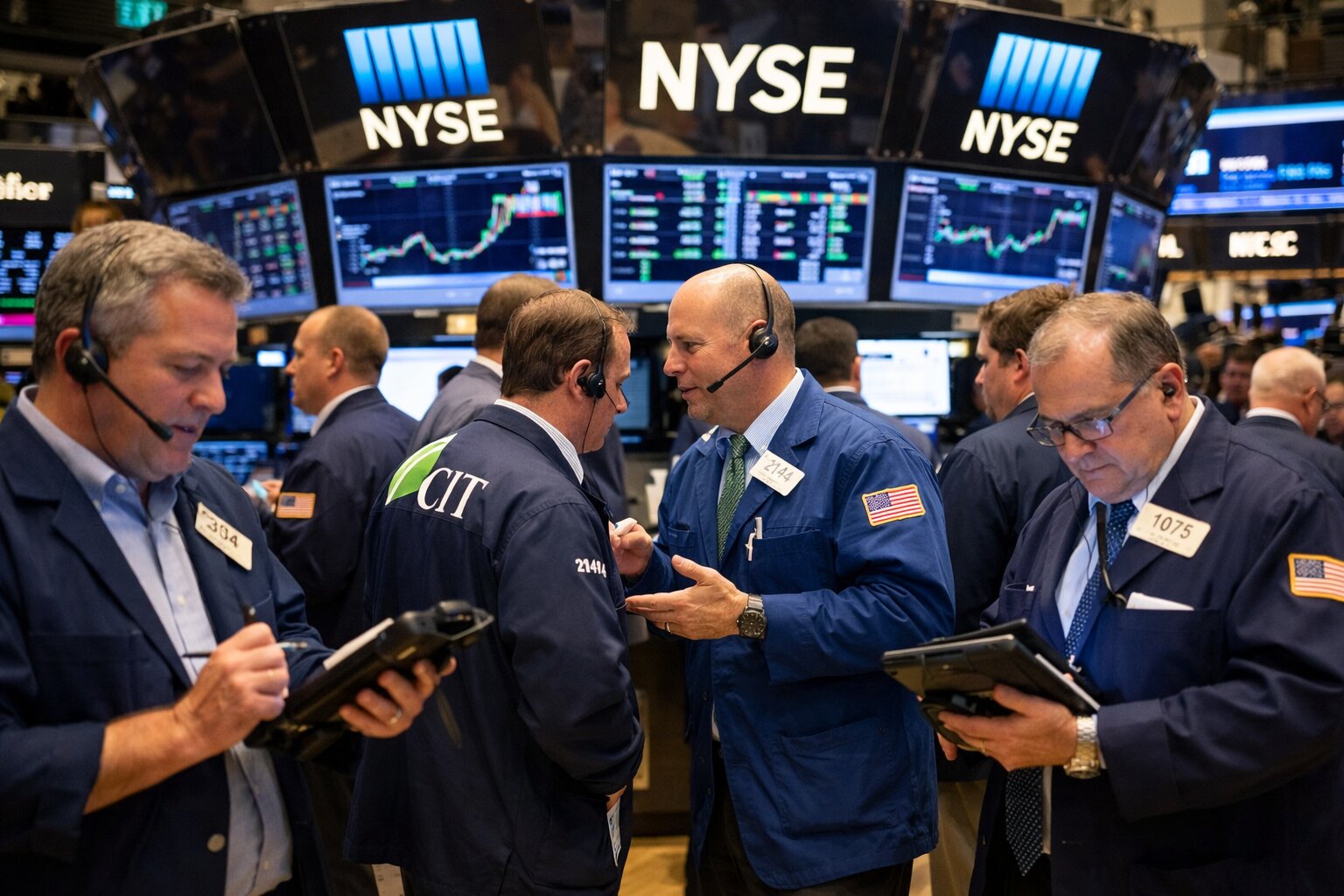
Tuesday, March 10, 2026 handed Wall Street a session that will get cited in market history textbooks — not because of where indices closed, but because of the violent journey to get there. The Dow Jones Industrial Average (^DJI) shed 296 points at its worst before reversing to finish up 248 points, a 544-point round trip inside a single session, closing at 47,986.92, up 0.52%. The S&P 500 (^GSPC) bottomed at -0.5% before recovering to 6,819.27, a gain of 0.34%. The Nasdaq Composite (^IXIC) was the relative outperformer of the three major indices, closing at 22,824.24, up 0.57%, having shed 0.4% at its session low. None of these headline numbers tell the full story. The real action was in crude oil crashing 12%, gold surging past $5,236, Bitcoin ripping 3.29% higher, and a collection of individual stocks putting up moves that dwarfed anything the index scorecard shows.
The Russell 2000 closed up 0.92% at 2,577.06 — the strongest performer among the major US benchmarks. Small-cap outperformance in a geopolitically rattled, oil-shocked tape is a notable signal. It suggests that the portion of the market most sensitive to domestic economic conditions is not pricing in a recession, at least not yet. The KBW Nasdaq Bank Index gained 0.95% to 154.45, which is equally telling — financials don't rally when the credit market is panicking. The 10-Year Treasury yield settled at 4.118%, stabilizing after Monday's surge, while the Dollar Index slipped 0.19% to 95.38. The VIX collapsed 10.08% to 22.93 — still elevated relative to pre-conflict levels, but the direction matters. Fear is retreating, not advancing.
Crude Oil's Historic Collapse: From $119 to $83 in Days — and Why Chasing This Move Is How You Blow Up an Account
Crude oil (CL=F) is down 12.18% to $83.23 on Tuesday, and that number alone doesn't capture the scale of what just happened in energy markets. In six trading days, WTI surged roughly 80% from pre-conflict levels to touch approximately $119 per barrel on Sunday. Monday's session saw Brent (BZ=F) trade in a $36 range — the widest single-day band ever recorded, wider even than the chaos during Russia's invasion of Ukraine in 2022. Tuesday morning, both WTI and Brent opened above $100 and are now sitting near $83-$84. That's a reversal of nearly 30% from the peak in fewer than 48 hours.
The trigger for Tuesday's oil collapse was a combination of two forces: Trump's signaling of a potential ceasefire and the G7's formal request to the International Energy Agency to prepare scenarios for releasing strategic petroleum reserves. French Finance Minister Roland Lescure confirmed the G7 asked the IEA to calculate how many barrels each member country could contribute. IEA Executive Director Fatih Birol subsequently called an extraordinary member meeting to assess supply security conditions. The 30-plus member nations of the IEA — overseeing reserves held across nearly 40 OECD economies — represent a massive potential supply overhang that, even before a single barrel is released, is psychologically crushing speculative oil positions.
The popular oil ETF USO saw options volume running at nearly 10 times its year-to-date daily average in recent sessions — a clear sign that momentum traders piled in at the worst possible time. Anyone who bought crude north of $110 thinking they were riding a structural energy crisis is now nursing losses that would require another $30 move higher just to break even. This is the classic anatomy of a commodity spike: parabolic moves are driven by fear and momentum, not sustained supply destruction, and they reverse just as violently. WTI crude's long-term chart is a story of sharp rallies punctuated by equally brutal retreats. The S&P GSCI Index Spot is down 5.45% to 671.75, reflecting broad commodity weakness.
Wells Fargo's chief economist Tom Porcelli put a number on the recession threshold: oil sustained at $130 per barrel — exactly 100% above pre-conflict baseline — would trigger back-to-back contractions in personal consumption expenditures in the middle of 2026. Paul Gooden of Ninety One puts the next potential spike ceiling above $120 if Hormuz disruption extends. Neither scenario is today's price. At $83, the market has essentially priced in a near-term resolution to the shipping blockade, even though the Strait of Hormuz remains effectively closed. Goldman Sachs data shows trace amounts of oil crossings resuming, but Saudi Aramco (2222.SR) CEO Amin Nasser — who called this conflict the single largest crisis his industry has ever faced — confirmed the company can ramp output back to full capacity within days, not weeks, once Hormuz normalizes. That's the bullish card the market is betting on. Rating on crude oil at current levels: Hold with a short bias. The bounce from $83 back toward $90-$95 is possible if ceasefire talks stall — Iran's foreign minister explicitly said negotiations are off the table and Defense Secretary Hegseth promised Tuesday would bring the most intense strikes yet. But chasing momentum above $95 makes no structural sense. The G7 SPR backstop and Aramco's ramp-up capacity create a ceiling. Do not treat oil like a meme stock. The roll cost on USO alone will eat you alive in a flat or choppy environment.
Exxon (XOM), Aramco (2222.SR), and the Energy Sector's Paradox: Revenue Windfall vs. Operational Nightmare
Exxon Mobil (XOM) CEO Darren Woods addressed the situation directly Tuesday morning: his teams have been evacuating joint venture personnel across the Middle East while simultaneously diversifying supply chains to keep operations running. The language was measured, but the subtext is clear — XOM is both a beneficiary of elevated prices and an operational hostage to the conflict. Exxon's global diversified supply network is an asset here. Unlike pure-play Gulf-exposed operators, XOM's upstream production isn't concentrated in Hormuz-dependent geography.
Saudi Aramco's Ras Tanura facility — the world's largest offshore crude oil processing plant — briefly shut down after a drone interception before restarting normally, per Jefferies researchers monitoring the earnings call. Nasser's willingness to promise full ramp-up in "days not weeks" once Hormuz reopens is a confident operational statement, but it simultaneously tells you that Aramco's current output is suppressed. The UAE, Kuwait, and Iraq have all reduced production in parallel, according to sourced reporting. Every barrel not flowing through Hormuz today is a barrel Aramco can sell at a premium the moment the strait reopens. Rating on XOM: Buy. Even at normalized oil prices around $80-$90, Exxon's earnings power is substantial. If the conflict drags and prices stabilize in the $90-$100 range, XOM becomes a cash generation machine. The downside is limited by its diversified production base. The upside, if oil spikes again toward $110-$120, is asymmetric.
Airline Stocks — DAL, UAL, AAL — Are Pricing in Catastrophe That May Not Materialize
Delta Air Lines (DAL) has dropped 7% over the past week. United Airlines (UAL) is down 9%. American Airlines (AAL) has given back 10%. All three are being punished by the same mechanism: fuel costs are the second-largest expense line for carriers, and with jet fuel prices tracking crude, every dollar on the barrel hits directly. But Bernstein analyst David Verno made the case Tuesday that the market is overcorrecting. Airlines have navigated fuel shocks before — repeatedly — and their longer-term earnings power is far more resilient than the recent stock moves imply.
The key insight is magnitude and duration. At $83-$84 crude today, the existential fuel cost scenario has already partially resolved itself. If oil normalizes toward $75-$80 on a genuine ceasefire, DAL, UAL, and AAL have all priced in an oil crisis that no longer exists. Verno's note explicitly acknowledged the impossibility of knowing the conflict's duration but argued that under conservatively reasonable assumptions, the long-term earnings impairment is far smaller than a 7-10% stock decline suggests. Rating on DAL: Buy the dip. At 7% off with fuel costs now reversing sharply, the risk-reward favors the long side. UAL at -9% is the more aggressive trade — higher beta, more international exposure to route disruptions, but also more leverage to a normalization scenario. AAL is the most distressed and carries the highest balance sheet risk; treat it as a high-risk, high-reward speculative play only.
Oracle (ORCL) Earnings Tonight: AI Revenue vs. OpenAI Drama
Oracle (ORCL) reports Q4 earnings after the close Tuesday, and the setup is unusually complicated. The stock rose roughly 2% in premarket on earnings anticipation, but it enters the print carrying two pieces of conflicting news: it has reportedly halted plans to expand its AI data center buildout with OpenAI (OPAI.PVT), and simultaneously it is cutting thousands of jobs. The data center pullback is the more significant variable. Oracle's cloud infrastructure business has been on a multi-year acceleration driven precisely by AI workload demand, and any signal that the OpenAI partnership — one of its marquee AI revenue anchors — is fraying will hit the stock in after-hours regardless of what the headline EPS prints. Adobe (ADBE) reports Thursday, and its AI monetization story through its creative suite remains the central question. Both ORCL and ADBE trade on forward AI revenue expectations, not trailing results, which makes the guidance commentary on each call far more important than the quarterly numbers. Rating on ORCL heading into earnings: Hold with a cautious stance. The OpenAI data center halt is a meaningful headwind. If management addresses the partnership status directly and reaffirms cloud infrastructure growth targets, the stock can run. If they dodge it or downgrade guidance, expect a 5-8% after-hours decline.
Vertex Pharmaceuticals (VRTX): A Drug That Actually Works Is Worth More Than Any Macro Noise
Vertex Pharmaceuticals (VRTX) surged 4% premarket after announcing that its drug targeting IgA nephropathy — a chronic kidney disease that can progress to kidney failure — met its primary endpoint in a late-stage Phase 3 trial. This is not a preliminary result. A Phase 3 primary endpoint hit in a rare kidney disease indication, for a company that already has dominant positions in cystic fibrosis, is a serious catalyst. The stock popped more than 5% in after-hours Monday before paring to a 4% premarket gain. IgA nephropathy represents a significant unmet medical need with limited approved treatment options. Vertex entering this space with a successful late-stage readout positions it to file for regulatory approval and enter a market where pricing power is substantial. This is exactly the kind of pipeline execution that justifies owning VRTX through geopolitical noise — its revenue doesn't depend on the price of oil or the status of the Strait of Hormuz. Rating on VRTX: Buy. The CF franchise generates consistent cash. A new approved indication in nephrology adds a second growth vector. The Phase 3 hit removes binary trial risk. Any pullback below the premarket levels is an accumulation opportunity.
HPE Beats — But the Revenue Miss on Q1 Deserves Attention
Hewlett Packard Enterprise (HPE) delivered a mixed Q1 print that the market initially treated kindly with a roughly 3% premarket gain. Adjusted EPS came in at $0.65 versus the $0.59 consensus — a solid 10% beat on the bottom line. But revenue of $9.30 billion missed the $9.33 billion estimate, even as it grew 18% year over year. CEO Antonio Neri cited double-digit order growth across all segments, and the company raised its fiscal 2026 adjusted EPS guidance to $2.30-$2.50 from the prior $2.25-$2.45. Q2 revenue guidance of $9.6-$10.0 billion is above the analyst consensus of $9.58 billion. The 18% revenue growth is genuinely impressive and squarely tied to AI infrastructure demand for HPE's server business. The guidance raise is the more important number for positioning. HPE is not a glamour AI stock — it's the picks-and-shovels play, selling the hardware that hyperscalers and enterprises buy to run AI workloads. The margin expansion story here is the real driver. Rating on HPE: Buy. The Q1 revenue miss is noise against an 18% growth rate and a guidance raise. The AI infrastructure buildout is a multi-year secular trend. HPE at current levels is undervalued relative to the earnings power the guidance implies.
Strategy (MSTR) Rides Bitcoin Higher — But This Is a Leveraged Bitcoin Bet, Not a Company
Strategy Inc. (MSTR) climbed 3% premarket and is trading around $140.90, tracking Bitcoin (BTC-USD), which surged 3.29% to $71,278.04. Bitcoin's move is directly tied to the perceived de-escalation in Iran — risk assets across the board caught a bid as crude collapsed and the geopolitical temperature dropped a few degrees. Strategy holds one of the largest corporate Bitcoin reserves on earth, making its stock essentially a levered Bitcoin tracker with corporate overhead. Bitcoin at $71,278 is behaving exactly as a risk asset, not a safe haven — it rose 3.29% alongside equities and fell in parallel with the initial war-shock sell-off. The "digital gold" narrative takes another hit every time BTC correlates directly with equity risk appetite. Gold (GC=F) surged 2.60% to $5,236.50, which is the true safe haven trade. When crude was spiking toward $119, gold was being held back by the Fed rate hawkishness repricing. Now, with Trump signaling conflict resolution, the dollar weakening 0.19%, and yields stabilizing at 4.118%, gold has room to breathe. TD Securities strategist Daniel Ghali noted physical over-the-counter buyers have been buying dips, though volume remains modest. Rating on MSTR: Speculative Hold. This is not a long-term portfolio position — it is a high-beta Bitcoin proxy. If you are bullish Bitcoin near $71K, owning MSTR gives you amplified exposure. If Bitcoin corrects back toward $65K, MSTR will punish you disproportionately. Know what you own. Rating on Gold: Buy. $5,236 with the Fed potentially pivoting more dovishly than the market expects, a weakening dollar, and sustained geopolitical uncertainty — the setup for gold is exceptionally strong. The metal is not done.
Boeing (BA) Wiring Problems Are Not a Geopolitical Story — They're a BA-Specific Execution Failure
Boeing (BA) dropped 1% Tuesday after disclosing it will delay some 737 MAX deliveries due to a newly discovered wiring problem. Strip away the Iran war noise and you have a company that continues to find manufacturing defects that delay planes, disappoint airline customers, and erode whatever production credibility it has rebuilt since the 737 MAX grounding. Every delivery delay is revenue that doesn't get recognized on schedule and cash that doesn't flow in on time. For an airline industry now facing elevated fuel cost pressure from the Iran conflict, delayed deliveries from BA compound the operational headache. Rating on BA: Sell. Another self-inflicted wound on an already battered production record. Until Boeing demonstrates consistent, defect-free delivery performance at scale, the stock deserves a discount. This is not the time to be a hero buyer.
Micron (MU) and Applied Materials (AMAT) Partner on Next-Gen AI Memory — This Is a Multi-Year Earnings Catalyst
Micron Technology (MU) and Applied Materials (AMAT) announced a partnership to co-develop next-generation memory chips specifically architected for artificial intelligence workloads. Both stocks rallied on the news. AI systems require memory bandwidth that current DRAM architectures are straining to provide. The partnership positions both companies at the bleeding edge of the next memory transition — HBM and beyond — which is where margin and volume growth will concentrate over the next three to five years. Nvidia (NVDA) already relies on HBM from Micron and SK Hynix for its H100 and Blackwell GPU chips. A dedicated co-development program between MU and AMAT signals that the memory supply chain is investing ahead of demand, not chasing it. That's exactly the kind of capital discipline the semiconductor cycle rewards. Rating on MU: Buy. The AI memory cycle is structurally bullish. The AMAT partnership accelerates the technology roadmap. Rating on AMAT: Buy. Equipment companies that co-develop next-gen processes with end customers lock in adoption before competitors can bid. This is a durable competitive moat in formation.
Taiwan Semiconductor (TSM): 30% Sales Growth in Two Months Is Not an Accident
Taiwan Semiconductor (TSM) shares rose roughly 1% in premarket after the company reported a 30% year-over-year increase in sales for the first two months of 2026. This is the foundry that manufactures chips for Apple, Nvidia, AMD, and virtually every other AI-adjacent fabless semiconductor company. A 30% top-line expansion in just January and February tells you that upstream AI chip demand has not softened at all, despite macro turbulence. The Iran conflict is a macro overlay — the underlying silicon supercycle continues to print hard numbers. Rating on TSM: Buy. A 30% revenue growth rate from the world's most critical semiconductor foundry is unambiguous. Geopolitical risk around Taiwan is real but it's the same risk that has existed for years. The earnings power story is dominant.
Kohl's (KSS) and Casey's (CASY) — Two Very Different Ways to Miss
Kohl's (KSS) collapsed 9% premarket after reporting Q4 revenue of $4.97 billion — missing the $5.03 billion consensus by $60 million. The EPS side was actually fine at $1.07 versus the $0.85 expected, but nobody owns a retailer for a cost-cutting-driven earnings beat when the top line is deteriorating. Revenue is the health signal for a consumer-facing business. Kohl's missing on sales in a quarter that includes the holiday season is a structural demand problem, not a temporary disruption. The Iran war and elevated energy prices threatening consumer spending only make the forward picture darker. Casey's General Stores (CASY) fell 2.6% after posting Q3 revenue of $3.92 billion against a $4.04 billion estimate — a $120 million miss. A convenience store chain with significant fuel sales exposure is a complicated story when crude oil is spiking 80% in a week. Fuel volume was almost certainly impacted, though EPS came in above expectations. The earnings beat on cost management doesn't offset a revenue miss of that magnitude. Rating on KSS: Sell. Consumer discretionary with a deteriorating top line heading into a potential oil-driven consumption slowdown is not where you want to be. Rating on CASY: Hold. The fuel exposure is a headwind, but convenience retail is a resilient business with non-fuel revenue diversification. Wait for a cleaner setup before adding.
Vail Resorts (MTN) Misses on Both Lines — Weather Is Not a One-Time Event in the Rockies
Vail Resorts (MTN) slid 1.2% in after-hours Monday after reporting $5.87 EPS on $1.08 billion in revenue for Q2 — versus the consensus of $6.10 EPS and $1.11 billion in revenue. Management blamed persistently difficult weather conditions in the Rockies and lowered full-year guidance as a result. Weather-dependent businesses always invoke conditions as an explanation for shortfalls, but consecutive misses force the question of whether guidance is structurally too optimistic. Rating on MTN: Hold. The ski business is a premium consumer leisure play that will recover when weather normalizes. But the guidance cut means earnings estimates come down across the board and the stock needs time to reset valuation expectations.
Read More
-
Qualcomm Stock Price Forecast - QCOM Crashes 34% - The Memory Crunch Is Temporary, the Upside Is Not
10.03.2026 · TradingNEWS ArchiveStocks
-
XRP Price Forecast - XRP-USD Rallies to $1.42, The $1.55 Break That Changes Everything Has Not Happened Yet
10.03.2026 · TradingNEWS ArchiveCrypto
-
Oil Price Forecast - Oil Crashes 11.5% to $83 From a $120 Peak — But the Strait of Hormuz Is Still Shut
10.03.2026 · TradingNEWS ArchiveCommodities
-
SCHD ETF at $31.02 — 15.8% YTD, LMT Stock Fills War Orders, and Every Tech ETF Sits Flat
09.03.2026 · TradingNEWS ArchiveMarkets
-
GBP/USD Price Forecast - Pound Rallies to 1.3480 After Bouncing From 1.3285 — Three Days of Gains
10.03.2026 · TradingNEWS ArchiveForex
BioNTech (BNTX) Loses Both Founders — An 18% Decline Is Probably Not the Bottom
BioNTech (BNTX) cratered 18% Tuesday after the company announced that co-founders Ugur Sahin and Özlem Türeci will depart at year-end to launch a new mRNA-focused biotech venture — their third company. BioNTech will contribute certain mRNA technology rights to the new entity in exchange for a minority stake. The departure coincided with a larger-than-expected 2025 loss per share. The founders leaving is not a normal executive transition. Sahin and Türeci built BioNTech from scratch, co-developed the first approved mRNA COVID vaccine, and represent the intellectual foundation of the company's scientific credibility. When the architects of a biotech company's core platform leave to start a competing entity, the market has to reprice the probability that the best innovation at that company happened in the past, not the future. The minority stake in the new company is a consolation prize, not a strategic asset. Rating on BNTX: Sell. An 18% single-day decline in a biotech where the founders just announced they're leaving to build something new is not a buying opportunity. It is a signal. There will be a better entry point after the dust settles and the market understands what pipeline assets remain with the parent company.
Bill Ackman's Pershing Square Goes Public Under Ticker "PS" — The Hedge Fund World's Biggest IPO Move
Pershing Square Capital Management filed for an NYSE IPO Tuesday under the ticker "PS", combining the hedge fund vehicle with a new investment fund in a dual listing structure. Pershing Square Holdings — Ackman's existing European-listed closed-end fund — rose more than 4% in London on the news. Ackman is one of the highest-conviction, most publicly visible hedge fund managers operating today, and his public track record includes massive wins on pandemic credit default swaps and activist campaigns at major US corporations. The combination of a hedge fund management company IPO with an investment fund is structurally interesting: it gives retail access to Ackman's strategy while also monetizing the management company itself. The question is valuation — hedge fund manager IPOs historically price at a discount to private market comps because performance fees are uncertain and management fees compress over time. That said, Ackman's brand equity is exceptional and the timing — amid a market searching for macro navigation talent during a geopolitical energy crisis — is deliberate. Rating on PS at IPO: Watch closely. The management company component has inherent long-term value. If the IPO prices at a reasonable discount to NAV, this is worth owning. If it prices aggressively, wait for the post-IPO volatility to settle.
The Fed Calculus Is Being Misread — Bank of America Gets This Right
Bank of America economist Aditya Bhave published a note Tuesday that deserves more attention than it's getting: the consensus assumption that rising oil prices will force the Fed into a hawkish posture is, in his view, wrong. His argument is contextual. In 2022, when Russia invaded Ukraine and energy prices surged, the US economy had core PCE above 5%, unemployment below 4%, payrolls running at 500,000 per month, and a consumer flush with stimulus cash. Today's baseline is categorically different — softer labor market, moderately elevated but not extreme inflation, and minimal fiscal support remaining. The 2-year Treasury yield — the market's shorthand for near-term Fed policy expectations — has been moving in lockstep with oil prices since the Iran conflict began, implying the market thinks higher oil equals higher rates. Bhave calls this a mistake. A supply shock "fattens the tails" — it simultaneously raises the probability of the Fed hiking AND cutting, depending on how the shock transmits into the real economy. If oil prices at $130-plus crush consumption, the Fed cuts. If oil normalizes toward $80-85 quickly, the inflation scare was temporary and the cut path resumes. The 10-year yield at 4.118% and the 2-year's stabilization suggest the market is starting to process this nuance. The implication for rate-sensitive equities — housing, tech, financials — is meaningful. The KBW Nasdaq Bank Index at 154.45, up 0.95%, reflects a market that believes the Fed's next move is still a cut, not a hike. That's the right trade if Bhave's analysis holds.
Housing: A 1.7% Sales Gain Gets Immediately Complicated by the War
February existing home sales rose 1.7% month-over-month to a seasonally adjusted annual rate of 4.09 million — beating the consensus forecast of a 1.3% decline by a wide margin. The median existing-home price rose to $398,000. Sales improved in every region except the Northeast, where a February blizzard disrupted activity. NAR chief economist Lawrence Yun attributed the improvement to mortgage rates averaging 6.05% last month — near multi-year lows — which coaxed first-time buyers back into the market. The problem is that February's mortgage rate environment no longer exists. The Iran conflict has pushed rates back up to 6.14% as of this week, and NAR has explicitly flagged concern about this reversal. Every 10 basis points of mortgage rate increase meaningfully reduces purchasing power at a median home price of $398,000. The housing recovery that February's data suggested is already being undermined by the geopolitical premium embedded in the bond market. Real estate investment trusts with residential exposure face headwinds if rates stay elevated. Watch the CPI print Wednesday and the PCE print Friday — those will determine whether the bond market eases or tightens further.
Live Nation (LYV) Antitrust Drama: A Federal Judge Forces a Resolution Timeline
Federal Judge Arun Subramanian on Tuesday ordered Live Nation Entertainment (LYV) and a coalition of state attorneys general to negotiate a resolution to the monopolization lawsuit by the end of the week, one day after the DOJ and Live Nation announced a preliminary settlement framework. The judge's intervention accelerates the timeline and creates binary risk — either the parties reach terms this week, removing a massive legal overhang, or the case proceeds on a contested basis. The DOJ settlement, if it holds, likely involves structural remedies around Live Nation's vertical integration of venues, ticketing through Ticketmaster, and artist management. The state coalition may push for more aggressive divestitures. Rating on LYV: Hold through resolution. If the settlement finalizes on terms that preserve core operations, the stock has significant upside from current levels given that the legal overhang has been the primary drag. If talks fail and the case escalates, the structural breakup risk becomes material.
Airbnb (ABNB) Hires Uber Executive for Global Operations — The One-Stop Travel Ambition Gets Serious
Airbnb (ABNB) hired a former Uber (UBER) executive to lead global operations, weeks after beginning to test airport pickup services outside North America. The company relaunched its Experiences platform last year and has been adding on-demand services including personal chefs and massage bookings. The strategic ambition is to transform ABNB from a lodging platform into a comprehensive travel commerce company. Bringing in Uber operational DNA is the right move — Uber is the gold standard for marketplace logistics at scale. If ABNB can execute even half of what UBER built in ride-sharing, the addressable market expansion is enormous. The risk is execution complexity: hospitality and on-demand services have very different operational profiles, and the Iran conflict's impact on international travel — particularly the Asian route disruptions through the Middle East — creates a near-term headwind to any travel-adjacent revenue. Rating on ABNB: Buy on the long-term transformation story. Short-term, the travel disruption from the Middle East conflict creates noise. Six to twelve months out, a fully operational travel marketplace with airport transfers, experiences, and home-sharing is a materially larger business than what's priced today.
Lindt Cuts Guidance — War Economics Are Now Reaching the Chocolate Aisle
Swiss confectioner Lindt cut its annual guidance Tuesday, citing the Middle East conflict's cascading effects on consumer mood and travel patterns. CEO Adalbert Lechner specifically flagged that Asian airline routes which previously transited through Middle Eastern hubs — a key artery for duty-free luxury goods including premium chocolate — have been disrupted. Energy cost spikes are adding to the pressure. This is what oil shock contagion looks like when it reaches consumer goods companies with global supply chains and travel-dependent revenue streams. Lindt is not a major US-listed stock, but its guidance cut is a proxy for every premium consumer brand with significant travel retail exposure. The message is clear: the Iran conflict is not just an energy problem. It is a tourism problem, a consumer confidence problem, and a logistics problem simultaneously.
Global Equity Scoreboard: US Lags While the Rest of the World Rips
While US indices ground out modest gains, international markets exploded higher. Korea's KOSPI (^KS11) jumped 5% — the single biggest gainer among major global indices. Japan's Nikkei 225 (^N225) rose 2.8%. The Hang Seng (^HSI) gained 2.1%. In Europe, Germany's DAX surged 1.8%, the pan-European STOXX 600 (^STOXX) climbed 1.4% with an open at 2.2% higher, London's FTSE gained 1.2%, and Paris's CAC (^FCHI) added 1.1%. The Euro STOXX 50 (^STOXX50E) finished up 2.96%. The divergence between international and US equity performance is instructive. US markets carry more geopolitical responsibility — the conflict involves US military assets, US political uncertainty about timelines, and US inflation data that is directly impacted by oil prices. International markets, particularly in Asia, were simply pricing out the worst-case oil shock after Trump's ceasefire signals. The KOSPI's 5% single-session move is the most dramatic expression of that relief trade. If the conflict resolves, international equities have more room to run on a relative basis than US benchmarks, which are already closer to fair value and carrying more macro uncertainty around Fed policy.
What's On the Calendar That Actually Matters This Week
Wednesday brings February CPI — the single most important data point of the week. The market's rate expectations, the Fed's posture, and the Treasury market's direction all pivot on that number. Critically, February CPI was compiled before the Iran conflict began, meaning the oil spike will not appear in Wednesday's data. But the reaction to the print will tell you how the market is interpreting the Fed's forward path. A hot CPI print — even one that predates the current oil crisis — will be read as ammunition for a hawkish Fed, pushing yields higher and compressing equity multiples. Friday's January PCE reading is the Fed's preferred inflation gauge. January also predates the conflict. A hot print will amplify hawkish fears even though the data is backward-looking. Oracle (ORCL) reports after the close tonight. Adobe (ADBE) reports Thursday. The IEA member meeting that took place Tuesday afternoon on strategic reserve releases will also generate market-moving headlines. Any formal decision to release SPR barrels into the market would drive another leg lower in crude and another leg higher for equities. Watch that decision closely — it is the single most important near-term catalyst for the direction of energy prices.
The Trump Budget Non-Event and What It Means for Markets
Treasury's top tax official Kenneth Kies confirmed Tuesday that the fiscal 2027 budget release — expected in coming weeks — will likely not include major new tax proposals. The department is focused on implementing last year's tax legislation, which extended expiring provisions and added new cuts. The absence of a "green book" detailing further tax plans means no incremental fiscal stimulus or tightening from the tax code in the near term. For capital markets, this is a neutral-to-slightly-positive data point — no surprise tax increases to model, no need to reprice after-tax corporate earnings.
Final Positioning Read: Where to Lean in This Market
The tape on March 10, 2026 is a geopolitical market in recovery mode, not a market that has fully resolved its core uncertainty. The Strait of Hormuz remains closed. Iran's foreign minister says ceasefire talks are dead. Defense Secretary Hegseth called Tuesday the most intense strike day yet. Trump's language has been contradictory within hours of itself. The VIX at 22.93 is falling but not normalized — a reading above 20 signals that options markets are still pricing elevated tail risk. The correct posture: overweight quality growth in MU, AMAT, TSM, VRTX, and HPE — underweight energy-adjacent consumer names KSS and BNTX — selectively buy the dip in airlines through DAL — stay disciplined on oil exposure and avoid chasing crude — and watch gold at $5,236 for the next leg higher as the Fed's dovish pivot probability rises. The market is not broken. It is navigating. Position accordingly.