

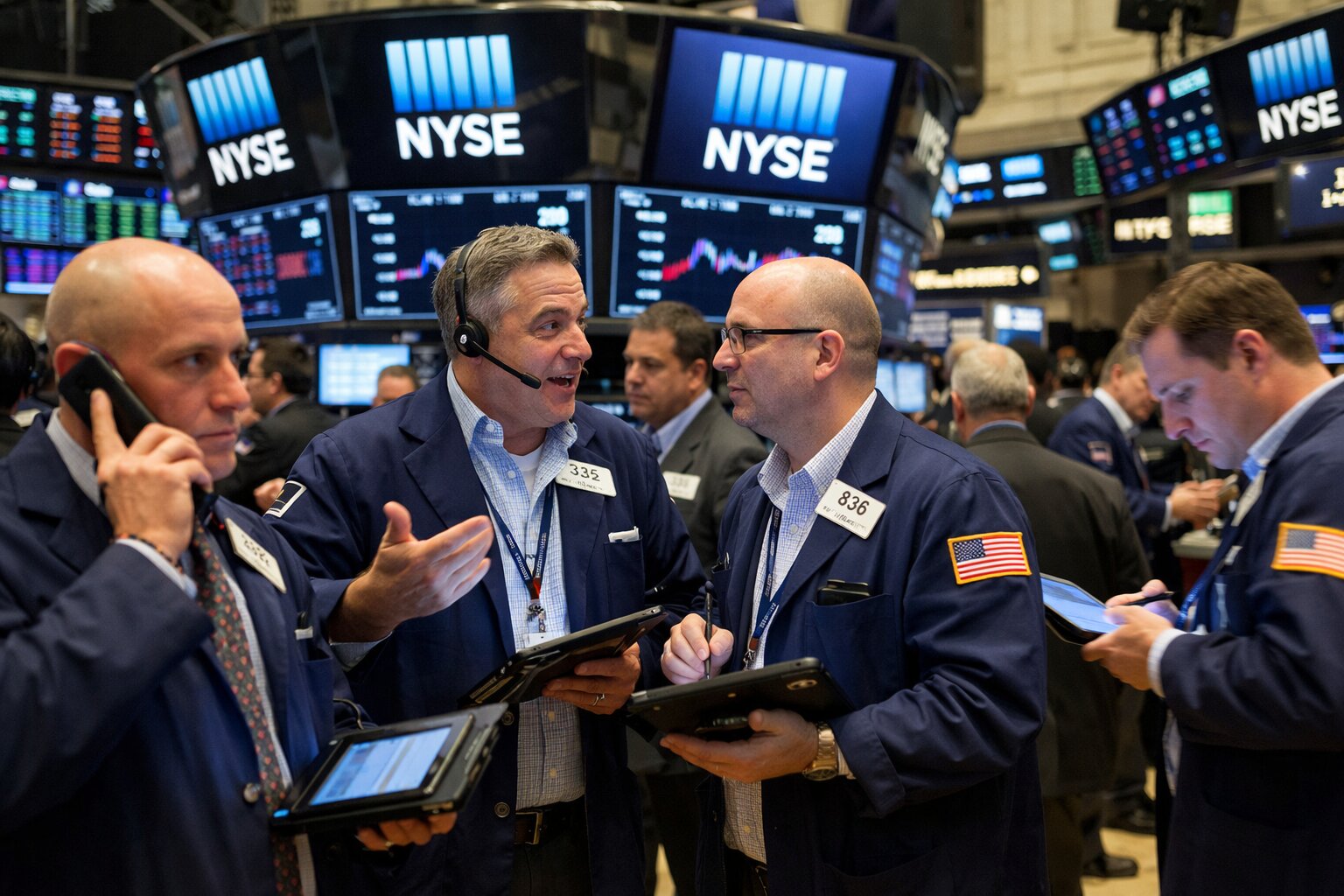
Stock Market Today: S&P 500, Dow Jones and Nasdaq Rebound as Supreme Court Strikes Down Trump Tariffs
S&P 500 closed near 6,884, the Dow around 49,533 and the Nasdaq near 22,783 as a 6–3 Supreme Court ruling against Trump’s tariffs lifted transports and retailers despite 1.4% GDP growth, 3% core PCE and gold above $5,050 | That's TradingNEWS
Holiday-shortened week ends with tariff shock turning into a relief rally
After a Presidents Day break on Monday, U.S. equities closed the shortened week with indexes higher despite a clear growth scare and sticky inflation. The Dow Jones Industrial Average finished around 49,533.62 (up roughly 0.3%), the S&P 500 near 6,884 (about +0.3%–0.4%), and the Nasdaq Composite around 22,783 (up roughly 0.4%–0.5%). The Russell 2000 lagged at about 2,662.78, down around 0.1%, underperforming large caps again even as the market tone turned more constructive into the close.
Volatility stayed elevated but controlled, with the VIX around 20.3, while the U.S. 10-year Treasury yield hovered near 4.09% and the 30-year pushed closer to 4.75% after a late-session selloff in long-dated bonds. The WSJ dollar index traded in the 94.8–97.7 band, marginally softer on the day, signaling that the tariff ruling and softer growth data took some support out of the recent dollar bounce. Hard assets were firm: gold futures traded above $5,050 per ounce (about +1.1% on the day), the broad S&P GSCI spot index sat around 601.33 (roughly +0.4%), and Bitcoin (BTC-USD) changed hands near $67,236 (up about 0.2%), confirming that real-asset and crypto hedges remain firmly in play alongside equities.
Growth slows to 1.4% as core PCE sticks at 3% – controlled deceleration, not a collapse
Fourth-quarter U.S. GDP expanded at just 1.4% annualized, far below the roughly 2.5%–3.0% expectations and sharply lower than the 4.4% pace in the third quarter. The drag came heavily from Washington: federal government spending contracted at roughly a 16.6% annualized rate as the record 43-day government shutdown in October–November carved close to 1 percentage point off growth. Under the surface, private-sector demand looked better than the headline. Real final sales to private domestic purchasers — the cleanest read on household and business appetite — grew 2.4%, only modestly below the prior 2.9%, which tells you the engine is throttling back, not stalling.
At the same time, inflation refused to roll over. The PCE price index rose 0.4% month-on-month in December and 2.9% year-on-year, while core PCE (excluding food and energy) also climbed 0.4% m/m and 3.0% y/y, both a touch hotter than the 0.3% consensus. Personal income increased 0.3%, and personal spending advanced 0.4%, showing households are still spending faster than incomes, helped by accumulated cash buffers and a still-solid labor market.
For rates, this combination — 1.4% growth with 3.0% core inflation — locks the Federal Reserve into patience. Minutes from the January meeting already flagged that officials see less downside risk to employment and remain worried about “more persistent” inflation. The latest numbers justify exactly that stance: cuts are coming, but not at the speed the market was hoping for a few months ago. Equities are being forced to live with a 10-year yield around 4%–4.25% for longer, which caps valuations but doesn’t kill the bull case as long as earnings keep grinding higher.
Supreme Court kills Trump’s emergency tariffs – transports, retailers and trade plays surge
The true intraday game-changer was the 6–3 Supreme Court decision that the International Emergency Economic Powers Act (IEEPA) does not authorize the president to impose sweeping tariffs. That ruling effectively knocks out the bulk of President Trump’s “Liberation Day” tariff package from April 2025, a signature policy that had been hanging over trade-exposed stocks for nearly a year.
Equity reaction was textbook. The Dow Jones Transportation Average spiked as much as 1.7% before easing, led by trucking, rail and delivery names. J.B. Hunt Transport Services (JBHT) traded up around 1.5%+ near $229.22, Union Pacific (UNP) added roughly 1.3% to around $266.55, and FedEx (FDX) advanced about 1.5% to $388.85. Tariff-sensitive consumer and industrial names ripped higher: Floor & Decor (FND) jumped almost 6.7% to about $70.53, Yeti Holdings (YETI) gained over 4% to roughly $49.06, Abercrombie & Fitch (ANF) added around 2.5% to $98.25, and Stanley Black & Decker (SWK) climbed roughly 2.5% to $91.85.
Big-box and specialty retailers joined the move. Lululemon (LULU) rose around 1.8% toward $186, Williams-Sonoma (WSM) gained almost 2.8% to roughly $216.62, Target (TGT) moved up about 1.6% to $117.54, and Dollar Tree (DLTR) advanced roughly 2.5% toward $136. This is precisely the cohort that has been squeezed for years by rising import costs and freight volatility; the court just handed them a margin tailwind.
On the macro side, academic estimates suggest potential tariff refunds could reach roughly $175 billion for importers, depending on how far back claims are allowed and how the administration responds. The White House has already hinted at trying to replicate the tariffs through alternative legal frameworks, but those tools are narrower and slower. Markets are therefore pricing in a partial rollback, not a full reset, which is why the rally faded from its intraday peak and the WSJ dollar index only slipped modestly. Even so, the message for equity risk is clear: the worst-case trade-war scenario is off the table for now, and tariff-exposed cyclicals just got a valuation re-rating.
Breadth finally broadens – more S&P 500 names are beating the index than at any time since 2001
One of the most important — and underappreciated — shifts is happening beneath the index level. The share of S&P 500 constituents outperforming the benchmark has climbed to the highest level since 2001. That means the rally is no longer just an AI–mega-cap story, even though the giants still matter.
Friday’s tape proved the point. The S&P 500 advanced about 0.3%, yet a growing list of mid-cap industrials, consumer names and financials posted larger percentage gains. The KBW Nasdaq Bank Index traded near 167.82, up about 0.1%, small on the day but meaningful in context: banks are holding their ground even as a private-credit shock plays out elsewhere. The Russell 2000 closed slightly negative, but the tariff reversal and improving breadth clearly favor domestically focused small caps over the next leg if growth stabilizes above 1%–2%.
A VIX around 20 signals elevated uncertainty, not panic. That is exactly what you want to see in a maturing bull market: risk is being repriced, not abandoned. The regime has shifted from a narrow, multiple-driven melt-up in a handful of names to a grind higher with rotation, where stock selection and sector calls matter far more than they did in 2023–2024.
Tech cools while communication services and AI infrastructure carve out new leadership
The most visible loser in the rotation remains classic big-tech and semiconductor beta. The technology sector map is showing stress in some of the prior darlings: Oracle (ORCL) fell around 2.5%, NVIDIA (NVDA) slipped nearly 0.9%, Advanced Micro Devices (AMD) dropped about 1.5%, and Intel (INTC) gave up more than 2.5%. Apple (AAPL) was down roughly 0.7%, all pointing to investors taking profits in mature, crowded trades after an enormous multi-year run.
Yet the picture is not simply “tech bad, everything else good”. The communication services bucket — which houses several of the most profitable digital platforms — showed more resilience. Alphabet (GOOG, GOOGL) added roughly 0.8%–2.0%, helping to pull the Nasdaq into the green. Netflix (NFLX) traded modestly negative (around -0.5%) but remains well-supported after its own re-rating on subscriber growth. This split underscores how the market is differentiating between commoditized tech hardware/software and platform businesses with durable cash engines.
On the AI front, the strategic trend still points in one direction: more concentration of power. NVIDIA (NVDA) is deepening its footprint in data-center infrastructure through expanded deals with Meta Platforms (META), including the rollout of Grace CPU-only servers at scale, while talks around a roughly $30 billion investment into OpenAI would further cement its role as the arms dealer of the AI cycle. The result is straightforward: when NVDA sells into a hyperscale data center, it is increasingly capturing the GPU, CPU and networking stack, eroding the relative bargaining position of legacy CPU players such as Intel (INTC) and even AMD (AMD). Friday’s modest red in those tickers is less about this single day’s news and more about the market recalibrating long-term profit pools inside the data center.
Private credit stress flashes yellow as Blue Owl gates redemptions and sells $1.4 billion in loans
While banks traded calmly, alternative credit was the weak link. Blue Owl Capital (OWL, OBDC) slid again (another ~1%–3% session after a ~6% drop the previous day) after permanently restricting withdrawals from one of its semi-liquid private-credit vehicles and selling roughly $1.4 billion of loans across three funds, including to its own insurer. The move reignited the debate about whether private credit — especially software-heavy loan books — has been marked too optimistically in a higher-rate, AI-disrupted world.
Peers Blackstone (BX) and Ares Management (ARES) slipped around 1% as well, not because they face the same immediate liquidity crunch, but because the narrative has turned: what was marketed as low-volatility, stable yield is now trading with equity-like headline risk. For the listed managers, fee streams remain robust, but any sign that retail-focused vehicles can be gated without warning will attract regulators and scare marginal buyers. The key market takeaway is that credit stress is being expressed outside the regulated banking system for now; the KBW bank index being slightly positive while OWL drops is exactly that divergence.
If you are long broad U.S. equities through the S&P 500 or Nasdaq, this is a sector-allocation story, not an index-level panic — for now. But the more private credit resets its valuations lower, the more vulnerable highly levered capital-light businesses become, particularly in software and lower-quality real estate.
Earnings tape: Walmart, Opendoor, Live Nation, AppLovin and Newmont sketch a picture of resilient demand
Corporate earnings continue to show that the real economy is sturdier than a 1.4% headline GDP print suggests. Walmart (WMT), whose results hit earlier in the week, posted solid numbers and commentary that gave no sign of a consumer collapse. CFO John David Rainey explicitly framed demand as steady, which matters more for markets than what a delayed government report prints. When the largest U.S. retailer tells you business is holding up, you listen.
In housing, Opendoor Technologies (OPEN) delivered a classic high-beta rebound story. Fourth-quarter revenue came in around $736 million, crushing expectations near $577 million, as home acquisition volume jumped roughly 46% quarter-on-quarter. The stock ripped about 19% to roughly $5.53. The flip side: OPEN still posted a loss of about $1.26 per share and guided to a first-quarter adjusted EBITDA loss of $30–35 million, but management’s target of positive adjusted net income by end-2026 on a rolling 12-month basis gives the market a clear profitability milestone. In a world where mortgage rates remain elevated, seeing any housing-linked platform grow volume that quickly is notable.
Experiential spending remains red-hot. Live Nation (LYV) logged about an 11% year-over-year revenue increase to roughly $6.31 billion, driven by a 12% gain in concert sales. The stock rose more than 3% pre-market and extended gains intraday, proof that consumers still prioritize events even as inflation eats into discretionary budgets elsewhere. AppLovin (APP) popped around 5% after posting better-than-expected fourth-quarter numbers and laying out a new social networking platform plan, reinforcing that well-positioned adtech and app-monetization players can still grow topline in a crowded space.
In the commodity complex, Newmont (NEM) showed what high gold prices can do for miners. The company reported adjusted earnings of about $2.52 per share, comfortably ahead of the roughly $2.04 consensus, and announced a record $7.3 billion in free cash flow. The stock gained around 2% after hours, aligning perfectly with spot gold’s move above $5,050. At these metal prices, balance sheets for quality miners are being rebuilt faster than most equity investors realize.
Read More
-
QQQM ETF (NASDAQ:QQQM) Around $249: AI-Powered NASDAQ-100 Fund Pulls In $304M
20.02.2026 · TradingNEWS ArchiveStocks
-
XRP ETFs Snap Back: XRPI and XRPR Climb as XRP-USD Defends $1.40
20.02.2026 · TradingNEWS ArchiveCrypto
-
Natural Gas Futures Price Forecast - NG Hangs on $3 as LNG Demand and EU Storage Deficit Set the Next Break
20.02.2026 · TradingNEWS ArchiveCommodities
-
USD/JPY Price Forecast: Yen Holds Above 155 as Japan Inflation Cools and Tariff Ruling Jolts the Dollar
20.02.2026 · TradingNEWS ArchiveForex
Shock losers remind the market that single-stock risk is back in full force
Not every earnings story was benign. Chemours (CC) collapsed roughly 14%–15% to around $17.42 after posting a $47 million fourth-quarter loss, equating to about -$0.31 per share on a GAAP basis, although adjusted earnings printed roughly $0.05 per share. Revenue of $1.33 billion essentially matched expectations, but the mix was ugly: ongoing weakness in titanium technologies and advanced materials is feeding doubts about the medium-term demand trajectory. When a cyclical chemical name misses like this in a “soft landing” environment, the message is straightforward: stock-picking in old-economy cyclicals still matters.
Biotech provided an even harsher lesson. Grail (GRAL) plunged close to 47% to the mid-$50s after its Galleri multi-cancer screening test failed to show a “statistically significant reduction” in Stage 3 and 4 cancers in a 142,000-patient U.K. trial. Management pointed to a favorable trend in a subset of 12 high-mortality cancers and more early-stage diagnoses, but when a story is priced for a clean win, “trend” is not enough. The repricing here is not just about this trial; it is about compressing the valuation premium across early-stage liquid-biopsy names unless and until they deliver hard, mortality-linked endpoints.
In cloud and infrastructure, Akamai Technologies (AKAM) fell nearly 8% in after-hours trading after guiding first-quarter adjusted EPS to roughly $1.50–$1.67, below a roughly $1.75 consensus, signaling that growth in high-margin security and edge-compute is decelerating faster than the market hoped. Dropbox (DBX) actually beat marginally — around $0.68 vs $0.67 EPS and $636 million versus $629 million in revenue — but the stock barely moved. Investors are now demanding clear acceleration or capital-return stories in mature SaaS; small beats no longer re-rate the multiple.
Gold, oil, dollar and Bitcoin – cross-asset signals line up with a cautious but not broken risk backdrop
The cross-asset message is consistent: risk is being repriced, not abandoned. Gold at roughly $5,050–$5,056 per ounce and up more than 1% on the day is a direct function of real yields remaining positive but unstable, the core PCE stuck around 3%, and rising geopolitical risk. As the U.S. ramps up pressure on Iran and President Trump openly threatens that “really bad things” could happen within 10 days absent a deal on the nuclear program, investors are paying for insurance.
Brent crude (BZ=F) traded near $71.35–$71.50 per barrel, down only about 0.2%–0.4% on the session but still more than 5% higher than a week ago, its biggest weekly gain since October. WTI (CL=F) hovered around $66.07–$66.30, off roughly 0.2%–0.5%, which is exactly what you expect after a sharp run-up: small pullbacks as traders lock in profits but keep the overall uptrend intact. The combination of potential U.S.–Iran escalation, tight OPEC+ discipline and a still-decent demand backdrop is supporting the entire commodity complex, as reflected in the S&P GSCI above 600.
The U.S. dollar index (DXY / WSJ dollar) eased roughly 0.13%–0.27%, reflecting the idea that tariff removal and a softer GDP print reduce the case for an ever-stronger dollar, even as U.S. yields stay elevated. A slightly weaker dollar, firmer gold and steady-to-higher oil is a classic “late cycle, but not recession” configuration. Bitcoin (BTC-USD) holding in the high-$60,000s near $67,236 while alt-coins wobble tells you that digital assets remain part of the macro hedge basket, but the days when crypto traded as pure high-beta tech are fading. Correlations to equities are lower than they were in 2022, which is precisely what diversified portfolios want.
Positioning into next week – tariff relief vs sticky inflation and what that means for U.S. equities
Put all of this together and the message for Nasdaq, S&P 500, Dow and the broader U.S. market is clear and nuanced at the same time. Growth has slowed to 1.4%, but private-sector demand is still running above 2%. Core inflation is 3%, not 5%. The Fed is not hiking, but it is in no hurry to slash rates. A major legal overhang — emergency tariffs — has just been knocked out, handing an immediate repricing to transports, retailers and other import-heavy businesses. Breadth is expanding, with the highest proportion of S&P 500 names outperforming the index since 2001, while the speculative edges of private credit and biotech are being disciplined.
At the same time, valuations at 6,800+ on the S&P 500 and nearly 22,800 on the Nasdaq already embed a decent amount of good news: AI spending booms, margins stabilize, and the Fed engineers a soft landing. A VIX near 20 and a 10-year around 4.1% tell you the market is not mispricing risk as egregiously as it did in past late-cycle episodes, but it is not cheap either. Add in Iran risk, lingering tariff uncertainty if the administration tries to rebuild them via other laws, and visible stress points in private credit, and the picture is not one-way bullish.
Given that balance, the stance for broad U.S. equities at these levels is Hold with a constructive tilt. For a global allocator reading Trading News, that means: stay invested in the S&P 500 and Nasdaq, use pullbacks driven by data scares or tariff headlines to add selectively, overweight beneficiaries of tariff relief and solid domestic demand — transports, quality retailers, industrials, and cash-rich platforms like Alphabet (GOOGL) — and underweight or outright avoid over-levered private-credit plays and high-expectation biotech stories that are one trial away from a 40% gap down.
Directionally, the tape is mildly bullish, not euphoric. The Supreme Court just removed one of the market’s biggest macro tail risks, breadth is improving, and earnings from names like Walmart (WMT), Newmont (NEM), Opendoor (OPEN), Live Nation (LYV) and AppLovin (APP) show real demand is still there. Until either the data decisively breaks or the Fed is forced back into a hawkish corner, the path of least resistance for Dow, S&P 500 and Nasdaq remains higher — but with enough volatility and dispersion that stock selection, sector rotation and risk control matter far more than simply buying every dip.