
Stock Market Today: Nasdaq 23,100, S&P 500 6,925, Dow 49,250 as Nvidia Earnings, Tariffs and Iran Risks
S&P 500 hovers near 6,925 and Dow around 49,250 while gold climbs above $5,200, Bitcoin trades near $66,500 and oil holds around $65, as AI mega-caps rally | That's TradingNEWS
Wall Street extends rebound as indices climb ahead of NVDA earnings
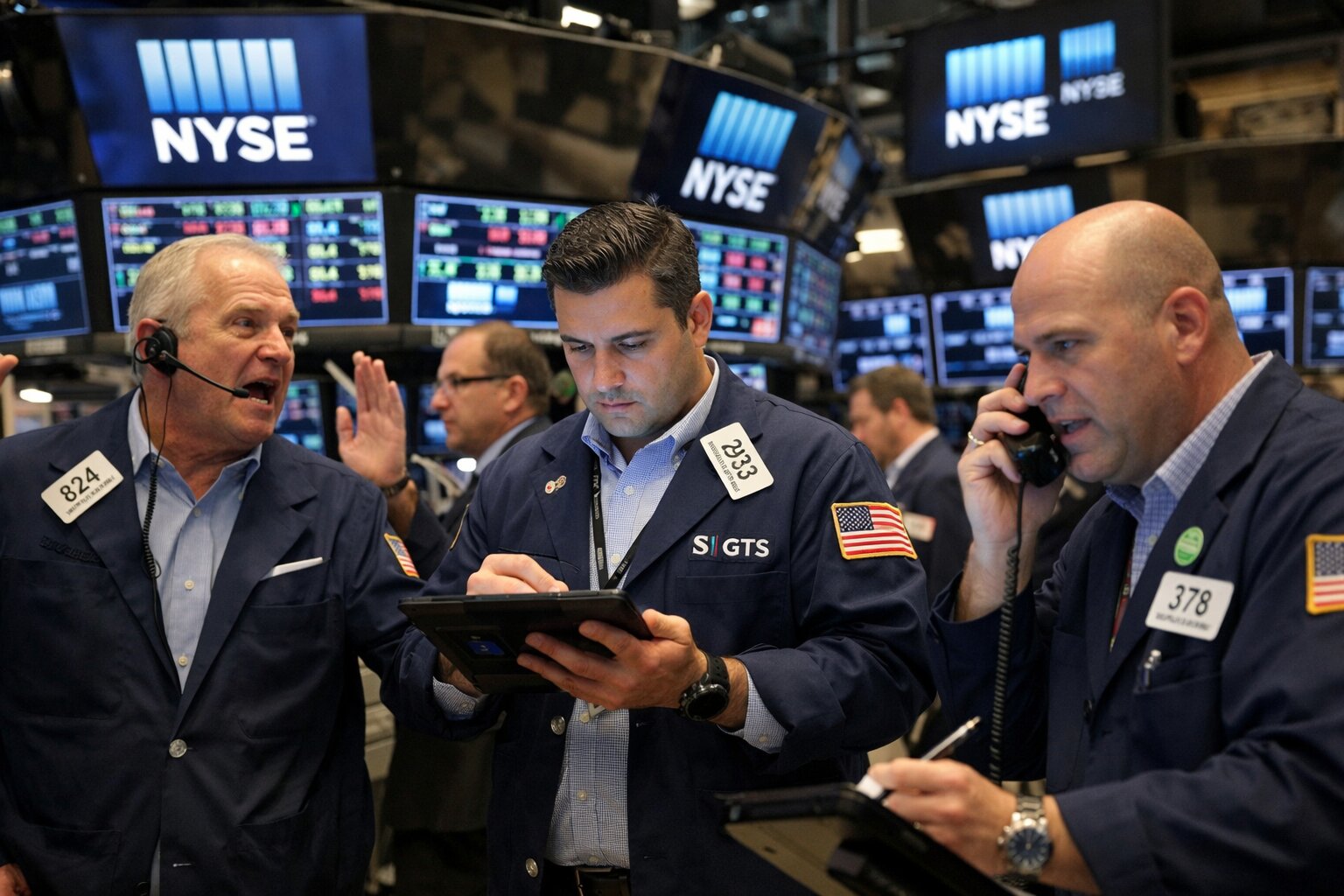
U.S. equities pushed higher on Wednesday morning, extending Tuesday’s reversal from Monday’s AI-driven selloff and shifting the focus back to hard numbers from Nvidia (NVDA). The S&P 500 added roughly 0.5% to trade around 6,925–6,930, the Nasdaq Composite advanced about 0.8–0.9% to roughly 23,100, and the Dow Jones Industrial Average hovered near 49,250, up about 0.2–0.3%. Futures earlier in the day had already pointed to modest gains across the S&P 500, Nasdaq-100 and Dow, and cash trading confirmed the move as investors rotated back into large-cap tech after Monday’s shock.
The backdrop remains one of elevated volatility: Monday’s sharp decline on AI-disruption fears and tariff confusion was followed by a broad-based rally on Tuesday, with the Nasdaq up 1.1%, the Dow up 0.8%, and the S&P 500 up 0.8%. That whipsaw is now turning into a two-day rebound, but with the market clearly positioning around one catalyst: whether NVDA can justify the current AI premium when it reports after the close.
AI mega-caps lead: NVDA, MSFT, CRM, SNOW reset the tone
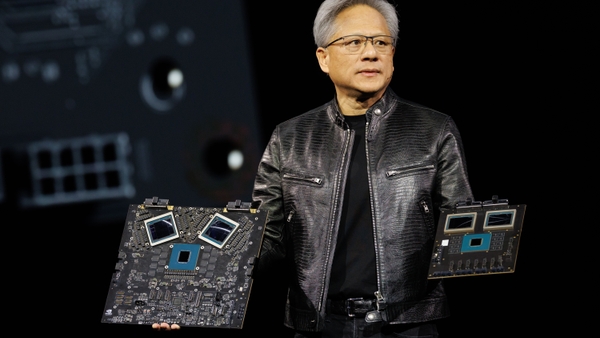
Tech is again setting the pace. NVDA is trading more than 1% higher ahead of its quarterly release, a print that will effectively test whether hyperscalers’ massive AI capex can keep translating into 50–60%+ revenue growth at the world’s most valuable chipmaker. Expectations are not just for a beat versus consensus; markets are looking for an upgraded revenue outlook that validates another leg of AI spending from cloud giants.
Software and AI-exposed names are participating in the rebound. Salesforce (CRM) is up around 1.5% ahead of its own results, while Snowflake (SNOW) is also firmer into its after-hours report. Every member of the “Magnificent Seven” basket is higher, led by Microsoft (MSFT) with a gain of roughly 2.5%, signaling that investors are willing to re-embrace the AI trade after last week’s drawdown in software, semis, and cyber.
The move builds on Tuesday’s 9% surge in Advanced Micro Devices (AMD), after Meta Platforms (META) signed a multiyear deal to secure 6 gigawatts of AI compute from AMD. That announcement helped calm fears that a handful of model providers would crush incumbent software vendors, and shifted attention back to the plumbing of AI infrastructure—GPUs, data centers, and power.
Trump tariffs, Supreme Court pushback and market recalibration
Policy risk is not in the background; it is threaded through every risk asset. The Supreme Court struck down roughly three-quarters of the tariffs imposed last year under emergency powers, ruling that the International Emergency Economic Powers Act did not authorize wide-ranging import taxes. That decision would have cut the average U.S. tariff rate nearly in half to around 9.1%, reduced the tariff-driven price bump from 1.2% to 0.6%, and lowered the typical household income drag to about $618 per year.
Instead, the White House moved quickly to restore the barrier. President Donald Trump imposed a temporary 10% across-the-board tariff on global imports and is now signaling a ramp to 15% for a 150-day window. U.S. Trade Representative Jamieson Greer said the administration aims to keep effective tariff rates on Chinese goods in a 35–50% band using alternative legal tools such as Sections 301 and 232 of the Trade Act, even after the court ruling.
The State of the Union speech reinforced that stance. Trump denounced the Court’s “unfortunate involvement,” pledged that “the deals are all done,” and floated the idea that tariffs could “substantially replace” income tax over time. That claim is inconsistent with current math—tariffs are bringing in on the order of tens of billions per month, a fraction of income tax receipts—but it signals that the administration treats tariffs as a cornerstone of its growth narrative, not a bargaining chip. Polls, however, show roughly two-thirds of Americans disapprove of his tariff handling, suggesting ongoing political and market friction whenever legal authority is tested again.
State of the Union: growth claims vs. affordability reality
In a nearly two-hour address, Trump painted the U.S. economy as being on the cusp of a “new age of prosperity.” The headline number he leaned on—full-year GDP growth of about 2.2%—is only slightly above the longer-run trend, and in fact the weakest annual pace since 2020. Part of that softness reflects the recent government shutdown, which shaved roughly one percentage point from fourth-quarter growth by some estimates.
The speech largely sidestepped affordability pressures that voters consistently flag. Instead of offering new relief measures, the president accused Democrats of lying about affordability and blamed them for the shutdown. At the same time, he rolled out a proposal for a government-backed retirement account and repeated his push to ban large institutions from acquiring single-family homes, framing both as ways to ease pressure on households without heavy new spending.
Equity markets have effectively discounted the rhetoric. After initial volatility around the Supreme Court decision and tariff headlines, index futures and cash markets are back to trading primarily off AI earnings and sector-specific fundamentals rather than the text of the speech. The risk is that another legal or legislative setback on tariffs could trigger a second round of uncertainty layered on top of already fragile positioning.
Energy, Iran and the tariff-inflation nexus
Oil is quietly embedding a geopolitical risk premium as tariff confusion and Middle East tensions collide. West Texas Intermediate futures are trading near $65.6 per barrel, up about 0.3% earlier in the session, while Brent sits just above $70.7, also higher by roughly 0.3%. The U.S. has amassed significant military assets in the Gulf, including two aircraft carriers and the largest air-power buildup since 2003, ahead of nuclear talks with Iran. Any disruption to the Strait of Hormuz, through which a large share of global seaborne crude flows, would transmit quickly into energy prices and inflation expectations.
Trump signaled he “wants a deal” with Tehran but conditioned any agreement on explicit language that Iran will “never have a nuclear weapon.” Iran’s foreign minister responded publicly that the country will “under no circumstances” pursue nuclear arms, but markets remain skeptical until there is a formal, verifiable framework. For now, the roughly $65–71 crude band reflects a compromise between ample non-OPEC supply and the possibility of shipping disruptions or sanctions escalation.
In that environment, energy equities are trading more on company-specific drivers than outright oil price spikes. The current crude strip does not scream crisis, but the embedded option value is significant: a headline-driven jump toward the mid-$70s for WTI would likely tighten financial conditions through higher gasoline and freight costs just as tariffs lift import prices.
Gold above $5,200 and metals volatility: hedging tariff and conflict risk
Gold continues to act as the cleanest hedge against tariff whiplash and Iran risk. April futures are trading around $5,209 per ounce, up roughly 0.5–0.6% on the day and clawing back much of a 1.6% drop in the previous session. The metal has stabilized above the psychologically important $5,000 mark after a violent two-day liquidation at the turn of the month, and strategists are again talking about an upside break if trade and geopolitical noise intensify.
Silver is amplifying the move, up about 3.6% to roughly $90.7 per ounce. The gold-silver ratio remains compressed relative to history, signaling that investors are increasingly willing to express reflation and manufacturing-linked views through silver as well as through the more traditional monetary hedge in gold.
Soft commodities tell a different story. May coffee futures are down almost 19% year-to-date and roughly 15% just in February—on track for the biggest monthly slide since October 2022. May cocoa futures have dropped more than 31% in January and another 26% in February, leaving prices almost 50% lower for 2026 so far. Translating those futures into lower supermarket prices is not straightforward given sticky supply chains and branding, but it does chip away at headline inflation pressure even as tariffs push in the opposite direction.
Rates, FX and global equity spillovers
The 10-year U.S. Treasury yield is grinding higher, sitting just above 4.06% compared with just under 4.04% at Tuesday’s close, as investors balance a still-resilient earnings season against tariff-linked inflation risks and the possibility that AI capex extends the cycle. The curve is steepening modestly as long-dated yields drift up faster than the front end, reflecting reduced fears of an immediate recession but no consensus on the timing or depth of future rate cuts.
The U.S. dollar index is trading around 97.9–97.95, slightly firmer after earlier softness, as risk sentiment swings back toward “risk-on.” A weaker dollar earlier in the session had helped gold, but as equities firm and tariff uncertainty becomes the norm rather than a shock, the greenback is finding support from relatively high U.S. yields.
Internationally, Japan’s Nikkei 225 closed at a fresh record near 58,583, gaining roughly 2.2% on the session. Metals and tech-linked exporters led the charge, leveraging Wall Street’s overnight rebound and a still-supportive yen backdrop. That combination—robust Japanese equity performance and high U.S. yields—continues to incentivize global investors to run equity risk while funding through low-yielding currencies, a classic late-cycle pattern.
Earnings tape bomb: CAVA, CRCL, AXON, TJX, FSLR, LOW, WDAY, GDDY, PYPL
The single-name earnings tape is noisy and influential. On the upside:
Mediterranean-focused Cava Group (CAVA) is surging—up roughly 20–22%—after delivering fourth-quarter revenue of about $273 million and adjusted EPS of $0.04, both above visible-alpha consensus. Same-store sales grew 0.5% versus expectations for a 1.1% decline, and the company opened 24 new restaurants in the quarter, again ahead of forecasts. That combination of modest comps, solid unit growth, and positive earnings surprises is the textbook profile of an early-stage growth restaurant stock still earning its multiple.
Circle Internet Group (CRCL) is ripping higher, up nearly 18–20%, as revenue jumped on the back of a 72% year-on-year increase in USDC circulation to $75.3 billion. Income from reserves reached $733 million as the firm deployed cash into low-risk assets such as Treasuries and high-grade deposits. The GENIUS Act—passed last year—gave dollar-pegged stablecoins a clearer federal framework, and Circle is now harvesting that regulatory tailwind through scale.
Public-safety technology leader Axon Enterprise (AXON) is another major winner, with the stock up close to 20% after reporting adjusted EPS of $2.15 versus $1.60 expected and revenue of $796.7 million against estimates near $755.3 million. Annual bookings surged 46% to $7.4 billion, driven by federal procurement and strong adoption of its AI-infused platform, including “Draft One” automated report writing and the “Axon Assistant” voice AI. Management highlighted use cases such as live translation in high-risk traffic stops, underscoring that AI is already improving frontline productivity.
Off-price retail giant TJX Companies (TJX) continues to execute. The company posted adjusted EPS of $1.43 versus $1.38 expected on net sales of $17.74 billion, up 9% year-on-year and ahead of the roughly $17.34 billion consensus. Same-store sales rose 5%, crushing estimates near 3.4%. Guidance is characteristically conservative—2–3% comp growth in the current quarter versus a roughly 3.45% Street bogey—but management plans a 13% dividend increase and $2.50–2.75 billion in buybacks through fiscal 2027, signaling high confidence in cash-flow durability. TJX shares are already up around 30% over 12 months and are still being treated as a core defensive growth holding into a choppy macro.
On the downside, the earnings tape is brutal for several growth and cyclical names. Solar manufacturer First Solar (FSLR) is down roughly 14–17%. Q4 EPS of $4.84 beat last year’s $3.65 but missed the $5.15 consensus, and while revenue of $1.68 billion topped expectations of $1.56 billion, full-year 2026 guidance of $4.9–5.2 billion is far below the Street’s roughly $6.1 billion view. The company announced a non-exclusive patent deal with Oxford Photovoltaics to advance perovskite-based devices, but that longer-term positive is being swamped by near-term growth disappointment.
Home-improvement bellwether Lowe's (LOW) beat on Q4 revenue and adjusted earnings but issued underwhelming EPS guidance through January 2027. The company expects earnings of $12.25–12.75 per share, vs. consensus near $12.90. The stock is down around 3–4.5%, reflecting skepticism that ongoing productivity initiatives can fully offset a still-pressured housing macro.
Enterprise cloud-applications provider Workday (WDAY) is under pressure, with shares off about 9–10% at the open and still down more than 9% over the past week. Q4 revenue of $2.53 billion slightly beat estimates, and EPS of $2.47 topped the Street’s $2.32, but guidance was light. Management sees Q1 subscription revenue at $2.335 billion and full-year at $9.92–9.95 billion, implying a deceleration that investors were not prepared to accept amid AI fears for software incumbents.
GoDaddy (GDDY) fell 9–16% after projecting 2026 revenue of $5.195–5.275 billion versus consensus near $5.28 billion. The headline miss is small, but commentary about slower-than-hoped adoption of AI-related services is enough to hit a stock whose multiple still embeds growth optionality.
Payment platform PayPal Holdings (PYPL) has rallied about 13% over the past two sessions on reports that Stripe is exploring an acquisition of all or part of the company, alongside interest from banks. With PYPL trading around the high-$40s (circa $47.6, up about 1–1.5% intraday), the story has shifted from pure execution risk to embedded M&A optionality. That re-rating may fade if no formal bid materializes, but the tape is now forced to value PAYPAL’s network and data assets in a strategic context, not just a standalone turnaround.
Read More
-
SCHD ETF Price Holds Around $31.50 as 2026 Rebalance Targets Higher-Quality Yield
25.02.2026 · TradingNEWS ArchiveStocks
-
XRP Rebounds: XRPI and XRPR ETFs Rip Higher as $1.30 Support Holds
25.02.2026 · TradingNEWS ArchiveCrypto
-
Natural Gas Futures Price Forecast - NG Smashes Winter Spike: NG=F Slides to $2.86 with $2.50 Now on the Radar
25.02.2026 · TradingNEWS ArchiveCommodities
-
USD/JPY Price Forecast: Bulls Defend 155 as Policy Gap Lifts the Pair Toward 158
25.02.2026 · TradingNEWS ArchiveForex
Software stress test: AI disruption narrative vs. real numbers
The software complex remains the focal point of AI disruption anxiety. Earlier in the month, reports about Anthropic’s Claude Cowork and its new connectors—integrating with Alphabet (GOOG) Drive and other enterprise tools—sparked a sharp rotation out of traditional SaaS, on the theory that horizontal AI agents would erode demand for incumbents’ workflow products.
Recent sessions have partially reversed that damage. The iShares Expanded Tech-Software ETF (IGV) gained about 2% in Tuesday’s session and is marginally higher again. Names like Palantir Technologies (PLTR) and MSFT are up, while laggards such as WDAY are being repriced based on very specific guidance details rather than blanket fear. Upgrades are helping at the margin: Oracle (ORCL) has jumped roughly 4% after being raised to “outperform” by one major broker with a $185 price target, 27% above the current roughly $151–152 level, on a thesis that its compressed multiple already reflects concerns about capital intensity.
At the same time, some legacy names are simply adjusting to more realistic expectations. International Business Machines (IBM) has been upgraded from “sell” to “neutral” by another broker after a 22% slide year-to-date and underperformance versus the S&P 500 by nearly 27 percentage points over 12 months. With the stock now trading around 18.5x projected 2026 EPS of $12.43 and 17.5x 2027 EPS of $13.13 on expected organic growth of 3–4%, the risk-reward is seen as balanced rather than skewed negative.
Beneath the surface, market structure is getting more fragile. According to one major asset manager, the share of S&P 500 constituents moving more than 10% in a single session has climbed, implied correlation has fallen, and options activity remains extremely elevated—signs that dispersion is high and retail speculation significant. That mix improves stock-picking opportunities but makes the entire structure more vulnerable to a sudden, outsized move if a core AI name like NVDA disappoints.
Crypto and stablecoins: BTC-USD, ETH-USD, XRP-USD, USDC digest policy silence
Crypto assets are grinding higher despite being completely absent from Trump’s State of the Union. Bitcoin (BTC-USD) is changing hands near $66,500 after probing lows below $63,900 overnight and remains about 3–4% higher on the day. The omission of digital assets from the speech was notable but not market-moving; traders care far more about the practical impact of the GENIUS Act and other regulatory frameworks than about headline mentions.
Ethereum (ETH-USD) and XRP-USD are also firmer, aided by the stabilization in tech equities and the sense that stablecoin regulation is moving toward clarity rather than crackdown. Circle’s USDC growth—72% year-on-year circulation expansion to $75.3 billion—underscores that regulated dollar-tokens are becoming infrastructure, not just speculative chips.
From a cross-asset standpoint, the key takeaway is that crypto is trading as a high-beta macro asset: it sold off hard during Monday’s AI panic and tariff confusion, then rebounded as equities stabilized and as the GENIUS Act framework and stablecoin adoption supported the structural bull case. The absence of any hostile rhetoric in the State of the Union is, by default, a mild positive.
Household pressure, energy demand and AI power pledge
A less appreciated angle from the State of the Union was energy. Trump acknowledged that Americans are worried about soaring electricity bills as AI data-center demand explodes. Average retail power prices hit about 17.24 cents per kilowatt-hour in December, roughly 6% above year-earlier levels, despite campaign-trail promises to halve bills.
The administration’s “ratepayer protection pledge” requires major tech developers to fund their own power usage rather than shifting costs to households. In regions served by PJM Interconnection, the largest U.S. grid operator, capacity prices have already spiked from roughly $28.9 per megawatt-day for 2024–2025 to about $329.2 for 2026–2027—more than an order of magnitude jump. For investors, that creates a powerful spread trade: long select grid operators, transmission and generation assets positioned to sign long-term contracts with AI hyperscalers; cautious on consumer-exposed utilities if policy fails to contain bills.
The pledge matters for the AI trade because the full cost of power-hungry training and inference must eventually be priced into margins, either at hyperscalers or at downstream enterprise users. If developers truly shoulder the bulk of grid upgrades and energy costs, that could pressure profitability in AI infrastructure while cushioning households—and by extension, consumption and retail-oriented names like TJX and CAVA.
Index-level stance: rally intact but dispersion and policy risk argue for selectivity
Given all the above, the index verdict is nuanced:
For the S&P 500 around 6,925–6,930 and the Nasdaq Composite near 23,100, the stance is HOLD with a modestly bullish bias. Earnings have been stronger than feared—Q4 S&P 500 EPS grew roughly 13%, nearly six points above expectations, and guidance revisions in the Russell 3000 have skewed 4-to-1 positive. Yet the indices started the season near record highs, and AI-heavy winners are richly valued. NVDA’s print is a genuine binary risk for sentiment over the next few weeks.
The Dow near 49,250 is also a HOLD, tilted toward selective BUY in defensive earnings compounders like TJX that continue to raise dividends and buy back stock while delivering mid-single-digit comps. With tariffs, energy and AI grid costs all creating headline risk, market leaders that can grow EPS without relying on multiple expansion deserve a premium.
Gold above $5,200 per ounce, given tariff uncertainty and Iranian tensions, screens as a BUY. The metal has re-anchored above $5,000 after a forced liquidation and benefits both from any renewed dollar weakness and from safe-haven flows if rates volatility returns. Silver at roughly $90.6 is a higher-beta expression of the same themes and is BUY for aggressive accounts, but too volatile to be core.
Crude around $65.6 for WTI and $70.8 for Brent is a HOLD. There is enough geopolitical premium embedded that a benign outcome in U.S.-Iran talks could knock prices lower, but not so much that a negative surprise would be fully priced in. Energy equities should be treated as trading vehicles rather than set-and-forget positions at this level.
BTC near $66,500 is a HOLD with a speculative bullish tilt. Regulatory momentum behind stablecoins, USDC’s scale, and the absence of overt political hostility support the structural bull case, but the asset is still trading as levered beta to tech and macro risk. Position sizing needs to reflect that single-day drawdowns of 10%+ remain very possible.
The overarching message from today’s tape is clear: the AI-led U.S. equity rally is not broken, but it is increasingly a market of individual winners and losers, not a monolithic bet. With dispersion high, correlation low, tariffs in flux, and NVDA about to report, broad indices justify a HOLD, while select names and hedges—TJX, AXON, CAVA, CRCL, gold—earn a more decisive BUY call, and duration and richly priced solar or software names like FSLR, WDAY and GDDY warrant caution or selective SELL into strength.