

Stock Market Today: Nasdaq, S&P 500 and Dow Jones Struggle While Gold and Oil Diverge
S&P 500 hovers near 6,900, Dow holds around 49,500 and Nasdaq lags, with gold futures above $5,180, WTI crude near $67 and tech names such as NVDA, MSFT and AMZN adjusting to tariff and AI risk | That's TradingNEWS
Tariff shock and the new market playbook
Donald Trump’s shift to a flat 15% global tariff under Section 122 has reopened the trade war chapter with a different legal base and a fixed 150-day clock. The Supreme Court’s rejection of the emergency IEEPA tariffs removes one framework and replaces it with a time-limited structure that will force Congress to either endorse or kill this broad levy before late July. That binary decision is now a major macro event on the 2026 calendar. At the same time, key partners are pushing back. The European Commission is signalling it will freeze ratification of last year’s trade deal and is repeating the line that “a deal is a deal.” Indian officials are postponing a US visit, and Japanese policymakers are calling the situation “a real mess.” The message from overseas is simple: existing commitments remain on paper, but nothing new will be agreed until Washington clarifies whether this 15% tariff is a short-term bargaining chip or the start of a longer regime.
Nasdaq, S&P 500 and Dow: price action under policy crossfire
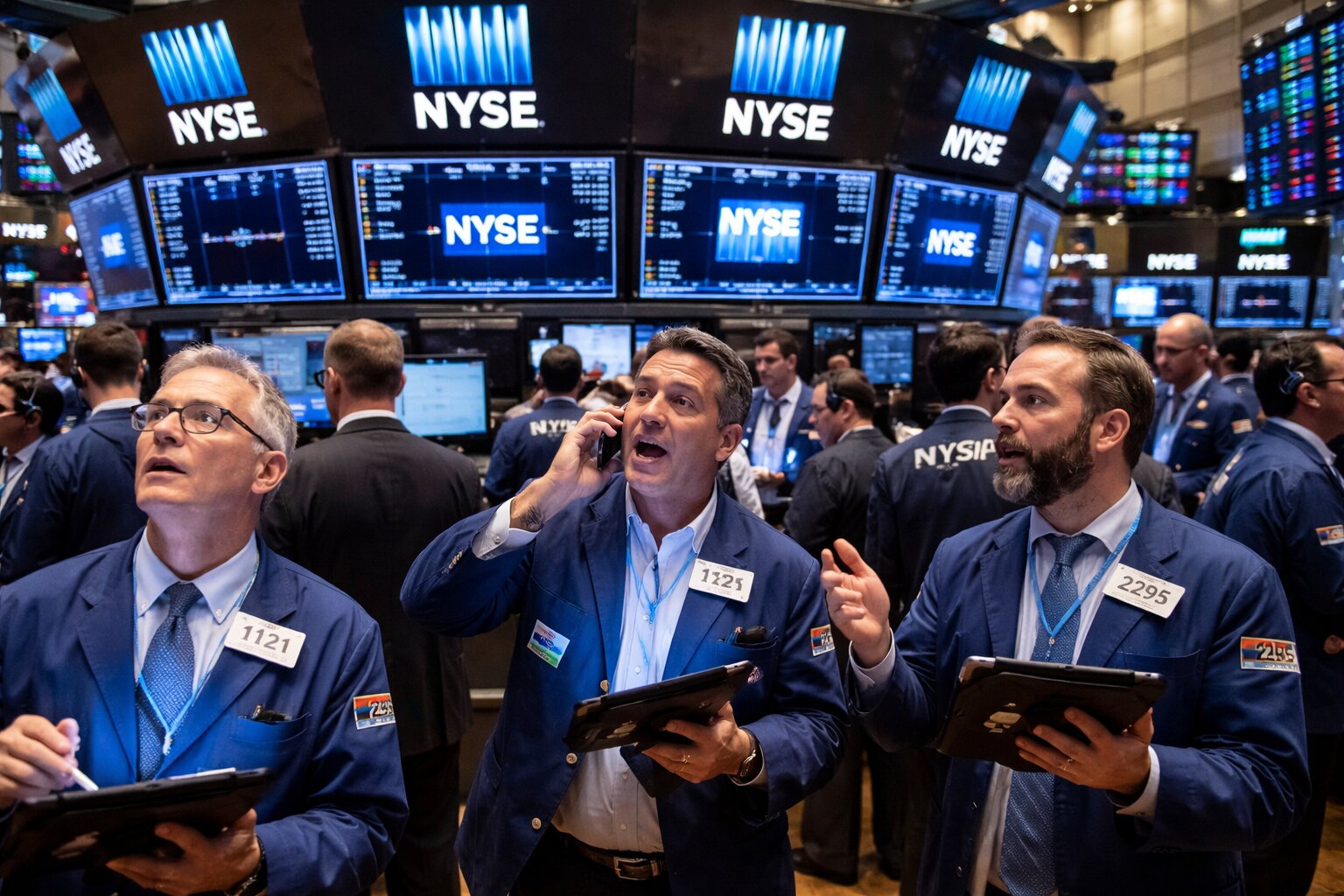
The equity indices are absorbing the tariff shock rather than collapsing. The S&P 500 (SPX) is hovering around 6,895–6,900, down roughly 0.2%. The Dow Jones Industrial Average (DJIA) is trading near 49,500, off about 0.25%. The Nasdaq Composite (COMP) is lagging with a drop of around 0.4–0.5% near 22,780–22,800, as growth and software carry more of the policy risk premium. Futures set the tone earlier: E-Mini S&P 500 (ES=F) slipped about 0.3%, Nasdaq 100 futures (NQ=F) around 0.5%, and Dow futures (YM=F) roughly 0.3%. Volatility is repricing higher but contained, with the VIX around 20, up about 5%, consistent with a regime shift in uncertainty rather than a systemic shock. Abroad, the tariff story is visible in regional spreads. The pan-European Stoxx 600, DAX and CAC 40 are down around 0.3–0.6%, while India’s Nifty 50 and Sensex are up about 0.5%, reflecting expectations that some supply-chain and trade flows may tilt toward India. In Asia, Hong Kong’s Hang Seng added roughly 2% as the market speculates about new bargaining leverage for China if existing US tariffs are trimmed or reshaped.
Gold and silver: safe-haven demand at $5,100+ and $86+
The metals market is behaving like a pure barometer of policy anxiety. COMEX April gold futures (GC=F) are trading around $5,180–$5,190 per ounce, up close to 2% on the session and extending a run of three weekly gains. Silver futures (SI=F) have jumped to roughly $86–$87, a 4–6% daily move. A softer dollar, with the U.S. dollar index (DXY) slipping to about 97.7, makes bullion cheaper in non-dollar terms, but the real driver is the tariff shock layered over already-elevated geopolitical risk. At these prices gold has moved beyond a quiet hedge role and is trading like a high-beta macro momentum vehicle: each new headline on trade or fiscal refunds squeezes shorts and forces late entrants to chase. That dynamic can continue while the policy picture remains unclear, but it also means the metal is vulnerable to a fast air-pocket if Congress signals it will allow the Section 122 tariffs to lapse or if the Fed reinforces its easing bias in a way that stabilises risk sentiment.
Bitcoin, ETFs and the breakdown of the ‘digital hedge’ story
Crypto is moving in the opposite direction to metals. Bitcoin (BTC-USD) slid overnight to almost $64,300, its lowest print since early February, before rebounding toward $66,000. It is still down about 2–3% on the day and roughly 50% below the October peak above $126,000. Ether (ETH-USD) is underperforming with losses of more than 5%. The move is not just a knee-jerk tariff reaction. Regulatory filings show that fast-money capital is stepping away from spot bitcoin funds. Aggregate positions in US bitcoin ETFs among the biggest hedge-fund holders dropped around 28% between the third and fourth quarters of 2025, with one high-profile firm cutting an iShares Bitcoin Trust (IBIT) stake by roughly 86%, from about $2.4 billion to $275 million. With macro risk rising and the easy ETF basis trade fading, bitcoin is trading like a high-beta equity proxy again. Instead of offsetting volatility in SPX and COMP, it is amplifying it, which undermines the institutional “digital gold” argument at precisely the moment when a hedge would be most useful.
Fed governor Waller, January jobs noise and Treasury yields
Monetary policy is the second buffer between tariffs and risk assets. Fed governor Christopher Waller, who dissented at the January meeting to push for a further rate cut, is framing the next step as a labour-market call rather than a tariff call. January non-farm payrolls rose by about 130,000, but the gains were concentrated in healthcare and weather-boosted construction, while many other sectors posted small job losses. Waller’s point is that this pattern looks more like statistical noise than a genuine re-acceleration in hiring. He has flagged the February jobs report, due on March 6, as the real signal for the March decision. If February confirms stronger job creation and a low unemployment rate, he can live with holding the policy rate where it is. If revisions drag January down and February looks weak, he has already created the narrative space for another cut. Crucially, he has dismissed Friday’s tariff ruling and the new 15% levy as marginal for his inflation view. The Treasury curve reflects this: the 2-year yield sits near 3.48%, the 10-year just above 4.0%. Those levels say the market still expects disinflation and a bias toward lower rates, even with tariff headlines in the background.
AI earnings and mega-cap rotation: NVDA, CRM, WDAY, IGV
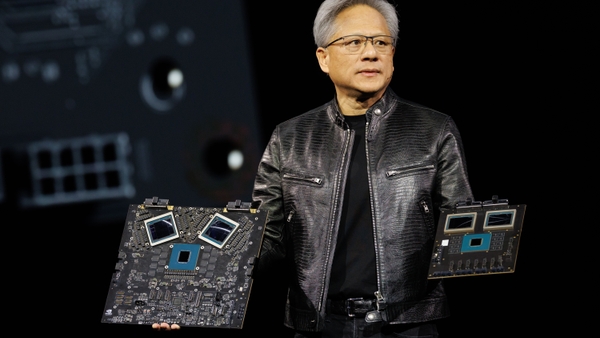
While tariffs dominate politics, earnings from the AI complex are still the primary driver for the growth trade. NVIDIA (NVDA), which reports mid-week, is up about 1.5% around $192–$193 even as broader software trades lower. Street expectations imply another “beat and raise,” with some desks talking about the potential for revenue guidance above $70 billion versus a current consensus in the mid-$60 billions and a backlog that could exceed $500 billion in AI compute demand. The message is that supply remains tight and hyperscalers still need every GPU they can secure. The rest of software is not getting the same premium. Workday (WDAY) is trading roughly 5–6% lower, Salesforce (CRM) about 4% down, and the iShares Expanded Tech-Software Sector ETF (IGV) is off around 4%. The market is now ruthless: large capex promises tied to AI must show up as operating leverage and durable free-cash-flow growth, or the multiple compresses. More broadly, the “Magnificent Seven” leadership is under real pressure. Year-to-date, Microsoft (MSFT) has fallen almost 18%, Tesla (TSLA) and Amazon (AMZN) more than 8%, Alphabet (GOOGL) is roughly flat and NVDA is only up about 1%. The dedicated Roundhill Magnificent Seven ETF (MAGS) is down close to 6% in 2026. That profile points to a maturing trade where concentration risk is being challenged and earnings execution, not story-telling, determines performance.
Read More
-
FDVV ETF Price Tests $60 Ceiling as Dividend Flows Drive $10B AUM
23.02.2026 · TradingNEWS ArchiveStocks
-
XRP ETF Flows Clash With Fear: XRPI $7.75, XRPR $11.09 After $53M Hit
23.02.2026 · TradingNEWS ArchiveCrypto
-
Natural Gas Futures Price Forecast - NG Jump on US Winter Storm, But Bears Still Aim at $2.60
23.02.2026 · TradingNEWS ArchiveCommodities
-
USD/JPY Price Forecast - USDJPY Slides From 155.65 High as Tariff Shock and Policy Split Pull Pair Toward 154
23.02.2026 · TradingNEWS ArchiveForex
Single-stock moves: obesity arms race, pizza cash machine, private credit stress
The most dramatic single-name reaction sits in the obesity-drug battlefield. Novo Nordisk (NVO) is down about 13–15% after its next-generation combination therapy CagriSema failed to match Eli Lilly (LLY)’s tirzepatide on weight-loss outcomes. Patients on a 2.4 mg CagriSema dose lost roughly 23% of body weight over 84 weeks, against about 25.5% for a 15 mg tirzepatide dose. In a market where payers and prescribers are looking for maximum efficacy, that gap is enough to shift future cash-flow expectations. Lilly shares are up around 3–4%, reinforcing its lead across the Mounjaro and Zepbound franchises and signalling that capital will continue to crowd around the strongest data set. In consumer discretionary, Domino’s Pizza (DPZ) is a clean example of consistent execution being rewarded. Q4 revenue rose 6.4% year-on-year to about $1.54 billion, ahead of estimates around $1.52 billion. US same-store sales growth of 3.7% beat expectations closer to 2–3%. The board approved a 15% dividend increase to $1.99 per share, and the company added 776 stores in 2025, taking the global footprint to more than 22,100 locations. The stock, which had been down roughly 16–17% over twelve months, is now up around 4–6% on the day as the market pays up for visible growth, higher payouts and scale. In healthcare M&A, Arcellx (ACLX) has exploded higher, gaining close to 80% after Gilead Sciences (GILD) agreed to acquire the company for $7.8 billion. The deal structure – $115 per share in cash plus a $5 contingent value right – underscores how much value large pharma still places on differentiated CAR-T and immunotherapy platforms, even in a shakier macro environment. There are also cracks in more opaque parts of credit. Blue Owl Capital (OWL) has permanently gated withdrawals in one of its tech-focused private-credit funds after investors tried to pull more than 15% of net assets. The fund is now selling assets to return capital, and the stock has suffered an eleven-day losing streak since going public. That pattern – tight gates and secondary sales under pressure – is drawing comparisons with the pre-2008 period, when credit vehicles over-promised liquidity. On the cyclical side, International Paper (IP) is down about 6% after containerboard price data disappointed analysts who expected tighter supply, and airline stocks are being hit by weather rather than tariffs. A major blizzard on the US East Coast has led to more than 5,000 flight cancellations on Monday, with cancellation rates near or above 90% at JFK, LaGuardia and Boston Logan. United Airlines (UAL) and American Airlines (AAL) are down roughly 1%, while Delta Air Lines (DAL) is off around 0.5%, reflecting short-term lost revenue and higher operational costs.
Dollar, crude and cross-asset positioning: DX-Y.NYB, CL=F, BZ=F
The currency and energy tape confirms that this is a policy-uncertainty shock, not a growth shock yet. The U.S. dollar index (DX-Y.NYB) is trading near 97.66, around 0.1% lower, reflecting marginally weaker confidence in the US policy mix and expectations of lower future rates rather than immediate concern about US solvency. In crude, both benchmarks are slightly softer after a sharp year-to-date run. West Texas Intermediate (CL=F) is around $66.5–$67.2 per barrel, while Brent (BZ=F) trades near $71.5–$72.0. Both are up about 15–16% since the start of 2026, driven by Iran-related supply anxiety and thin OECD inventories, but they are giving back around 0.3–0.7% today as traders weigh tariff-driven demand risk against supply tension. Strategists at major banks have already raised 2026 crude targets, but current prices sit above those new levels, signalling that the market is trading ahead of fundamental forecasts. For equities, that set-up – firm but not spiking oil, a slightly softer dollar, and stable long yields – is uncomfortable for margins but far from an outright stagflation scenario.
Earnings backdrop and valuation: SPX at 21–22x, Citi EPS at $320
Underneath the noise, the earnings engine for S&P 500 remains solid. A prominent global bank is holding a 2026 EPS forecast of $320 for the index, about 2% above the current analyst consensus. At today’s level around 6,900, that implies a forward price-to-earnings multiple near 21.5x. The core of that thesis is a broadening of profit growth beyond mega-cap tech into the “other 492” stocks that have lagged the Magnificent Seven over the past two years. The tariff saga actually pushes in that direction: persistent uncertainty around trade, capex and global supply chains makes it harder to justify extreme concentration in a small cluster of AI beneficiaries and nudges capital toward domestically focused, cash-generative businesses with clearer pricing power. With GDP tracking around the mid-3% area for Q1 including the rebound from the 2025 government shutdown, and full-year 2026 growth projected close to 2.5% on a Q4/Q4 basis, the macro baseline still supports earnings expansion rather than contraction.
Positioning verdict: SPX buy-the-dip, gold hold, bitcoin underweight
Taken together, the current environment is a volatility event within an ongoing earnings cycle, not the start of a structural bear market. Tariffs at 15% under Section 122 create a visible risk premium and a known binary decision point in 150 days, but they do not yet translate into a collapse in 2026 profit expectations. With SPX off less than half a percent from Friday and an EPS path near $320, the stance on US large-cap indices is Buy-the-dip with a clear quality bias. Pullbacks driven by tariff headlines and higher VIX, rather than by hard earnings downgrades, offer chances to add exposure to balance-sheet-strong, cash-rich names that can navigate policy noise. For gold, the move above $5,100 has already priced in a significant amount of stress. The metal still plays a useful hedge role against political and fiscal surprises, but the risk-reward at current levels is less attractive than it was below $5,000. The stance here is Hold, with a preference to scale in on corrections toward prior breakout zones instead of chasing new highs. For bitcoin, price behaviour and ETF flows both argue for caution. A drawdown of nearly 50% from the October peak, combined with a 28% slide in hedge-fund ETF holdings and a renewed correlation with high-beta equities, weakens the case for bitcoin as a portfolio stabiliser. In this backdrop the rational allocation call is Sell down to underweight or reduce exposure, especially in portfolios that already carry meaningful equity and credit risk.