Stock Market Today — Dow Loses 903 Points, S&P 500 Cracks 6,734 and Breaks December Support, Nasdaq Hits 22,458 as February NFP Sheds 92,000 Jobs
S&P 500 breaks December support at 6,778 closing at 6,734.63, Nasdaq drops to 22,458.69, VIX spikes to 28, Marvell (MRVL) +15% on AI earnings beat, Gap (GAP) -10%, OXY +3.3% | That's TradingNEWS
Stock Market Today — Dow Jones Plunges 903 Points, S&P 500 and Nasdaq Each Down 1.6%, February NFP Sheds 92,000 Jobs, Brent Crude Tops $91, and Marvell Technology Surges 15% While Gap Collapses 10%
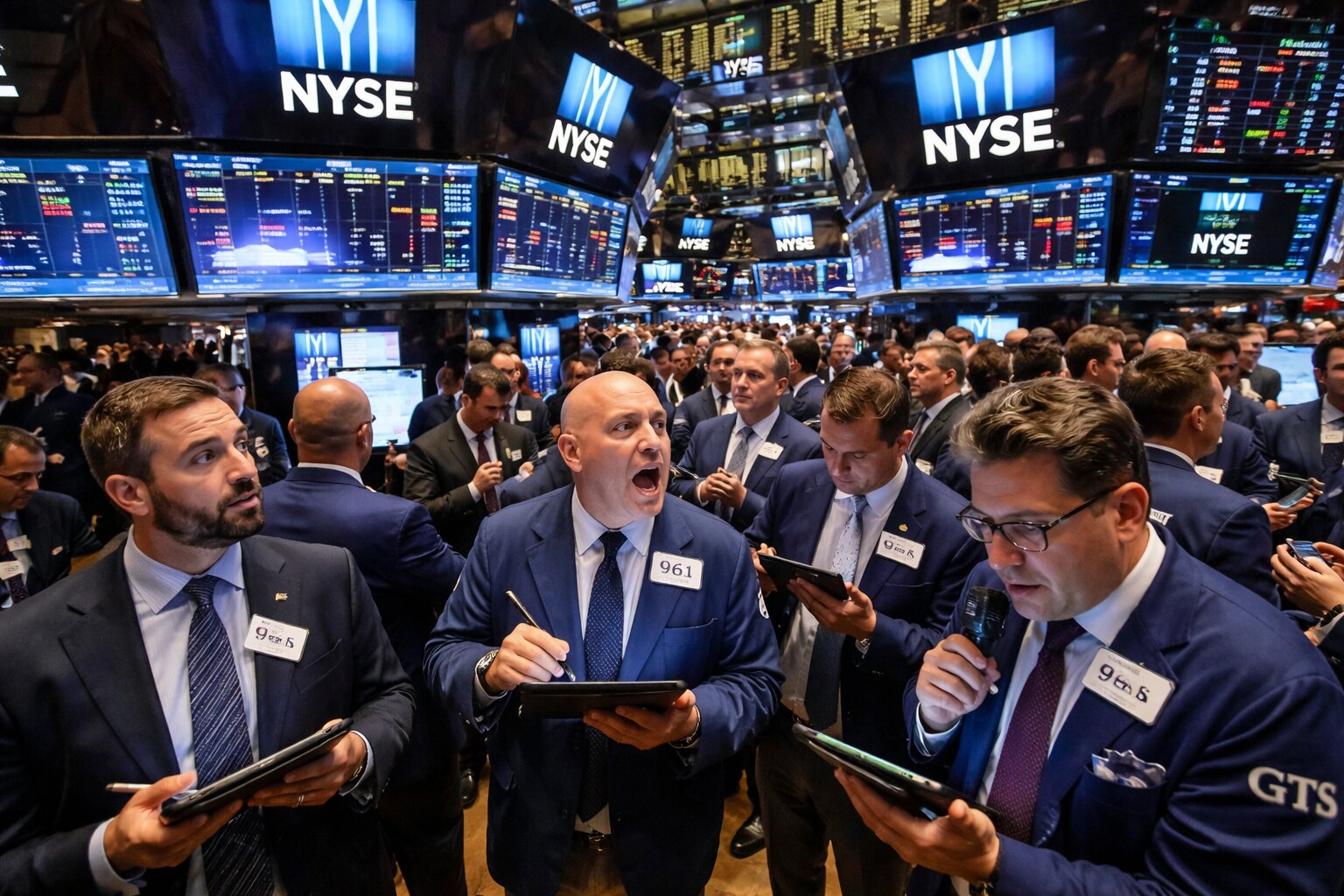
Friday, March 6, 2026 delivered the kind of session where every risk model breaks simultaneously. The Dow Jones Industrial Average lost 903 points or 1.9%, closing at 47,096.94. The S&P 500 fell 96.08 points or 1.6% to 6,734.63. The Nasdaq Composite dropped 290.30 points or 1.6% to 22,458.69. The Russell 2000 shed 60.53 points to 2,525.04. For the week, the S&P 500 is on pace to lose more than 2%, the Dow has fallen nearly 3% — its worst weekly performance since October — and the Nasdaq is tracking more than 1% lower. Two simultaneous shocks hit markets within the same morning window: a February jobs report that was not just a miss but a complete collapse, and an oil market that is now pricing a scenario where the Strait of Hormuz stays closed long enough to destroy global growth.
92,000 Jobs Lost in February — The Labor Market Shock That Changes the Fed's Calculus Entirely
The Bureau of Labor Statistics reported February nonfarm payrolls fell by 92,000 — a number so far outside consensus expectations that it requires a moment of genuine analytical reckoning. Economists surveyed by Dow Jones expected a gain of 50,000 jobs. January's print was revised down to 126,000 from 130,000. December was also revised lower. The unemployment rate rose to 4.4% from 4.3%, exceeding the 4.3% consensus. Every directional assumption entering Friday was wrong simultaneously — not a modest miss, a 142,000-job swing from the midpoint of expectations.
The structural problem beneath the headline is worse than the number suggests. Health care added 137,000 jobs in January — nearly the entire month's growth — and that pattern has been consistent throughout 2025. Strip health care from the employment picture and job growth would have been negative for most of last year. 2025 was already the slowest year for job creation outside a recession in more than twenty years. February's outright job losses confirm the deceleration is not stabilizing — it is accelerating. The 10-year Treasury yield sits at 4.166%, up from 4.14% Thursday and 3.95% last Friday — yields rising every single day this week even as the labor market collapses, which is the stagflation signal markets are now pricing.
CME FedWatch shows odds of at least one rate cut through June at only 35.3% — barely moved from 33.7% pre-report. A Fed that cannot cut into job losses because oil-driven inflation is simultaneously surging is the exact definition of a stagflationary trap. The VIX is at 28.07, up 4.32 on the session — not panic territory, but sustained elevated volatility that reflects genuine macro uncertainty rather than technical selling.
Read More
-
FDVV ETF at $57.41 — 22% Discount to SPY, Why the Barbell of Nvidia and Coca-Cola Makes This a Buy
06.03.2026 · TradingNEWS ArchiveStocks
-
XRP ETF (NASDAQ:XRPI) at $7.76, XRPR at $11.12 — $153M Institutional Buying Into a 25% Decline, 7B Tokens Off Exchanges
06.03.2026 · TradingNEWS ArchiveCrypto
-
Natural Gas Futures Price at $2.97 — Qatar's 77M Ton LNG Halt and Why $2.90 Is the Most Dangerous Floor in Energy Markets Right Now
06.03.2026 · TradingNEWS ArchiveCommodities
-
USD/JPY Price at 157 — Fed Cut Odds at 50%, and Why the Dollar Climbs Despite the Worst Jobs Miss in Years
06.03.2026 · TradingNEWS ArchiveForex
Brent Above $91, WTI Above $89 — Qatar's Energy Minister Warns of $150 Oil and Economic Collapse
West Texas Intermediate (WTI) crude futures broke above $89 per barrel Friday, up approximately 9% on the session and 30% for the week — the largest weekly gain since Russia invaded Ukraine in February 2022. Brent crude crossed $91.33, up 6.93% on the day after hitting $89.38 earlier in the session. These are prices not seen since 2024, reached in less than seven trading days of Middle East conflict escalation.
The proximate catalyst for Friday's final leg higher was President Trump posting on Truth Social that there will be no deal with Iran without "unconditional surrender" — eliminating any near-term de-escalation probability the market had been pricing. Qatar's energy minister Saad al-Kaabi told the Financial Times that Gulf energy producers may need to call force majeure within days, shutting production entirely. His warning: oil could reach $150 per barrel if tankers cannot pass through the Strait of Hormuz — a scenario he said could "bring down the economies of the world." More than 14 million barrels per day of crude passed through the Strait in 2025, approximately one-third of all seaborne oil exports globally according to Kpler. Danish shipping giant Maersk suspended services linking the region to Europe and Asia on Friday.
Edward Jones senior strategist Angelo Kourkafas noted the U.S. is a net oil exporter since 2019 and the economy is less energy-intensive than historically — oil would likely need to remain above $100 for an extended period to meaningfully slow U.S. growth. That threshold is now 12% away from Friday's WTI print and potentially days away if the Strait remains closed.
Marvell Technology (NASDAQ:MRVL) Surges 15% — The Only Earnings Winner in a Sea of Red
Marvell Technology (NASDAQ:MRVL) was the session's standout, surging 11% in premarket before extending to 15% gains at the open. Q4 adjusted EPS came in at $0.80 on revenue of $2.22 billion — beats against the $0.79 EPS and $2.21 billion revenue consensus. Management guided for year-over-year revenue growth to accelerate each quarter through fiscal 2027, with AI-driven demand for its custom silicon and data center interconnect products driving the outperformance. In a market where the Magnificent Seven are broadly lower, MRVL's ability to rally 15% on earnings day in a 1.6% down tape reflects genuine institutional conviction in its AI infrastructure positioning. MRVL is a buy on any pullback toward its 50-day moving average — the AI custom silicon cycle it is riding is not a single-quarter event.
Gap (NYSE:GAP) Collapses 10%, Costco (NASDAQ:COST) Slips 1.5% — Earnings That Missed the Moment
Gap (NYSE:GAP) reported Q4 EPS of $0.45 against the $0.46 consensus — a one-cent miss on $4.24 billion in revenue that came in line with expectations. The stock slid 8% in after-hours Thursday and extended to 10% losses at Friday's open. A one-cent EPS miss normally produces a 2-3% move, not 10% — the magnitude reflects broader anxiety about consumer discretionary names in an environment where gasoline is surging, employment is contracting, and middle-income households are already adjusting spending behavior. Gap is a hold at best until the energy-driven consumer squeeze clarifies.
Costco Wholesale (NASDAQ:COST) reported Q2 fiscal earnings of $4.58 per share on revenue of $69.6 billion — beats against $4.56 EPS and $69.29 billion revenue consensus. Membership fees totaled $1.36 billion, a 13.6% year-over-year gain reflecting sustained consumer preference for value-oriented bulk purchasing. Despite beating on every metric, COST slipped 1.5% — the market is selling quality indiscriminately on macro fear rather than fundamentals. Costco's membership fee growth is a recession-resilient revenue stream that does not compress when consumer spending contracts. COST is a buy on weakness below $900 for long-term allocation.
Oil Stocks Outperform — Exxon (NYSE:XOM) and Chevron (NYSE:CVX) Each Gain 1%+, Occidental (NYSE:OXY) Climbs 3.3%
While every major index bled, the energy sector was the session's lone winner. Exxon Mobil (NYSE:XOM) and Chevron (NYSE:CVX) each gained more than 1% as Brent and WTI hit multi-year highs. Occidental Petroleum (NYSE:OXY) climbed 3.3% — the largest single-session gain among major integrated operators. These moves are directly connected to the supply shock arithmetic: at $91 Brent, every barrel XOM, CVX, and OXY produces generates operating cash flow well above their sustaining capital requirements. At $150 Brent — Qatar's warning scenario — these companies would generate the highest free cash flow in their histories. Energy is the only sector where the macro catastrophe scenario is simultaneously the maximum earnings scenario.
Royal Caribbean (NYSE:RCL) Down 4%, Retailers Walmart (NASDAQ:WMT) and Costco (NASDAQ:COST) Pressured on Fuel Cost Fears
Royal Caribbean (NYSE:RCL) fell 4% Friday after losing 13% for the week — fuel costs represent a direct operating expense for cruise operators, and at $89 WTI the economics of running a fleet of diesel-powered ships across global routes compress violently. Caterpillar (NYSE:CAT) shares, which have also fallen sharply this week on global growth fears, dropped another 3%. Walmart (NASDAQ:WMT) and Costco (NASDAQ:COST) were marginally lower on fears that higher gasoline prices will reduce discretionary spending capacity for their core middle- and lower-income customer bases — precisely the demographic already showing behavioral spending changes according to Walmart's own management commentary.
Microsoft (NASDAQ:MSFT) Holds as the Rest of the Magnificent Seven Falls
All Magnificent Seven names were lower Friday except Microsoft (NASDAQ:MSFT), which held its ground while Nvidia (NASDAQ:NVDA) slid alongside the broader tech selloff. Bitcoin (BTC-USD) traded around $68,400, down from overnight highs near $71,600 and well off the $63,000 low hit immediately after the Iran strikes. Gold futures held above $5,100 per ounce — up less than 1% — while silver futures sat at $82.85. The Dollar Index was essentially unchanged at 99.27-99.29, reflecting competing pressures: weak jobs data pushing the dollar lower while energy-driven inflation expectations support it.
European and Asian Markets — Stoxx 600 Heads for 4.6% Weekly Loss, Nikkei 225 Closes Up 0.62%
European markets opened positive Friday before the full weight of the jobs report and Trump's Truth Social post reversed the session. The Stoxx 600 is on course for a 4.6% weekly loss — its steepest since last April's U.S.-China trade war peak. The German DAX led with a 0.6% morning gain before reversing. Japan's Nikkei 225 closed up 0.62% at 55,620.84, reversing earlier losses, while the Topix added 0.39% to 3,716.93. South Korea's Kospi finished marginally higher at 5,584.87 after its best single session since 2008 the prior day. Hong Kong's Hang Seng gained 1.69%, leading Asian markets. Australia's S&P/ASX 200 fell 1% to 8,851, dragged by basic materials stocks.
The trading posture for this market is defensive energy long, avoid consumer discretionary, hold quality tech through the volatility. Oil stocks — XOM, CVX, OXY — are the only sector where the geopolitical risk scenario directly improves the fundamental earnings case. MRVL's 15% earnings surge confirms AI infrastructure spending is intact regardless of macro conditions. The S&P 500 breaking below its December low of 6,778 intraday is technically significant — that level served as support all week and its failure opens the path toward the next major support zone near 6,500. The February NFP shock at -92,000, Brent at $91, and Trump's unconditional surrender statement eliminating near-term ceasefire probability create a setup where the path of least resistance remains lower until either the Middle East conflict de-escalates materially or the Fed signals emergency accommodation. Neither appears imminent.