

Tesla Stock Price Forecast: $418 Price Bakes In Musk’s $20B AI, Robotaxi and Optimus Pivot
With $44B in liquidity, negative free-cash-flow risk for 2026 and a 204x forward P/E, Tesla (NASDAQ:TSLA) is a high-beta bet on robotaxis, Optimus and energy scaling | That's TradingNEWS
Tesla (NASDAQ:TSLA) – liquidity-rich EV leader pricing in an AI and robotics future
Balance sheet and cash flow – why $44B in liquidity matters for NASDAQ:TSLA
Tesla (NASDAQ:TSLA) trades around $418–$420 with a market cap near $1.6 trillion, supported by more than $44 billion in liquidity on the balance sheet. Trailing twelve-month operating cash flow is roughly $14.75 billion, enough to underwrite a 2026 CapEx plan above $20 billion without new debt or equity. Free cash flow already shows the cost of the pivot, sliding from $3.99 billion in Q3 FY25 to $1.42 billion in Q4 FY25 as quarterly CapEx rose from $2.25 billion to $2.39 billion. Several analysts now expect negative free cash flow of around $6 billion in 2026 as spending on AI, factories and robotics outruns near-term revenue. The core point is that Tesla can afford a multi-year investment cycle funded internally, but the longer revenue stays flat while CapEx and R&D climb, the higher the pressure on the equity multiple.
Core business performance – shrinking auto volume, protected margins at NASDAQ:TSLA
2025 was a transition year. Total revenue slipped about 3% to roughly $94.8 billion, while automotive revenue declined 1.56% and deliveries fell about 9% to 1.64 million units. GAAP net income dropped to $3.8 billion, down 46% year over year, with the operating margin compressing from 7.2% in 2024 to 4.6% in 2025. Underneath those weak top-line and earnings numbers, margin quality actually improved. Automotive gross margin excluding credits increased quarter on quarter from 15.4% to 17.9%, and total GAAP gross margin moved up to 20.1% despite a 15.6% decline in deliveries. That combination signals that vertical integration, cost control and mix management are offsetting volume pressure. The lithium refinery in Corpus Christi and the cathode plant in Austin give Tesla (NASDAQ:TSLA) a domestic refining footprint no other US OEM has, stabilizing cell costs and improving margin resilience against commodity swings.
Energy and storage – the second profit engine behind NASDAQ:TSLA
The energy generation and storage segment is now a meaningful contributor to the story. Revenue there climbed 26.6% year over year to $12.8 billion, with deployments up 49% to about 46.7 GWh and record gross profit. As high-ticket Model S and X units are discontinued and the vehicle mix shifts, this business offers diversification. Megapack and the new Megapack 3 and Megablock products are leveraged to grid-scale storage demand, while Powerwall and related solutions add a distributed layer. If management sustains this growth, the energy and storage arm can carry a significant portion of the equity value even before robotaxis and humanoid robots ramp. It also cushions cash flows through the automotive reset, which reduces the risk that heavy 2026–2027 CapEx collides with a cyclical trough.
CapEx wave – $20B plus in 2026 to build AI, robotaxis and Optimus
The 2026 capital plan is effectively a bet that NASDAQ:TSLA will not be judged primarily as an auto name a few years from now. Over $20 billion of CapEx is earmarked for dedicated Cybercab robotaxi lines, Semi and Megapack capacity, conversion of existing lines to Optimus Gen 3 humanoid robot production, expansion of AI training clusters, and a large LFP “megaplant” to support cheaper batteries. On top of that, Tesla is committing about $2 billion of equity into xAI, aiming to embed Grok and advanced reasoning into the fleet. That level of spend will very likely push free cash flow negative in 2026. If Cybercab, Optimus and new energy platforms start generating visible revenue and margin as this spend rolls through, the market will treat 2026–2027 as a bridge year. If execution slips by two or three years, investors are left with a shrinking auto business, pressured free cash flow and a valuation that has very little room for disappointment.
Chip strategy and Terafab – pushing NASDAQ:TSLA toward software-style margins
Elon Musk has been explicit that memory and logic chips are the growth bottleneck over the next three to four years. The response is an internal AI5 chip program and the exploration of a domestic “Terafab” facility integrating logic, memory and advanced packaging in one vertically controlled stack. If Tesla (NASDAQ:TSLA) can secure its own compute capacity at scale, it would capture more of the AI value chain instead of paying external GPU pricing and competing for allocations. That can push the long-term margin structure closer to software-plus-hardware leaders, especially once FSD, robotaxis and Optimus are rolled out at scale. The risk is equally obvious. Chip manufacturing and advanced packaging are fields where Tesla has no proven edge. Missteps here would be expensive and would slow both FSD progress and robotics deployments. Given how much of the long-term equity story hinges on autonomy and AI, a delay in compute availability would feed directly into delays in monetization.
Valuation – NASDAQ:TSLA priced as if the AI and robotics pivot works
At around $418–$420, Tesla (NASDAQ:TSLA) trades on a forward non-GAAP P/E near 204x, more than ten times typical sector levels, and a forward EV/Sales multiple of about 15.3x, roughly 1,000% above sector medians. The forward non-GAAP PEG ratio is about 5.7, which is a clear signal that investors are paying an extreme price per unit of near-term earnings growth. 2025 revenue contracted, deliveries fell and GAAP net income halved, yet the stock is valued as a high-growth software platform. That only makes sense if the Street is roughly correct in assuming aggressive adoption of robotaxis, high software revenue per vehicle, strong Optimus deployment and sustained growth in energy and storage. There is almost no margin of safety. Any combination of slower autonomy approvals, weaker FSD monetization, delay in Optimus ramp or softer energy margins creates scope for sharp multiple compression even if the underlying business remains solvent and growing.
Read More
-
GPIQ ETF Price Forecast: Can a 10% Yield at $52 Survive the Next Nasdaq Selloff?
09.02.2026 · TradingNEWS ArchiveStocks
-
XRP ETF Price Forecast: XRPI at $8.32, XRPR at $11.86 as $44.95M Inflows Defy BTC and ETH Outflows
09.02.2026 · TradingNEWS ArchiveCrypto
-
Natural Gas Futures Price Forecast: Will The $3.00 Floor Hold After The $7 Winter Spike?
09.02.2026 · TradingNEWS ArchiveCommodities
-
Stock Market Today: Dow Back Under 50K While S&P 500 and Nasdaq Push Higher as Gold Reclaims $5,000
09.02.2026 · TradingNEWS ArchiveMarkets
-
USD/JPY Price Forecast: Can Bulls Clear 157.5 Without Triggering a 160 Intervention Line?
09.02.2026 · TradingNEWS ArchiveForex
Earnings trajectory and Street stance – near-term cuts, long-term optimism for NASDAQ:TSLA
On the earnings line, the pattern is mixed. In Q4, non-GAAP EPS of $0.50 beat consensus by $0.05, but revenue of $24.9 billion fell 3% year over year and only modestly beat expectations. Over the last 90 days, 12 EPS forecasts have been cut while only 6 were raised, and consensus non-GAAP EPS for 2026 has drifted from $2.26 to about $2.13. At the same time, many models still show Tesla approaching roughly $4.50 in non-GAAP EPS by 2027 with double-digit top-line growth as Cybercab, Semi, Optimus and energy scale. The market is effectively choosing to look past a flat to negative revenue year and a dip into negative free cash flow, assuming those outer-year numbers are credible. If management delivers on product timelines and margin expansion, the current premium can be maintained. If not, those 2027-style earnings estimates will be revised down and the equity will have to reprice.
Technical picture – NASDAQ:TSLA in a wide ascending triangle
From a price-action standpoint, Tesla (NASDAQ:TSLA) sits in a broad ascending triangle. Support around $360 has held through the recent drawdown, while resistance has formed just below the $500 zone. The 200-day moving average is rising, which confirms the primary trend is still up. At around $418–$420, the stock is trading not far above trendline support within that pattern. A clean break under $360 would open air pockets to the downside and likely coincide with either a macro shock or a sharp reset in expectations around robotaxis or AI. A decisive breakout above $500 with strong volume would confirm the bull structure and validate the idea that the CapEx wave is being converted into credible growth assets. Until either level breaks, the chart argues for volatility inside a wide but defined range.
Governance, concentration risk and insider behavior in NASDAQ:TSLA
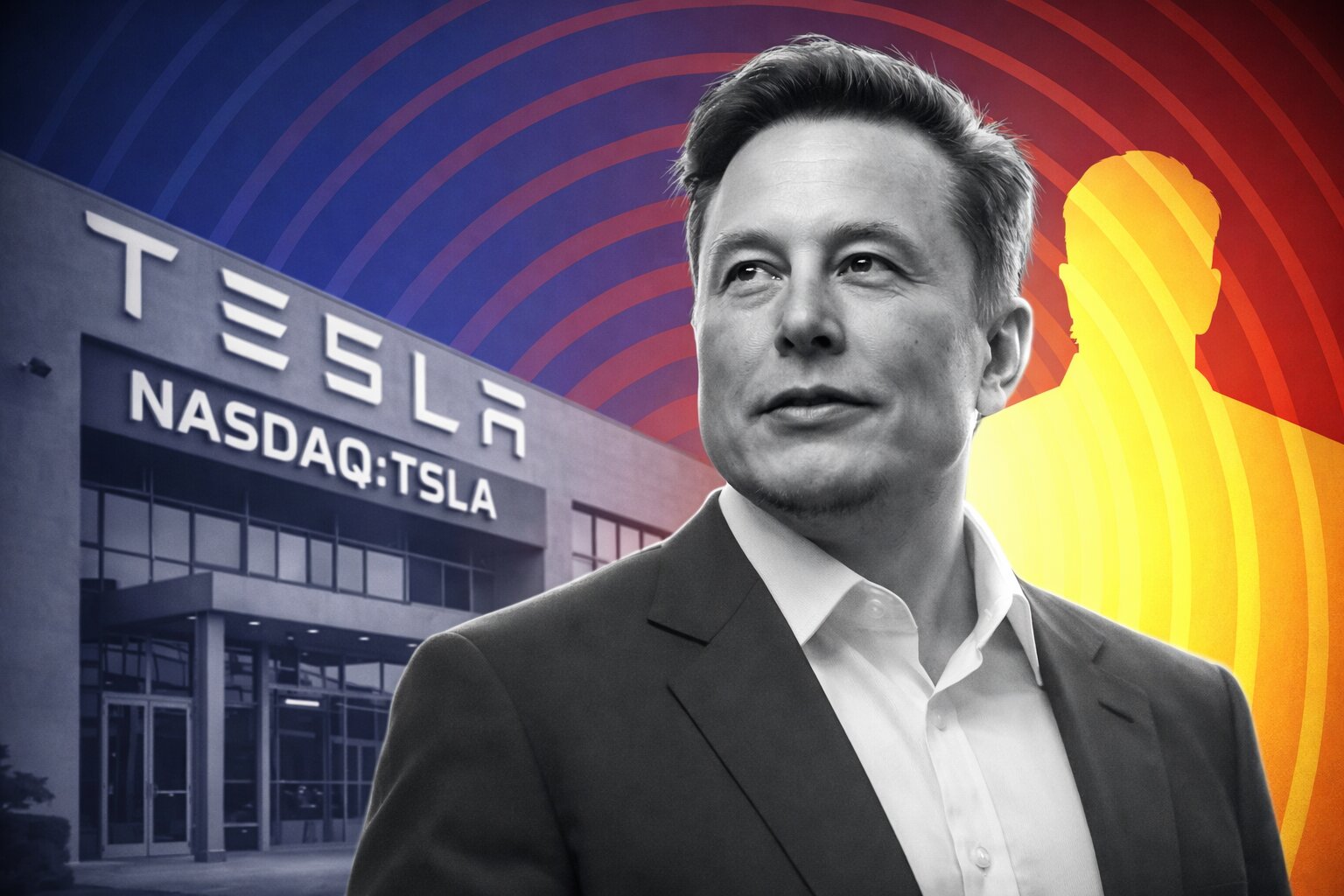
The concentration of control and narrative in Elon Musk remains a double-edged factor. His execution record across EVs, rockets, satellite internet and now AI is the main justification for investors accepting a 200x forward P/E. At the same time, it creates key-person risk and ties Tesla’s perception to the performance and governance of SpaceX and xAI.
Strategy view on Tesla (NASDAQ:TSLA) – high-beta Buy with AI and robotics as the core thesis
At current levels, Tesla (NASDAQ:TSLA) should not be treated as a conventional auto manufacturer. It is a leveraged play on Musk successfully converting a large EV cash engine and a $44 billion liquidity position into a vertically integrated AI, autonomy and robotics platform. The balance sheet, energy and storage growth, and battery and potential chip integration provide genuine downside protection versus many high-multiple growth names. The upside case is strong if robotaxis gain regulatory approval at scale, Optimus becomes a deployable product line and xAI delivers differentiated AI infrastructure. The risk is equally direct: 204x earnings and 15.3x sales do not tolerate long execution delays or major missteps. On a pure risk-reward basis, the stance is Buy, but only as a high-risk, high-beta position sized appropriately, with the understanding that volatility and potential multiple compression are part of the package while the AI and robotics thesis is being proven.