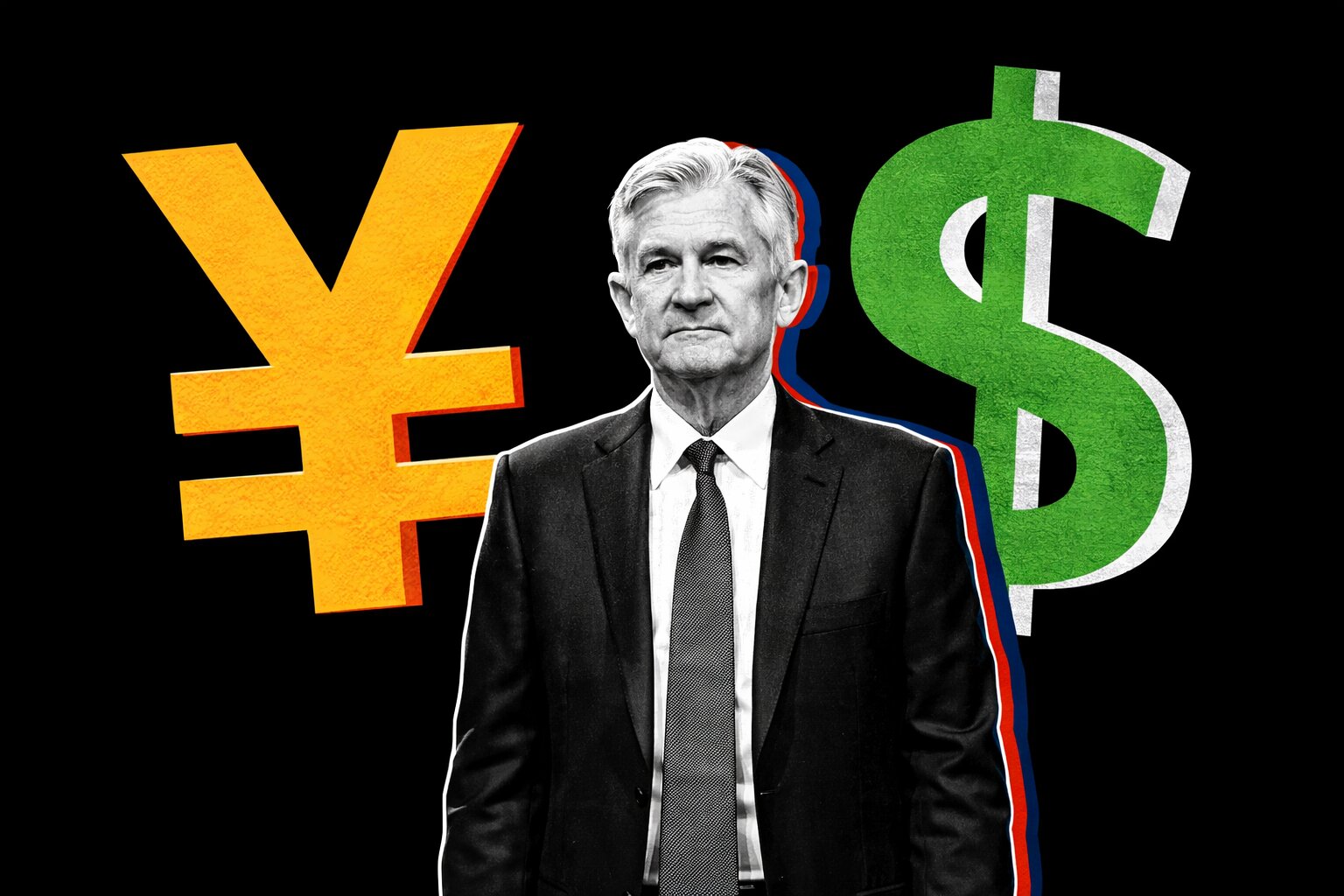
USD/JPY Forecast: Dollar Hits 158.90 Against Yen — BOJ Intervention at 159–160 or Historic Breakdown?
Japan imports 90% of its energy, the Strait of Hormuz is closed, the Fed won't cut, and Bank of America says effective intervention may not come until well above 160 | That's TradingNEWS
USD/JPY at 158.10 — Three Straight Days of Gains, a Session High of 158.90, and the Most Dangerous Resistance Level in the Entire G10 FX Market Sitting 90 Pips Away
USD/JPY is trading at approximately 158.02 to 158.10 Monday, up 0.07% to 0.10% on the session — the third consecutive day of advances for the dollar against the yen in a market where every single number printed above 158.90 triggers alarm bells inside the Bank of Japan. The session high of 158.90 came and went without incident only because traders booked profits aggressively ahead of the 159.00 to 160.00 zone that Japanese authorities have repeatedly identified as the intervention threshold. That profit-taking behavior — selling USD/JPY at 158.90 not because the fundamentals argue for yen strength but because traders fear government action — is the single most important dynamic defining this pair right now. The pair is being pulled higher by a combination of forces that are each individually powerful: oil above $100 devastating Japan's trade balance, the Fed's rate-cut timeline collapsing under inflation pressure, the DXY at 99.35 grinding toward 99.70, and a Bank of Japan that cannot raise rates aggressively into a global stagflation shock without risking a domestic recession. Against all of that, the yen's only defense is the credible threat of intervention — and Bank of America is now explicitly warning that the intervention threshold in the current environment may be well above 160 rather than at 160, which means the buffer between current prices and genuine forced-seller intervention is wider than most participants assume.
The Oil Shock and Japan's Structural Vulnerability — $100 WTI Is Not a Financial Problem for Japan, It Is an Economic Emergency
Japan imports approximately 90% of its energy requirements. It is one of the world's five largest crude oil importers, overwhelmingly dependent on Middle Eastern supply that transits the Strait of Hormuz — the same waterway that has been effectively closed for more than a week since Iran threatened to attack any tanker attempting passage. WTI crude (CL=F) surged to $119.48 overnight before pulling back to approximately $96 to $101. Brent (BZ=F) hit $119.50 before retreating to $98 to $102. At these price levels, Japan's monthly energy import bill is rising by billions of dollars relative to the pre-war baseline of approximately $60 WTI. The country's trade balance — already under structural pressure from decades of current account deterioration in goods trade — faces a significant deterioration that is immediate, mechanical, and not offset by any domestic production buffer. Japan has virtually no indigenous oil production. It cannot pivot to alternative suppliers quickly. It cannot reduce consumption in the short term without economic contraction. Every day WTI stays above $90 is a day that Japan's balance of payments worsens, which is structurally yen-negative through exactly the mechanism Bank of America is now quantifying in its published research.
Japan's Prime Minister Sanae Takaichi acknowledged Monday that households are concerned about rising gasoline prices and that the government is exploring mitigation measures — but simultaneously admitted it is difficult to assess how the Middle East war will affect the broader economy. That dual acknowledgment — concern plus uncertainty — is the political equivalent of a central bank issuing a dovish statement while wanting to tighten. It signals awareness of the problem without communicating a credible solution, which in FX terms translates to continued yen weakness. The government exploring gasoline price subsidies would involve fiscal expenditure that widens the deficit, which itself is yen-negative at the margin. Japan's fiscal capacity is already constrained by one of the highest debt-to-GDP ratios in the developed world — an equity market downturn, which Bank of America explicitly flags as a risk factor, could prompt institutional rebalancing from bonds into equities, adding steepening pressure to the Japanese government bond (JGB) curve that further complicates BOJ policy options.
USD/JPY Technical Levels — 158.90 Session High, 159.00 to 160.00 Intervention Zone, 157.97 the Line in the Sand
The technical structure of USD/JPY is unambiguously bullish on every timeframe from the daily chart through the 2-hour, with the single exception that the RSI is approaching overbought territory — a mechanical warning that does not change the directional bias but suggests the next move toward 159.00 to 160.00 may require a brief consolidation or minor pullback first. The pair touched 158.90 as the intraday high Monday — ten pips from the 159.00 level that both market participants and Japanese authorities treat as the first line of the intervention danger zone. The pullback from 158.90 to 158.02 was not driven by fundamental selling — it was pure risk management from traders unwilling to hold longs into a potentially binary event where the Ministry of Finance and BOJ could intervene with hundreds of billions of yen in dollar selling without warning.
On the upside, the first resistance cluster is 159.00 — psychological round number and the lower boundary of the intervention zone. Above that, the January 2026 highs at 159.22 to 159.45 represent the structural resistance that defined the pair's ceiling in early 2026 before the war began. Above 159.45, the April 2024 peak at 160.21 comes into focus — the level at which Japan conducted its most aggressive intervention operations in recent history, deploying approximately ¥9.8 trillion in a multi-day defense of the yen. That April 2024 precedent is the most important historical reference point for what happens if USD/JPY breaks above 160 without an intervention response — it tells you the government has acted decisively at exactly that level before and has the institutional memory and political will to do so again.
On the downside, 157.97 is the March 3 high that has converted to support — the first level that needs to break for any meaningful yen recovery to begin. Below that, 156.45 is the March 5 swing low and the next significant support. Below 156.45, the 50-day SMA at 156.15 provides additional floor. The 20-day and 100-day SMAs are converging at approximately 155.49 to 155.51 — a critical confluence that, if reached, would represent a complete technical reset of the current uptrend. The short-term outlook remains bullish above the March 5 low of 156.46. The medium-term outlook is neutral with a bullish bias while above the January low of 152.10 and below the January peak of 159.45.
Read More
-
SCHD ETF at $31.02 — 15.8% YTD, LMT Stock Fills War Orders, and Every Tech ETF Sits Flat
09.03.2026 · TradingNEWS ArchiveStocks
-
XRP ETF Forecast: XRPI at $7.81, XRPR at $11.29 — First Weekly Outflow Since January as $16.62M Exits Friday
09.03.2026 · TradingNEWS ArchiveCrypto
-
Natural Gas Price Forecast: Henry Hub Spikes to $3.494 as Europe's TTF Hits €69
09.03.2026 · TradingNEWS ArchiveCommodities
-
GBP/USD Price Forecast: Pound Hits 1.3283 Low as Dollar Surges to 99.35 — BOE Hike Odds Hit 70%
09.03.2026 · TradingNEWS ArchiveForex
The Fed's Frozen Rate Path and Why USD/JPY Keeps Going Up Even When Risk Sentiment Deteriorates
The textbook expectation for safe-haven flows in a geopolitical crisis is that both the JPY and the USD benefit simultaneously — but the JPY should benefit more because Japan's current account surplus historically attracts repatriation flows during periods of global uncertainty. That textbook has been invalidated in the current episode, and the reason is specific and quantifiable: the Iran war's oil shock is creating an inflationary impulse that forces the Federal Reserve to maintain rates at 3.5% to 3.75% indefinitely, while simultaneously creating an economic shock for Japan that makes BOJ tightening essentially impossible in the near term. The policy divergence between the Fed and BOJ — which was already wide before the war — has widened further because of the oil shock, not despite it.
Last week's U.S. labor market report showed job losses and a higher unemployment rate — the classic stagflation signal that complicates the Fed's task enormously. The Fed faces rising inflation from oil-driven supply shock on one side and rising unemployment from demand destruction on the other. In the 1970s, that combination forced the Fed to prioritize inflation control at the cost of growth. The current setup is analogous. Fed funds futures have already priced out one full rate cut that was expected before the war — the market now prices maybe one less cut by year-end at most, potentially none. The U.S. CPI for February releases Wednesday. That February print will not fully capture the $119 WTI spike — it represents the pre-war price environment — but any upside surprise will accelerate the Fed hawkishness narrative and push DXY above 99.70, which translates directly into additional USD/JPY upside pressure toward 159.00 to 159.45.
The BOJ, meanwhile, faces the opposite dilemma. Its wait-and-see stance — explicitly noted by Bank of America — means Japan's interest rates remain near zero while U.S. rates stay at 3.5% to 3.75%. That 350 to 375 basis point differential is the gravity pulling USD/JPY relentlessly higher. Every basis point the Fed keeps rates elevated and every basis point the BOJ cannot raise rates is a basis point of incremental carry trade incentive to be long dollars and short yen.
Bank of America's USD/JPY Framework — Intervention Above 160, Structure Has Changed, EUR/JPY Risk Rising
Bank of America's published analysis on USD/JPY is among the most structurally significant research in the current market and deserves direct examination of each component. The firm identifies three sequential pressure channels for yen weakness. First, high oil prices directly increase Japan's import bill, mechanically worsening the trade balance and weakening the yen through the current account channel. Second, the BOJ's historically tolerant stance toward supply-shock inflation — waiting to see whether inflation becomes demand-driven before tightening — creates policy divergence with the Fed and ECB that drives carry trade positioning against the yen. Third, political pressure for fiscal stimulus despite limited fiscal capacity adds deficit spending risk that further pressures the yen through the fiscal channel. All three channels are active simultaneously Monday.
Bank of America's intervention threshold analysis is the most consequential part of the research. The firm explicitly states that unlimited tolerance for further yen depreciation appears unlikely — acknowledging that intervention will come eventually — but places the threshold for effective government action well above 160 in the current environment. The rationale: foreign exchange intervention in the context of broad dollar strength driven by genuine oil-driven inflation and policy divergence carries significant execution risk. Japan selling dollars and buying yen while the Fed is on hold and oil is at $100 is swimming against a fundamentally-driven current rather than a speculative one. In March 2022 and again in September to October 2022, Japanese interventions were more effective because the dollar strength was partly speculative and partially policy-divergence driven — meaning intervention could shift sentiment. Today's dollar strength is reinforced by an actual inflation shock that gives the Fed a real reason to maintain rates, which means intervention would need to be much larger and more sustained to generate the same price effect.
Bank of America's expected policy sequence — intervention first, BOJ tightening second — implies that even if intervention is deployed above 160, it may not be sufficient without a subsequent BOJ rate hike to provide a fundamental anchor for yen recovery. A BOJ rate hike into a global stagflation environment with Japan's economy already absorbing an energy import shock is a genuinely difficult policy decision with no clean answer. EUR/JPY is also highlighted as an escalating risk — currently contained because the Euro itself has been weakening against the dollar, but if elevated crude prices persist, the asymmetric yen depreciation against all crosses accelerates.
Nikkei 225 Down 7%, South Korea's KOSPI Down 8%, and What Asian Equity Market Stress Means for USD/JPY
Asian equity markets experienced some of their most severe single-session declines in years Monday. Japan's Nikkei 225 dropped approximately 7%. South Korea's benchmark fell more than 8%. These moves have a direct and specific relevance to USD/JPY that goes beyond general risk sentiment. Japanese institutional investors — pension funds, insurance companies, life insurers — hold enormous portfolios of both domestic and foreign assets. When Japanese equity markets collapse, these institutions face losses on their domestic equity book that can trigger rebalancing decisions — specifically, selling foreign bonds to buy Japanese equities that have become relatively cheap. That rebalancing flow involves selling foreign currency (primarily dollars) and buying yen, which is yen-positive at the margin. In the August 2024 yen carry trade unwind, the combination of a BOJ rate surprise and equity market stress generated a USD/JPY move from approximately 160 to 141 in a matter of weeks — the fastest major-pair move in years. Bank of America specifically flags the equity downturn as a risk that could trigger rebalancing from bonds to equities, adding steepening pressure to the JGB curve — which is the mechanical precursor to a BOJ policy response.
The key distinction between the August 2024 episode and the current situation: in August 2024, the carry trade unwind was driven by a BOJ rate hike surprise that directly altered the interest rate differential. In the current episode, the BOJ has not moved — its wait-and-see stance is unchanged. Without the fundamental interest rate trigger, the position-unwind mechanism is less likely to generate the same speed or magnitude of yen appreciation even if equity markets continue declining. Bank of America explicitly acknowledges this: structural changes have weakened the underlying potential for a position-unwind-driven yen rebound. The implication is that even a significant Nikkei selloff does not automatically generate the yen strength it would have generated 18 months ago.
Japan's Revised Q4 GDP — 0.3% Expected vs. 0.1% Preliminary — The Only Near-Term Yen Positive
Tuesday brings Japan's revised Q4 2025 GDP figures. Economists expect the revision to show 0.3% growth — three times the preliminary estimate of 0.1%. That upward revision, if confirmed, would be the single most significant near-term positive data point available for the yen. Stronger-than-expected Japanese growth gives the BOJ more latitude to contemplate policy normalization and reduces the argument that the Japanese economy is too fragile to absorb tighter monetary conditions. A 0.3% Q4 GDP print versus a 0.1% preliminary would shift the narrative from "BOJ must wait" to "BOJ can consider moving" — which at the margin compresses the rate differential between the U.S. and Japan and provides some fundamental support for yen recovery.
However, the GDP revision is a backward-looking measure of pre-war economic conditions. The market will immediately question how much of that Q4 strength survives into Q1 2026 given oil at $100-plus and the global economic disruption from the Middle East conflict. Japan's Q1 2026 GDP will almost certainly reflect significant energy import cost inflation and potential export disruption if global trade volumes decline — which means the Q4 2025 GDP upward revision is a one-day positive catalyst at most before the market refocuses on the forward-looking stagflation risk.
DXY at 99.35 Heading to 99.70 — The USD Strength Architecture That Is Driving USD/JPY Higher
The U.S. Dollar Index trading at 99.35 — with an intraday high of 99.70 — is the underlying architecture generating USD/JPY's advance. USD was the strongest major currency Monday against the Swiss Franc (0.27%), EUR (0.10%), and JPY (0.19%). The only currencies outperforming USD on the day were AUD (0.45%) and NZD (0.32%) — both commodity-linked currencies that benefit from the energy and materials price surge. CAD was essentially flat against USD (0.05%) given its own oil revenue exposure. That currency table tells the complete story of what the Iran war is doing to G10: it is creating a two-tier world of commodity exporters outperforming and energy importers underperforming, with the USD sitting in an intermediate strong position driven by safe-haven demand and Fed hawkishness. Japan is the most extreme energy importer in G10 and therefore the most extreme currency underperformer in the current environment — with the sole exception that Swiss franc is also down 0.27% against the USD, suggesting that even traditional safe havens are being overwhelmed by the inflation-driven dollar strength.
The DXY's technical trajectory — targeting 99.68 at the immediate resistance level inside its rising channel — is directly translatable to USD/JPY upside. Every 0.5% DXY advance historically correlates to meaningful USD/JPY appreciation given the yen's approximately 13.6% weight in the DXY basket. A DXY move from 99.35 to 99.70 implies incremental USD/JPY upside of approximately 0.5 to 0.7 yen at current correlation levels — enough to push the pair from 158.10 toward 158.70 to 158.80, directly back into the intervention concern zone.
Verdict on USD/JPY — Buy Dips to 156.45 to 157.00, Target 159.22 to 159.45, Sell Hard at 159.45 to 160.00
USD/JPY at 158.10 is a buy on dips to the 156.45 to 157.00 range — the zone defined by the March 5 swing low and the March 3 support conversion at 157.97. The fundamental drivers of USD/JPY strength — BOJ waiting, Fed frozen by inflation, Japan's trade balance deteriorating at $100 oil, DXY grinding toward 99.70 — are all intact and reinforcing. The GDP revision Tuesday providing a 0.3% print versus 0.1% preliminary creates a potential one-day yen recovery bounce that is itself a buy opportunity in the dip toward 157.00 to 157.50 rather than a trend reversal. The pair is going to 159.22 to 159.45 — the January 2026 highs — on the current trajectory absent intervention or a major BOJ policy surprise.
The critical discipline is the sell at 159.45 to 160.00. This is not a discretionary decision — it is structural. The April 2024 precedent shows Japan deployed approximately ¥9.8 trillion of intervention at exactly this level. Bank of America places the effective intervention threshold well above 160, but acknowledges intervention will come eventually. Trading through 160 without a position reduction plan is accepting binary risk from a government with both the institutional will and the foreign reserve capacity to move the market 3 to 5 yen in hours. Buy the dip, target 159.22 to 159.45, hard stop above 157.97 on any long position, and sell aggressively into the 159.45 to 160.00 window where the risk-reward of being long turns sharply negative due to intervention probability.