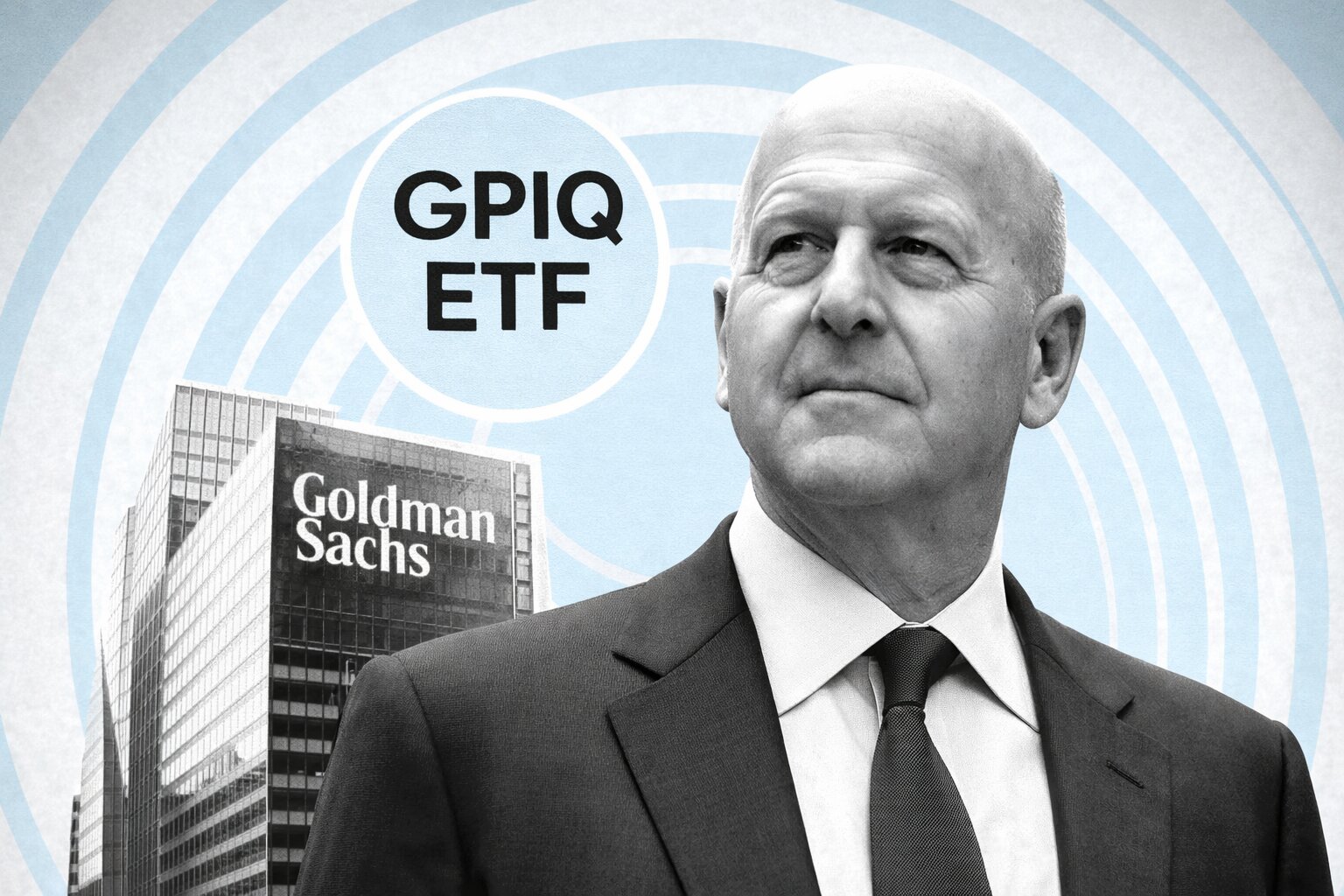
GPIQ ETF Holds $51.59 With 10.25% Yield — But 61.5% of the Portfolio Is Unhedged as Iran War Threatens a 15% Nasdaq Correction
Goldman's active managers are running GPIQ at just 38.5% call coverage while oil crashed from $120 to $83 and the Nasdaq sits at 100% three-year returns | That's TradingNEWS
Goldman Sachs Nasdaq-100 Premium Income ETF (GPIQ) at $51.59 — 10.25% Yield, $3.09B in Assets, and the Iran War Risk That Makes a 50% Portfolio Hedge the Smartest Move of 2026
$51.59 on March 10 — The Deceptively Quiet Price Action Hiding a Critical Strategic Decision That Income Investors Need to Make Right Now
Goldman Sachs Nasdaq-100 Premium Income ETF (NASDAQ: GPIQ) closed Tuesday, March 10, 2026 at $51.59, down just -0.02% on the session after trading a tight intraday range of $51.43 to $52.00 against a previous close of $51.60. After-hours activity pushed the price to $51.51, a further -0.16% — a directionally negative aftermarket move that is small in absolute terms but consistent with the broader pressure the Nasdaq-100 is navigating in the current macroeconomic environment. The year range of $38.13 to $54.63 tells the fuller story: GPIQ hit its low of $38.13 during the February-April 2025 correction — a -30.2% drawdown from the $54.63 peak — and has since recovered to current levels representing a 35.3% rally off the bottom. The fund currently holds $3.09 billion in total AUM with a class AUM of $3.06 billion and trades at average daily volume of 1.06 million shares, giving it sufficient liquidity for both institutional and individual position sizing. The expense ratio of 0.29% is remarkably lean for an actively managed options-overlay strategy, and the monthly dividend of $0.4655 per share — annualizing to approximately $5.29 — produces a current yield of 10.25%. That combination of 10.25% yield, $3.09B in assets, 0.29% cost, and Goldman Sachs active management backing represents a genuinely compelling income vehicle. The question — and it is the only question that actually matters right now — is whether the current geopolitical and macroeconomic environment demands that the pure GPIQ position be hedged structurally before the market forces that decision at a much worse price.
The Covered Call Architecture — Why 38.5% Option Coverage at This Moment Is Either Brilliant or a $400 Million Mistake
GPIQ's option strategy operates within a mandate that allows Goldman Sachs Asset Management to write covered calls covering anywhere from 25% to 75% of the underlying portfolio value — a flexibility band that is the defining structural characteristic separating this fund from its more mechanical competitors. As of early February 2026, with the Nasdaq-100 trading around $600 on QQQ, GPIQ held approximately $2.9 billion in net long equity positions — essentially fully invested in stocks matching the Nasdaq-100 composition — and had written approximately 18,700 call contracts on QQQ across four staggered strike layers. At $600 QQQ, those 18,700 contracts translate to roughly $1.12 billion in overwritten notional exposure — which means 38.5% of the equity portfolio is currently covered by calls. That 38.5% sits at the lower end of the 25%-75% permitted range, which is the single most analytically important data point in the entire GPIQ structure right now.
Goldman's active managers are running GPIQ with the most growth-preserving configuration available to them within the fund's mandate. At 38.5% coverage, 61.5% of the portfolio has zero option cap on the upside — meaning if the Nasdaq-100 rips 20%, GPIQ captures nearly two-thirds of that move in full. That is an aggressively bullish portfolio posture for a fund that is also being marketed as an income vehicle. The managers are effectively making a bet that the Nasdaq-100 will recover from current levels and that preserving upside capture is worth more than maximizing current premium income. That bet is defensible in a world where Iran cools off, oil retreats from $83-$120 toward $65, the Fed resumes cutting rates, and AI monetization validates the 47.10% concentration in the top-10 GPIQ holdings. It is a dangerously exposed bet in a world where oil stays elevated, inflation re-accelerates, and the Fed pivots hawkish — which is the tail risk scenario that makes the current 38.5% coverage the central analytical concern for any position in GPIQ.
For comparison, the Global X NASDAQ 100 Covered Call ETF (QYLD) is running at ~100% coverage — short calls on the Nasdaq at the 25,550 strike across approximately 3,303 contracts against an $8.11 billion net long equity position equivalent to roughly 3,310 NDX contracts. That is essentially perfect call-for-call coverage, meaning QYLD is collecting maximum premium income but has zero upside participation above the strike. The trade-off is exact: GPIQ at 38.5% coverage earns less income but captures more upside. QYLD at ~100% coverage earns maximum income and captures none. In a flat-to-sideways market — which is the prevailing regime for the past several months — QYLD wins the income competition decisively, and it has been doing so.
Read More
-
Alibaba Stock Price Forecast - BABA Jumps 3.22% to $136.95; The $200 Case Is Getting Harder to Ignore
10.03.2026 · TradingNEWS ArchiveStocks
-
Goldman Sachs Holds $154M in XRP ETFs as Inflows Hit $1.4B — XRPI at $7.88, XRPR at $11.37, and Bitwise XRP at $15.51 While XRP-USD Sits 62% Below Its All-Time High
10.03.2026 · TradingNEWS ArchiveCrypto
-
Natural Gas Crashes to $3.03 as Trump Says Iran War Is "Very Complete" — But the Tanker Is Still Sunk
10.03.2026 · TradingNEWS ArchiveCommodities
-
Stock Market Today: Dow Stages 544-Point Reversal, Nasdaq Climbs as Oil Collapses to $83 and Iran Ceasefire Bets Heat Up
10.03.2026 · TradingNEWS ArchiveMarkets
-
USD/JPY Price Forecast - Pairs Drops From 158 to 157 - The Yen Relief Rally Is Built on a Presidential Speech
10.03.2026 · TradingNEWS ArchiveForex
The Performance Gap Since October 2025 — What a Sideways Nasdaq Has Cost GPIQ Holders in Real Dollar Terms
Since October 2025, markets have traded essentially flat on a net basis with significant intraperiod volatility — the exact market regime that structurally disadvantages GPIQ's low-coverage approach. GPIQ delivered a 1-year total return of 22.84% and a 6-month total return of 5.53% versus QYLD's 6-month return of 2.92% — but that 6-month comparison understates how much the regime has shifted against GPIQ in recent months specifically. The YTD comparison is more revealing: GPIQ is at -1.00% YTD versus QYLD's -1.27% — a margin so thin it is analytically meaningless. What matters is the trajectory: GPIQ outperformed dramatically during the sharp bull market phase that ran through mid-2025, but as the market shifted sideways and the Iran war shock introduced volatility without directionality, the premium collection advantage that QYLD generates through its 100% coverage has begun asserting itself.
The long-term scorecard since GPIQ's October 24, 2023 launch is unambiguous about which structure wins over full cycles: GPIQ total return of 68.59% versus QYLD's 59.43% — a 9.16 percentage point outperformance over the full measurement window. That gap was generated almost entirely during the sharp bull market runs of 2024 and the April-October 2025 rally, where GPIQ's ability to capture upside above the option strike made a decisive difference. The Nasdaq-100 itself returned 67.12% in the same window — meaning GPIQ's 68.59% essentially matched the index total return while also delivering a 10.25% annual income yield. That is a remarkable outcome for a covered call strategy, achieved specifically because the 25%-75% coverage flexibility allowed managers to run low coverage during bull markets and participate in most of the upside. QYLD's 59.43% against the same 67.12% index return is the price of 100% coverage — you give up 7.69 percentage points of return versus the index over 2-plus years in exchange for more consistent income.
The stress test number that makes the current Iran-risk environment acutely uncomfortable for pure GPIQ positions is the February 16 to April 10, 2025 drawdown: GPIQ lost -15.45% in total return while QYLD lost only -10.86% — the index itself fell -17.24%. QYLD's outperformance during that specific drawdown was 1.3x better than GPIQ and 1.4x better than the Nasdaq-100, demonstrating exactly what the 100% covered call cushion delivers when markets decline: the premium income received from the written calls provides a buffer that GPIQ's 38.5% coverage cannot match in magnitude. In dollar terms on a $10,000 position: the GPIQ holder lost approximately $1,545 during that drawdown. The QYLD holder lost approximately $1,086. The $459 difference on a $10,000 position sounds modest, but on a $1 million portfolio the difference is $45,900 — and on a $3 billion institutional position it is $137.7 million in protected capital during a single two-month drawdown.
QQQH's Put Spread Architecture — The Third Tool That GPIQ and QYLD Both Lack
The NEOS Nasdaq-100 Hedged Equity Income ETF (QQQH) introduces a structural dimension that neither GPIQ nor QYLD possesses: purchased put spreads that provide active downside protection independent of the premium income generated from covered calls. QQQH currently holds 108 positions with 47.16% in its top 10 — nearly identical to GPIQ's 47.10% top-10 concentration — and runs a three-layer option strategy. Layer one is the underlying equity portfolio tracking the Nasdaq-100. Layer two is the covered call writing that generates premium income, the same mechanism GPIQ and QYLD both use. Layer three — and this is the differentiating architecture — is the purchase of put spreads funded from a portion of the call premium, providing structural downside protection that works most effectively when the Nasdaq-100 falls 3% to 10%. Beyond 20-30% drawdown, the put spreads' effectiveness declines as the index trades through the lower strike of the spread — a limitation that must be understood clearly before sizing the position.
The cost of this protection manifests in the comparative metrics: QQQH's expense ratio of 0.68% is 2.34x higher than GPIQ's 0.29% — a difference that compounds meaningfully over time. QQQH's AUM of $349.76 million is dramatically smaller than GPIQ's $3.09 billion — a 8.8x AUM gap that reflects the market's current preference for yield over protection but also raises questions about liquidity and bid-ask spreads for larger position sizes. The QQQH dividend yield of 9.17% trails GPIQ's 10.37% — the cost of buying put protection is approximately 120 basis points of annual yield sacrifice. The beta comparison is the clearest expression of what the protection buys: QQQH carries approximately 0.7x beta to Nasdaq-100 volatility versus GPIQ's 0.9x — meaning QQQH absorbs roughly 22% less of the index's directional moves in either direction. In practical terms, if the Nasdaq-100 drops 10%, GPIQ falls approximately 9% and QQQH falls approximately 7%.
The five-year dividend CAGR of 3.04% for QQQH — which has a longer history since its December 19, 2019 inception versus GPIQ's October 24, 2023 launch — provides actual historical evidence of dividend sustainability across full market cycles including the COVID crash, the 2022 bear market, and the subsequent bull run. GPIQ has no comparable multi-year dividend history, and its $5.29 annualized dividend at the current $51.59 price is a recent run rate rather than a proven through-cycle yield. That distinction matters enormously when evaluating income sustainability during a potential prolonged market correction.
The 50/50 GPIQ + QQQH Portfolio — What the Blended Numbers Actually Deliver
The proposed 50%/50% combination of GPIQ and QQQH produces a portfolio with a blended 9.77% dividend yield — splitting the difference between GPIQ's 10.37% and QQQH's 9.17%. The blended beta drops to 0.8x — a meaningful reduction from GPIQ-only's 0.9x exposure to Nasdaq-100 directional moves. The blended expense ratio of 0.48% is higher than GPIQ-only at 0.29% but still competitive for an actively managed options overlay with embedded downside protection. The protection mechanism shifts from "only premium" — which is GPIQ-only's sole cushion mechanism — to "partial hedge" via the QQQH put spreads covering their share of the combined portfolio.
Running the three-scenario analysis produces specific outcome expectations. In a bull market — defined as a sharp Nasdaq-100 rally — the combined portfolio underperforms pure GPIQ because QQQH's call-selling partially caps upside on its 50% allocation and the put spread premium spent on downside protection represents income that cannot be paid out. In a sideways market — which is the current regime and the expected regime for at least several more quarters based on the 3-year rolling return analysis showing the Nasdaq at ~100% three-year total returns historically associated with mean reversion — the combination performs well because call premiums on both funds are generating income while QQQH's put spread purchases are relatively cheap in lower-volatility environments. In a bear market with a 10-15% Nasdaq decline — the specific scenario that the Iran war, inflation re-acceleration, and potential Fed hawkish pivot make plausible — the QQQH's put spreads generate intrinsic value that offsets approximately 30-40% of the drawdown on their 50% portfolio share, meaningfully cushioning total portfolio losses versus pure GPIQ exposure.
The tax structure of both funds is a detail that deserves explicit attention: both GPIQ and QQQH use Section 1256 index options, which means option income is taxed under the 60/40 rule — 60% taxed at long-term capital gains rates and 40% at short-term rates — regardless of the actual holding period. For positions held in taxable accounts, this creates a meaningful tax efficiency advantage over ETFs using equity options (like JEPQ), where all option income is taxed as ordinary income. The blended effective tax rate on option income for GPIQ and QQQH is typically well below 25% for most bracket-qualified holders — a structural advantage that makes the 9.77%-10.25% headline yields more valuable after-tax than they appear on a pre-tax comparison against ordinary income instruments.
The Iran War Variable — Why a 10-20% Nasdaq Drawdown Is Not a Tail Risk But the Baseline Scenario If Oil Stays Elevated
The macroeconomic mechanism connecting the Iran conflict to GPIQ's performance is direct and operates through two distinct channels that reinforce each other. Channel one: oil prices above $83-$120 (the range seen during the Iran war period) push headline inflation higher, which reduces the Federal Reserve's ability to cut interest rates and may force a return to hawkish rhetoric or outright rate hikes. Higher rates compress the discount rate applied to technology company future cash flows — the primary driver of Nasdaq-100 valuations — producing multiple compression that hits the highest-PE growth stocks in GPIQ's 47.10% top-10 concentration disproportionately hard. Channel two: energy cost increases directly compress the operating margins of data center-dependent AI companies, which constitute the largest individual positions in the Nasdaq-100 underlying that GPIQ tracks. When NVIDIA, Microsoft, and Amazon — the top holdings in the Nasdaq-100 index and therefore in GPIQ's equity portfolio — face simultaneously higher energy costs for training workloads and multiple compression from rate pressure, the index faces structural headwinds that no amount of covered call premium income can fully offset.
The 3-year rolling return framework adds the most quantitatively specific risk signal: at approximately 100% total returns in the prior 3-year window, the Nasdaq-100 is trading at a level that has historically been followed by consolidation or correction rather than continued sharp appreciation. The probability of a follow-through bull market delivering another 67% in the next 3 years from current levels — the kind of return that made GPIQ's 68.59% total return possible since October 2023 — is materially lower than the base rate observed across prior cycles. This is not a prediction of catastrophe. It is a statement about expected value: the distribution of likely outcomes over the next 12-18 months has shifted toward consolidation and moderate correction, which is exactly the regime where QQQH's put spreads earn their cost and GPIQ's 38.5% coverage leaves significant downside exposed.
The specific downside quantification: if the Iran conflict fails to de-escalate and the Nasdaq-100 corrects 15% from current levels, GPIQ-only at 0.9x beta loses approximately 13.5% in price. On $51.59, that is a price target near $44.65 — a -$6.94 per share move. The combined 50/50 GPIQ + QQQH portfolio at 0.8x blended beta loses approximately 12% before the QQQH put spread activation — and with the put spread generating intrinsic value on the 50% QQQH allocation, the effective combined drawdown is reduced further to approximately 8-9%. The difference between -13.5% and -9% on a $1 million position is $45,000 in protected capital — which is the concrete dollar case for the hedge, not a theoretical construct.
GPIQ's Top-10 Concentration and Dividend Sustainability — The 47.10% Question
GPIQ's top-10 holdings represent 47.10% of the total portfolio, tracking the Nasdaq-100 index structure passively in its equity component. This concentration means that approximately half of the fund's equity value is exposed to the price performance of roughly ten technology and AI-adjacent companies — NVIDIA, Apple, Microsoft, Amazon, Meta, Alphabet, Tesla, Broadcom, and their immediate peers depending on current index weights. The 10.25% annualized yield at $51.59 — delivering $0.4655 per share monthly — is generated by the combination of those equity holdings' intrinsic dividend payments (minimal, given the growth-oriented Nasdaq-100 composition) and the call option premium collected on the 38.5% of the portfolio currently overwritten. The sustainability of that 10.25% yield in a declining market depends entirely on two variables: the volatility of the Nasdaq-100 (higher volatility = higher option premiums = more income) and the direction of the index (a declining index with high volatility generates premium income even as NAV erodes).
In a sharp bear market where Nasdaq-100 volatility spikes — like the February-April 2025 episode — GPIQ's option premium income actually increases because implied volatility commands higher prices. But that elevated income does not offset the NAV erosion from the 61.5% of the portfolio that has no call cap protection at the current 38.5% coverage level. The $0.4655 monthly dividend is not at immediate risk of reduction in a moderate correction, but if the Nasdaq-100 enters a prolonged low-volatility decline — the scenario where both premium income and upside capture disappear simultaneously — dividends across both GPIQ and QQQH could realistically compress to the 6-7% range from current double-digit levels. That scenario is the tail risk for income-focused holders who are sizing positions based on the current 10.25% yield rate.
The SA Analysts rating of Buy (4.00 score) versus the Quant rating of Hold (3.26) reflects this tension explicitly. SA Analysts are looking at the full-cycle performance, the Goldman Sachs active management track record, and the 1-year 22.84% total return that demonstrates the strategy works when the underlying index cooperates. The Quant model is looking at current momentum, near-term price action, and relative performance — and is finding enough signals of regime pressure to downgrade from Buy to Hold. Both assessments are internally consistent. The disagreement is about time horizon, not analytical rigor. Wall Street shows Not Covered — Goldman Sachs Asset Management does not publish external sell-side research on its own ETF product, which is standard practice.
Regime Timing Risk — Why Switching From GPIQ to QYLD Is the Trade That Sounds Smart and Costs You the Recovery
The temptation when analyzing the GPIQ vs QYLD performance divergence in sideways markets is to rotate into QYLD's 100% coverage structure to capture the superior near-term income and then rotate back into GPIQ when the market starts trending again. This is the regime-timing trade that sounds logical in theory and destroys returns in practice. The structural problem is tax friction: each rotation out of GPIQ into QYLD generates a taxable event on any accumulated gains in the GPIQ position, which immediately reduces the capital base available for redeployment into QYLD. If GPIQ has appreciated 10% since purchase and you rotate into QYLD at a 25% marginal tax rate on the gain, you are starting the QYLD position with 97.5% of your original GPIQ capital rather than 100%. When the inevitable sharp Nasdaq-100 recovery arrives — and historically these recoveries are sharp, fast, and occur without warning — the QYLD position at 100% coverage misses most of the upside, you rotate back to GPIQ, generating another taxable event, and your round-trip position is significantly behind where a consistent GPIQ hold would have left you.
The second timing problem is more fundamental: nobody accurately identifies the transition point between sideways and trending markets in real time. The call to rotate from GPIQ to QYLD is made during the sideways market — and the regime shift back to trending typically happens with a shock event (Fed cut announcement, Iran ceasefire, AI earnings beat) that produces a 5-8% single-day Nasdaq move. By the time rotation back to GPIQ is executed, the recovery is already 40-60% complete. The correct solution for investors who want to maintain the GPIQ long-term position while hedging the current regime risk is the 50% reallocation to QQQH — executed once, without a round-trip tax event from complete rotation, maintaining exposure to both the income-generation mechanism and the structural downside protection.
GPIQ Rating: BUY for Long-Term Holders With a Mandatory 50% QQQH Hedge in the Current Regime — HOLD for New Positions Until Iran Risk Resolves
GPIQ (NASDAQ: GPIQ) at $51.59 — with its 10.25% yield, $3.09B AUM, 0.29% expense ratio, 22.84% 1-year total return, 68.59% total return since October 2023 inception, and Goldman Sachs active management backing — remains a BUY for long-term holders who entered at prices below $50 and have the conviction to hold through the current sideways/correction regime. The full-cycle outperformance case is intact: 68.59% vs QYLD's 59.43% since launch proves the strategy works, and the active 25%-75% coverage flexibility is a structural advantage that compounds in value over complete market cycles. The SA Analysts Buy rating at 4.00 is the correct long-term assessment.
For new positions initiating at $51.59 in the current environment, the risk-adjusted entry is a HOLD pending one of two developments: confirmation of Iran de-escalation with oil retreating below $75, which removes the primary macro headwind, or a 10%+ Nasdaq pullback that resets GPIQ to the $46-$47 range where the margin of safety improves materially. The year-low of $38.13 established during the February-April 2025 drawdown is the worst-case scenario that illustrates how far the current $51.59 price can move in a sustained correction — a -26.1% additional decline from current levels if the Iran scenario deteriorates to the 20-30% Nasdaq correction scenario that more pessimistic analysts are modeling. That risk, combined with GPIQ's 0.9x beta and current 38.5% coverage providing limited cushion, makes partial hedging via QQQH not optional but structurally necessary for any position of consequence. The 50/50 combination delivering 9.77% blended yield, 0.8x blended beta, 0.48% blended expense ratio, and partial put spread protection is the most analytically defensible positioning for the current macro regime — and the only approach that preserves both income and capital without incurring the regime-timing tax friction that full rotation strategies guarantee.