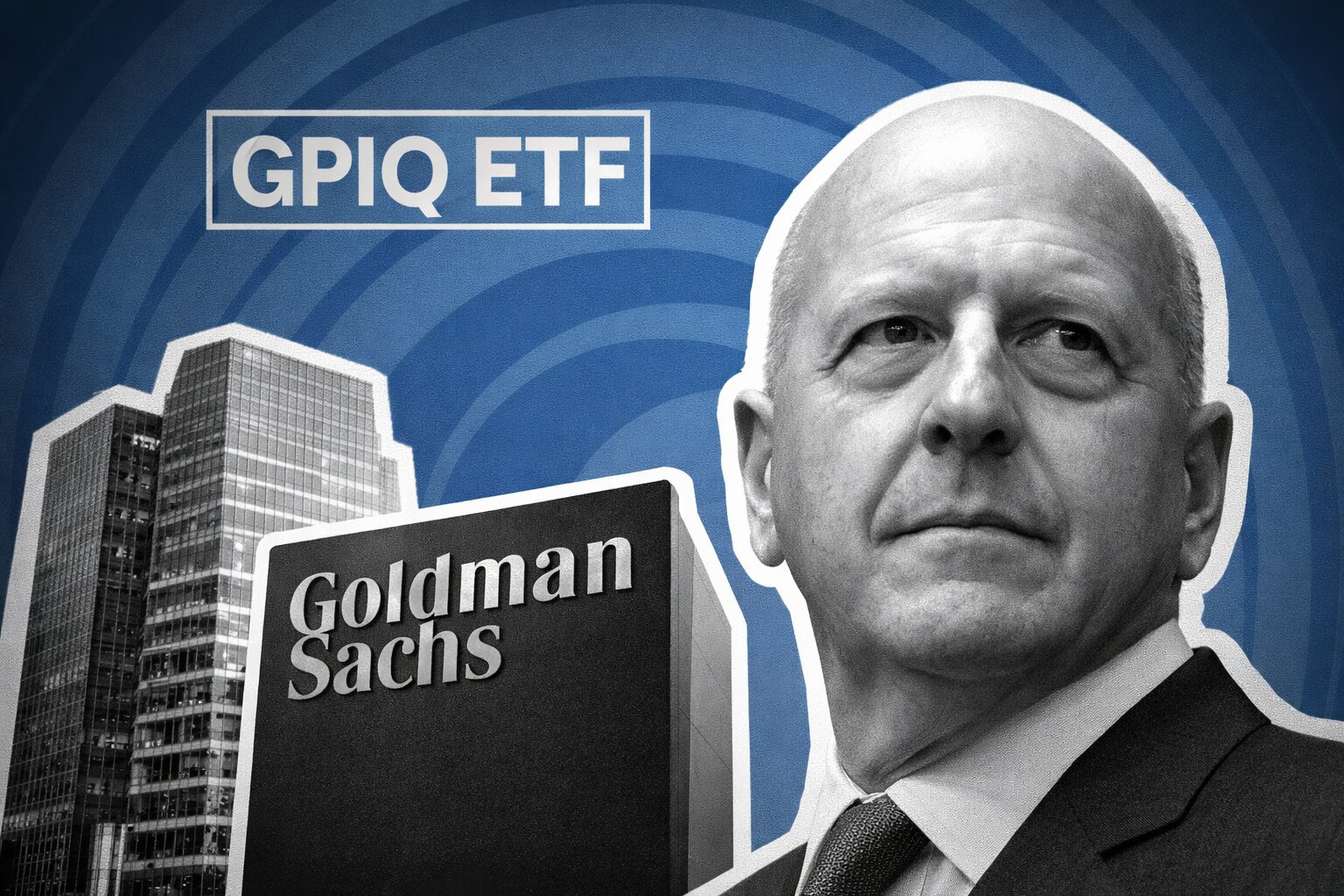


GPIX ETF Climbs to $52.54 as 8% Yield Turns S&P 500 Volatility Into Income
Goldman Sachs’ GPIX ETF sits near its $53.50 high, delivers an 8% monthly yield and outperforms JEPI on 1–2 year returns as investors rotate from credit risk to equity-based income for 2026 | That's TradingNEWS
NASDAQ:GPIX: 8% Monthly Yield From S&P 500 Volatility
Current NASDAQ:GPIX price, range and trading setup
NASDAQ:GPIX trades around $52.54, up roughly 0.22% on the day, with an intraday range of about $52.31–$52.73. The 52-week range sits between $40.01 and $53.50, so the ETF is trading close to the top end of its yearly band, not far from its high. Average daily volume around 670–680k shares gives enough depth for meaningful orders without serious execution damage. At this price, the fund’s size is roughly $2.6–2.7B in assets under management, which is a strong figure for a relatively new income product and confirms persistent demand for this structure.
Income profile and tax structure: 8% forward yield at $52.54
On trailing numbers, GPIX has distributed about $4.23 per share over the last twelve months. At $52.54, that translates into a forward yield close to 8.0%, with distributions paid monthly. The most recent cash payment is in the $0.37–0.38 per share range, in line with the current run-rate and consistent with that 8% yield profile. A key differentiator is the tax composition of those payouts: the majority has been classified as return of capital, with a smaller slice treated as ordinary dividends or 1256 gain. Practically, that means a taxable investor can receive an 8% cash stream while deferring a large part of the tax hit until the position in NASDAQ:GPIX is eventually sold, at which point gains can qualify for long-term capital-gains treatment if the holding period is over a year.
Core engine of NASDAQ:GPIX: dynamic covered calls on the S&P 500
The strategy behind GPIX is straightforward: own a broad S&P 500 equity basket and overlay a dynamic covered-call program written on the index. Management adjusts the overwrite between roughly 25% and 75% of the notional equity exposure. When the team expects a stronger up-move in the S&P 500, they keep overwrite low, closer to 25%, so more upside is left uncapped. When they anticipate a choppy or weaker tape, they move toward 75%, capturing more option premium to offset potential drawdowns. Importantly, the fund sells listed index options cleared through the exchange, not bank-issued notes. That eliminates counterparty credit risk from ELNs and keeps risk where it belongs: market risk on the S&P 500 plus volatility risk, not balance-sheet risk on a dealer.
Portfolio composition and beta: broad S&P 500 with a tech-heavy spine
Under the hood, NASDAQ:GPIX holds a large-cap portfolio that closely tracks the S&P 500. The fund owns around 500 names, with the top-10 positions making up roughly 40% of assets. The biggest line is Nvidia at around 7–8%, followed by the usual S&P 500 leaders: Apple, Microsoft, Amazon, Alphabet and Broadcom. Sector allocation is strongly tilted toward technology, with tech near 35% of the portfolio, and the rest spread across communication services, financials, health care, industrials and other sectors. That construction produces a beta around 0.9 versus the S&P 500. In practice, GPIX will move almost as much as the index in both directions before the impact of call income, making the ETF effectively a slightly muted S&P 500 total-return vehicle with an 8% cash-flow overlay.
Relative performance against JEPI: income with higher growth participation
When you compare GPIX to JEPI over the last periods, the return gap is clear. Over roughly the last 6 months, NASDAQ:GPIX total return is near 13.7%, while JEPI is around 6.9%. Over 1 year, GPIX posts about 13.8% versus roughly 5.3% for JEPI. On a 2-year look, the spread is even more pronounced: roughly 45% for GPIX against about 23% for JEPI. The reason is structural. JEPI runs a more defensive equity selection with lower beta and relies heavily on ELNs, which sacrifices upside in sustained bull phases. NASDAQ:GPIX stays closer to a full S&P 500 profile and uses a dynamic overwrite, so it captures much more of an AI-driven index rally while still generating high income. For an investor willing to tolerate equity volatility, the numbers say GPIX has been the superior income-plus-growth choice.
Comparison with SPY: what you give up and what you gain
Against SPY, the trade-off is different. Since inception, GPIX has delivered total returns around 60–61%, versus roughly 70% for SPY over the same span. GPIX’s price is up about 34–35% in that window, while SPY’s price appreciation is higher; the gap is the cost of systematically selling upside via index calls. In exchange, an investor receives that 8% yield in cash, which SPY does not provide. The structure is simple: SPY is the pure growth proxy on the S&P 500, while NASDAQ:GPIX converts part of that potential growth into a predictable monthly income stream. If the objective is maximum capital appreciation, SPY wins. If the objective is high cash yield with equity participation and better behavior in sideways markets, GPIX is the more rational tool.
Three S&P 500 paths and expected behavior of NASDAQ:GPIX
In a continued uptrend for the S&P 500, GPIX should produce positive price gains and strong total returns but underperform SPY on the upside because calls cap part of the rally. At $52.54 and 8% yield, that is still an attractive profile for income-focused holders. In a sideways or mildly choppy index environment, management can increase overwrite toward the top of the 25–75% band, harvesting richer option premiums on each reset. In that regime, NASDAQ:GPIX can realistically outperform SPY on total return, because SPY has no way to monetize volatility directly. In a sustained downtrend, GPIX will lose value with the index; the call overlay does not provide hard downside protection. Option income and distributions soften the blow, but the NAV will still fall, and the recovery phase will be slower because part of the rebound gets sold via calls.
Macro backdrop: recession odds, rates and why the GPIX structure fits
Recession probability estimates derived from the US Treasury yield curve have been drifting down, from above 30% a year ago to the mid-20% range for the next twelve months. At the same time, policy rates remain elevated versus the last decade, even after several 25 bps cuts. That mix is problematic for classic high-yield credit products and BDCs, where higher funding costs and a more stressed borrower base translate into rising non-accruals and dividend pressure. NASDAQ:GPIX avoids those credit channels entirely and instead expresses a view on S&P 500 earnings, volatility and AI-driven growth. In a world where the base case is a soft landing with volatility, that is exactly the regime where a dynamic covered-call ETF on the S&P 500 can justify its existence: you get equity exposure, you get paid from volatility, and you are not underwriting default cycles.
Dividend behavior through stress: what 2025 told investors
The tariff-driven pullback in early 2025 gave a live look at how GPIX behaves in real stress. SPY’s total return dropped around 15% peak to trough; NASDAQ:GPIX total return fell about 14% once distributions were included, so the cushion from option income was visible but modest in a sharp, fast drop. Distributions themselves edged down from roughly the mid-$0.34–0.35 area into the low-$0.32 range between March and May as the index sold off, then rebuilt as the S&P 500 recovered into new highs. That pattern is exactly what you should expect: payouts are variable and will compress when volatility and direction move against the option book for a time. The important point is that the cuts were limited and temporary in that episode, with the annualized run-rate still consistent with an 8% yield at current pricing.
Read More
-
GPIQ ETF Price Forecast: Can a 10% Yield at $52 Survive the Next Nasdaq Selloff?
09.02.2026 · TradingNEWS ArchiveStocks
-
XRP ETF Price Forecast: XRPI at $8.32, XRPR at $11.86 as $44.95M Inflows Defy BTC and ETH Outflows
09.02.2026 · TradingNEWS ArchiveCrypto
-
Natural Gas Futures Price Forecast: Will The $3.00 Floor Hold After The $7 Winter Spike?
09.02.2026 · TradingNEWS ArchiveCommodities
-
Stock Market Today: Dow Back Under 50K While S&P 500 and Nasdaq Push Higher as Gold Reclaims $5,000
09.02.2026 · TradingNEWS ArchiveMarkets
-
USD/JPY Price Forecast: Can Bulls Clear 157.5 Without Triggering a 160 Intervention Line?
09.02.2026 · TradingNEWS ArchiveForex
Risk profile: equity drawdown, tech concentration and payout sensitivity
Owning NASDAQ:GPIX at $52.54 means underwriting three main risk buckets. First, you are exposed to full-fat S&P 500 equity risk with a beta close to 0.9 and heavy concentration in mega-cap technology. If AI capex or earnings disappoint, GPIX will feel the hit almost as much as SPY on the NAV side. Second, you are sacrificing pure upside; in a runaway melt-up, SPY will outrun GPIX because GPIX is systematically selling part of that convexity every month. Third, distributions are not guaranteed or fixed; a prolonged and deep bear market can force more visible payout reductions as option income shrinks and management protects capital. You are swapping credit risk and default risk for index equity risk, not eliminating risk altogether.
Positioning call on NASDAQ:GPIX at $52.54: equity-income Buy with a bullish tilt
At roughly $52.54 with a trailing $4.23 per-share distribution and an effective yield near 8%, NASDAQ:GPIX offers a high, tax-efficient equity-income stream backed by a broad S&P 500 book and a proven dynamic options overlay. Assets around $2.6–2.7B, one-year total return in the mid-teens, and a clear performance edge over JEPI on growth participation all point in the same direction: this is not a niche product; it is increasingly the reference S&P 500 income vehicle for investors who can live with equity volatility. Given the current macro picture, AI-driven earnings momentum and still-elevated volatility, GPIX (NASDAQ:GPIX) at $52.54 justifies a clear Buy stance for investors seeking high monthly cash flow with meaningful exposure to further upside in the S&P 500.