

Stock Market News: Wall Street Rallies as $7.1 Trillion Options Expire and AI Trade Roars Back
Dow 48,134, S&P 500 6,834 and Nasdaq 23,307 finish higher after the Fed’s hawkish cut, Nvidia (NVDA) +3.9%, Micron (MU) +7%, gold near $4,380, oil around $60 and Bitcoin above $87,000 cap a volatile week | That's TradingNEWS
Quad Witching, Fed Jitters and an AI Rebound Define Friday’s Close
Index Performance and Options Gravity into the Close
Friday closed with a clear risk-on bias, even as positioning stayed heavy. The S&P 500 (^GSPC) finished near 6,834.50, up about 0.9% on the day and roughly 0.1% on the week. The Nasdaq Composite (^IXIC) climbed around 1.3% to 23,307.62, securing a 0.4% weekly gain. The Dow Jones Industrial Average (^DJI) added about 0.38% to 48,134.89 on Friday but still ended the week down close to 0.6%. Small caps lagged as the Russell 2000 slipped roughly 0.9% for the week, reflecting ongoing pressure from higher funding costs and credit risk. All of this unfolded on the largest options expiry ever recorded, which effectively pinned major indices near heavy strikes and kept realized volatility far lower than the headline macro risk would imply. At these levels, broad indices justify a Hold stance, with a relative preference for the Dow and an equal-weight S&P 500 over the cap-weighted Nasdaq, while the Russell 2000 remains a high-beta, high-risk play that looks cheap structurally but fragile in the short term.
Record $7.1 Trillion Quadruple Witching and Dealer Hedging Dynamics
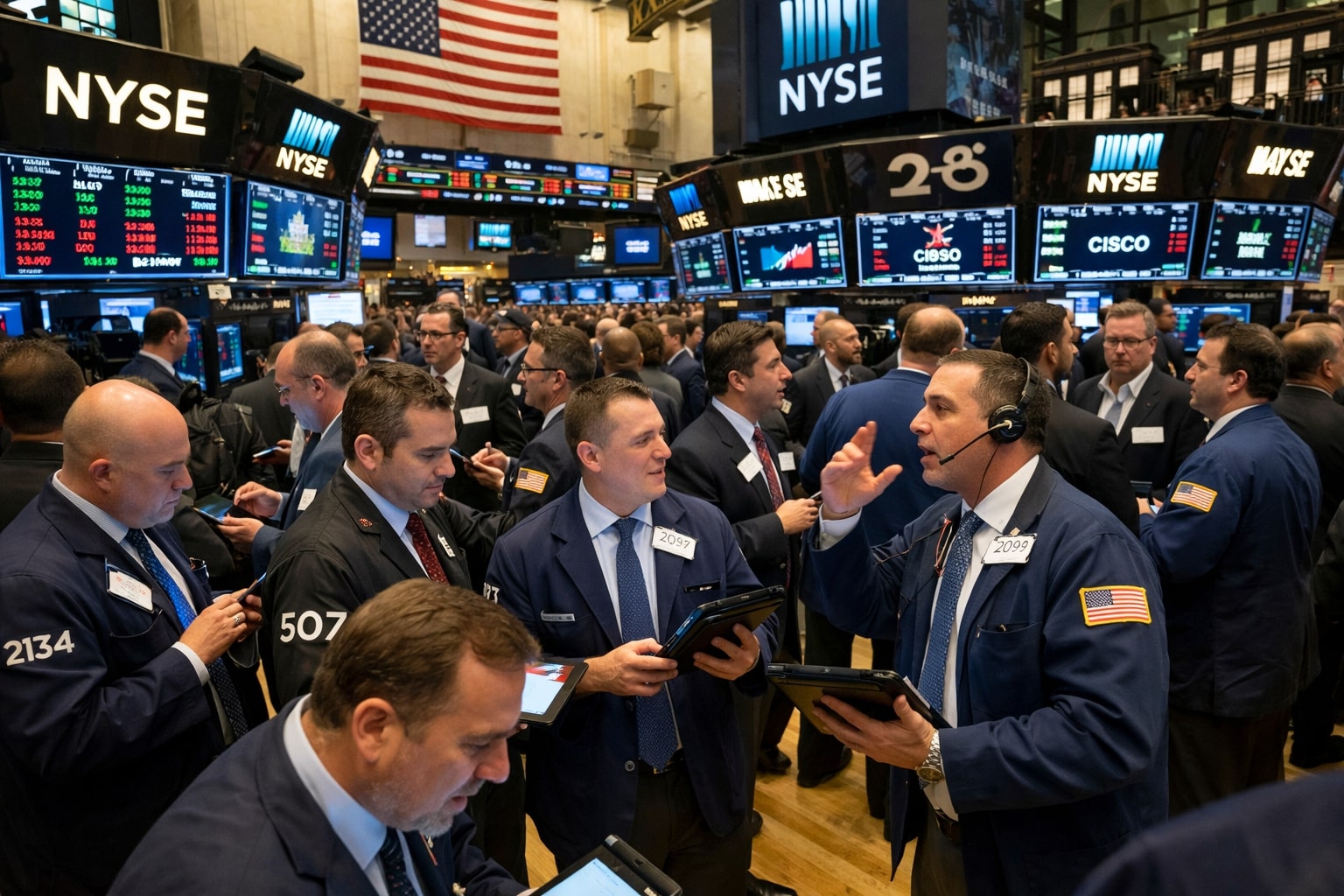
This was not a standard expiry. It was a record Quadruple Witching session with about $7.1 trillion of notional options coming off the board across index options, single-stock options, index futures and index-futures options. That amount equals over 10% of the entire Russell 3000 market cap. Roughly $5 trillion was tied directly to the S&P 500, with another $880 billion linked to single stocks. The heaviest positioning clustered around round levels, with S&P 500 futures trading near 6,785, turning 6,800 into the main strike magnet. Dealer hedging around those strikes suppressed volatility: as spot gravitated toward key levels, hedges were reduced rather than added, which pinned prices instead of causing a dislocation. For short-term traders, this setup is a classic range-bound environment, with gamma walls around 6,800–7,000 in the S&P and 48,000–50,000 on the Dow defining the risk bands into year-end. For investors, it reinforces the point that index beta is expensive at these levels, and capital is better deployed into sectors and single names with clear earnings and policy catalysts than into broad passive exposure.
The Fed’s Third Cut of 2025 and a Hawkish Path for 2026
The Federal Reserve remains the dominant macro anchor. The December meeting delivered a third 25-basis-point cut in 2025, taking the federal funds range to 3.50%–3.75%. On the surface, that supports risk assets, but the forward guidance is restrictive. Two policymakers opposed any cut, one wanted a 50-basis-point move, and the dot plot now implies just one additional 25-basis-point cut in 2026 and one more in 2027. The statement still describes inflation as “somewhat elevated,” even as labor data signal downside risks. The complication is a 43-day government shutdown that delayed crucial reports: the November jobs release and key CPI prints slid into mid to late December, leaving the Fed to cut with incomplete data. Markets initially cheered: the Dow jumped about 1.05% (almost +500 points to roughly 48,058), the S&P 500 gained around 0.67%, and the Nasdaq added roughly 0.33%. But the next day, Dow futures slipped about 0.1%, S&P futures about 0.5%, and Nasdaq 100 futures nearly 0.8% lower as investors processed the message that 2026 cuts will be limited. The deeper issue is credibility: futures markets still price closer to two cuts in 2026, so either the Fed shifts toward the market, or risk assets face a valuation reset. With Powell’s term ending in May 2026 and political pressure mounting for faster easing, there is also non-trivial risk that the next Chair will be more tolerant of higher inflation. That mix argues for a cautious stance on broad valuations and a focus on companies that can grow earnings without relying on lower discount rates.
Global Rates, BOJ Tightening and the Valuation Ceiling for US Equities
Global rates added another layer of pressure. The Bank of Japan raised its policy rate by 0.25% to 0.75%, the highest since 1995, undermining the economics of the classic yen carry trade that has long supported US Treasuries and risk assets. In response, US Treasury prices fell and yields rose on Friday: the 10-year (^TNX) moved to about 4.15%, the 30-year (^TYX) approached 4.83%, and the 5-year (^FVX) climbed to roughly 3.69%. This came on top of a prior move higher in yields driven by the Fed’s shallow 2026 path and concerns that a more politically sensitive Fed might tolerate higher inflation. The key point is that the cost of capital is not collapsing. That means high-duration equities with weak current cash flows deserve a discount, while companies with strong free cash flow and pricing power deserve a premium. The rate structure supports a Bullish bias on quality value and cash-generative tech and a Bearish stance on speculative names that still trade as if money were free.
AI Trade Re-Ignites: NVDA, MU, AVGO, AMD, INTC and CRWV Lead the Charge
The AI complex, which had looked vulnerable earlier in the week, took back control on Friday. NVIDIA (NVDA) jumped roughly 3.93% to about $180.99, after the administration began an export-license review that could allow H200 chip sales to China with a 25% government fee attached. That structure keeps NVDA in the driver’s seat on global AI hardware, satisfies Trump’s pledge to monetize exports, and compresses demand for Chinese alternatives. Micron Technology (MU) extended its own surge, up about 7% on Friday after a 10% earnings-driven rally the previous day, as investors priced in stronger memory demand from AI data centers. Advanced Micro Devices (AMD) climbed nearly 5%, Intel (INTC) added around 3%, and Broadcom (AVGO) gained about 2.5%. The message is clear: the market still sees AI infrastructure – GPUs, high-bandwidth memory, networking silicon – as the core secular growth engine of US equities. On top of that, CoreWeave (CRWV) soared over 22% to approximately $83.00 after Citi reinstated coverage with a $135 target and reports surfaced that OpenAI is seeking up to $100 billion in new funding that could value it around $830 billion. That capital pipeline, and CoreWeave’s multi-billion-dollar partnership with OpenAI, positions CRWV as a leveraged way to express the same AI theme. In terms of stance, NVDA, AVGO, MU and AMD remain Buys despite volatility, because they combine leadership, pricing power and real earnings. INTC is a Hold with an improving bias, still a turnaround story. CRWV is a Speculative Buy only for high-risk capital; the volatility and single-partner concentration are too high for conservative portfolios.
Healthcare and Cannabis: Big Pharma Up on Tariff Relief, Weed Stocks Sell the News
Healthcare quietly outperformed as policy risk eased. The administration struck deals with nine major drugmakers that will lower US drug costs in exchange for a three-year exemption from threatened tariffs. Merck (MRK) rose about 0.40% to roughly $101.09, while Bristol Myers Squibb (BMY), Gilead Sciences (GILD), Amgen (AMGN) and Novartis (NVS) all advanced. The agreements include reduced Medicaid prices, discounts for cash buyers, and commitments to launch new medicines domestically at price points similar to overseas markets. For investors, the key is not the headline concessions but the removal of a major tariff overhang and the improved visibility on US pricing power and margins. That supports a Buy stance on large-cap pharma as defensive, cash-generative holdings in a noisy macro environment. By contrast, the long-awaited cannabis rescheduling – moving the drug from Schedule I to Schedule III – produced a classic “sell the news” response. Tilray (TLRY) fell around 9.6%, Trulieve slipped roughly 0.1%, Constellation Brands (STZ) dropped about 1.3%, Curaleaf (CURLF) lost about 5.5%, while Green Thumb Industries (GTII) managed a roughly 2% gain. Rescheduling improves the tax situation and opens more research, but it does not instantly clean up balance sheets, pricing pressure or oversupply in the sector. The market is signaling that only the most efficient operators will survive and thrive, and that a lot of regulatory optimism was already in the price. Sector view remains Bearish, with only selective, highly speculative positions justified.
Cruise Lines and Travel: Carnival’s 2026 Playbook Versus Recession Fears
Leisure travel continues to defy gloomy sentiment headlines. Carnival (CCL) surged around 9.81% to about $31.12, with Norwegian Cruise Line (NCLH) up roughly 6% and Royal Caribbean (RCL) gaining near 3%. Carnival’s 2026 guidance was the catalyst. Management expects adjusted net income to grow about 12% year over year on less than 1% capacity growth, and projects full-year adjusted diluted EPS of $2.48, which tops Street expectations. The company is already around two-thirds booked for next year at historically high prices across North America and Europe, which points to robust pricing power and strong visibility. Even as macro surveys show weak consumer morale, actual booking behavior in cruises suggests households are still prioritizing experiences. With leverage gradually improving and pricing firm, CCL justifies a Buy rating for investors willing to accept cyclical volatility. RCL and NCLH remain Hold to Buy names, with Royal favored for balance-sheet quality and Norwegian for upside torque when sentiment improves further.
Nike and Footwear: Tariffs, China and Margin Pressure Hit NKE and Peers
On the consumer side, NIKE (NKE) dragged the footwear space lower. The stock dropped about 10.54% to $58.71 after reporting $792 million in quarterly profits, down 32% year over year, on revenues up only 1% to $12.4 billion. The company faces a structural $1.5 billion annualized tariff bill and persistent weakness in Greater China and Converse, which prompted management to admit that the turnaround is not progressing at the speed they want. Though inventories in North America have improved, the combination of tariff drag and slower China growth is capping margin recovery. The pain spread to peers: Deckers Outdoor (DECK) fell about 1.3%, On Running (ONON) eased roughly 0.3%, and Crocs (CROX) slid around 1.2%, while Dick’s Sporting Goods (DKS) traded slightly higher thanks to a more diversified product mix. The conclusion is straightforward. NKE remains a world-class brand, but at around $59, investors are being asked to look through both tariff and China headwinds without a clear catalyst. The stance is Hold for long-term holders and near-term Bearish until there is evidence either of tariff relief or a clear inflection in China. For DECK, ONON and CROX, the call is Hold as well: they are higher-growth names but already carry premium valuations and are now more exposed to sentiment swings around discretionary spending.
Read More
-
GPIQ ETF Price Forecast: Can a 10% Yield at $52 Survive the Next Nasdaq Selloff?
09.02.2026 · TradingNEWS ArchiveStocks
-
XRP ETF Price Forecast: XRPI at $8.32, XRPR at $11.86 as $44.95M Inflows Defy BTC and ETH Outflows
09.02.2026 · TradingNEWS ArchiveCrypto
-
Natural Gas Futures Price Forecast: Will The $3.00 Floor Hold After The $7 Winter Spike?
09.02.2026 · TradingNEWS ArchiveCommodities
-
Stock Market Today: Dow Back Under 50K While S&P 500 and Nasdaq Push Higher as Gold Reclaims $5,000
09.02.2026 · TradingNEWS ArchiveMarkets
-
USD/JPY Price Forecast: Can Bulls Clear 157.5 Without Triggering a 160 Intervention Line?
09.02.2026 · TradingNEWS ArchiveForex
Prediction Markets, DKNG, HOOD, COIN and the Next Speculation Wave
Market structure is changing under the surface. DraftKings (DKNG) gained about 1.7% premarket and finished near $34.21 after announcing a CFTC-supervised prediction market platform with event contracts in sports and financial markets across 38 states at launch. This follows moves by Robinhood (HOOD) and Coinbase (COIN) to expand similar products, turning event trading into a fast-growing segment sitting between speculation, hedging and gambling. COIN traded about 3% higher premarket as it positions itself not only as a crypto exchange but as an infrastructure provider for tokenized prediction and settlement rails. While the revenue opportunity is significant, the embedded risk is behavioral: overly leveraged retail users could face credit stress in a downturn, and regulators may respond retroactively once problems surface. From an equity standpoint, DKNG remains a Hold at current levels; growth is strong but much of it is priced in and regulatory risk is non-trivial. COIN is a Speculative Hold/Buy tied to crypto adoption and regulatory outcomes, and HOOD remains a Hold, with optionality from new products but a business model still heavily reliant on retail trading cycles.
Trump-Era Corporate Deals: DJT–TAE Fusion, TikTok–Oracle and Pharma Tariff Swaps
Policy continues to reshape individual stocks. Trump Media & Technology Group (DJT) announced an all-stock merger with TAE Technologies, valuing the combined fusion-energy entity at more than $6 billion, with each shareholder base owning 50% of the new public company. DJT shares jumped about 8.3%. The strategic pitch is that fusion power will deliver cheap, abundant electricity, secure America’s AI advantage, and revive manufacturing. The reality is that commercial fusion remains highly speculative and capital-intensive, so for now DJT sits firmly in Speculative Buy or Avoid territory depending on risk tolerance. The TikTok US restructuring is another major storyline. ByteDance signed a deal to spin its US operations into a joint venture where Oracle (ORCL), Silver Lake and MGX will collectively own 45%. Oracle will become the security and cloud backbone of the venture, and its stock rose about 6.6% on Friday, partly reversing a 14% slide earlier in the month after a major data center backer withdrew funding. The TikTok contract, together with Oracle’s AI and cloud initiatives, supports a Hold to Buy rating on ORCL for investors willing to carry regulatory risk. The third leg is the previously discussed pharma-tariff swap: major drugmakers accepted lower prices and various discounts in exchange for a three-year exemption from tariffs. For large-cap pharma, that trade is attractive and underpins their Buy status as stable, politically savvy compounders.
Commodities and Crypto: Gold and Silver Rip, Oil Slumps, Bitcoin Stalls
Commodities and crypto show a split market view on growth and fear. Gold futures (GC=F) rose about 0.4%–0.52% on Friday to roughly $4,380–$4,387 per ounce, hovering near record highs and up over 60% year-to-date after hitting about $4,350 in mid-October. Silver futures (SI=F) advanced around 3% to above $67 per ounce, and are up roughly 125–130% year-to-date, with TheStreet citing a new high at $67.385, up 8.6% on the week. By contrast, Brent crude (BZ=F) sits near $60.47, up about 1.09% on Friday but down about 1.4% on the week and roughly 20% for the year, while WTI (CL=F) trades around $56, up 0.8% on the day but off 1.7% weekly. Natural gas gained about 2.9% Friday yet remains 2.4% lower for the week. Underlying this, physical traders expect Brent to stay in the $50s through mid-2026 due to oversupply, as OPEC+ and non-OPEC producers have added barrels faster than demand. Geopolitical risks, including a Ukrainian strike on a Russian-linked tanker and a US “total and complete blockade” on sanctioned Venezuelan oil shipments, are not enough to offset the fundamental glut. Meanwhile, Bitcoin (BTC-USD) trades around $87,000–$88,158, up about 0.13%–0.26% on the day but flat over five sessions after October–November losses, stuck in a tight range. High-net-worth investors have been quietly adjusting: within one large network, members with over $100 million each have pulled back “a couple of points” from equities and real estate and increased allocations to cash, fixed income, gold and bitcoin. That shift is defensive, prioritizing liquidity and alternative stores of value as the probability of policy mistakes and market shocks in 2026 rises. The stance is Hold on gold with Buy on dips, Speculative Hold on silver, Bearish near term on oil, Neutral to tactical on natural gas, and Speculative Hold/Buy on BTC-USD for investors who treat it as a high-volatility hedge rather than a core asset.
Global Equity Stories: CRH, META, ASX 200, KRX and Nifty 50
Outside the US, several equity narratives matter for global flows. CRH PLC (CRH) has been propelled by inclusion in the S&P 500, updated 2025 guidance, aggressive buybacks, and active deal-making. Index inclusion guarantees passive inflows, while guidance and M&A give active managers clear reasons to allocate. That combination is structurally Bullish, and CRH screens as a Buy on weakness for long-only portfolios seeking infrastructure and construction exposure. In Australia, the ASX 200 is trading near 8,600 while the regulator forces a strategic reset at ASX Ltd itself. That mix of oversight and modest growth expectations justifies a Hold on the index, with upside capped by global rate headwinds. In Korea, the Korea Exchange (KRX) is pursuing a KOSDAQ revival plan and fee cuts to compete with platforms like Nextrade and boost liquidity. That is positive for domestic growth stocks and supports a selective Buy stance on high-quality Korean tech and biotech names. In India, the National Stock Exchange (NSE) is pushing derivatives reforms, preparing a robust IPO pipeline, and supporting a Nifty 50 that has already priced strong growth into 2026. The long-term view remains Bullish, but the near-term call is Buy on corrections and Hold at current levels, given stretched valuations. Meta Platforms (META) sits somewhere in between: the company is pushing hard into AI video, faces EU scrutiny, and has ambitious 2026 earnings forecasts. The stock is still an attractive Hold/Bullish name for investors comfortable with regulatory and cyclical ad-risk, because its scale, data and AI optionality still justify a premium multiple.
Macro Data: Payrolls, CPI, Housing and Sentiment Keep the Fed Cornered
Macro data this week painted a nuanced picture that does not fully justify aggressive easing. The November non-farm payroll report looked broadly similar to September, suggesting a labor market that is slowing but not collapsing, although the integrity of some series is compromised by the shutdown-related data gaps. CPI for the 12 months ending in November printed around 2.7%, down from about 3% in September, which markets embraced, even as statisticians acknowledge that some readings rest on delayed or incomplete inputs. In housing, existing home sales in November rose 0.5% month on month to an annualized 4.13 million units, the third consecutive monthly increase, but 2025 is still likely to be the weakest year for home sales in three decades. Mortgage rates near 6.2% during September–October improved affordability versus early 2025 but did not fully reset demand. On the sentiment side, the University of Michigan consumer sentiment index rose to 52.9 in December from 51, yet remained below expectations at 53.5 and nearly 30% below its December 2024 level. Lower-income households showed improvement, while higher-income sentiment was largely unchanged. Year-ahead inflation expectations eased to 4.2%, marking an 11-month low. Taken together, these data points lock the Fed into a cautious stance: inflation is easing but above target, growth is decelerating but not in crisis, and data quality is impaired. That combination means guidance will remain hawkish relative to market hopes, which in turn keeps a ceiling on how far equity multiples can stretch without stronger earnings.
Seasonality, Flows and Final Market Stance into Year-End
Seasonality now takes center stage. Historically, the S&P 500 tends to edge higher through late December and into early January in what traders call the Santa Claus rally. This year, the pattern is reappearing late. After a choppy first half of December, Goldman Sachs and other desks see positioning as “clean” enough to allow further upside, even if the move is not explosive. The weekly scoreboard is modest but important: the S&P 500 (^GSPC) gained about 0.06% on the week to 6,834.50, effectively recovering prior losses; the Nasdaq (^IXIC) added 0.3%, while the Dow (^DJI) slipped 0.7% and the Russell 2000 fell 0.9%. That pattern shows leadership returning to large-cap growth and quality, while small caps remain constrained by financing costs. Combined with the record $7.1 trillion options expiry, this sets up a year-end environment with muted volatility, strong seasonal bias and heavy options-driven pinning around key strikes. Absent a shock from delayed data, geopolitics or policy, the base case is a controlled grind higher in indices rather than a runaway melt-up. After covering all of the data, the stance is clear. Large US indices – S&P 500, Nasdaq and Dow – are Hold, with a preference for the Dow and equal-weight S&P over the cap-weighted Nasdaq. AI chip leaders (NVDA, MU, AVGO, AMD) remain Buys on the back of real demand and earnings, while INTC is a Hold with upside optionality. Big pharma (MRK, BMY, GILD, AMGN, NVS) and cruise lines (CCL in particular) are Buys as policy and pricing power work in their favor. Nike and cannabis sit on the other side as Holds with a negative bias and outright Bearish sector view, respectively, until either margins or balance sheets materially improve. Gold and silver are Holds with selective Buy-on-dip potential, oil is Bearish short term, and bitcoin and COIN remain speculative holdings for investors willing to embrace volatility as the market edges into a far more uncertain 2026.