TRADING NEWS STOCK MARKET TODAY – 4.3% GDP SURPRISE FREEZES NASDAQ, S&P 500 AND DOW NEAR RECORDS
Nasdaq, S&P 500, Dow and Russell 2000 stall as growth beats and Fed cut hopes cool
4.3% GDP beat: strong consumer, tariff distortions and what it really means for SPX and COMP
The U.S. economy expanded at a 4.3% annualized rate in Q3, smashing the roughly 3.0%–3.2% consensus and outpacing the prior quarter’s 3.8% pace. That is the fastest growth in two years and well above the 2.6% four-year average. The core engine was the consumer: real consumer spending grew 3.5%, up from 2.5% in Q2, confirming that households are still spending even as sentiment softens. Imports dropped sharply after earlier front-loading tied to tariffs; because imports subtract from GDP, that mechanical effect inflated the headline. Exports, government spending and inventories all contributed positively. This is why the tape is conflicted: on the surface you have a “booming” 4.3% print, underneath you have a tariff-distorted trade line and a consumer that is strong today but increasingly nervous. For S&P 500 (SPX 6,880.73, +0.03%) and Nasdaq Composite (COMP 23,417.25, –0.05%), that mix supports earnings but undermines the case for aggressive Fed cuts in early 2026, which is exactly how the market is trading.
Index tape: Dow, S&P 500, Nasdaq and Russell 2000 pause just below highs
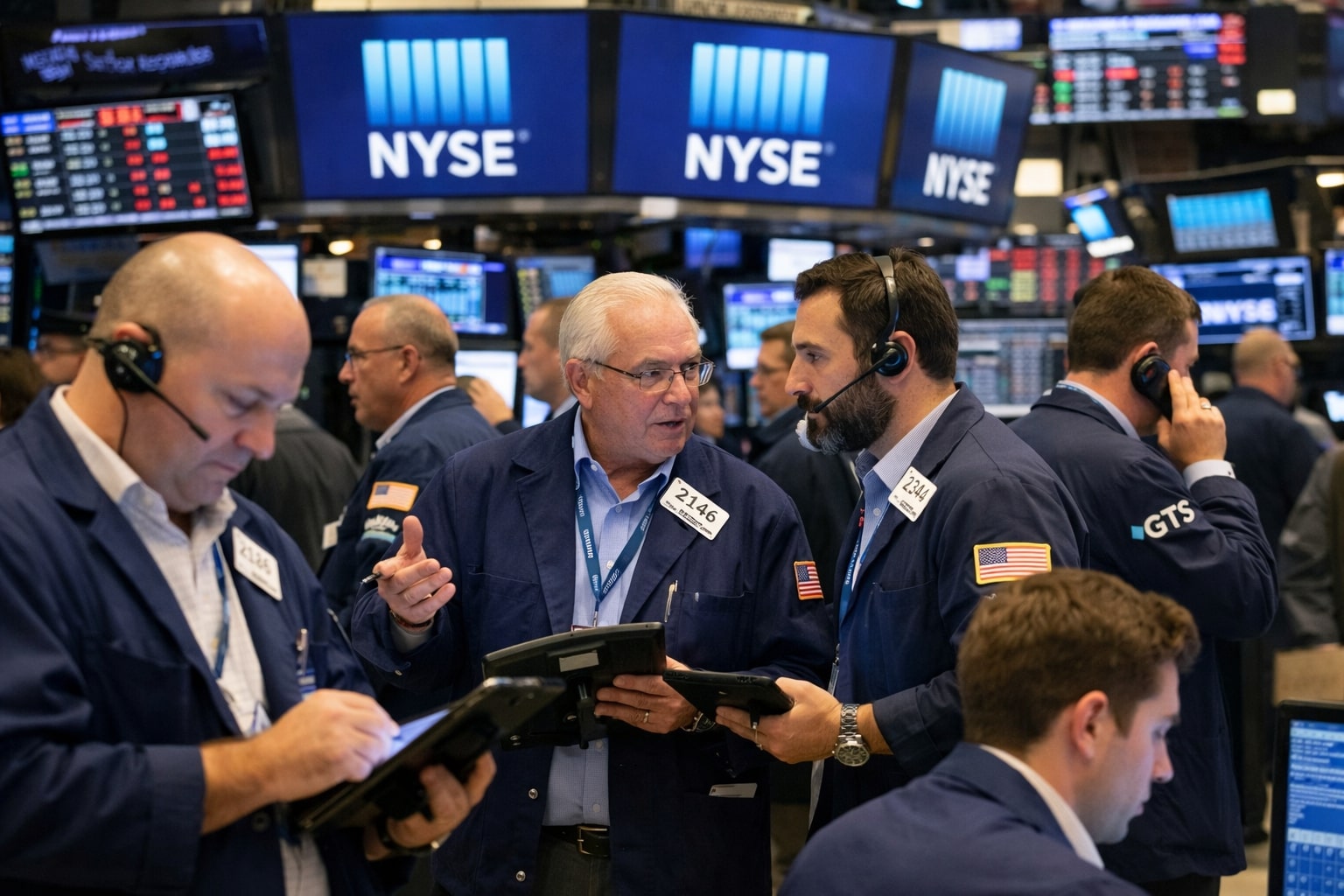
The three flagship indices are effectively marking time after a strong multi-day run. The Dow Jones Industrial Average (DJIA 48,381.20, +0.04%) is hovering near its intraday highs, up roughly 20–30 points, reflecting modest strength in cyclicals, defense and financials. The S&P 500 is trading almost flat, up about 2.2 points (+0.03%), sitting only 0.2%–0.3% below its recent all-time closing high. The Nasdaq Composite is marginally negative, off around 9–12 points (-0.04%–-0.05%), as AI and software leaders lose some of Monday’s momentum. The Russell 2000 (RUT 2,540.80, –0.70%) is the clear laggard; small caps are absorbing higher yields and weaker confidence with less cushion, and they do not benefit as directly from the mega-cap AI and GLP-1 stories. Under the surface, breadth is adequate rather than euphoric: VIX at 14.13 shows volatility is suppressed, but the lack of follow-through after Monday’s gain tells you funds are protecting year-to-date P&L rather than chasing into thin holiday liquidity.
Fed path repricing: 10-year at ~4.19%, January cut odds fall toward 13%–15%
The bond market reacted to 4.3% GDP before equities did. The U.S. 10-year Treasury yield moved up to roughly 4.18%–4.20%, from around 4.15% before the release. The 2-year yield pushed toward 3.55%, and the 30-year traded near 4.85%. That upward parallel shift in the curve is classic strong-growth price action. Fed futures now assign only about 13%–15.5% probability to another 25 bps cut at the late-January FOMC meeting, down from roughly 20% a day earlier. Markets still price a credible chance of two cuts across 2026, but the narrative has flipped from “emergency easing to save growth” to “careful calibration with growth running hot and inflation risk still alive.” For Nasdaq-heavy growth this is a direct headwind: higher real yields compress multiples on NVIDIA (NASDAQ:NVDA), Micron (NASDAQ:MU) and software names. For banks and insurers, the move is constructive, which is why the KBW Nasdaq Bank Index (BKX 167.64, +0.14%) is holding gains even as tech pauses.
Macro cross-check: strong GDP versus weak confidence, falling durable goods and a split Fed
The rest of the macro board does not look as clean as a 4.3% headline suggests. Durable goods orders for October fell 2.2%, almost double the expected 1.2% decline, signaling softness in big-ticket capex-linked spending. Consumer confidence fell for the fifth straight month, undercutting the idea that households will keep driving 3.5% consumption growth indefinitely. At the same time, job-market concerns and tariff headlines are feeding into a more cautious outlook even as realized spending remains strong. This is exactly the setup the Fed hates: growth strong enough to keep inflation risk alive, but forward-looking labor and confidence metrics weak enough to justify some easing. It explains the internal division on the FOMC and why futures now see a high likelihood of “hold” at the January 27–28 meeting, with the real debate shifting to the pace of cuts later in 2026 rather than more near-term action.
Tariffs, politics and the growth narrative: markets price policy risk without trading the drama
Tariffs are now embedded in both the macro data and the political narrative. The growth surge partly reflects earlier import front-loading to avoid higher tariffs, followed by a drop in imports that mechanically boosts GDP. At the same time, the administration is publicly crediting tariffs for the “great” economic numbers and tying them to low inflation and national security, while a Supreme Court case questions the legal basis of some of these measures. Equities are not trading the politics tick-by-tick, but they are pricing policy risk as a structural factor: higher uncertainty premia in global trade, more volatile supply chains, and a bias toward onshoring. That mix is one reason metals, defense, and domestic services are outperforming, while long-duration global growth stories command less automatic multiple expansion than they did in 2023–2024.
Sector rotation: financials, materials and defense outpace stretched AI leaders
The leadership profile confirms a rotation that has been building for weeks. Financials and materials are now the quiet winners of this tape. Banks benefit from higher long yields, a steepening curve versus the lows of the year, and a still-growing economy. Over three- and five-year windows, JPMorgan Chase (NYSE:JPM) has quietly outperformed many well-known tech names, and the current setup reinforces that trend. Materials are being driven by a full-blown metals squeeze: gold, silver and copper all setting or testing records on the same day is rare and signals structural repricing. Defense has become a clear leadership pocket, with Huntington Ingalls Industries (NYSE:HII) extending Monday’s 5% surge with another 1%–3% gain as investors price multi-year U.S. naval spending and a new frigate program built with South Korea’s Hanwha. By contrast, AI leaders and high-beta tech are fragmenting. NVDA is up around 0.2% after a 1.5% gain Monday, MU is down about 0.3% after a 4% pop, and Oracle (NYSE:ORCL) is off roughly 1.5% after a 3.2% jump. That is classic late-stage rotation: the AI story is intact, but investors are no longer willing to pay any price for it.
Gold above $4,500, silver over $70, copper beyond $12,000: metals trade like a structural regime shift
Metals are the most aggressive part of the market right now. Gold futures spiked above $4,500 per ounce, tagging intraday highs around $4,530.80 and trading recently near $4,470–$4,495, marking roughly 71% gains year-to-date and more than 50 record closes in 2025. Silver futures cleared $70, hitting about $70.63 at the peak and trading near $70.30, up roughly 138% this year. Copper three-month futures on the LME pushed above $12,000 per metric ton, around $12,040, a historic high. This is not just fear trade. Copper is riding AI-driven electrification and a data-center build-out estimated at $1 trillion in North America through 2030, while gold and silver are absorbing de-dollarization hedging, tariff risk, geopolitical tension and thin above-ground inventories. The key point for XAU/USD and base-metal traders: when gold is up 71%, silver 138%, and copper at record supply-tight levels, you are no longer in a simple cyclical upswing; you are in a regime where any policy, trade, or geopolitical shock can trigger violent mean-reversion, even if the long-term thesis remains bullish.
Oil and commodities ex-metals: WTI and Brent flat after largest jump since October
Energy is the calm part of the commodity complex. West Texas Intermediate (WTI) crude is trading around $57.77–$58.05 per barrel, effectively flat on the day, while Brent crude sits near $62.10. Monday delivered the largest one-day gain since October 23, driven by U.S. action against tankers moving sanctioned Venezuelan crude and renewed concern about supply enforcement. Today’s flat tape tells you the market now wants concrete disruptions, not just headlines. The S&P GSCI spot index at 550.35 (+0.15%) shows commodities broadly firmer, but the real action is in metals, not oil. For equities tied to crude, this is a consolidating environment, not a trend-acceleration phase: stable high-50s WTI and low-60s Brent support cash flows but do not yet justify a major re-rating for the broader energy complex.
Dollar and rates: DXY drops toward 98, then stabilizes as yields jump
The U.S. Dollar Index (DXY 98.04, –0.24%) and the WSJ Dollar Index (95.86, –0.24%) spent the morning in a two-step dance with rates. Before the data, the dollar traded near a one-week low as markets leaned into the easing narrative. After the 4.3% GDP print and the move in the 10-year to ~4.19%, the greenback recouped part of its intraday losses. Technically, the dollar is finishing a difficult year but now flashing a “golden cross” setup on some measures, suggesting the worst drawdown may be over if U.S. growth stays firm and Europe and the U.K. continue to struggle. That matters directly for multinationals in the S&P 500, for emerging-market risk, and for gold: a stabilizing or firmer dollar into 2026 is a possible ceiling on the next leg of the metal rally, even if the structural case remains intact.
Bitcoin slips below $88,000 as macro takes control of the crypto tape
Crypto is trading as a leveraged macro proxy, not an idiosyncratic story. Bitcoin (BTC-USD) traded around $87,700–$86,882, down roughly 1.6% on the session and off an overnight high near $88,900. The reversal is aligned with the move in yields and the repricing of Fed odds: as soon as futures priced fewer near-term cuts, the appetite to keep pushing BTC above $90,000 faded. There is no structural damage here; the drawdown is modest compared with recent swings, but it confirms that crypto is now tightly linked to real-rate expectations and liquidity conditions. For high-beta tech and speculative software, that correlation matters because it signals that when macro tightens, the risk complex—BTC, high-multiple tech, small caps—still sells off as a group.
Single-stock movers: Novo Nordisk, Eli Lilly, ServiceNow, Micron, Oracle, Tesla, Huntington Ingalls, ZIM
The most important single-name move is Novo Nordisk (NYSE:NVO). U.S.-listed shares are up roughly 8%–10% after the FDA approved the Wegovy 25 mg once-daily GLP-1 pill for long-term weight management and cardiovascular-risk reduction. This is the first oral GLP-1 pill for obesity on the market and will launch in early January. It transforms the addressable market for Novo’s obesity franchise: pills penetrate patients who are unwilling to use injectables, expand primary-care adoption, and support higher long-run revenue visibility. The stock had dropped nearly 45% earlier in 2025; today’s move is the market re-rating NVO as a leader with a defensible moat in a category that remains underpenetrated. Direct rival Eli Lilly (NYSE:LLY) is down roughly 0.7%–1.5% today after a roughly 40% year-to-date gain, reflecting profit-taking and the perception that NVO now has the edge in the pill format, even as Lilly’s injectable franchise stays dominant.
ServiceNow (NYSE:NOW) is down about 2% after announcing a $7.75 billion cash acquisition of Armis, a cybersecurity startup recently valued at $6.1 billion after a $435 million raise. Strategically, the move makes sense: combining workflow automation with cybersecurity and risk analytics deepens NOW’s platform and raises its TAM. The market’s reaction is textbook: a rich cash deal in a high multiple environment triggers near-term multiple compression until investors see accretion and integration proof.
In chips and software, MU, ORCL and NVDA illustrate the rotation. Micron is giving back 0.3% after a 4% rally Monday, Oracle is down about 1.5% after a 3.2% jump, while NVIDIA is still edging higher, up 0.2% on top of 1.5% the prior day. The message: the market is starting to separate balance-sheet strength and earnings power from weaker players rather than treating the whole complex as a single AI trade.
In autos, Tesla (NASDAQ:TSLA) is trading around $486, down about 0.3% after tagging a new record near $500 yesterday. Canaccord reiterated a BUY rating and raised the target from $482 to $551, implying about 13% upside from current levels even after the run. The firm trimmed near-term delivery estimates but is explicitly telling clients to look through short-term demand noise toward structural software, autonomy and energy optionality; the stock reaction shows the market is already doing that.
Defense and shipping are where the real outperformance hides. Huntington Ingalls added another 1%–3% after Monday’s 5% spike tied to a new U.S. Navy frigate program built with Hanwha. This is a multi-year revenue stream, not a one-off. ZIM Integrated Shipping Services (NYSE:ZIM) jumped about 10% in premarket trading as the company confirmed its board is reviewing multiple competing acquisition proposals. For a sector that has been crushed by freight-rate volatility and overcapacity, credible M&A interest is a direct re-rating catalyst.
Live Nation, 2026 positioning and the quiet winners outside mega-cap tech
Beyond today’s macro headlines, some 2026 positioning calls are starting to firm up. Live Nation Entertainment (NYSE:LYV) was singled out with an “outperform” view and a raised price target from $168 to $188, implying about 33% upside. The thesis is straightforward: accelerating consolidated AOI growth, more predictable earnings power and durable demand for live events even in a slower growth backdrop. This is one of the cleaner discretionary names for investors who want exposure to consumer spending without owning broad retail or high-multiple e-commerce. Separately, wealth-management notes continue to push barbelled portfolios for 2026: hold some cash, but not so much that inflation erodes returns; lean into quality growth and structural themes like AI and GLP-1; and balance that with value in financials, defense and select industrials. Today’s tape—strong GDP, higher yields, modest tech underperformance—validates that framework more than it challenges it.
Santa Claus rally mechanics: low VIX, thin volume, and why “no bad news” is the real catalyst
Seasonality remains an important backdrop. Historically, the final days of December deliver the “Santa Claus rally”, and this year the preconditions are in place: VIX at 14.13, indices within 0.2%–0.3% of records, and a very limited macro and earnings calendar into the Christmas break. A key point: the rally is less about aggressive new buying and more about the absence of negative catalysts. With many large players off desks, incremental sellers disappear, and even small net demand pushes prices higher. Today’s reaction to 4.3% GDP—a pause instead of a sell-off—suggests that unless we see a sudden shock in labor, inflation or geopolitics, the path of least resistance into year-end remains modestly higher, particularly for Dow components, selective S&P 500 names in financials and defense, and structural winners like NVO rather than the most crowded, highest-multiple AI trades.
Trading News verdict: buy, sell or hold across indices, metals, crypto and key stocks
For the major indices, the stance is differentiated. S&P 500 (SPX) is a HOLD with a bullish bias: at 6,880+, only 0.3% below record highs, upside exists but is not compelling enough to chase index-level exposure aggressively after a strong run and with yields rising. Nasdaq (COMP) is a straight HOLD: AI and software remain secular winners, but the combination of 4.3% GDP, higher real yields and a fragmented tech tape argues against new broad-based buying at these levels. Dow Jones (DJIA) screens as a BUY: its mix of banks, industrials, healthcare and defense is the direct beneficiary of strong growth, moderate inflation and higher long rates, with valuations that are less stretched than benchmark tech. Russell 2000 (RUT) is a selective BUY, index HOLD: small caps as a group are under pressure, but this is where bottom-up stock picking will pay most over 2026.
In commodities, gold (XAU/USD) at $4,470–$4,500 is a short-term SELL / long-term BUY. After a 71% year and a spike above $4,530, traders should expect sharp pullbacks on any hawkish surprise or dollar recovery, but structurally the case for higher allocation to gold remains strong given tariffs, geopolitics and central-bank buying. Silver and copper share that pattern: with silver above $70 and copper above $12,000 per ton, the short-term trade skews toward consolidation or correction, while the 3–5 year story tied to electrification and data-center build-out remains bullish.
For Bitcoin, the verdict is HOLD. Around $86,000–$88,000, with macro and rate expectations in flux, the risk/reward is balanced; the asset will move with real yields and liquidity more than anything idiosyncratic in the near term.
On single names, Novo Nordisk (NVO) is a clear BUY: a first-in-class obesity pill with cardiovascular benefit, launching in early January, justifies a re-rating from oversold levels even after today’s 8%–10% jump. Eli Lilly (LLY) is a HOLD: still a GLP-1 giant, but now facing a credible oral competitor that may cap further multiple expansion until its own pill is approved. ServiceNow (NOW) is a HOLD to cautious BUY: the $7.75B Armis acquisition is strategically sound but rich; upside depends on flawless integration and clear cross-sell evidence. In tech hardware and AI, NVIDIA (NVDA) remains a core BUY on any pullback, while MU and ORCL look like HOLDs after sharp recent rallies and minor give-backs. Tesla (TSLA) is a BUY on dips with a target zone anchored around the $551 sell-side mark; at $486, the risk is short-term volatility rather than structural damage. Huntington Ingalls (HII) is a BUY with a multi-year defense spending tailwind and a defined shipbuilding pipeline. ZIM is a speculative BUY on M&A optionality only, not on the underlying freight cycle. Live Nation (LYV) is a BUY into 2026 on durable live-events demand and 33% implied upside to $188.
Bottom line for Trading News – Stock Market Today: the 4.3% GDP print has not derailed the bull case, but it has shifted leadership. The easy beta trade in mega-cap tech is fading; the next leg of this market will be driven by selective longs in Dow-style cyclicals, metals with discipline, GLP-1 leaders like NVO, defense contractors like HII, and high-quality financials, while broad Nasdaq exposure and speculative crypto remain hostage to every tick in the 10-year yield and every nuance in the Fed’s 2026 playbook.
That's TradingNEWS