Stock Market Today: Dow Climbs as S&P 500, Nasdaq Slip While AMD Crashes and Eli Lilly Soars as Gold Jumps Back Above $5,000
Stocks split as S&P 500 and Nasdaq slip, AI and software names unwind, LLY and SMCI outperform, and soft ADP payrolls data jolts rate and gold trades. | That's TradingNEWS
Stock Market Today: Dow Holds Up While Tech and AI Darlings Reset
Index Check: Dow, S&P 500, Nasdaq, Russell 2000 and Cross-Asset Tone
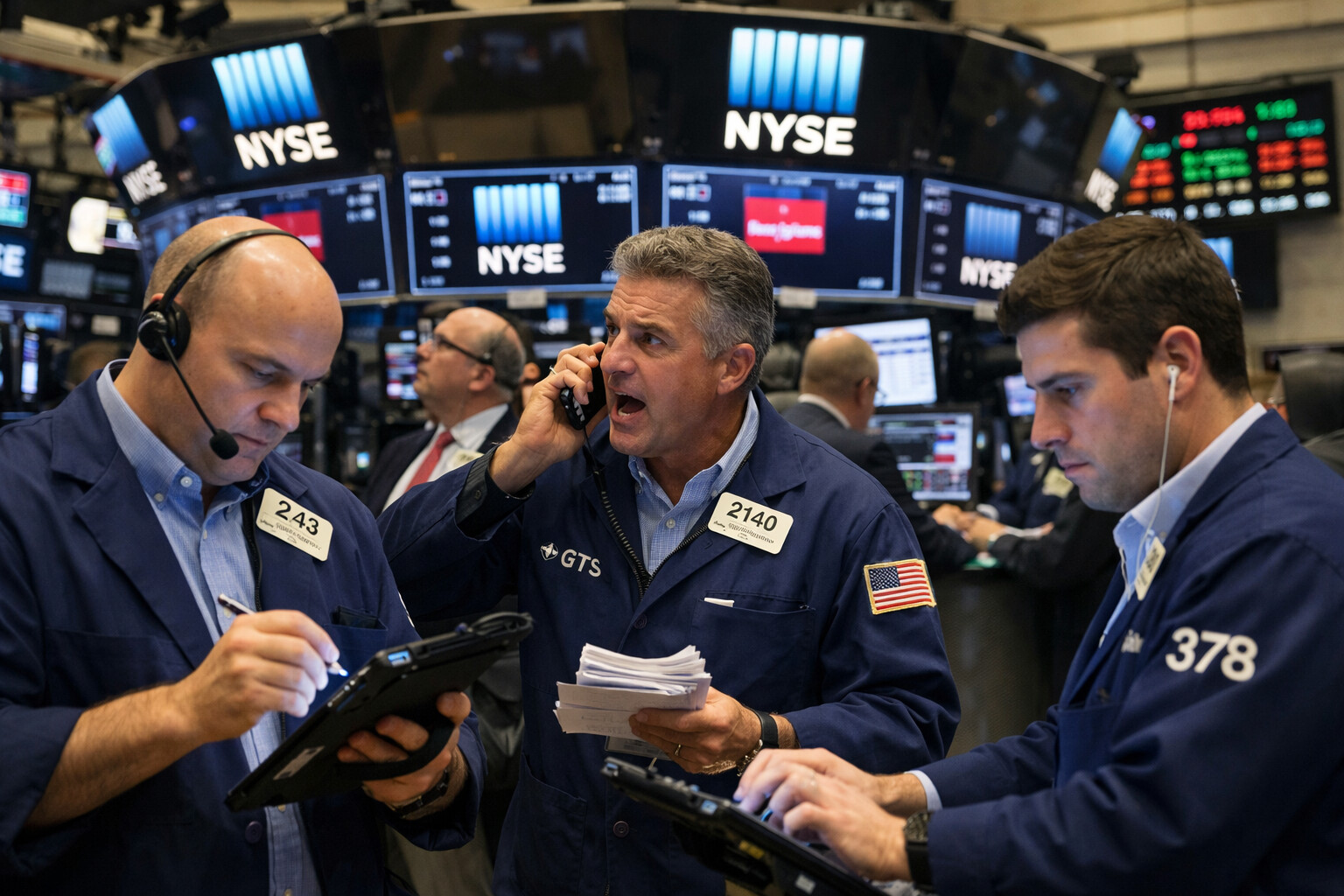
The tape is split again. The Dow Jones Industrial Average (^DJI) trades near 49,500–49,600, up about 0.6–0.7%, driven by health care, industrials and a rotation into value. The S&P 500 (^GSPC) sits around 6,900, down roughly 0.2–0.3%, as its heavy tech weighting drags on broader strength. The Nasdaq Composite (^IXIC) is the weak spot, sliding about 0.8–0.9% toward 23,000 as AI, software and high-multiple chip names give back more of the recent boom. The Russell 2000 (RUT) is almost flat around 2,647, down only about 0.1%, showing that selling is concentrated in mega-cap growth rather than across the entire equity complex. The VIX hovers near 18.5, elevated but far from panic.
Labor Data, Services Activity and the Fed Path
Macro data lean soft on jobs and mixed on activity. ADP’s private payrolls report shows only 22,000 jobs added in January versus expectations near 45,000 and a revised 37,000 in December. That is a major step down from the 771,000 private jobs created in 2024 and the 398,000 pace in 2025, confirming a slow-grind cooling rather than a collapse. Health care carries the load with about 74,000 new positions, while manufacturing continues to shed jobs, extending a downtrend that has run since early 2024.
The ISM services index prints 53.8, unchanged from the prior month and modestly above the 53.5 consensus, so the dominant services sector is still expanding. Under the surface, the business activity sub-index improves to 57.4, but new orders drop 3.4 points, inventories fall 9.1 points and new export orders collapse 9.2 points, flagging some loss of forward momentum. The employment component slips to 50.3, just above the 50 threshold. The prices-paid index jumps to 66.6, reinforcing sticky services inflation. This mix—slower hiring, firm activity and hot prices—keeps the 10-year Treasury yield locked around 4.28–4.30% and prevents the Fed from rushing into deep cuts, even as growth cools at the margin.
Gold Above $5,000, Silver Spikes, Dollar and Yields Pivot Around Risk
Hard assets respond to the macro and geopolitical backdrop. Gold futures (GC=F) trade back above $5,000 an ounce, roughly $5,050–$5,100, up about 2.5–3.5% on the day after a violent pullback from last week’s peak near $5,625. Silver rebounds even more aggressively, jumping close to 10% to above $91 an ounce after a collapse from highs around $121.75. The move is classic “buy the dip” behavior in a market that still sees U.S.–Iran tension and political risk as live issues.
At the same time, the U.S. Dollar Index (DXY) sits near 97.5, close to four-year lows, and the 10-year holds just below 4.30%. That combination—firm gold, weak dollar, yields that refuse to break lower—signals investors are hedging policy risk and geopolitical shocks rather than betting on a clean Fed-driven disinflation glide path. West Texas Intermediate (CL=F) trades around $63 a barrel, slightly positive on the day, reflecting the Iran headlines but also soft global growth expectations and strong supply.
AI Trade Cracks: AMD, NVDA, MSFT and the End of “Buy Anything AI”
The most important message from today’s tape is that the market is no longer willing to finance AI stories at any price. Advanced Micro Devices (AMD) is the poster child. The stock sinks about 14–15% to the $205–$210 range after what, on the surface, looks like a strong quarter. Q4 revenue hits $10.27 billion versus expectations around $9.7 billion, a record. Adjusted EPS lands at $1.53 versus roughly $1.32 forecast. For Q1, AMD guides to $9.8 billion in revenue plus or minus $300 million, again above a consensus near $9.4 billion.
The issue is not growth; it is the quality and cost of that growth. Around $390 million of AI accelerator sales appear tied to China, where export controls can change fast and undermine visibility. Operating expenses overshoot guidance by about $200 million, underlining how much AMD is spending to catch NVIDIA (NVDA) in the GPU arms race. At $200+ per share, the market was priced for flawless AI execution, aggressive share gains and fat margins. Instead, investors are staring at heavy opex, regulatory uncertainty in China and guidance that is “good” but not spectacular versus the hype built into the valuation.
That disappointment bleeds into the rest of the AI complex. NVDA trades lower again as the market reassesses how much incremental AI demand is left after a year of massive capex by hyperscalers and cloud players. Microsoft (MSFT), already hit after its own results triggered a software selloff, remains under pressure as investors rotate out of richly valued AI “infrastructure winners” and into parts of the market where valuations still reflect normal cycle risk rather than perfection. The message is simple: AI remains a secular driver, but the “everyone wins” phase is over. Only those with clear pricing power, sustainable demand and disciplined spending are being rewarded.
Software and Data Repricing After Anthropic’s Claude Cowork Launch
Beyond chips, the real fear is what AI does to traditional software and data-services business models. Anthropic’s new Claude Cowork agents and plug-ins can automate tasks across legal, sales, marketing and data analysis. The market translates that directly into pressure on classic subscription and workflow platforms. Large names like Salesforce (CRM), ServiceNow (NOW), SAP (SAP), Workday (WDAY), Thomson Reuters (TRI), PayPal (PYPL), Expedia (EXPE), Equifax (EFX), Intuit (INTU) and LegalZoom (LZ) have seen double-digit drawdowns over the past few sessions as investors mark down terminal value assumptions.
The reaction is harsh because the narrative flips. For the last two years, markets assumed AI would reinforce these franchises: better automation, higher pricing, stickier customers. Now, with agent-style tools sitting between end users and traditional software, the risk is that workflows consolidate around AI copilots rather than legacy platforms. The repricing is not about next quarter’s EPS; it is about whether 2030–2035 free-cash-flow trajectories are too optimistic. Until management teams show credible integration of AI agents inside their ecosystems with clear monetization, the discount on these names will stay.
The shock is global. The NIFTY IT Index (^CNXIT) in India falls nearly 6% in a single session, its worst day since 2022, as exporters like Infosys (INFY), Tata Consultancy Services (TCS.NS), Wipro (WIT) and Persistent Systems (PERSISTENT.NS) sell off in sympathy. The market is starting to price a future where routine coding and process work face margin pressure from AI, and where offshore labor leverage is less powerful than it was in the last cycle.
Health Care Divergence: LLY Surges, NVO Stumbles, ABBV and BSX Punished
Health care is split between weight-loss winners and earnings casualties. Eli Lilly (LLY) jumps around 9% toward $1,090–$1,100 after posting Q4 numbers and, more importantly, laying out a powerful 2026 outlook. The company guides 2026 revenue to a range of $80–$83 billion, a roughly 20–25% jump from about $65.2 billion in 2025, driven by obesity and diabetes blockbusters like Zepbound and Mounjaro plus new launches such as Inluriyo and Kisunla. Adjusted EPS guidance of $33.50–$35 per share sits above the Street’s roughly $33.20 view. The market cap pushes back toward the $1 trillion line as investors reward visible high-margin growth.
The flip side is Novo Nordisk (NVO). After years of being treated as an unstoppable GLP-1 story, the stock sinks another 4% today as the company projects a 5–13% sales drop in 2026 due to pricing pressure, more competition and regulatory pushback. Since the start of February, NVO has seen roughly $50 billion in market capitalization erased. The contrast is brutal: LLY is viewed as having the right mix of innovation, capacity expansion and pricing power, while NVO is now seen as more exposed to policy risk and rival launches.
Other health-care names are on the wrong side of the earnings ledger. Boston Scientific (BSX) drops around 16% and AbbVie (ABBV) falls about 8% after disappointing updates, showing that investors are unforgiving when guidance or pipeline commentary fails to justify rich valuations. The market is happy to own best-in-class secular growers like LLY at a premium multiple, but anything that looks cyclical, patent-cliff-exposed or weak on innovation is being derated quickly.
**Earnings Tape in Cyclicals and Growth: ENPH, SMCI, UBER, TTWO, MTCH, CMG, QCOM
The rest of the earnings tape shows how selective the market has become. Enphase Energy (ENPH) explodes higher, up roughly 35–37% toward the low-50s. Q4 revenue comes in at $343.3 million versus expectations of about $334.6 million and adjusted EPS prints $0.71 versus around $0.54. Even though the stock is still down more than 40% over the past year, the market is willing to pay for companies that can stabilize margins and top estimates in a difficult solar environment.
Super Micro Computer (SMCI) rallies more than 10% after raising its annual revenue forecast. Fiscal Q2 revenue hits about $12.68 billion versus consensus near $10.23 billion, and management now sees fiscal 2026 revenue of at least $40 billion versus a prior market view near $36.1 billion. SMCI has positioned itself as the key integrator for AI servers built around NVDA and AMD GPUs. The stock is getting rewarded because it converts the AI boom into concrete, near-term revenue with less regulatory risk than the chipmakers themselves.
On the consumer and internet side, Uber Technologies (UBER) trades lower by around 5% despite its scale story, showing that even large platforms are not untouchable when expectations run high. Take-Two Interactive (TTWO) slips roughly 4% even after raising 2026 net bookings guidance to $6.65–$6.7 billion, as the stock already priced in a strong gaming pipeline. Match Group (MTCH) gains about 3–4% on Q4 EPS of $0.83 versus $0.70 expected and revenue of $878 million versus $871 million, plus 2026 free-cash-flow guidance in the $1.085–$1.135 billion band, far above prior estimates near $955 million.
Fast-casual remains under pressure. Chipotle Mexican Grill (CMG) falls around 5% after reporting a 2.5% Q4 same-store sales decline and guiding 2026 same-store growth to flat, versus Street hopes for a roughly 1.8% gain. Full-year 2025 comps fell 1.7%, and traffic continues to slip even though higher menu prices support revenue. Adjusted EPS of $0.25 versus $0.24 and revenue of $2.98 billion versus $2.96 billion are not enough when investors are worried about traffic and pricing power at these valuations.
In semis, Qualcomm (QCOM) trades modestly higher, up about 2–3% into earnings. The market expects the company to lean on handset recovery and early AI device opportunities. QCOM is being treated as a more balanced way to play semis versus the high-beta AI names, with less extreme expectations priced in.
**Housing, ‘Trump Homes’ and Homebuilder Positioning: LEN, TMHC, BLDR, LPX, OC
Housing catches a political headline. A reported plan to roll out “Trump Homes” as part of an affordability push sends U.S. homebuilders higher, with Lennar (LEN) and Taylor Morrison Home (TMHC) up roughly 3% yesterday and extending gains today. The concept is simple: attach a political brand to large-scale new construction to claim a win on affordability. Analysts are skeptical that this is a structural positive for builders, arguing that a supply-driven solution in markets already facing inventory normalization could pressure margins if units are pushed into weak demand pockets.
The more interesting angle is on building products. Barclays and others highlight potential upside for suppliers like Builders FirstSource (BLDR), Louisiana-Pacific (LPX) and Owens Corning (OC) if volumes ramp across multiple regions. These companies benefit from higher throughput and operating leverage without taking the same direct pricing risk at the unit level as the builders. For now, the move is more about sentiment and optionality than hard numbers, but it reinforces the broader rotation into cyclicals that benefit from moderate growth and stabilizing rates.
**M&A in Semis: Silicon Labs (SLAB) Taken Out by Texas Instruments (TXN)
Deal activity adds another layer to the semiconductor story. Texas Instruments (TXN) agrees to acquire Silicon Laboratories (SLAB) for about $7.5 billion in an all-cash transaction at $231 per share. That price represents roughly a 69% premium to SLAB’s last unaffected close. The stock responds accordingly, jumping around 50–52% into the low-200s. TXN shares slip modestly, down less than 1%, as investors digest the balance between strategic logic and near-term dilution.
For TXN, the acquisition deepens its embedded processing strategy and expands its wireless connectivity portfolio for internet-of-things and industrial applications. Management aims to fund the deal with cash and debt and expects it to be accretive to earnings, excluding transaction costs, in the first full year after closing. The transaction underlines that high-quality niche semis with strong IP and connectivity stacks remain valuable assets, even as the market punishes over-hyped AI plays.
Read More
-
AMLP ETF Price Forecast: Can An 8% Yield Around $50 Hold In 2026?
04.02.2026 · TradingNEWS ArchiveStocks
-
XRP ETFs Attract $19.46M Inflows as XRPI Falls to $8.81 and XRPR Slips to $12.63
04.02.2026 · TradingNEWS ArchiveCrypto
-
Natural Gas Price Forecast: From $7.50 Fern Shock To A Delicate $3–$3.50 Range
04.02.2026 · TradingNEWS ArchiveCommodities
-
USD/JPY Price Forecast: 155–156 Range Caught Between 160 Intervention Threat And 145 Reversal Zone
04.02.2026 · TradingNEWS ArchiveForex
Crypto Rout and Risk Sentiment: BTC-USD Under Pressure
Digital assets mirror the tech weakness. Bitcoin (BTC-USD) trades around $74,000–$75,000, down roughly 3–4% on the day and about 40% below the peak reached in early October. The token briefly dipped near $72,900, a 15-month low, and sentiment is stuck in “extreme fear” territory. Over the last week, nearly $468 billion has been wiped off total crypto market value as forced liquidations cascade through leveraged positions. A single day in October already saw about $19 billion in leveraged bets destroyed, and the market has not fully recovered from that shock.
Despite a White House that is more crypto-friendly and growing institutional use, the current phase shows the downside of leverage-driven rallies. Names with large Bitcoin treasuries feel the pressure, and investors are reassessing how much portfolio risk they want tied to volatile digital assets when safer yields above 4% are on offer in Treasuries.
Mega-Cap Tech Setups: GOOGL, AMZN, AAPL, ARM into AI-Heavy Earnings
While MSFT, NVDA and AMD absorb selling, other mega caps are at inflection points. Apple (AAPL) outperforms inside the Nasdaq, gaining close to 3% and acting as a partial stabilizer for the index. The market is re-embracing the cash-flow strength and buyback capacity of AAPL as a defensive growth name in a tech tape that has become crowded in AI.
The real spotlight is on Alphabet (GOOGL, GOOG) and Arm Holdings (ARM) after the close. Consensus looks for Alphabet Q4 revenue around $111.4 billion, up more than 15% year over year, with EPS rising from $2.15 to about $2.65. Google Cloud is expected to grow more than 35% to about $16.2 billion in revenue, while Google Services, including Search and YouTube, should grow around 13% to $94.9 billion. Analysts like the fact that Alphabet is now selling its own AI chips (TPUs) to external customers rather than using them only internally, positioning it as a full-stack AI provider. Implied options move is roughly 5% either way after results, which tells you how critical the AI narrative is here.
Amazon (AMZN) reports tomorrow, with the market focused on AWS growth, profitability and how generative AI services are contributing to cloud demand. After the recent derating in AI-linked names, both GOOGL and AMZN need to show that AI is a concrete revenue and margin catalyst, not just an R&D cost line.
Cross-Asset and Policy Backdrop: Jobs, AI and Structural Shifts
Beyond day-to-day trading, the macro and policy backdrop continues to shift in ways that matter for equity risk premia. The soft ADP print and delayed nonfarm payrolls report due to the partial government shutdown increase the importance of private labor data and surveys in the near term. At the same time, AI is reshaping the jobs discussion. Entry-level white-collar roles are under pressure, pushing more graduates into advanced degrees and specific professions where demand is still robust, such as mental health counseling, law and career guidance. That feeds into long-term consumption and housing patterns, and it also shapes political risk that markets will have to price over the next cycle.
On the policy front, decisions like the Small Business Administration’s move to restrict loans to firms with any non-citizen ownership highlight a tighter stance toward immigration and credit support. That directly affects more than five million non-citizen business owners and has implications for small-business formation, hiring and local economic growth. Equity markets are not trading that headline tick-by-tick today, but it feeds into the broader narrative of fragmentation and policy uncertainty that lifts risk premia over time.
Positioning View: Bullish, Bearish or Neutral on Dow, S&P 500, Nasdaq and Key Themes
From a trading and allocation standpoint, the setup is very clear. The Dow and value-heavy segments of the S&P 500 are in better shape than the Nasdaq. Cyclicals and quality defensives are holding their ground, while high-valuation AI, software and long-duration growth stocks are being repriced.
The Nasdaq and pure AI/high-multiple software complex look tactically bearish to underweight here. The market is no longer rewarding simple “AI adjacency”; it is demanding clear, profitable business models and disciplined spending. Names like AMD, crowded software platforms and richly valued data providers remain at risk if AI agents threaten their long-run economics, and if earnings guidance cannot keep pace with expectations that were set last year.
The broad S&P 500 sits in neutral to cautious-positive territory. Index-level downside is buffered by banks, industrials, health-care leaders and energy, but heavy tech weighting caps upside until the AI and software complex finds a floor. Selective exposure to earnings winners like LLY, SMCI, high-quality value names and some homebuilders or suppliers tied to stable housing demand still makes sense.
The Dow screens as relatively bullish versus the other majors in the short to medium term. Its composition leans into industrials, health care and large, diversified franchises that benefit from stable nominal growth and do not depend on AI euphorias to justify their multiples. As long as the labor market cools without breaking and the Fed moves cautiously rather than aggressively, that factor mix should keep the Dow more resilient on drawdowns.
Cross-asset signals—gold above $5,000, Bitcoin under pressure, a soft dollar, 10-year yields stuck near 4.3%—point to a market that is still risk-on but rotating toward hard assets and quality rather than leveraged growth. In that environment, the advantage shifts away from speculative AI narratives and toward companies and indices that convert current conditions into visible cash flow.