

Stock Market Today: Dow (^DJI) 48,404 And S&P 500 (^GSPC) 6,812 Slip As Jobs Hit +64K And AVGO Sells Off
Nasdaq (^IXIC) 23,085, AVGO, ORCL, PLTR, MU, F, TSLA, PFE, ROKU, KHC, gold (GC00 $4,356) and oil (CL=F $55, BZ=F < $60) drive today’s Trading News action | That's TradingNEWS
Stock Market Today – Jobs Jolt, AI Unwind, Ford’s $19.5B Reset And A Tired Nasdaq
Nasdaq, S&P 500, Dow And Key Stocks React To 64,000 New Jobs And 4.6% Unemployment
Labor Market Sends Mixed Signal With 64,000 New Jobs And 4.6% Jobless Rate
November nonfarm payrolls increased by 64,000 versus expectations around 45,000–50,000, signaling that hiring has not stopped but is slowing. At the same time, the unemployment rate climbed to 4.6%, its highest level since 2021 and above the 4.4%–4.5% forecasts. October data, released alongside the delayed report, showed a loss of 105,000 jobs, confirming that weakness is not a one-month anomaly. Federal government employment is a swing factor: payrolls dropped by 162,000 in October and another 6,000 in November as previously agreed buyouts finally hit the statistics. Traders see the report as distorted by shutdown effects but still directionally negative for growth.
Fed Expectations, Rate-Cut Odds And Market Pricing After The Jobs Data
Fed-funds futures barely moved in headline terms but shifted at the margin toward more easing. Markets now price about a 26% chance of another rate cut at the January meeting, with probabilities closer to 40%–45% for the first move in April and a base case of two cuts in 2026. The numbers are too soft to declare the labor market healthy but not weak enough to force panic easing. That combination compresses upside for expensive growth and AI trades while keeping the broader indices in a grinding, data-dependent range rather than a trend reversal.
S&P 500, Nasdaq, Dow And Russell 2000: Index Moves Mask A Significant Rotation
The S&P 500 traded near 6,812–6,815, down around 0.1%. The Nasdaq Composite hovered around 23,085–23,095, off roughly 0.1%–0.2%. The Dow Jones Industrial Average oscillated near 48,400–48,413, slipping about 0.03%. The Russell 2000 traded around 2,533 with a modest gain. The three main U.S. benchmarks remain close to recent highs but are digesting the rally rather than extending it. Under the surface, leadership is shifting away from crowded AI winners toward health care, utilities, staples and select cyclicals. All eleven S&P 500 sectors are still positive year to date, but breadth is improving as the market moves from a narrow AI-led advance to a broader, more balanced structure.
AI Leaders Broadcom AVGO, Oracle ORCL And Palantir PLTR Face A “Show Me” Phase
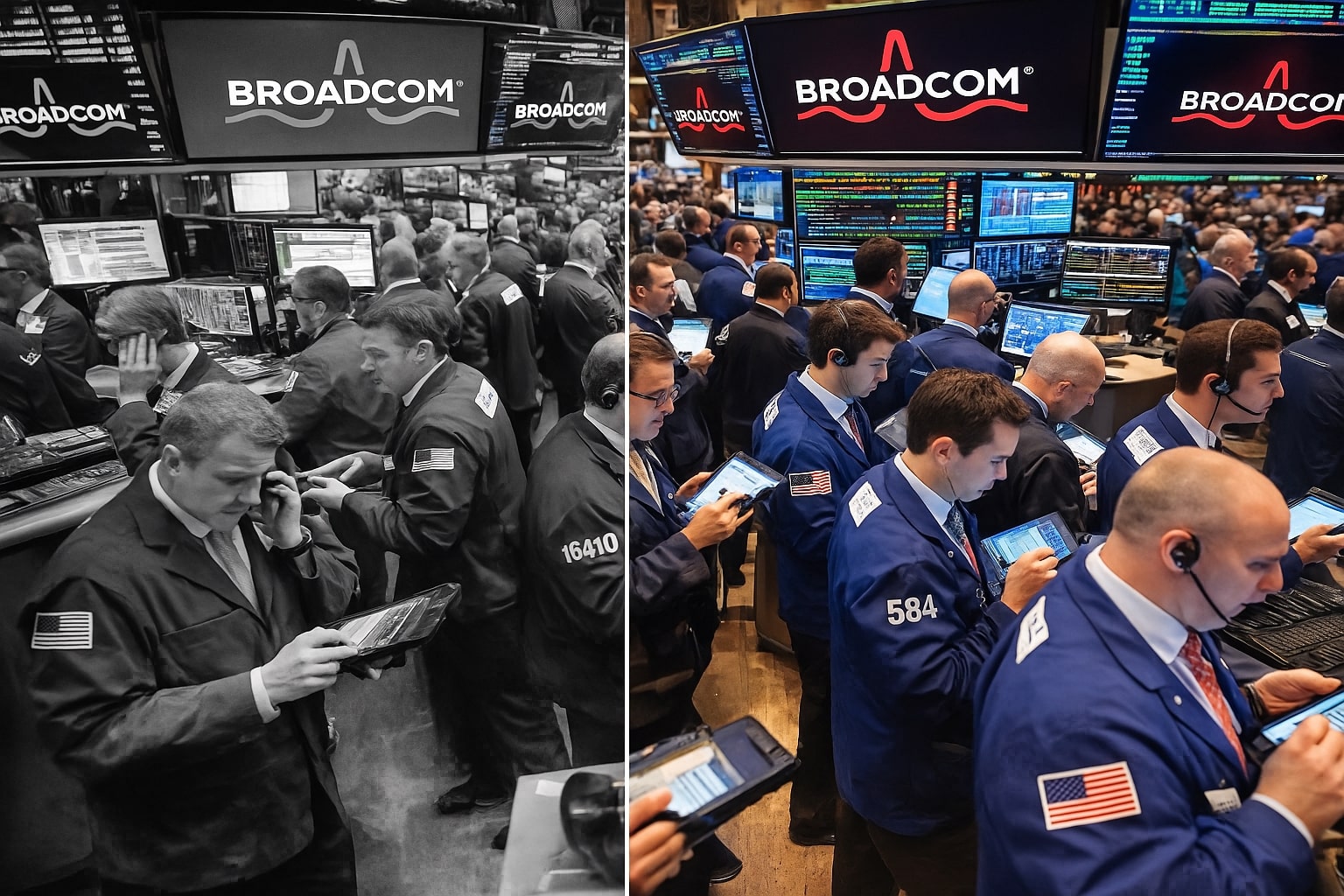
The Nasdaq’s weakness is concentrated in the prior AI winners. Broadcom, ticker AVGO, has fallen roughly 16%–18% in three sessions, including a 5.5%–5.6% drop on Monday, despite beating headline estimates. The problem is perception: a $73 billion AI backlog over the next 18 months is huge in absolute terms, but not as aggressive as the market had priced in. At around $341–342, AVGO is still up about 46% year to date but is clearly deflating from a momentum extreme. Oracle, ticker ORCL, has dropped around 17% over the same period as investors question how quickly its cloud and AI businesses can translate hype into revenue and margin. Palantir, ticker PLTR, has also been hit in early trading sessions as the market reviews which AI stories actually produce cash flow. The AI complex has transitioned from narrative-driven multiple expansion to a “deliver or de-rate” regime, and that is directly pressuring the Nasdaq.
Dow Versus Nasdaq: Factor Rotation Into Value, Defensives And Domestic Exposure
The Dow is holding up better than the Nasdaq because of its heavier weighting in industrials, financials, consumer names and health care rather than pure high-multiple tech. With the Dow off only about 0.1%–0.2%, investors are signaling a preference for resilient earnings and dividends over long-duration growth stories. The Russell 2000, sitting near 2,533, benefits from increased speculation that future Fed cuts and a weaker dollar will eventually ease funding costs and support domestic small caps, although that thesis still competes with slower macro data. The relative performance gap between the Dow and Nasdaq underlines a classic late-cycle stance: quality value over hyper-growth.
European Indices And Defense Stocks React To Ukraine Ceasefire Hopes
European markets are trading lower, with the FTSE 100 around 9,667, down about 0.9%, and the DAX near 24,079, lower by roughly 0.6%. The move is driven by a pullback in defense names as early hopes of progress in Ukraine ceasefire talks gain traction. BAE Systems, ticker BA, Babcock, ticker BAB, Rheinmetall, ticker RHM, Thales, ticker HO, and Leonardo, ticker LDO, are down in the region of 2.5%–5.5%. Defense stocks have priced in persistent conflict-related demand, so any hint of peace talks immediately compresses risk premia. That rotation is the mirror image of what is happening in oil, where peace hopes are accelerating downside.
Dollar Index, Treasury Yields And VIX Set A Cautiously Risk-Off Backdrop
The U.S. Dollar Index, ticker DXY, trades around 97.9–98.0, down about 0.3% on the day and near a 10-week low after closing at 98.31, its weakest finish since early October. A softer dollar reflects both rising expectations for future Fed cuts and relative outperformance of other major economies. Ten-year Treasury yields hover near 4.17%–4.18%, about one to two basis points lower, while the two-year yield is around 3.48%–3.50%, down roughly three to four basis points. That modest bull-steepening signals slower growth and gentle disinflation rather than a shock. The VIX near 17.0–17.3 is above the ultra-calm regime below 14 but far from stress levels, consistent with an orderly repricing of risk rather than a panic.
Gold Near Record High While Oil Breaks Down Below $60 In A Rare Divergence
Gold futures, ticker GC00, trade around $4,356–$4,358 per ounce, up about 0.5% and within striking distance of the all-time high around $4,398 set in October. Lower real yields, a weaker dollar and rising concern about growth are boosting demand for hedges. After three rate cuts this year and expectations for more in 2026, the opportunity cost of holding gold has collapsed. West Texas Intermediate crude, ticker CL=F, trades around $55.4–$55.5 per barrel, down more than 2% and at its lowest level since May. Brent crude, ticker BZ=F, has broken below $60, losing about 1.4%–2.4% and approaching multi-year lows. Supply growth from both OPEC and non-OPEC producers in the Americas is outpacing demand, and the International Energy Agency now expects one of the largest surpluses on record for next year. Hopes of a framework for Ukraine peace talks are eroding geopolitical premia as well. The combination is strongly supportive for gold and clearly negative for oil in the near term.
Bitcoin BTC-USD Stuck Between $85,000 And $94,000 As Liquidity Thins
Bitcoin, ticker BTC-USD, dropped below $86,000 for the first time in two weeks before recovering toward $87,300–$87,500, still down roughly 1%–1.5% on the day. The cryptocurrency has spent recent sessions oscillating inside a wide $85,000–$94,000 band, with every rally meeting selling from investors who bought near the all-time highs in early October. Correlation with equities has broken down on the upside: Bitcoin has sold off alongside risk assets but has not fully recovered when stocks have bounced. That pattern underscores weak liquidity and fading risk appetite in crypto, even after the latest Fed cut. Near term, the structure is Bearish to neutral, with the risk that a clean break below the lower end of the range triggers a deeper unwinding of leveraged positions.
Ford F Takes A $19.5 Billion EV Charge And Pivots Toward Hybrids And Smaller EVs
Ford Motor, ticker F, trades around $13.86 with a gain of about 1.6%–1.7% after announcing roughly $19.5 billion in special items tied to a restructuring of its EV strategy. The company is pivoting toward hybrids and extended-range EVs instead of a fully electric line-up, cancelling the next generation of large all-electric trucks in favor of smaller, more affordable EVs built on a new Universal EV Platform. The first midsize pickup from that platform is slated for Louisville Assembly Plant in 2027. Despite the massive charges, Ford raised its 2025 adjusted EBIT guidance back to about $7 billion, restoring the upper end of its previous target range after earlier cuts to $6–6.5 billion. This is a harsh acknowledgment that previous EV capital plans were uneconomic, but the willingness to redeploy capital into higher-return hybrids, trucks, vans and energy storage is equity-friendly. The stock now trades as a high-risk turnaround with improving capital discipline rather than a pure EV story.
Read More
-
GPIQ ETF Price Forecast: Can a 10% Yield at $52 Survive the Next Nasdaq Selloff?
09.02.2026 · TradingNEWS ArchiveStocks
-
XRP ETF Price Forecast: XRPI at $8.32, XRPR at $11.86 as $44.95M Inflows Defy BTC and ETH Outflows
09.02.2026 · TradingNEWS ArchiveCrypto
-
Natural Gas Futures Price Forecast: Will The $3.00 Floor Hold After The $7 Winter Spike?
09.02.2026 · TradingNEWS ArchiveCommodities
-
Stock Market Today: Dow Back Under 50K While S&P 500 and Nasdaq Push Higher as Gold Reclaims $5,000
09.02.2026 · TradingNEWS ArchiveMarkets
-
USD/JPY Price Forecast: Can Bulls Clear 157.5 Without Triggering a 160 Intervention Line?
09.02.2026 · TradingNEWS ArchiveForex
Tesla TSLA Hits A 2025 High On Robotaxi Tests In Austin
Tesla, ticker TSLA, closed Monday at $475.31, up nearly 3.6%, marking its highest close of 2025. Executives confirmed that driverless cars are being tested on public roads in Austin with no human occupants, and the company signaled a phased fleet activation through over-the-air software updates, describing the process as “slowly then all at once.” Tesla shares are up about 17.7% year to date, with the latest leg of the rally driven less by core EV volumes and more by renewed enthusiasm around full self-driving and robotaxis. The stock now reflects substantial optionality on autonomy and software economics layered on top of the EV business. That optionality justifies a premium multiple, but it also creates binary regulatory and safety risk. At current levels, TSLA is best treated as a Hold for existing holders with a speculative Bullish bias, rather than a fresh core entry at a 2025 high.
Pfizer PFE Slides After 2026 EPS Guidance Misses Consensus
Pfizer, ticker PFE, trades near $25.6, lower by about 3% after issuing 2026 earnings guidance of $2.80–$3.00 per share versus the $3.05 expected by analysts. Management reaffirmed the 2025 outlook, but the new numbers confirm that the earnings rebuild after the COVID revenue cliff is slower than bulls hoped. Investors wanted a clearer bridge from cost-cutting and COVID unwinds to durable growth in oncology, vaccines and other franchises. With the stock trading at a value-like multiple and offering a solid dividend yield, PFE sits in Hold territory. It is cheap enough to keep in income portfolios, but not yet compelling for aggressive accumulation until the growth narrative beyond COVID is better defined.
Roku ROKU Upgraded To Overweight As Connected TV Momentum Builds
Roku, ticker ROKU, trades around $110–111, up roughly 1.5% after a double upgrade to Overweight and a price-target hike from $85 to $135. Analysts highlight that platform revenue growth has re-accelerated in the second half of 2025, supported by an expanding user base, higher streaming prices, deeper streaming partnerships, premium subscription adoption and a healthier advertising backdrop. Tailwinds in connected TV, including political and sports ad migration, reinforce the story. After a brutal drawdown in prior years and a strong rebound in 2025, ROKU is back in the growth conversation, but volatility remains high. At this valuation, the stock looks like a speculative Buy for investors who believe management can convert viewership scale into durable advertising and subscription economics.
Micron MU Faces A High-Expectation Earnings Event After A 2025 Tripling
Micron Technology, ticker MU, is set to report earnings with options implying a potential move of about 9% in either direction. The stock closed near $237.50, and a 9% swing would push MU toward $258 on the upside or roughly $217 on the downside. Consensus expects revenue of around $12.93 billion, up roughly 48% year on year, and adjusted earnings of about $3.96 per share, more than double the prior year. The driver is surging demand for memory in AI data centers, with MU supplying high-bandwidth memory to leaders like Nvidia and AMD. After nearly tripling in 2025, Micron is one of the best-performing names in the S&P 500, which means expectations are extremely elevated. Structurally the AI memory story is intact and Bullish, but event risk is high into this print. For portfolio construction, MU is a Hold through earnings only for investors comfortable with large gap risk.
Kraft Heinz KHC Brings In Steve Cahillane To Lead A Break-Up Into Two Companies
Kraft Heinz, ticker KHC, trades around $24.7, up about 1%, after announcing that Steve Cahillane, former CEO of Kellanova, will become chief executive on January 1, 2026. He will also join the board and lead the planned separation into two independent, publicly traded companies. The larger entity, “Global Taste Elevation Co.,” will house global growth brands including Heinz, Philadelphia and Kraft Mac & Cheese. The second business, “North American Grocery Co.,” will include Oscar Mayer, Kraft Singles and Lunchables. KHC shares are down roughly 22% year to date, reflecting years of underperformance and questions around strategy. Bringing in a seasoned brand operator with a clear breakup roadmap creates a credible value-unlock story. For equity holders, KHC is moving into Turnaround Hold territory with a gradual Buy bias for investors willing to wait for execution on the split and margin improvement.
Frontier ULCC Replaces Its CEO As Ultra-Low-Cost Carriers Struggle
Frontier Group Holdings, ticker ULCC, announced the replacement of longtime CEO Barry Biffle with company president James Dempsey on an interim basis, with Biffle staying on as an advisor through year-end. The airline operates in the ultra-low-cost segment, which has suffered as larger carriers roll out more premium cabins, deep loyalty programs and expanded international networks. Frontier’s attempted merger with Spirit failed, and Spirit has since been forced into bankruptcy processes twice in just over a year. ULCC shares have lost around 19% this year, showing that the business model is under severe structural pressure rather than facing a temporary cyclical headwind. The CEO change may improve governance and execution but does not fix industry economics. For stock investors, ULCC remains best categorized as Avoid or Sell until there is tangible evidence of sustainable profitability and a more rational competitive landscape.
Nasdaq NDAQ Seeks 23-Hour Weekday Trading And Reshapes Market Microstructure
Nasdaq, ticker NDAQ, has asked the SEC for approval to extend U.S. equity trading to 23 hours a day during the week. The proposal would add an additional session running from 9 p.m. to 4 a.m. Eastern Time on top of existing premarket, regular and postmarket hours. For global investors in tech and high-beta equities, this move would effectively bring U.S. stocks into local trading hours in Asia and Australia, allowing real-time reaction to earnings and macro news. It also raises the likelihood that a larger share of price discovery and big moves in names like Nvidia, Tesla, Coinbase or crypto-adjacent stocks occur outside traditional 9:30 a.m.–4:00 p.m. ET cash hours. The downside is the potential for sharp, thin-liquidity swings overnight, which can complicate stop-loss execution and risk management. If approved, near-continuous trading would further blur the line between futures, CFDs and cash equities.
Macro Data Beyond Jobs: Retail Sales, Inventories And PMI Readings
Beyond the headline labor report, October retail sales were flat against expectations for a 0.1% month-on-month increase, suggesting that consumer momentum is losing steam at the margin. Business inventory data for September and S&P Global PMI readings for December will help refine the view on goods demand and services activity. The manufacturing PMI’s preliminary reading and the services PMI, previously at 54.1, will show whether the U.S. economy is trending toward a soft landing or something weaker. The combination of flat retail sales, cooling jobs, and still-positive but moderating PMIs argues for slower but ongoing growth, not a sudden contraction.
Upcoming Earnings Watch: Lennar LEN, Worthington WOR And Cyclical Signals
Lennar, ticker LEN, will report after the close and will be treated as a key barometer for U.S. housing. Order trends, cancellation rates, pricing discipline and commentary on mortgage affordability will drive not only LEN but the broader homebuilder complex. Worthington Enterprises, ticker WOR, will provide a smaller but useful read on industrial demand and materials exposure. After a flat retail sales print and a mixed jobs report, any additional signs of weakness from housing or industrials would reinforce the view that the economy is drifting into a slower-growth, lower-margin environment.
Cross-Asset Takeaways And Relative Calls Across Indices And Sectors
Putting the pieces together, U.S. equities remain in a late-cycle adjustment rather than a full-blown downturn. The S&P 500 around 6,812–6,815 is effectively a Hold with a mild upside bias over 12 months, supported by sector rotation away from crowded AI trades. The Nasdaq around 23,085–23,095 is a Hold to tactically Bearish near term, as AVGO, ORCL, PLTR and other AI darlings undergo a necessary valuation reset. The Dow near 48,400 is a Hold with a balanced sector mix. The Russell 2000 around 2,533 is a speculative Buy for long-term investors who accept rate and credit risk. Gold at $4,356–$4,358 is firmly in Buy or Overweight territory as real yields fall and the dollar weakens. Oil at $55.4 for CL=F and below $60 for BZ=F is a Sell or Underweight until either supply is cut or demand accelerates. Bitcoin around $87,300–$87,500 remains in a fragile Bearish to neutral band with weak liquidity. In single names, AVGO is turning into a high-beta Buy on weakness for AI believers, MU is a high-risk Hold into earnings, TSLA is a momentum-driven Hold at a 2025 high, F is a speculative Buy on a rational EV reset, PFE is a value Hold, KHC is a turnaround Hold with selective accumulation, ROKU is a speculative growth Buy, and ULCC remains structurally a Sell or Avoid.