Stock Market Today: Dow Extends Record Run While Oil, Metals And Crypto Reset
Indices Snapshot: Dow And S&P 500 Outperform As Nasdaq Catches Its Breath
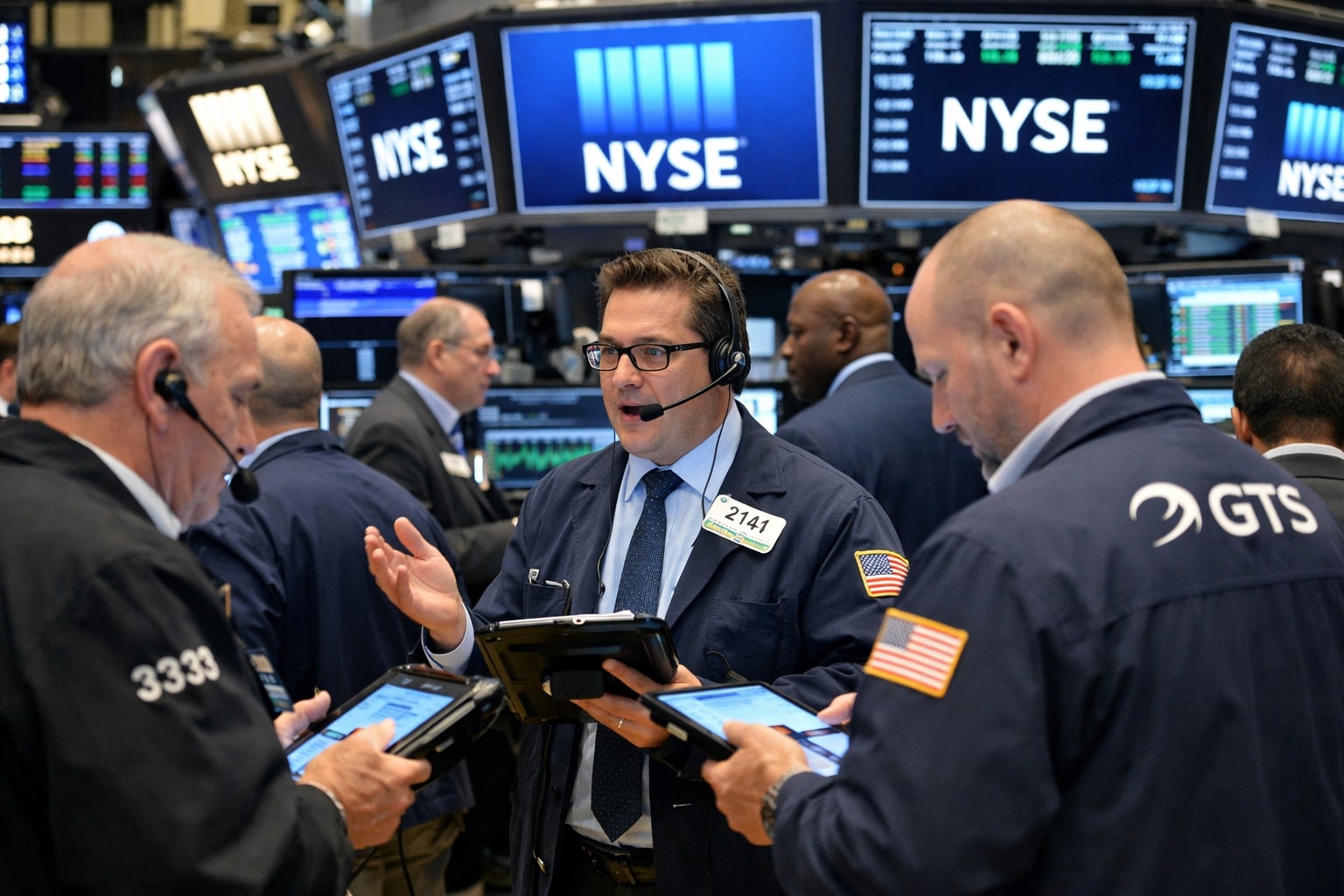
U.S. equities hold near all-time highs, but leadership underneath the surface is rotating fast. The Dow Jones Industrial Average (^DJI) trades around 49,480–49,490, up about 0.05%–0.06% on the session after finally closing above 49,000 for the first time. That move caps a 2.9% gain over the first three trading days of 2026, the strongest start since 2003, when the Dow rose 5.2% over the same window. The S&P 500 (^GSPC) sits near 6,955, up about 0.15%, marking yet another record close as investors lean into large-cap U.S. exposure. The Nasdaq Composite (^IXIC) holds around 23,600, adding roughly 0.23%–0.26% in cash trade after dipping a marginal 0.1% at the open. The Russell 2000 is positive but subdued near 2,584, up roughly 0.06%, signaling that the current advance remains mega-cap led rather than broad-based risk-on across small caps.
Volatility stays muted. The VIX trades around 15.0, up less than 2%, consistent with a market that digests record levels without real fear. Cross-asset context reinforces that picture. The U.S. 10-year Treasury yield is hovering near 4.14%–4.15%, down a couple of basis points on the day as investors price in a softer growth path and more cuts later in 2026. The Dollar Index trades around 96–99, roughly flat, while the KBW Nasdaq Bank Index sits under pressure near 171, down close to 0.9%, showing banks lagging even as indices print highs. Broad commodities, via the S&P GSCI Spot Index around 553, are down about 0.4%, confirming that this leg of the equity rally is not coming from raw materials.
Jobs, Yields And The ‘Just Weak Enough’ Macro Narrative
The macro anchor for today’s session is the ADP private payrolls print for December. U.S. private employers added 41,000 jobs, missing expectations for around 47,000–50,000 and following a November decline of roughly 29,000–32,000. Private payrolls have now fallen in three of the last five months, and the latest move only barely takes the series back into positive territory. The quality of hiring underscores a narrow growth story. Gains come mainly from services, especially healthcare and education, while professional and business services post the largest declines. Annual pay growth is locked at 4.4% year-over-year, unchanged from November, suggesting wage pressures are moderating but far from deflationary.
Bond markets embrace this “not hot, not cold” setup. The U.S. 10-year hovers near 4.145%, down around 2–3 bps, while global yields echo the move. The UK 10-year gilt trades near 4.43%–4.44% after weak construction data, prompting markets to price multiple Bank of England cuts in 2026. In the euro area, the German 10-year Bund yield sits near 2.81% after inflation slowed to 2.0% in December, matching the ECB target for the first time since summer and strengthening the case for rate cuts in the second half of the year. The message is consistent: growth is losing speed, but there is no hard-landing signal yet. That combination is still supportive for long-duration assets, particularly U.S. megacap tech and AI beneficiaries, and explains why the S&P 500 and Dow can hold records even as cyclical pockets such as metals and energy trade heavy.
Friday’s official nonfarm payrolls report is the next catalyst. Consensus is roughly 55,000 job additions with unemployment dipping toward 4.5%. The delayed JOLTS report for November is expected around 7.65 million openings vs 7.67 million in October. Anything that confirms a gradual cooling without a collapse will extend this current “equities up, yields down” regime.
Venezuela Oil Deal: Bearish For Crude, Bullish For Refiners And Select Energy
The most acute macro shock comes from the Venezuelan oil story. President Donald Trump announced that interim authorities in Venezuela will deliver between 30 and 50 million barrels of sanctioned crude to the U.S., valued at up to $2.8 billion. In parallel, sources quoted by financial TV indicate that oil flows from Venezuela will continue indefinitely and that U.S. sanctions will be eased. Trump has framed the arrangement as the U.S. controlling the proceeds “to benefit the people of Venezuela and the United States.” Markets focus less on the politics and more on barrels.
The price action is direct. West Texas Intermediate (CL=F) trades around $56.60–$56.90 per barrel, down roughly 0.5%–1.0% on the day and extending a slide of more than $1 earlier in the week. Brent (BZ=F) hovers near $60.50–$60.60, lower by around 0.2%–0.3%. The key point is that what markets initially feared could turn into a disruptive supply shock around the Venezuelan operation is now being repriced as incremental, politically managed supply into the U.S. system. That caps upside for crude and explains why the last major bearish overhang for oil is now being described as “removed” by some traders.
Yet the reaction across energy equities is far from uniform. The winners are the refiners and complex downstream names. Valero Energy (VLO) jumps to roughly $185.72, up about 4.2% intraday and nearly 8% week-to-date. Marathon Petroleum (MPC) gains around 2%–3% in early trading, building on prior strength. Dow component Chevron (CVX) adds about 1.5% as investors price the combination of lower feedstock and embedded leverage to Venezuelan crude. The trade is straightforward: more supply at sub-$60 Brent squeezes upstream producers but widens refining spreads if product demand holds.
For traders, that argues for a barbell within energy. The commodity itself looks capped in the mid-$50s to low-$60s range in the near term. Integrated majors with refinery exposure like CVX, and pure refiners like VLO and MPC, screen as relative outperformers while directional oil longs face a more difficult risk-reward. On a pure stance, crude here is range-bound, not a high-conviction long, whereas refiners merit a Buy/Overweight bias as long as Venezuelan barrels keep flowing and sanctions keep loosening rather than snapping back.
Metals And Gold: Safe-Haven Momentum Breaks As Data, Not War, Sets The Tone
The precious-metals complex is giving back part of its geopolitical premium. Gold (GC=F) trades near $4,461.50 per ounce, down about 0.77% on the day after rallying more than 4% across the prior three sessions. Silver takes a harder hit, with front-month futures around $77.14, down approximately 4.8%, making it one of the sharpest decliners in the cross-asset dashboard. Copper and other industrial metals also lose altitude, and global mining shares underperform broader indices.
The pivot is from war risk to data risk. Over the past few days, headlines about Venezuela, tensions around Greenland, and fresh controls on Chinese exports of dual-use materials to Japan had driven a classic safety bid into gold and silver. Now the focus has flipped back to the labor market, ISM, JOLTS and the timing of Fed cuts. Real yields are grinding lower as Treasuries rally, which is usually a tailwind for bullion, but the market had already front-loaded a meaningful easing path. Without fresh panic, a simple “weaker but orderly” macro backdrop is not enough to push gold in a straight line higher from $4,400–$4,500.
In that context, gold here looks like a Hold, not an aggressive Buy. Levels are elevated, and the risk-reward for new longs is less compelling than it was sub-$4,300. Silver, given the nearly 5% drop today, behaves like a high-beta macro hedge rather than a stable store of value and will remain more volatile than gold into each data point. Positioning now is about trimming tactical overweights, not about flipping structurally bearish on the metal complex as long as real yields drift down and central banks remain biased toward easing.
AI Ecosystem: From NVDA H200 Demand To Memory, Foundries, And Asian Hardware
Artificial intelligence remains the core narrative supporting the Nasdaq and S&P 500, but leadership inside that trade is evolving. At CES 2026 in Las Vegas, Nvidia (NVDA) is again the focal point. The stock trades about 0.7% higher on the day, but the more important message is qualitative. CEO Jensen Huang reports “very high” demand from Chinese customers for the new H200 AI accelerator, after the U.S. government signaled that exports of that chip will be allowed. Nvidia has restarted production, with H200 units already moving through its supply chain as the company works out final export license details. That confirms the AI hardware cycle is not topping; it is broadening.
The pure-play beneficiaries are no longer only GPU vendors but also memory and storage suppliers. A dedicated data-storage spin-off has surged nearly 900% since its February listing, after Nvidia unveiled a new AI server memory platform that tightly integrates with connectivity and storage products. Legacy storage leaders Western Digital and Seagate Technology have rallied roughly 17% and 14%, respectively, as investors re-rate the earnings power of high-performance storage in AI workloads. Micron Technology (MU) is trading around $340.71, down 0.8% intraday but still well bid after a major global bank raised its target from $300 to $400, implying another 16% upside from Tuesday’s close. Investor meetings with Micron reinforced confidence in the durability of this memory upcycle as AI infrastructure continues to absorb high-bandwidth DRAM and cutting-edge NAND.
Asian hardware is being pulled into the same jet stream. Samsung Electronics (005930.KS) closed near 141,000 KRW, up about 1.5% on the day, after announcing a $1.73 billion share acquisition program to fund stock-based compensation for employees and executives. That move comes on top of a rally that has already restored around $350 billion in market capitalization and reversed years of underperformance versus SK Hynix (000660.KS). A key catalyst is speculation that Qualcomm (QCOM) will leverage Samsung’s 2-nanometer process for advanced chip manufacturing, highlighting that Samsung is once again back in the leading node conversation. Shares traded as much as 4% higher intraday ahead of a preliminary earnings release expected to show more than double quarterly profit.
On the foundry side, Taiwan Semiconductor Manufacturing Company (TSM) trades near $324.88, down around 0.79% today but up about 8% year-to-date after more than tripling over the last three years. It now represents close to 45% of Taiwan’s main equity benchmark by weight. At least six brokerages have lifted targets in early 2026, including JPMorgan, which boosted its local-currency price objective by 24% to NT$2,100 on expectations of strong revenue growth and higher profitability as AI demand remains relentless.
Putting it together, the AI ecosystem trade is no longer a single-ticker story. GPUs (NVDA), memory (MU), storage, Asian foundries (TSM) and integrated device makers (Samsung) are now tied together in one cycle. On current data, that supports a Bullish / Buy stance on the broader AI hardware complex, with selective profit-taking only where valuations have outrun near-term fundamentals.
Crypto And Strategy (MSTR): Index Victory, But Still Deep In A Drawdown
Crypto remains a key volatility source, but the story today is more about equity exposure than coins. Bitcoin (BTC-USD) trades around $91,700–$92,000, down around 0.8%, in parallel with moves in Bitcoin-linked equities. The headline name is Strategy Inc (MSTR), the listed bitcoin-treasury proxy. Shares trade near $165.82, up roughly 4.97% intraday after the index provider MSCI (MSCI) decided not to exclude digital-asset treasury companies from its benchmarks for the February 2026 review.
The mechanics matter. MSCI will maintain current treatment of these so-called DATCOs, defined as firms whose digital assets represent at least 50% of total assets. However, it will now refuse to count new shares issued by such companies when calculating index weights, effectively capping how much MSTR and peers can grow their benchmark influence by issuing equity to buy more bitcoin. The company itself highlighted the decision as a “strong outcome for neutral indexing and economic reality,” but the stock remains more than 60% below its 52-week high and is still down roughly 47%–48% from 2025 levels.
From a positioning angle, the index reprieve removes a near-term forced-selling risk but does not erase structural volatility. As long as BTC-USD sits near $90,000–$92,000 with no clear direction break, MSTR is a high-beta, high-risk vehicle rather than a core holding. The appropriate stance here is speculative Hold: the index outcome trims downside tail risk, but the stock remains hostage to bitcoin’s path and to future MSCI rule tweaks.
Media M&A: WBD Rejects PSKY As It Defends Its Netflix Pact
The media complex is dealing with M&A rather than pure growth. Warner Bros. Discovery (WBD), trading around $28.53 and up about 0.16% intraday, has again told shareholders to reject Paramount Skydance (PSKY)’s hostile bid. Paramount’s latest proposal offered $30 per share, backed by roughly $40.4 billion in equity financing personally guaranteed by Larry Ellison and sweetened by a higher break-up fee. Even so, the WBD board labels the offer “inferior” to its existing $72 billion merger agreement with Netflix (NFLX).
The reasoning rests on leverage and execution risk. Warner argues that Paramount’s heavy use of debt financing creates an “extraordinary” amount of balance-sheet risk and provides inadequate protection if the transaction fails to close. That stance has left WBD marginally higher, while PSKY and NFLX each add about 0.3% in early trading as investors reassess the ownership structure of streaming IP. For now, WBD is signaling that its strategic future is more closely aligned with a scaled streaming partner like NFLX than with a more indebted combined platform under PSKY.
On valuation and risk, WBD remains a high-leverage content play, but the board’s refusal to chase a debt-heavy bid is a modest positive for equity holders. Given the current macro and balance-sheet profile, the stock screens as Hold: upside exists if the Netflix tie-up unlocks synergies, but capital-structure risk and deal complexity cap near-term multiple expansion.
Robotics And Autonomy: MBLY, Hyundai And The Next Cycle For AI In The Real World
The next AI frontier in equities is the physical world. Mobileye Global (MBLY), trading near $13.23 and up about 8.62%–11% today, is rallying after announcing a $900 million acquisition of humanoid robotics startup Mentee Robotics. The logic is clear: autonomous driving and humanoid robotics share common stacks in sensing, perception and decision-making. That overlap allows Mobileye to leverage its ADAS and autonomy IP into embodied AI, a theme that has gone from science fiction to capital-markets story.
Intel (INTC), which retains about 23% of MBLY, benefits indirectly from any re-rating of Mobileye’s growth trajectory. The deal highlights that autonomy is no longer just a software or chip problem; it is about deployment in warehouses, factories and logistics centers to address labor shortages and boost productivity.
In parallel, Hyundai (HYMLF, 005380.KS) is pushing a subscription model for humanoid robots, positioning itself directly against Tesla (TSLA) in the long-term robotics race. Instead of selling robots outright, Hyundai is pitching them as recurring-revenue assets, mirroring the logic of streaming services and big-box membership models. That strategy amplifies the long-term earnings leverage but also raises questions about customer lock-in and “subscription fatigue.”
Taken together, the MBLY deal and Hyundai’s strategy support a Bullish long-term view on robotics and embodied AI, even if near-term valuations are rich. MBLY specifically looks like a Buy for aggressive growth portfolios, with the caveat that integration risk and macro cyclicality could create drawdowns along the way.
Meme And Specialty Movers: GME, DECK And FSLR React To Idiosyncratic Catalysts
Below the index level, idiosyncratic stock stories are still moving tape. GameStop (GME) trades near $21.62, up about 4.64% after revealing CEO Ryan Cohen’s compensation package. The plan links his pay to achieving a $100 billion market cap target, a level far above current valuation and clearly designed as a stretch goal. The market reads it as a renewed attempt to revive the long-dated growth story, but the lack of structural fundamental change keeps GME firmly in speculative territory. From a fundamental point of view, that aligns with a Sell / avoid stance unless one is explicitly trading meme flows.
Deckers Outdoor (DECK) is down about 4% in pre-market after printing second-quarter numbers that beat on headline metrics but came with warnings about tariff pressures. That kind of guidance is dangerous this late in the cycle, especially with the market laser-focused on Trump’s tariff path and possible Supreme Court rulings on trade measures as early as Friday. With the stock having run hard into earnings, today’s reaction is a straightforward de-risking move and argues for at best a Hold until tariff visibility improves.
First Solar (FSLR) edges lower after a downgrade from Buy to Hold at a major broker and a price-target cut from $269 to $260. The small reduction in target and downgrade reflect concerns around policy support and margin visibility, not an outright collapse in the solar thesis. Given the stock’s sensitivity to rate moves and policy headlines, the risk-reward now skews toward Hold, with value investors waiting for either a larger multiple compression or clearer catalysts.
China And Europe: AI-Led China Rebound Versus Defense-Led European Outperformance
Outside the U.S., two equity themes are prominent: China AI-driven recovery and European defense. On China, strategists at a major U.S. bank now project the MSCI China Index to climb roughly 20% to 100 by the end of 2026 from its 2025 close, while the CSI 300 (000300.SS) is expected to rise about 12% to 5,200 from around 4,776.67 today. The drivers cited are earnings growth, AI adoption, “Going Global” strategies, and supportive policy shifts, rather than pure multiple expansion. That view aligns with the ongoing rally that carried into early 2026 and reflects the belief that China’s equity recovery can continue even after hefty gains in 2025, as long as policy remains aligned with growth and AI remains a credible profit engine.
In Europe, defense stocks are the standout winners in early 2026. Names like Rheinmetall in Germany and Thales in France have climbed more than 10% just this week, making defense one of the top-performing segments in the Stoxx Europe 600. The catalyst is the perception that the U.S. shift toward more aggressive foreign policy, including the Venezuela operation and rising odds of moves on assets like the Panama Canal and Greenland, will push European governments to raise defense budgets again. For equity investors, this is a classic policy-driven trade, where earnings visibility improves as defense spending is politically locked in.
On balance, the China call supports a selective Buy on AI-linked Chinese benchmarks and large-cap leaders, while the European defense complex is a Buy on policy momentum and earnings visibility. Both themes are secondary to U.S. AI, but they matter for global allocators rotating out of crowded U.S. mega caps.
Sentiment And Earnings: Mid-Market Caution, Large-Cap Confidence
Below the index level, corporate surveys and earnings expectations reveal a split between midsize firms and mega caps. A new JPMorgan survey of more than 1,400 leaders at U.S. midsize businesses (annual revenue between $20 million and $500 million, representing about one-third of U.S. private-sector revenue and employment) shows that only 39% are optimistic about the national economy in 2026. That’s a sharp drop from 65% a year earlier, when optimism hit a five-year high. At the same time, 71% remain confident in their own firm’s outlook, only slightly below 74% last year. The label from JPMorgan’s head of commercial banking is “cautious optimism,” but the reality is clearer: companies trust their micro more than the macro.
At the big-cap level, the story is different. The Dow is enjoying its best start to a year since 2003, and strategists highlight a “pro-cyclical rally” and an expected broadening of earnings momentum beyond mega-cap tech. The earnings calendar today is light but telling: Constellation Brands (STZ), Jefferies Financial Group (JEF), Albertsons (ACI) and Applied Digital (APLD) are on the docket, providing reads on consumer staples, investment banking, grocery retail and digital infrastructure. Meanwhile, U.S. venture-capital fundraising has slumped to $66 billion in 2025, down 35% year-over-year and roughly 70% below the 2022 peak, showing that capital is concentrating in public markets and in the most trusted private platforms.
Overlay this with political risk. Prediction markets put odds of Trump “taking back the Panama Canal” above 35% by early 2029 and give a roughly 38% probability that the U.S. will “take control of any part of Greenland.” Analysts frame this as evidence that the President has grown more comfortable using military force in his second term. For equities, that mix of local business confidence, macro caution and geopolitical risk argues for staying long U.S. large caps, while keeping position sizes disciplined in the most geopolitically exposed sectors.
Big-Picture Stance: U.S. Equities Buy, Energy Mixed, Crypto High-Risk Hold
Putting all the data together, the tape says the following. Indices are at or near record highs with the Dow (^DJI) around 49,500, S&P 500 (^GSPC) near 6,955, and Nasdaq (^IXIC) around 23,600, supported by softening macro, lower yields, and a structurally strong AI cycle. The AI hardware complex spanning NVDA, MU, TSM, Samsung and storage names remains the core upside engine and justifies a Bullish / Buy bias for U.S. large-cap tech and AI infrastructure.
In energy, the Venezuela deal keeps crude (CL=F, BZ=F) capped in the mid-$50s to low-$60s, which is unsupportive for a directional long in the commodity but strongly positive for refiners such as VLO, MPC, and leveraged integrated names like CVX. That mix argues for Buy in refiners and Neutral / Hold on broad oil producers at current prices. Precious metals are digesting gains; gold (GC=F) around $4,460 is a Hold with a positive bias as long as real yields grind lower, while silver remains a high-beta trading instrument, not a core holding.
In crypto, BTC-USD near $92,000 and MSTR at about $166 reflect reduced index risk but persistent volatility. The immediate stance is speculative Hold rather than fresh Buy at these levels. Media and M&A names like WBD are Hold, given leverage and deal risk, while robotics and embodied AI via MBLY and Hyundai’s strategy justify a long-term Buy for high-risk growth capital.
Net view for a TradingNews-style allocation: U.S. large-cap indices and AI hardware remain a Buy, refiners are a Buy on spread expansion, gold is a tactical Hold, broad energy producers are Neutral, and crypto-linked equities remain high-risk Holds until price action or policy delivers a cleaner edge.
That's TradingNEWS