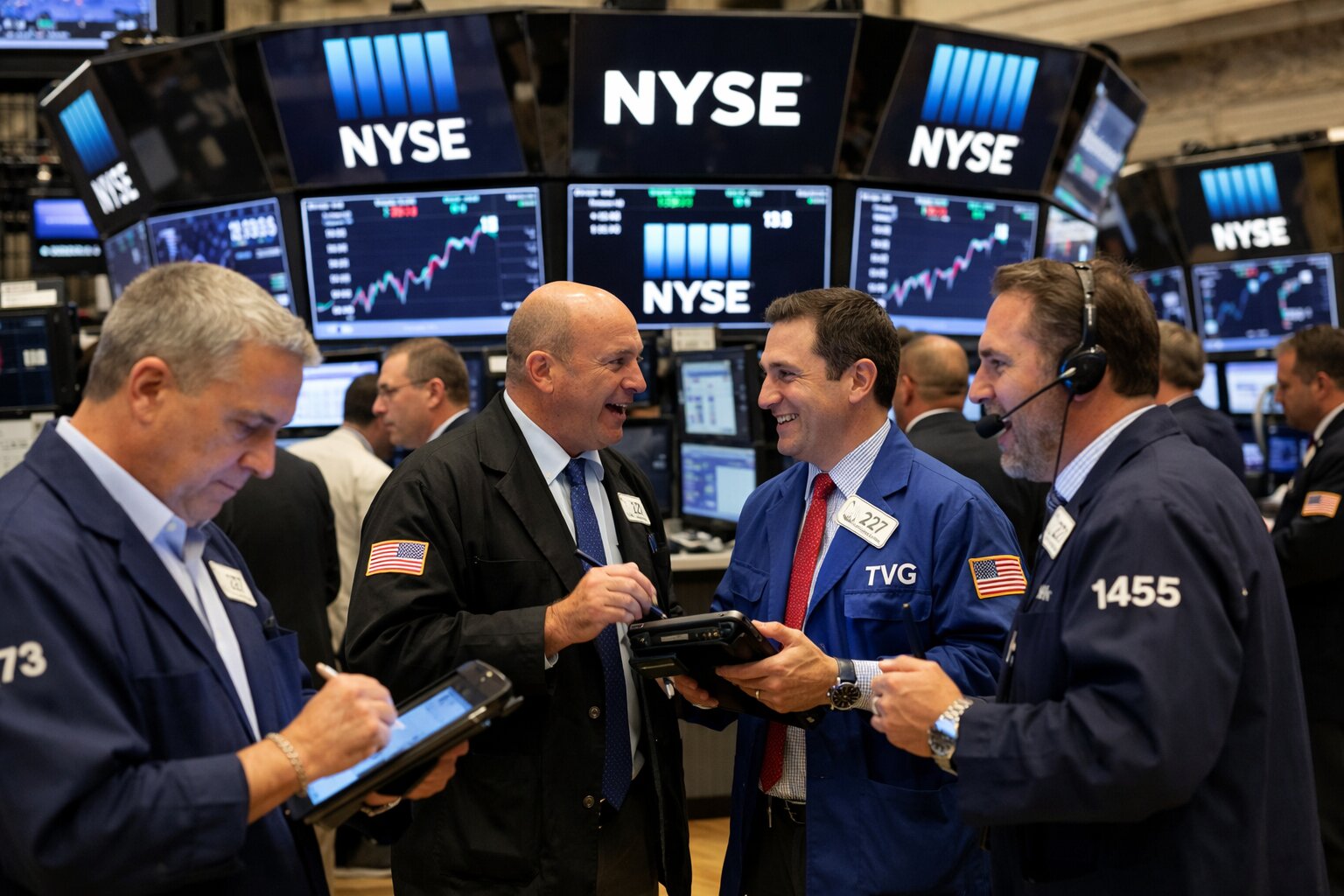
Stock Market Today: Dow Sinks 500, S&P 500 and Nasdaq Fall as Iran Conflict Sends Oil Past $79 and Shuts Strait of Hormuz
Lockheed Martin jumps 4%, Exxon gains 2%, AeroVironment surges 10% while United Airlines drops 6% | That's TradingNEWS
Stock Market Today: Dow, S&P 500, Nasdaq Slide as Middle East Conflict Triggers Oil Surge and Global Risk-Off Trade
Wall Street grapples with the largest geopolitical shock since Russia's invasion of Ukraine as Brent crude spikes above $79.
Monday's session opened under the heaviest geopolitical cloud Wall Street has faced in years. The coordinated U.S.-Israeli military offensive against Iran — dubbed "Operation Epic Fury" — entered its third day with no signs of de-escalation, killing Supreme Leader Ayatollah Ali Khamenei, striking more than 2,000 targets across the country according to briefed officials, and triggering retaliatory missile and drone attacks from Tehran that hit targets in the UAE, Saudi Arabia, Bahrain, and Israel. Iran's Red Crescent reported 555 Iranian casualties. The world's most critical oil chokepoint, the Strait of Hormuz, has effectively closed to commercial traffic. And risk assets across the globe responded accordingly.
Equity Benchmarks Sell Off at the Open, Then Pare Losses
The Dow Jones Industrial Average (DJIA) plunged as much as 600 points in the opening minutes before trimming those losses substantially. By mid-morning, the blue-chip index stood at 48,781, down 196.80 points or 0.40%. The S&P 500 (SPX) fell to 6,857.09, shedding 21.79 points or 0.32%. The Nasdaq Composite (COMP) dropped 82.30 points to 22,585.91, a decline of 0.36%. S&P 500 futures had flagged the weakness overnight, falling 0.68%, while Nasdaq futures dropped 0.79% and Dow futures lost 353 points — roughly 0.72% — in Sunday evening trading.
The CBOE Volatility Index (VIX) surged 18% in early action, climbing above 21.28 to breach its long-run average around 20 for the first time this year. That said, the level remained well below panic territory, suggesting institutional desks were hedging rather than liquidating. Tom Essaye at Sevens Report Research argued the conflict "is not a bearish gamechanger" at its current intensity. He maintained that the primary driver of equity direction remains anxiety around artificial intelligence business-model disruption, not the Middle East — barring further escalation.
Barclays' Ajay Rajadhyaksha struck a more cautious tone, noting the tail risk of a sustained conflict is materially higher now than during flare-ups in 2024 or 2025. His advice: early this week "is too early to buy any dip, especially with investors used to a pattern of quick de-escalation." Citi equity strategists echoed that caution, pointing out the geopolitical shock must be stacked alongside an already growing list of headwinds — the AI spending boom persisting even as AI-triggered disruption threatens existing business models and triggers layoffs, with fintech firm Block cutting nearly half its workforce last week because of automation.
The Strait of Hormuz Shutdown Changes the Calculus for Crude
Brent crude (BRN00) hit a fresh 52-week high Monday, spiking as much as 13% to briefly trade above $82 per barrel before settling around $78.25, up 5.38 or 7.38%. West Texas Intermediate (CL00) gained 5.83% to $70.93. In overnight over-the-counter trading on Sunday, Brent had already jumped 10% to around $80 according to oil traders. Deutsche Bank's Jim Reid put the Monday move in context: it tracked as the 38th-largest single-day gain in Brent prices since 1990.
Iran produced 4.7 million barrels per day last year — roughly 4.4% of global supply. But the real threat isn't Iranian output alone. Approximately 20% of the world's petroleum and 23% of global liquefied natural gas moves through the Strait of Hormuz. Iran's Islamic Revolutionary Guard Corps warned ships that passage is not permitted and claimed it struck three oil tankers with missiles on Sunday. Hundreds of tankers carrying crude and LNG had already dropped anchor or gone stationary near the strait, Reuters shipping data showed, after tanker owners, oil majors, and trading houses suspended movements as a precautionary measure on Saturday.
Danish shipping giant Maersk suspended all vessel crossings through the Strait of Hormuz until further notice and rerouted cargo bound for the Suez Canal around the Cape of Good Hope at the southern tip of Africa. Greece's shipping ministry advised vessels to avoid the Persian Gulf, the Gulf of Oman, and the Strait entirely. Wood Mackenzie senior VP Alan Gelder estimated that even in the most optimistic scenario — where Tehran cooperates — it could take several weeks for export flows to resume. He put $100 a barrel firmly back on the table, drawing a parallel to the immediate aftermath of Russia's invasion of Ukraine in 2022, when crude hit $125.
OPEC+ attempted to cushion the blow, agreeing in a virtual Sunday meeting to boost output by 206,000 barrels per day in April, up from its prior 137,000-barrel monthly increments. The cartel made no mention of the conflict in its statement. But as Gelder noted, that decision "is moot if flows do not resume through the Strait of Hormuz." On the consumer side, GasBuddy's Patrick De Haan expects U.S. national average gasoline prices to break above $3 a gallon and push toward $3.20–$3.25 within two to three weeks.
European Natural Gas Spikes Nearly 50% After Qatar Halts LNG Production
The energy shock extended well beyond crude. European natural gas prices spiked alarmingly Monday — nearly 50% — after QatarEnergy announced it was halting liquefied natural gas production in response to attacks on its facilities at Ras Laffan and Mesaieed. Qatar supplies approximately 10% of Europe's LNG imports. Current inventories are adequate, but any prolonged difficulty getting tankers out of the Persian Gulf into the Gulf of Oman threatens to draw down stocks rapidly. Saudi Aramco's Ras Tanura refinery was also partially shut after debris from intercepted drones struck the facility, though Saudi Press Agency said there was no impact on petroleum supply.
Defense Names Rally Hard — Lockheed Martin, Northrop Grumman, AeroVironment Lead
The conflict produced clear winners among defense contractors. Lockheed Martin (LMT) jumped roughly 4% in regular trading after gaining more than 6% premarket. Northrop Grumman (NOC) rose approximately 4–5%. Drone manufacturer AeroVironment (AVAV) surged more than 10% before the bell. RTX (RTX) climbed around 4%. Internationally, Germany's Hensoldt, Britain's BAE Systems, Japan's Mitsubishi Heavy Industries and IHI, and Singapore's ST Engineering all posted gains. President Trump told CNBC that military operations are "ahead of schedule," but his separate comments suggesting four to five weeks of continued action — and the stated goal of regime change — reinforced the thesis that defense spending is only heading in one direction.
Energy Equities: The Only Green Sector on the Board
The S&P 500 energy sector stood alone in positive territory Monday, up 2.4% and tracking toward a new record high at 875.27. Exxon Mobil (XOM) gained 2.12% to $155.73. Chevron (CVX) and ConocoPhillips (COP) rose more than 3% and 5%, respectively. Norwegian oil and gas exporters Vår Energi and Equinor led Europe's Stoxx 600, each gaining over 9%. Tanker stocks also surged — Frontline (FRO) rose more than 5%, DHT Holdings (DHT) gained 7%, and International Seaways (INSW) was up 6%.
Goldman Sachs strategists warned that the cyclical sectors that have been this year's market leaders — utilities, energy, materials, staples — could take a serious hit from a protracted war. Tech has underperformed in 2026 on AI disruption fears, but a sustained conflict could reverse even the cyclical outperformance that replaced it. Goldman's Dominic Wilson wrote that only a "severe and sustained oil price disruption (as in 1990 or 2022, for instance)" would fundamentally alter the global growth picture. But oil importers with strong year-to-date gains sit particularly vulnerable to a pullback.
Airlines and Travel Stocks Buckle Under Fuel Cost Fears
Airline equities absorbed some of Monday's worst damage. United Airlines (UAL), the most internationally exposed U.S. carrier, tumbled more than 6%. American Airlines (AAL) and Delta Air Lines (DAL) each fell over 5%. Nearly all flights into and out of Dubai International Airport were cancelled Sunday, with more cancellations spreading across the Gulf and Israel on Monday. Emirati stock markets closed until further notice.
Hotel and travel platforms also bled. Marriott International (MAR) slid nearly 5%. Hilton Worldwide (HLT) dropped close to 3%. Airbnb (ABNB) sank more than 3%. Expedia (EXPE) and Booking Holdings (BKNG) shed more than 4% and 3%, respectively. The U.S. embassy in Bahrain went so far as to advise Americans to avoid hotels as potential targets, after Iran confirmed striking the Crowne Plaza Hotel in Manama. Asia's carriers were hit equally hard — Australia's Qantas fell 5.4% despite none of its flights being affected, while Japan's ANA and Japan Airlines both lost more than 5%.
Tech Stays Weak, but Lumentum Soars on $2 Billion Nvidia Investment
Technology stocks were broadly lower as the risk-off impulse dominated, with Broadcom leading chip names down and Amazon and Alphabet both falling. Banking names including Morgan Stanley and Goldman Sachs also slipped. The S&P 500 had already closed February in the red after a selloff driven by AI and software fears.
One major exception: Lumentum Holdings (LITE) rocketed nearly 8% to a record high of $746.70 after Nvidia (NVDA) announced a $2 billion investment in the optical technology company. Nvidia disclosed multiyear strategic agreements to accelerate innovation in advanced optics for next-generation AI infrastructure. Nvidia itself edged up 1.57% to $179.98, an interesting show of resilience given the broader tech weakness. The deal underscores that despite growing skepticism about AI's near-term payoff, the biggest players continue deploying massive capital into the physical infrastructure layer.
Amazon Web Services Hit After "Objects" Strike UAE Data Center
In a reminder that the conflict's impact extends beyond energy and traditional finance, Amazon Web Services reported a disruption at one of its UAE data centers after unidentified "objects" struck the facility, sparking a fire and causing a power outage. AWS said on its health dashboard that customers experienced connectivity issues in the ME-CENTRAL-1 Region, though traffic could be rerouted to unaffected zones. No estimated restoration time was provided. The incident highlights a rarely considered risk: physical infrastructure damage to cloud computing nodes in conflict zones.
Safe Havens Respond — Gold Near $5,400, Dollar Hits Five-Week High
Gold futures (GC00) jumped 2% to roughly $5,350.80, pushing spot gold near $5,400 an ounce. Silver (SI00), however, diverged sharply, dropping 3.46% to $90.06 — a reminder that silver's industrial demand exposure sometimes overrides its safe-haven status during conflict-driven risk-off episodes.
The U.S. dollar index (DXY) surged 0.81% to 98.40, climbing above 98.5 at one point for the first time since January 22. The dollar gained 0.98% against the Japanese yen to 157.58, rose 0.87% against the euro to push EUR/USD to 1.1712, and advanced against the British pound, Swiss franc, and Norwegian krone. The Australian dollar — often viewed as a barometer for risk appetite in Asian currency markets — fell 0.28%, a relatively modest move that First Eagle's Idanna Appio interpreted as defensive positioning rather than severe disruption pricing. "I don't think this feels like a liquidity type event," she told reporters.
Treasury Yields Climb Back Above 4% as Rate-Cut Hopes Fade
The yield on the 10-year Treasury note (TMUBMUSD10Y) popped back above the psychologically significant 4% mark, rising 5 basis points to 4.007% before extending to 4.047%. The move reflects a straightforward calculation: higher oil means stickier inflation means fewer rate cuts. Fed Governor Christopher Waller, who dissented in favor of cutting rates at the most recent FOMC meeting, acknowledged before the strikes that March was "close to a coin flip." With crude above $70 and the Strait of Hormuz shut, that coin flip is rapidly tilting toward hold. Market pricing for near-term cuts compressed meaningfully during the session.
Wells Fargo Maps the Downside: S&P 500 at 6,000 in a Worst Case
Wells Fargo strategists quantified the tail risk. In an oil shock scenario where the Strait of Hormuz remains closed and crude sustains above $100, the bank forecasts the S&P 500 falling to 6,000 — a roughly 13% decline from Friday's close of 6,878.88. That's the worst case. Their base case still calls for the S&P 500 to reach 7,500 by year-end 2026, but the gap between those two numbers — 6,000 to 7,500 — illustrates just how wide the distribution of outcomes has become in a single weekend.
Kpler analyst Amena Bakr offered a blunt assessment: "Markets need to wake up and smell the geopolitical risk: flows through Hormuz remain disrupted, Trump's said his top candidates to lead Iran are dead, Iran's attacks across the Gulf persist, and there's no clear endgame." Diplomatic talks have not restarted. The conflict can drag on.
Global Markets Take the Hit — Asia, Europe All in the Red
Japan's Nikkei 225 fell 1.2% after deeper early losses. The Topix dropped 1.34%. Hong Kong's Hang Seng opened 1.15% lower. Mainland China's CSI 300 slipped 0.25%. Australia's S&P/ASX 200 fell 0.48%, partially offset by gains in oil and gold mining sectors. In Europe, the pan-European Stoxx 600 opened down 1.8%, with every sector except oil and gas retreating. The UK's FTSE dropped 0.6%, Germany's DAX fell 1.5%, France's CAC 40 lost 1.4%, and Italy's FTSE MIB declined 1.2%.
Bitcoin pared early losses to tick marginally higher at around $65,851, but that level sits dramatically below its October peak near $126,000 — a stark illustration of how far crypto has retreated from its highs even before this geopolitical shock.
Sovereign Risk in the Gulf — Missiles, Drones, but Strong Balance Sheets
Iran has directly targeted Bahrain, Qatar, and the UAE with missiles and drones. Hezbollah entered the fight after Khamenei's killing, with Israel launching retaliatory strikes on Hezbollah positions in Lebanon. But Appio at First Eagle argued most Gulf sovereigns carry balance sheets strong enough to absorb the marginal risk. She suggested the selloff may ultimately present a buying opportunity rather than signal structural deterioration — though she cautioned that's a scenario for the future, not this week.
President Trump told The New York Times Sunday evening he's open to lifting sanctions on Iran if new leadership that replaces Khamenei can serve as a pragmatic partner. But he also warned more casualties are likely, and the FBI is simultaneously investigating a mass shooting in Texas as potential terrorism. Secretary of State Marco Rubio is scheduled to brief congressional leaders at 4 p.m. ET Monday.
Berkshire Hathaway's Abel Identifies Four "Forever Stocks" in First Shareholder Letter
Away from the geopolitical chaos, Berkshire Hathaway (BRK.B, down 3.71%) drew attention for a different reason. New CEO Greg Abel published his inaugural shareholder letter, effectively naming four holdings as permanent positions: Apple (AAPL, -0.36%), American Express (AXP, -1.41%), Coca-Cola, and Moody's. These four represent more than half of Berkshire's equity portfolio. Abel added five Japanese trading companies valued at $35 billion to the "core" bucket, bringing the total permanent positions to nine stocks comprising two-thirds of the portfolio.
Notably absent from that list: Bank of America and Chevron — Berkshire's fourth and fifth largest equity positions. The omission is telling. Berkshire has cut its Bank of America stake roughly in half over the past 18 months to 517 million shares worth about $28 billion. The Chevron position stands at approximately $20 billion. Abel signaled Apple won't be trimmed further, which matters after Berkshire meaningfully reduced that stake from its peak. Berkshire has held Coca-Cola and American Express for over 40 years — paying an average of $3 per share for Coke in the late 1980s versus Friday's record close of $81. Warren Buffett will remain in the office five days a week and available to consult on equity investments.
Paramount Skydance Wins Warner Bros. Bidding War, Tops the Box Office
Paramount Skydance capped a landmark weekend by winning the bidding war for Warner Bros. Discovery (WBD, -0.30%) at $31 per share, valuing the company at $110 billion. Netflix refused to match the raised bid. The deal brings HBO's streaming platform, Warner's studio production assets, and legacy cable properties including CNN under one roof. Scream 7 debuted to a higher-than-expected $64.1 million domestic opening, with $33.1 million internationally for a $97.2 million global weekend. The estimated $110.8 million in total weekend domestic sales pushed year-to-date domestic box office to $1.17 billion — up 9.4% versus this point in 2025.
Read More
-
IVV ETF Price Forecast: S&P 500 Survives Iran War Monday at $689 as Dip Buyers Swarm — De-Escalation Could Send It Back to $700
02.03.2026 · TradingNEWS ArchiveStocks
-
XRP ETF Price Forecast: XRPI Bounces to $7.94, XRPR Hits $11.49, Bitwise XRP Climbs to $15.63
02.03.2026 · TradingNEWS ArchiveCrypto
-
Natural Gas Futures Prices Explode 46% as Qatar Shuts Down LNG Production — Strait of Hormuz Closure Puts 20% of Global Supply at Risk
02.03.2026 · TradingNEWS ArchiveCommodities
-
USD/JPY Price Forecast: Yen at 157.50 as Iran War Overrides Bank of Japan Rate Hike Bets — Dollar Dominance Targets 162
02.03.2026 · TradingNEWS ArchiveForex
The Week Ahead: Jobs Data, ISM Manufacturing, and a Fed Beige Book
Geopolitics will dominate headlines, but the economic calendar is loaded. Monday brings the ISM manufacturing activity index. Wednesday delivers ADP's private-sector payrolls report and the Fed's Beige Book survey of regional conditions. Thursday's docket includes fourth-quarter productivity data. And Friday's main event is the Labor Department's February jobs report — economists forecast 60,000 nonfarm payrolls added, nearly half January's 130,000 gain, with unemployment expected to hold at 4.3%. January's number had been the strongest since December 2024, easing labor market deterioration fears. Retail earnings also take the spotlight this week, with Target, Macy's, Kroger, and others reporting quarterly results. January retail sales, due Friday, are expected to show a 0.2% monthly increase.
Steve Eisman of "The Big Short" fame told CNBC Monday he wouldn't change "a single trade" because of the Iran conflict, calling it a long-term positive for markets. That's an aggressive stance, and history suggests contrarian voices during geopolitical shocks are often right over 12-month horizons but painfully early over 12-day ones.
Verdict: Bearish Short-Term, Selectively Constructive on Rotation
The weight of evidence points bearish for the near term. The Strait of Hormuz is functionally closed, there is no diplomatic off-ramp visible, Brent is knocking on $80 with $100 a realistic scenario, Treasury yields are climbing back above 4% as rate-cut expectations evaporate, and the VIX just cracked its 2026 high. Wells Fargo's downside case of S&P 500 at 6,000 is no longer academic — it's a scenario that requires monitoring week by week.
Holding broad index exposure here without hedges is an uncomfortable proposition. But specific sectors tell a more nuanced story. Energy is a clear buy on sustained Hormuz disruption — Exxon (XOM), Chevron (CVX), ConocoPhillips (COP), and the tanker names (FRO, DHT, INSW) all benefit directly from higher prices and rerouting premiums. Defense stocks (LMT, NOC, RTX, AVAV) have a multi-week tailwind regardless of how this resolves — military spending doesn't get rolled back quickly. Gold remains the premier hedge against an escalation nobody can forecast.
On the other side, airlines (UAL, AAL, DAL) are a sell until fuel cost visibility improves. Travel and hospitality names face legitimate demand destruction, not just margin compression. Tech is a hold at best — the AI disruption narrative was already weighing on sentiment before any missiles flew, and the Lumentum-Nvidia deal, while positive for optical infrastructure, doesn't resolve the broader concern about software business models being cannibalized by automation.
Barclays is right: it's too early to buy the dip. But it's not too early to rotate capital toward the sectors that benefit from exactly the environment now unfolding — higher energy, higher volatility, higher defense spending, and a flight to real assets. The next decisive inflection comes Friday with the jobs report. If payrolls disappoint alongside $80 oil, the Fed's path gets dramatically more complicated, and the S&P 500's hold above 6,800 will be tested in earnest.