

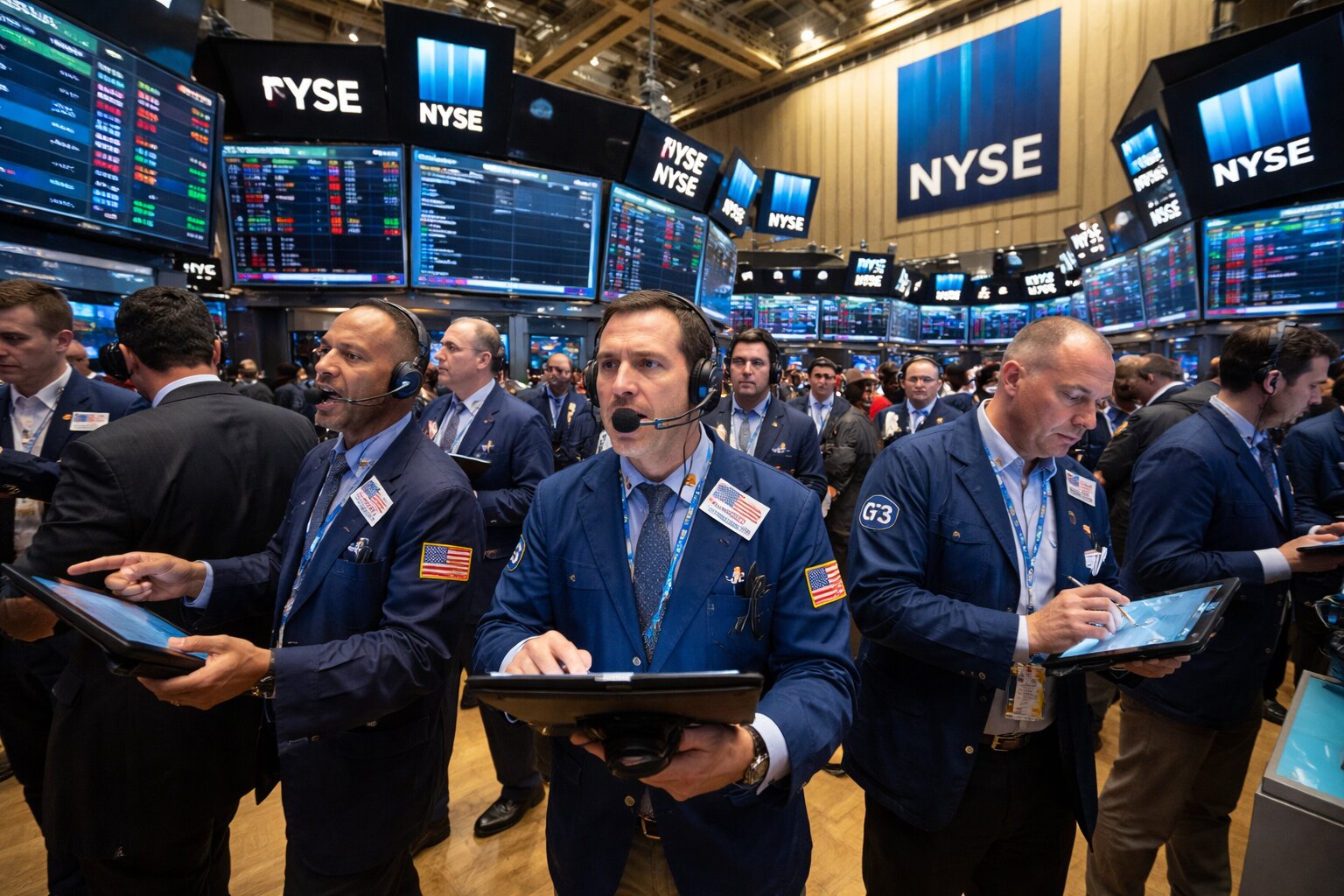
Stock Market Weekly Recap: S&P 500 Stalls, Nasdaq Leads the Decline, Dow Eases as AMZN, NVDA, AAPL Sell Off
After CPI eases to 2.4%, the S&P 500 holds near 6,836, the Nasdaq slips to 22,547 and the Dow hovers around 49,501, with AMZN, NVDA and AAPL weak while RIVN, COIN, AMAT, gold near $5,050 and Bitcoin around $69,000 outperform | That's TradingNEWS
S&P 500, Dow and Nasdaq: flat close hides the worst week of 2026 so far
The headline tape into Friday’s close looked benign: the S&P 500 finished around 6,836, up 0.05%; the Dow Jones Industrial Average held near 49,501, up 0.10%; the Nasdaq Composite slipped 0.22% to 22,547. On the surface that’s a quiet end to the week. Underneath, it was the sharpest weekly drawdown of 2026: the S&P 500 lost about 1.4%, the Dow 1.2%, and the Nasdaq 2.1%, with the Nasdaq now logging five consecutive weekly declines. The pattern is clear: mega-cap growth and high-multiple tech are bleeding, while defensives and hard-income trades are quietly absorbing capital.
Valuation risk is no longer theoretical. The cyclically adjusted P/E (CAPE) for the S&P 500 averaged about 40.1 in January, a zone equities have only visited ~3% of the time since 1957. At previous readings above 40, the index’s average forward path was a 3% drop over one year, 19% over two years and 30% over three years. At the same time, investment-grade credit spreads have compressed to roughly 71 bps over Treasuries, the tightest since the late-1990s dot-com era. Equities are priced for perfection just as credit markets are paying almost nothing for default risk. That is a classic high-risk, low-upside profile for broad U.S. risk assets.
Inflation, jobs and the Fed: macro data are supportive, not explosive
Macro data would normally justify a strong risk-on tape. January CPI rose 0.2% month-on-month and 2.4% year-on-year versus 2.5% expected, the weakest print in eight months. Core CPI (ex-food and energy) slowed to 2.5% year-on-year, the lowest since March 2021. On the labor side, nonfarm payrolls added roughly 130,000 jobs in January versus expectations near 70,000; unemployment edged down to 4.3% from 4.4%, even as prior payrolls were revised down by about 898,000 between April 2024 and March 2025.
Rates markets reacted like you’d expect in a “goldilocks” scenario: the U.S. 10-year yield slipped to about 4.05% from 4.11%, while the dollar index hovered just below 97. Inflation is moving in the right direction; growth is cooling but not collapsing. Fed futures still cluster around the first cut in mid-year, with odds heavily skewed toward June. The problem for equities is not the macro tape – it’s the starting valuation and the realization that AI disruption will create losers as well as winners.
AI shock and sector rotation: utilities, materials and staples outperform while software melts down
The defining feature of this week wasn’t CPI; it was a violent re-pricing of anything perceived as an “AI loser.” A “SaaSpocalypse”-style move in software has spilled into trucking, real estate, financial services, and gaming. One live-tape snapshot captured the rotation perfectly: utilities ripped roughly 7.1% on the week, materials gained around 3.7%, consumer staples climbed 1.4%, while a broad tech-software ETF sank about 23.4%.
Traditional defensives – regulated utilities, pipeline operators and grid owners – are being treated as a quasi-AI haven: low disruption risk, regulated returns, and equity duration that benefits from stable long-term rates. That’s why names like regulated power companies and midstream operators printed fresh all-time highs while high-multiple cloud software, digital advertising platforms and non-dominant SaaS names saw double-digit weekly drawdowns. Investors are no longer pricing AI as a universal tailwind; they’re actively sorting winners and losers.
Mega-cap tech check: Amazon (NASDAQ:AMZN) enters a bear market as AI capex and regulatory risk bite
Among the Nasdaq heavyweights, Amazon (NASDAQ:AMZN) is the clearest casualty of the rotation. From a 52-week high at $258.60 in November, the stock is now trading around $198.8–$199 after another 0.4% drop on Friday and more than 4% down on the week. That’s over 20% below its peak – textbook bear-market territory – driven by an earnings miss, concerns that massive AI and data-center capex will compress margins, and renewed worries about how AI changes the economics of cloud and e-commerce.
Other “Magnificent Seven” names didn’t escape. Apple (NASDAQ:AAPL) fell more than 2% on the day after the FTC flagged concerns about Apple News and fresh reports of delays in AI-powered Siri features, reinforcing the narrative that Apple is late to the AI party. Alphabet (NASDAQ:GOOG) and Meta Platforms (NASDAQ:META) traded lower by more than 1%, pressured by investor fatigue over ballooning AI and data-center budgets that could exceed $600 billion this year across the top hyperscalers. Microsoft (NASDAQ:MSFT) shed about 0.2%. Nvidia (NASDAQ:NVDA), the poster child of AI hardware, dropped roughly 2.2% as investors began to question how long hyperscaler capex can grow at 70%+ year-on-year without a pause. Tesla (NASDAQ:TSLA) was the lone mega-cap tech name to close marginally higher, up around 0.1% near $417–$418, but that’s more about short-term positioning than a firm risk-on signal.
The message from mega-caps is straightforward: the market is no longer granting automatic premium multiples just for having an AI story. Execution, regulatory overhangs and capital discipline are being repriced into each name.
Crypto, platforms and the new trading rails: Coinbase (NASDAQ:COIN), Bitcoin and X change the plumbing
Risk sentiment in digital assets diverged sharply from equities. Bitcoin (BTC-USD) bounced from sub-$65,000 levels on Thursday to trade around $68,800–$69,700 by Friday’s close, a move of roughly $3,000–$2,600 in a day, or about 4%. That recovery filtered directly into listed crypto platforms. Coinbase (NASDAQ:COIN) reported a weak fourth quarter – Q4 2025 revenue at $1.78 billion versus $1.81 billion expected and EPS down sharply year-on-year from $4.68 to $2.49 – largely due to a more than $700 million unrealized loss in its crypto investment portfolio. Despite that, the stock surged about 16–18% on Friday to roughly $164.5 as investors leaned into two numbers that matter more for the cycle: full-year 2025 trading volume of $5.2 trillion, up 156% year-on-year, and subscription & services revenue rising to $2.8 billion from $2.3 billion.
Simultaneously, platform plumbing is shifting. Social network X confirmed it will embed trading directly into the main feed through “Smart Cashtags.” Clicking a ticker like $BTC will show live charts, posts and a one-click execution interface. That step collapses the distance between social sentiment and order flow: users discover an asset, see a real-time chart and can trade without leaving the app. The integration pushes X deeper into the “everything app” model and, more importantly for markets, accelerates the speed at which retail flows can chase narratives in both stocks and crypto. That is a structural tailwind for volumes at brokers and exchanges, but it also amplifies intraday volatility around news and hype.
Net effect: crypto-linked equities such as Coinbase and listed exchanges are back in play as high-beta expressions of the Bitcoin cycle. The move in COIN – strong price reaction to mediocre earnings because the volume and structural revenue lines are intact – shows the market is willing to look through short-term P&L noise if the on-chain and trading activity trend remains up.
AI infrastructure winners: Applied Materials (NASDAQ:AMAT), Arista Networks (NYSE:ANET) and the $1 trillion chip cycle
While broad tech re-rated lower, AI plumbing outperformed. Applied Materials (NASDAQ:AMAT) jumped roughly 9–11% after reporting a fiscal Q1 2026 profit surge of more than 70% to about $2.03 billion, or $2.45 per share, even as revenue dipped 2% to $7.01 billion. The key line from management: demand for leading-edge logic, high-bandwidth memory and advanced packaging should push the company’s semiconductor equipment revenue over 20% higher this year. Guidance for next quarter – revenue between $7.15 and $8.15 billion and adjusted EPS in a $2.44–$2.84 range – implies high-teens to low-20s growth at the top end. CEO Gary Dickerson openly framed 2026 as a year when global semiconductor revenue could approach $1 trillion, driven overwhelmingly by AI data-center build-outs.
Arista Networks (NYSE:ANET) reinforced the same theme from the networking side. Q4 revenue climbed 29% year-on-year to $2.49 billion, net income topped $1 billion for the first time, and annual revenue hit $9 billion. The company guided Q1 revenue to about $2.6 billion with gross margins at 62–63%, a sharp contrast with Cisco Systems (NASDAQ:CSCO), which warned that rising memory costs would pressure margins and saw its stock hit double-digit losses this week. Arista’s commentary made clear that AI data-center demand and campus expansion are offsetting any softness elsewhere.
The take-away: AI “shovel sellers” sitting in the equipment, networking and high-bandwidth memory stack continue to deliver high-quality growth and beat-and-raise quarters. In a tape where software and platform multiples are compressing, these names remain among the few where investors are willing to pay up for visibility.
AI ‘losers’: freight, gaming, software and real estate get repriced
On the other side of the ledger, anything deemed structurally exposed to AI-driven efficiency gains was punished. Freight brokers and trucking plays like C.H. Robinson Worldwide (NASDAQ:CHRW), RXO, XPO and J.B. Hunt sold off hard after a new AI tool from Algorhythm Holdings promised to strip out route inefficiencies. CHRW is down roughly 13% week-to-date even though Barclays, JPMorgan and Stifel all argued the sell-off is excessive and reiterated overweight or positive views, pointing to Robinson’s more than two dozen in-house AI agents across the shipment lifecycle. In other words, one of the earliest adopters of AI in brokerage is being sold as if it were a laggard. That’s a classic fear-trade, not a fundamentals-trade.
Gaming and digital-experience stocks followed a similar script. Unity Software (NYSE:U) plunged about 25% on the week and is down more than 57% year-to-date. Take-Two Interactive (NASDAQ:TTWO) fell modestly this week but has lost roughly a quarter of its value this year; AppLovin (NASDAQ:APP) is off more than 40% YTD, and Roblox (NYSE:RBLX) has shed about 22%. The catalyst is Google’s Project Genie, an AI world generator capable of building interactive environments on the fly. Even though the tool is still early and limited to premium subscribers, the market is repricing long-term demand for traditional game engines and ad-driven virtual worlds.
Layer on top the earlier software drawdown and REIT pressure tied to automation in back-office functions, and the pattern is clear: traders are no longer treating AI as a uniform “growth factor.” They’re treating it as a secular margin squeeze for any business that sells human labor or legacy software into a process that can be automated.
High-beta earnings movers: Rivian (NASDAQ:RIVN), Pinterest (NYSE:PINS), DraftKings (NASDAQ:DKNG), Maplebear/Instacart and others
Earnings-driven single-stock moves were extreme.
Rivian (NASDAQ:RIVN) surged roughly 25–27% to about $17.7 after delivering Q4 revenue of $1.29 billion (above the $1.26 billion consensus) and an adjusted loss of $0.54 per share versus a $0.68 loss expected. The real driver was guidance: 2026 deliveries are forecast in a 62,000–67,000 range, a 47–59% increase over 2025’s 42,247 vehicles, with the cheaper R2 SUV on track to launch in Q2 and more product detail coming at a March 12 event. In an EV tape weighed down by weaker U.S. demand after tax credits expired, Rivian is one of the few names still projecting volume acceleration.
At the other extreme, Pinterest (NYSE:PINS) collapsed about 17–20% on Friday and is now down more than 40% year-to-date and over 60% in the last 12 months. Q4 revenue rose 14% to $1.32 billion with EPS at $0.67, but both slightly missed expectations and Q1 revenue guidance of $951–$971 million fell short. More importantly, management explicitly blamed Trump-era tariffs for disproportionately hitting ad budgets at large retailers – Pinterest’s core customers – at the same time AI-driven optimization on bigger platforms is pulling incremental ad dollars away. JPMorgan, Citi and Bank of America all downgraded the stock, arguing that tariffs are a headwind but AI-enabled competitors are the deeper structural problem.
DraftKings (NASDAQ:DKNG) slid 13–17% after guiding 2026 revenue to $6.5–$6.9 billion, well below the ~$7.3 billion Wall Street expected, despite a strong Q4: revenue up 43% to $1.99 billion and a swing from a $135 million loss to a $136 million profit ($0.25 EPS). The market is focused on guidance and the competitive threat from prediction markets, where Bank of America estimates about 20% of all Super Bowl-linked betting already migrated. DraftKings remains committed to investing growth capital into its own predictions offering, targeting “hundreds of millions” in future revenue, but for now the multiple is compressing along with expectations.
Maplebear, parent of Instacart and listed as CART, jumped 7–9% intraday and over 9% at one point after it guided Q1 gross transaction value to $10.13–$10.28 billion versus a $9.97 billion estimate and projected EBITDA of $280–$290 million versus a $277 million consensus. Revenue of $992 million topped the $974 million expected, although EPS at $0.30 missed the $0.52 forecast. The market is clearly rewarding upside in volume and profitability more than it is punishing a miss on per-share earnings.
The broader high-beta tape also saw Fastly (NYSE:FSLY) gain about 13.8% to $18.3, e.l.f. Beauty (NYSE:ELF) jump 9.5% to $81.4, and CrowdStrike (NASDAQ:CRWD) rise 4.4% to roughly $430. These are classic “quality growth” plays in cybersecurity and beauty, still benefiting from secular demand. On the downside, The Trade Desk (NASDAQ:TTD) hit 52-week lows not seen since April 2020, GoDaddy (NYSE:GDDY) fell to levels last visited in November 2023, Intuit (NASDAQ:INTU) traded at lows not seen since March 2023, and Booking Holdings (NASDAQ:BKNG) slipped back to October 2024 levels.
Autos, old-economy cyclicals and oil: Ford (NYSE:F), Venezuela flows and WTI at $62–$63
Away from tech, Ford Motor Company (NYSE:F) delivered a complex but ultimately constructive print. Q4 revenue came in at $42.45 billion versus $41.53 billion expected, although that was still a 5% year-on-year decline. 2025 was framed as “strong in a volatile environment,” but the P&L absorbed roughly $2 billion in losses tied to fires at a Novelis aluminum plant in New York, another $2 billion in net tariff headwinds (including $1 billion from delayed credits), and an enormous $15.5 billion in special charges linked to scaling back earlier EV plans. Despite that, the 2026 guidance topped expectations, the stock rallied three days in a row and retested its January highs, and CEO Jim Farley signed off on higher bonuses for 75,000 salaried staff off the back of improved vehicle quality. The market is willing to pay for disciplined capital allocation and realistic EV pacing over high-burn, high-fantasy roadmaps.
On the commodity side, WTI crude ended the week near $62.60–$62.85 a barrel, little changed on the day but down on the week after chatter that OPEC+ could resume output hikes from April. Gold staged a spectacular round-trip: after a mysterious $150 straight-line sell-off earlier, it rebounded $80 in North American trade and finished near $5,032–$5,050 per ounce, as lower yields and equity jitters renewed demand for hard hedges. Venezuela’s oil sales have now topped $1 billion, with revenue routed directly to a U.S. Treasury-controlled account rather than via Qatar – a reminder that sanctions architecture and revenue flows remain central to emerging-market oil risk.
Read More
-
Broadcom Stock Price Forecast: AVGO at $325 Ahead of AI-Driven Earnings
14.02.2026 · TradingNEWS ArchiveStocks
-
XRP Price Forecast: Ripple XRP-USD Climbs Back to $1.47 but $1.80 Wall and Sub-$1 Risk Still Dominate
14.02.2026 · TradingNEWS ArchiveCrypto
-
Natural Gas Futures Price Holds Around $3.20 as Storage Tightens and Winter Premium Fades
14.02.2026 · TradingNEWS ArchiveCommodities
-
Stock Market Today: AI Fears Hit Nasdaq as S&P 500 and Dow Struggle While AMAT and Rivian Rip Higher
13.02.2026 · TradingNEWS ArchiveMarkets
-
GBP/USD Price Forecast - Pound Stuck at 1.36 as Fed Cut Hopes Clash With UK Weakness
14.02.2026 · TradingNEWS ArchiveForex
Defensive income: AbbVie (NYSE:ABBV) and Merck (NYSE:MRK) as volatility buffers
In an environment where CAPE multiples scream “late-cycle” and AI is shredding parts of the growth universe, classic defensive pharma is back in focus.
AbbVie (NYSE:ABBV), with a market cap around $409 billion and a 10-year annualized return near 15%, has repeatedly proved it can outperform in down markets. In the 2022 bear market, the stock gained about 24% while the S&P 500 fell 18%. Its dividend was raised again last month by 5% to $1.73 per share quarterly, implying a yield around 3.1%, almost triple the S&P 500’s ~1.1%. Management is guiding for 2026 EPS between $14.37 and $14.57, roughly 43–45% above 2025 levels, and the Street still sees double-digit upside from current prices.
Merck (NYSE:MRK) carries a market value near $300 billion and a dividend yield close to 3.0%, with a quarterly payout of $0.85 and a 15-year streak of increases. In 2022 it rallied 49% in a down market; in 2018, when the S&P 500 lost 4%, Merck gained around 40%. Long-term, the stock has compounded at about 10% annually over the last decade, matching the index but with a very different path – surging in corrections and lagging modestly in roaring bull runs.
Together, ABBV and MRK exemplify the sort of defensive, cash-rich franchises that can cushion portfolios if the valuation air finally comes out of the index. In a week where dividend-light, ad-dependent platforms like Pinterest were punished, those steady healthcare cash flows look increasingly valuable.
Valuations, credit spreads and what they imply for the S&P 500 path
Overlay the micro tape with the macro valuation and credit signals, and the picture is not subtle.
On the equity side, the S&P 500’s CAPE ratio around 40.1 has only been exceeded in the late-1990s/2000 dot-com bubble and the very top of the 2021–2022 liquidity peak. Historically, when investors bought the market at this kind of valuation, the average outcome over the next three years was a 30% drawdown. There are upside outliers – one-year returns of +16% have occurred – but there has been no historical instance where the index delivered a positive three-year return starting from a CAPE above 40 while staying in that regime. Either earnings need to explode higher, or the multiple needs to compress – and often both happen as prices correct and profits normalize.
On the fixed-income side, a 71-bp spread between investment-grade corporate bonds and Treasuries says investors are paying almost no premium for corporate default risk. The last time spreads were this tight was 1998, shortly before the dot-com bubble’s blow-off phase. There is very little room for further spread compression, yet a lot of room for widening if tariffs, AI disruption, or policy missteps hit profits or credit quality. That asymmetry caps the upside in both bonds and equities while leaving the downside open.
Put simply: the broad U.S. equity market is expensive relative to its own history, credit markets are complacent, and yet macro data are merely “good enough,” not spectacular. That’s not a setup for chasing beta; it’s a setup for being selective and paid to wait.
Tactical stance into next week: indices, sectors and risk bias
Putting everything together after Friday’s close:
-
For the S&P 500, the stance is Hold with a bearish tilt. The index is priced for a near-perfect AI and soft-landing scenario at a time when dispersion between winners and losers is exploding and both CAPE and credit spreads are flashing late-cycle warnings. Upside exists if AI really does deliver margin expansion across the board, but the base case is lower forward returns and vulnerability to shocks.
-
For the Nasdaq Composite, the view is selectively bullish but tactically volatile. AI infrastructure and networking names like Applied Materials and Arista Networks – i.e., equipment and plumbing – still justify a Buy bias on strong order books and visibility. In contrast, ad-driven platforms and perceived AI losers such as Pinterest, DraftKings, non-dominant software, and potentially second-tier gaming/experience names skew Sell to Underweight until they prove they can defend margins and market share in an AI-saturated environment.
-
For the Dow and old-economy cyclicals, the stance is neutral to mildly constructive, especially on disciplined operators like Ford that are right-sizing EV ambitions and absorbing tariff shocks without blowing up the balance sheet. These names benefit more directly from resilient real-economy data and less from speculative AI narratives.
-
Defensives – notably large-cap pharma like AbbVie and Merck, regulated utilities, and select consumer staples – remain Buy/Overweight as structural volatility buffers. Their historical outperformance in corrections, sustained dividend growth (yields near 3% or better) and relatively undisturbed business models in an AI world make them natural destinations for capital rotating out of over-owned growth.
-
Crypto-linked equities and exchanges such as Coinbase sit firmly in the high-beta, high-risk Buy/Hold bucket. They will outperform sharply while Bitcoin holds above $65,000–$70,000 and volumes remain elevated, but they are also the first place to be hit if the risk cycle turns.
Net: after a Friday close that looks quiet on the surface, U.S. markets are walking into the long weekend with stretched valuations, rising dispersion, and a clear message from price action – 2026 won’t be a one-way AI melt-up. Index-level exposure deserves caution; stock and sector selection is where the real opportunity now sits.