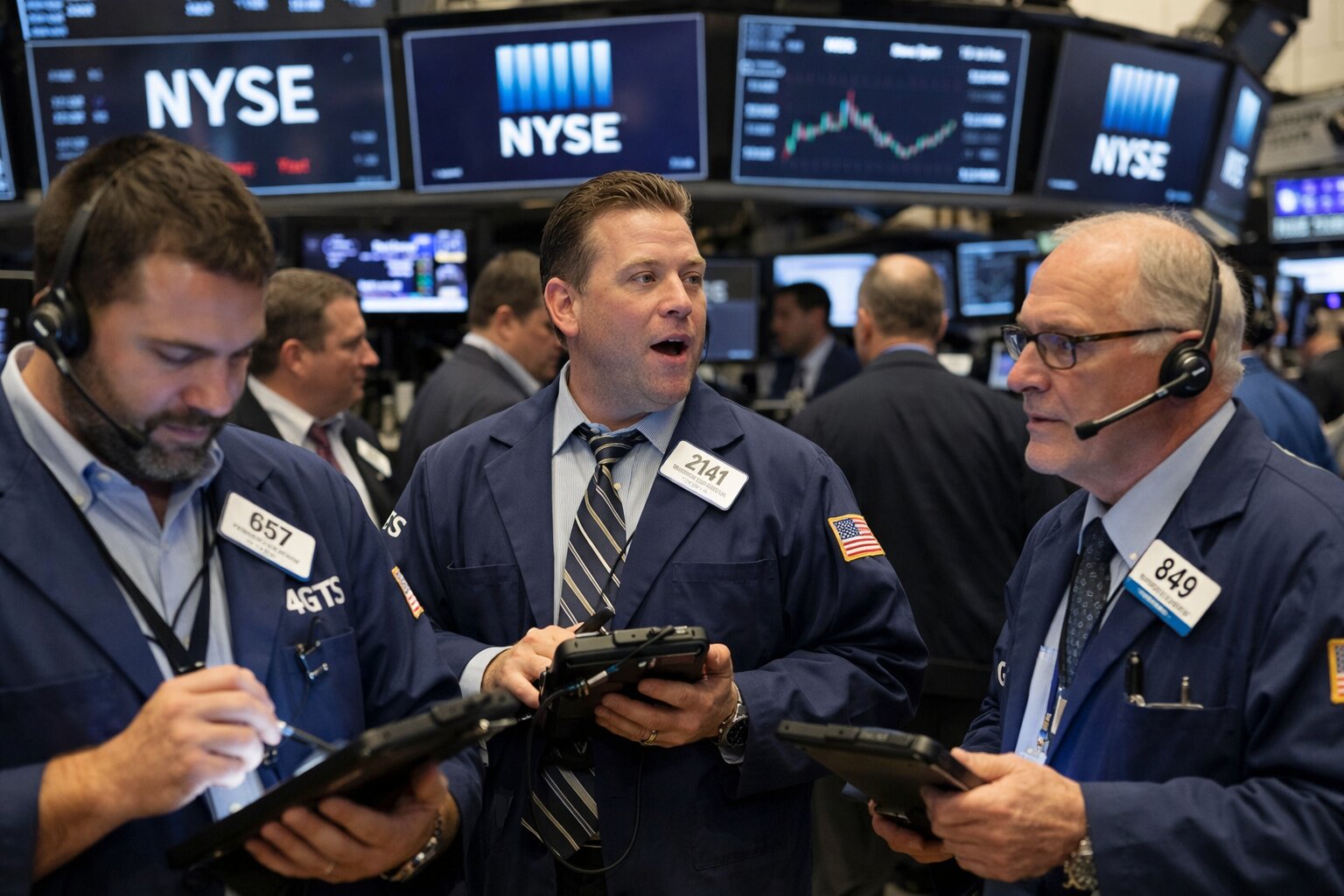
Stock Market Today: S&P 500, Dow and Nasdaq Rocked by AI Spending Shock, Crypto Rout and Stellantis Hit Rattle Wall Street
S&P 500 trades near 6,918, the Dow hovers around 49,241 and Nasdaq around 23,255 while Amazon (AMZN) drops toward $238 on a $200B AI plan, Bitcoin stabilizes near $66,000 and Stellantis (STLA), Reddit (RDDT) and Roblox (RBLX) drive the biggest moves | That's TradingNEWS
Stock Market Today – AI shock, Amazon capex and a violent crypto unwind test Wall Street’s conviction
Wall Street indices – futures rebound after a three-day tech beating but leadership stays fragile
US index futures are stabilizing after one of the heaviest tech-led drawdowns of 2026. The E-Mini S&P 500 (^SPX) March contract trades around 6,855, up roughly 0.5%, Nasdaq 100 (^NDX) futures are ahead about 0.7% near 24,800–24,900, and Dow Jones Industrial Average (^DJI) futures gain close to 0.5%. That bounce comes after cash equities dropped another 1.2% on the S&P 500 and Dow and about 1.6% on the Nasdaq Composite (^IXIC) in Thursday’s session, pushing both the S&P 500 and Nasdaq negative for 2026 while the Dow hovers roughly flat on the year. Over the last three trading days the Nasdaq has lost around 4% and the S&P 500 roughly 2%, giving this week the feel of an AI-positioning reset rather than a routine pullback. A separate AI-driven valuation model pegs the S&P 500 near 6,917.81 in cash with a one-month trajectory around 6,880 and a 12-month mark close to 6,982, implying very limited index upside over a year at current levels. For the Nasdaq 100 the same framework puts spot around 25,338.62 with a one-month level at 25,366.73 and a one-year figure near 25,640.77 – essentially a sideways grind unless earnings or multiples re-rate higher. That muted projected return profile explains why volatility is expanding while index dips are still being bought aggressively intraday instead of trending straight down.
Nasdaq, software and “Magnificent Seven” – AI darlings finally lag while defensives quietly outperform
The pain is concentrated where positioning has been heaviest. The tech-focused Nasdaq has been hit harder than the Dow as high-multiple growth lines up against a wall of AI-capex skepticism. On Thursday the broader Nasdaq Composite fell about 1.6% and is now down roughly 4% over three days, while the Dow is off closer to 1.2% and sits about flat for the week. A key tell is the Roundhill Magnificent Seven ETF (MAGS), which closed near $62.82, its lowest finish since October 10 and below a prior support band around $62.94 that had held on January 20 and November 20. From its late-October high the fund is off more than 9%, signaling that even the most loved mega-caps are no longer automatic winners whenever the AI narrative heats up. At the sector level the iShares Expanded Tech-Software Sector ETF (IGV) has dropped more than 11% this week, its steepest weekly drawdown since 2008, as investors question how much generative AI will cannibalize traditional software rather than simply augment it. Individual names like Datadog and ServiceNow have shed more than 7% in a single session, and even established information-services players saw heavy selling, with one major legal-data group down around 5.5% after insisting its franchise is not replaceable by generic large-language models. Defensive pockets such as utilities and staples, by contrast, have held up or even slightly outperformed, underlining a subtle but important regime shift: markets are still willing to pay for growth but no longer at any price and no longer without hard evidence of monetization.
Amazon AMZN – $200 billion AI and cloud capex turns a growth icon into a cash-flow stress test
The single stock doing the most damage to sentiment is Amazon (AMZN). The company reported roughly $213.4 billion in fourth-quarter revenue and earnings per share of about $1.95, a narrow miss versus expectations around $1.97. On the surface that miss is trivial when stacked against AWS revenue growth of about 24% year-on-year to $35.6 billion, but the headline numbers are not what markets are trading. The shock came from guidance and capital-allocation choices. Management laid out plans to lift 2026 capital expenditures to approximately $200 billion, essentially turning Amazon into the single biggest incremental capex story in the global equity market as it races to build AI-ready data-center and logistics infrastructure. Net profit of roughly $21.2 billion matched consensus, helped by further cost-cutting, including another 16,000 job cuts and a renewed focus on underperforming divisions. The company guided first-quarter revenue to a range of roughly $173.5 billion to $178.5 billion and operating income of about $16.5 billion to $21.5 billion. Those numbers are solid, but they come with the clear message that free cash flow will be pressured as the AI build-out peaks. The market reaction has been ruthless. AMZN dropped around 4.4% in regular trade and then slumped as much as 7%–11% in after-hours and premarket dealing before partially stabilizing, instantly wiping tens of billions off its market capitalization and dragging the S&P 500 and Nasdaq lower. An AI-driven quantitative model rates AMZN at B+ with a numerical score around 76.3 and shows the stock near $238.62 in recent trading. That same model projects a one-month level closer to $206.19 and a 12-month “target” near $217.06, effectively signaling expected downside from current prices over a year once the $200 billion spending wave is priced in, despite acknowledging strong profitability metrics and mid-30s trailing P/E. The message for sophisticated money is straightforward. At this valuation the market is being asked to front-load belief in an AI payoff that will be realized over a multi-year horizon, not the next four quarters. If management delivers on AWS growth and converts capex into durable cash-flow expansion, current weakness becomes an attractive entry point. If returns on invested capital lag the hype, AMZN will need a multiple reset. Bias here is constructive but selective buy on deep weakness, not blind dip-buying at any price.
Alphabet GOOG and GOOGL, Microsoft MSFT – rich quality pockets still act as relative safe havens
Even inside the tech complex the tape is not flat. While AMZN sells off, Alphabet (GOOG, GOOGL) and Microsoft (MSFT) are acting as relative stabilizers. GOOG trades around $340.70, up roughly 2.2%, and GOOGL near $339.71, up about 2.0% on the session, with AI-capex plans that are heavy but less shocking than Amazon’s. A quantitative grading system assigns GOOG a score around 82.2 and GOOGL about 82.5, reflecting strong fundamentals but also embedding expectations that one-month levels could drift down toward roughly $311.55 and $306.09 respectively and that 12-month fair value might sit closer to $254.02 and $250.16 if multiples compress. MSFT trades near $411.21, marginally lower on the day after a bruising week, but still carries one of the highest quality scores in the market at about 84.0, with that same model projecting a modest one-month dip toward roughly $407.09 but a far more optimistic 12-month level around $527.69 as AI services scale. The apparent contradiction – short-term downside forecasts alongside high quality scores – reflects the broader macro tension: earnings are good, but entry prices are demanding. Within that trade-off MSFT and the Alphabet share classes still screen as core long-term holds with a bias to accumulate on pullbacks, whereas AMZN is now the acid test for how much AI capex investors are willing to subsidize.
Bitcoin BTC-USD, Strategy MSTR and the crypto ETF hangover – leverage cuts both ways
Digital assets are amplifying the risk-off tone. Bitcoin (BTC-USD) has plunged roughly 45%–50% from last year’s high, at one point tumbling 16% overnight to briefly break below $61,000 before clawing back above $65,000–$66,000, marking its worst weekly slide since 2022 and vaporizing roughly $700 billion in aggregate crypto market value in a matter of days. One widely watched index now shows BTC-USD around $66,184 with a day move of about –9.3%, yet quantitative projections from the same AI platform flag a one-month level near $71,408 and a 12-month figure close to $97,709, underscoring the enormous volatility around a still-bullish long-term trajectory. The damage is magnified in listed vehicles. Retail buyers who piled into post-election, pro-crypto narratives via newly launched exchange-traded products have watched all the gains from the second Trump administration evaporate almost overnight. The most extreme case remains Strategy (MSTR), the listed proxy for a leveraged bitcoin treasury. Strategy holds around 713,502 bitcoins at an average cost near $76,052, roughly 20% above current spot, putting its entire stack underwater. The firm posted operating losses of about $17.4 billion versus roughly $1 billion in the same period of 2024, and the stock dropped about 17% on Thursday with another dip in after-hours trade before bouncing around 6% in premarket as bitcoin stabilized. The takeaway is that leverage on an already volatile underlying is no longer being rewarded. For unhedged portfolios the more disciplined stance on crypto here is neutral to cautiously bearish in the near term with a focus on position sizing, accepting that long-horizon upside remains but that the path will include brutal drawdowns like this one.
Reddit RDDT – ad-driven AI tools and a $1 billion buyback make it a standout winner
Against this risk-off backdrop, some growth names are doing exactly what investors want to see: convert user engagement into hard numbers. Reddit (RDDT) surged around 7%–8% in premarket trade after reporting adjusted earnings of roughly $1.24 per share versus consensus near $0.93 and revenue around $726 million, beating expectations centered near $667 million. Top-line growth of about 70% year-on-year is being driven by stronger advertiser demand and rising user engagement, helped by AI-based tools that make it easier for brands to target specific subreddit communities. Guidance was equally strong. Management guided first-quarter 2026 revenue to a band of about $595 million to $605 million against Street expectations near $577 million and projected adjusted EBITDA in the $210 million to $220 million range, again ahead of consensus. On top of that, Reddit announced its first share repurchase program of up to $1 billion. In a market that is punishing AI promises without cash flow, these are the numbers that justify premium multiples. The tape is treating RDDT as one of the day’s clear outperformers, and on the current trajectory the stance is bullish with a bias to buy on dips, while acknowledging that the stock will remain volatile given its still-short public history.
Roblox RBLX – bookings momentum and 144 million daily users keep the growth story alive
Another bright spot on the earnings front is Roblox (RBLX). The company guided fiscal 2026 bookings above Wall Street estimates, signaling that spending and engagement on the platform continue to expand even as competition for user time and wallet share intensifies. Shares jumped about 9%–11% in premarket trading, rebounding from recent weakness. The platform’s strategy – layering advertising and e-commerce on top of its virtual worlds – appears to be paying off. Average daily active users climbed roughly 69% year-on-year to about 144 million in the fourth quarter, a scale that very few gaming platforms can match. Management warned that margins are likely to be flat to slightly down in the near term due to heavier spending on safety initiatives, server infrastructure and higher payouts to developers, but the market is willing to look through that as long as bookings grow and engagement metrics remain robust. From a portfolio-construction angle RBLX remains a high-beta growth name that can be owned with a bullish bias, but only as a measured position given the investment phase and the inherent cyclicality of gaming.
Stellantis STLA – €22.2 billion EV charge turns Europe’s auto optimism into a cautionary tale
The most dramatic single-stock move of the day comes from the European auto space. Stellantis (STLA, STLAM.MI, IT:STLAM) warned it will take a charge of about €22.2 billion, or roughly $26 billion, as it scales back its electric-vehicle ambitions. The writedowns include around €6.5 billion in cash payments, largely to compensate suppliers as the group cancels several EV models and projects that no longer make economic sense in the current demand and cost environment. Shares collapsed more than 20% in premarket US trade and plunged as much as 24% in Milan, triggering temporary trading halts and erasing more than €5 billion in market value in a single session. This marks the biggest one-day decline on record for the automaker’s Italian listing and effectively resets investors’ confidence in the company’s EV strategy. The new CEO Antonio Filosa has framed the move as a necessary reset after the prior leadership over-estimated the pace of the energy transition and allowed costs to run ahead of demand, particularly in Europe and the US where market share and profits have slumped. At the index level the Stoxx Europe 600 still trades higher on the day by roughly 0.4%, with the DAX up around 0.5%, FTSE 100 slightly positive near a 0.17% gain and Spain’s IBEX 35 advancing close to 0.9%. Italy’s FTSE MIB, however, is down around 0.4%, dragged by STLA. Danish offshore wind group Orsted gained close to 5% after a better-than-feared earnings print, highlighting how capital is rotating within Europe rather than leaving the region entirely. Layered on top of fresh commentary that global equity leadership is starting to broaden beyond the US, Stellantis now sits firmly in the penalty box. The stance here is clear: STLA is a sell or at best an avoid until investors see a credible, execution-backed turnaround rather than just a large accounting reset.
Silver SI=F, gold and the retail crowd – extreme volatility after a parabolic spike
In commodities the most eye-catching price action belongs to silver. Silver futures (SI=F) swung violently, at one point dropping nearly 10% before rebounding, and are now down roughly 3.4% on the session near $74.12 an ounce. Spot prices briefly tumbled toward $64 earlier in the day after a 20% plunge in the previous session that wiped out all the gains from last month’s spectacular rally. From the late-January peak around January 29, silver has lost about 40%, making this the most volatile stretch in the white metal since 1980. Thin liquidity, heavier speculative positioning and an increasingly popular retail trade have all contributed to air pockets in pricing. Gold, by contrast, has swung between losses and gains but is modestly higher on the day, benefiting from its traditional safe-haven status as equities and crypto wobble. For portfolio construction the message is simple. Silver at these volatility levels is closer to an options contract than a classic commodity hedge; it is a trading instrument only, not a core allocation, unless risk budgets are very large. Gold remains a neutral-to-mildly bullish hold as a diversifier, but investors should avoid treating either metal as a one-way bet.
Hims & Hers HIMS and Novo Nordisk – regulatory overhang cools the weight-loss copycat trade
Beyond mega-caps and autos, litigation risk is asserting itself in the weight-loss space. Hims & Hers (HIMS) jumped as much as 15% intraday on Thursday after unveiling plans to offer a lower-cost, copycat version of Novo Nordisk’s blockbuster weight-loss pill. That euphoria evaporated quickly when Novo Nordisk (NVO) signaled its intention to pursue legal action and labeled the move “illegal.” Hims ended the session down about 3.8% at a 12-month low, and shares are down another 6%–8% in premarket trade. The episode is a reminder that intellectual-property protection and regulatory scrutiny remain powerful forces in high-margin therapeutic categories. While the headline story looks exciting for traders hunting cheap exposure to GLP-1-style demand, the balance of risk and reward is skewed negatively as long as legal clouds hang over the product roadmap. Here the stance on HIMS is avoid or outright sell for fundamental investors, leaving the name to short-term traders comfortable with binary litigation risk.
Read More
-
SCHD ETF Price Forecast - SCHD Climbs to $31.39 as Cash Rotates From AI High-Flyers Into Dividend Safety
06.02.2026 · TradingNEWS ArchiveStocks
-
Bitcoin ETF Inflows Flip: BTC-USD Halves From Peak While IBIT ETF Turns Into a Volatility Engine
06.02.2026 · TradingNEWS ArchiveCrypto
-
Natural Gas Price Meltdown: Henry Hub Fights Back Toward $3.50 After 29% Weekly Collapse
06.02.2026 · TradingNEWS ArchiveCommodities
-
USD/JPY Price Forecast - Pairs Near 157 as Japan Election, BoJ and Fed Paths Collide
06.02.2026 · TradingNEWS ArchiveForex
Global indices and Dow ^DJI – under the surface, leadership quietly rotates
Outside of the headline-grabbing tech and crypto swings, the index picture is more nuanced. The Dow Jones Industrial Average (^DJI) trades near 49,241 with a modest daily loss around 0.5%, but an AI-based scoring and forecasting model gives it a mid-range score near 58.6, with a one-month projection around 47,326 and a 12-month level near 52,270. The signal is that returns should be positive over a year but not spectacular from this starting point, consistent with a mature bull market punctuated by higher volatility. The Nasdaq Composite (^IXIC) sits around 23,255, up about 1.5% on the day in one snapshot but with that same modeling framework suggesting a one-month level near 23,041 and a 12-month path actually dipping toward roughly 22,428, capturing the idea that growth indices may deliver more churn than trend from here. Across the Atlantic, Europe’s Stoxx 600 is up about 0.4%, the DAX and CAC 40 edge higher, and Spain’s IBEX 35 leads with gains close to 0.9%. That fits with the narrative from institutional managers who argue that after years of US mega-cap dominance, relative opportunities are improving in foreign markets as valuation gaps, a somewhat softer dollar and more uneven global growth create entry points. The practical expression of that view is not an aggressive rotation out of US assets but a measured increase in non-US exposure via broad international and thematic ETFs, while maintaining US exposure in high-quality balance-sheet names.
Macro and the Fed – postponed jobs report, weaker labor signals and a more complicated growth picture
The macro backdrop is adding to the unease. The closely watched January jobs report, which was supposed to land today, has been pushed to next Wednesday because of a brief government shutdown, leaving traders flying partly blind on the most important single data point of the month. In its place, second-tier labor indicators have taken on outsized significance. Job openings have fallen to their lowest level since 2020 and layoff announcements have accelerated, pointing to cooling labor demand after an exceptionally tight period. Later today the University of Michigan’s preliminary consumer-sentiment reading is expected to ease to around the mid-50s, while consumer-credit data will help clarify how much households are leaning on borrowing to maintain spending. On the policy side, Federal Reserve Vice Chair Philip Jefferson is set to speak on supply-side inflation dynamics at the Brookings Institution, an event that could nudge rate expectations if he hints at a slower or faster path for future cuts. For equities this combination – softer labor but still-restrictive policy and elevated valuations – argues for a more tactical approach, using futures and options to manage downside risk rather than relying solely on buy-and-hold strategies, especially in the most crowded AI and crypto trades.
Positioning view – where risk is still worth taking and where caution pays
Pulling today’s tape together, several themes stand out. Heavy AI capex and high valuations are being punished when they are not matched by near-term free-cash-flow visibility, as AMZN is discovering. Serious execution and monetization, as shown by RDDT and RBLX, are still rewarded with double-digit moves. Leverage on top of volatile instruments, as seen with BTC-USD and MSTR, remains a dangerous way to express macro opinions. Europe is no longer a one-way value trap but needs careful stock selection, with STLA now a clear example of what happens when capital is misallocated in an EV transition that moves slower than the PowerPoint slides implied. Silver’s wild swings underline how crowded retail trades can unwind in days, while gold quietly resumes its role as a portfolio shock absorber. Quantitative forecasts showing limited 12-month upside for ^SPX, ^NDX, ^IXIC and ^DJI but healthier longer-term projections for quality names like MSFT and selectively for AMZN and GOOG/GOOGL suggest a barbell approach. On one side sit cash-generative mega-caps with real AI businesses and strong balance sheets; on the other, small tactical positions in high-beta winners like RDDT and RBLX for those willing to stomach volatility. Across all of it, the stance for sophisticated capital right now is broad indices as holds, high-quality large caps as buys on pullbacks, speculative crypto and leveraged proxies as underweights or short-term tactical only, and structurally impaired stories like STLA and legally challenged plays like HIMS as sells or zero-weight positions until the fundamental picture changes.