
Stock Market Today: S&P 500 (^GSPC), Nasdaq (^IXIC) and Dow (^DJI) Dip as Silver (SI=F) Bubble Deflates
The S&P 500 (^GSPC) sits at 6,886, Nasdaq (^IXIC) at 23,375 and Dow (^DJI) near 48,300 while silver (SI=F) retreats toward $72 after a 166% spike - gold (GC=F) trades around $4,359 | That's TradingNEWS
Wall Street Ends 2025 Flat While The Bull Market Stays Intact
AI, Tariffs And Volatility Define The Path To Record Highs
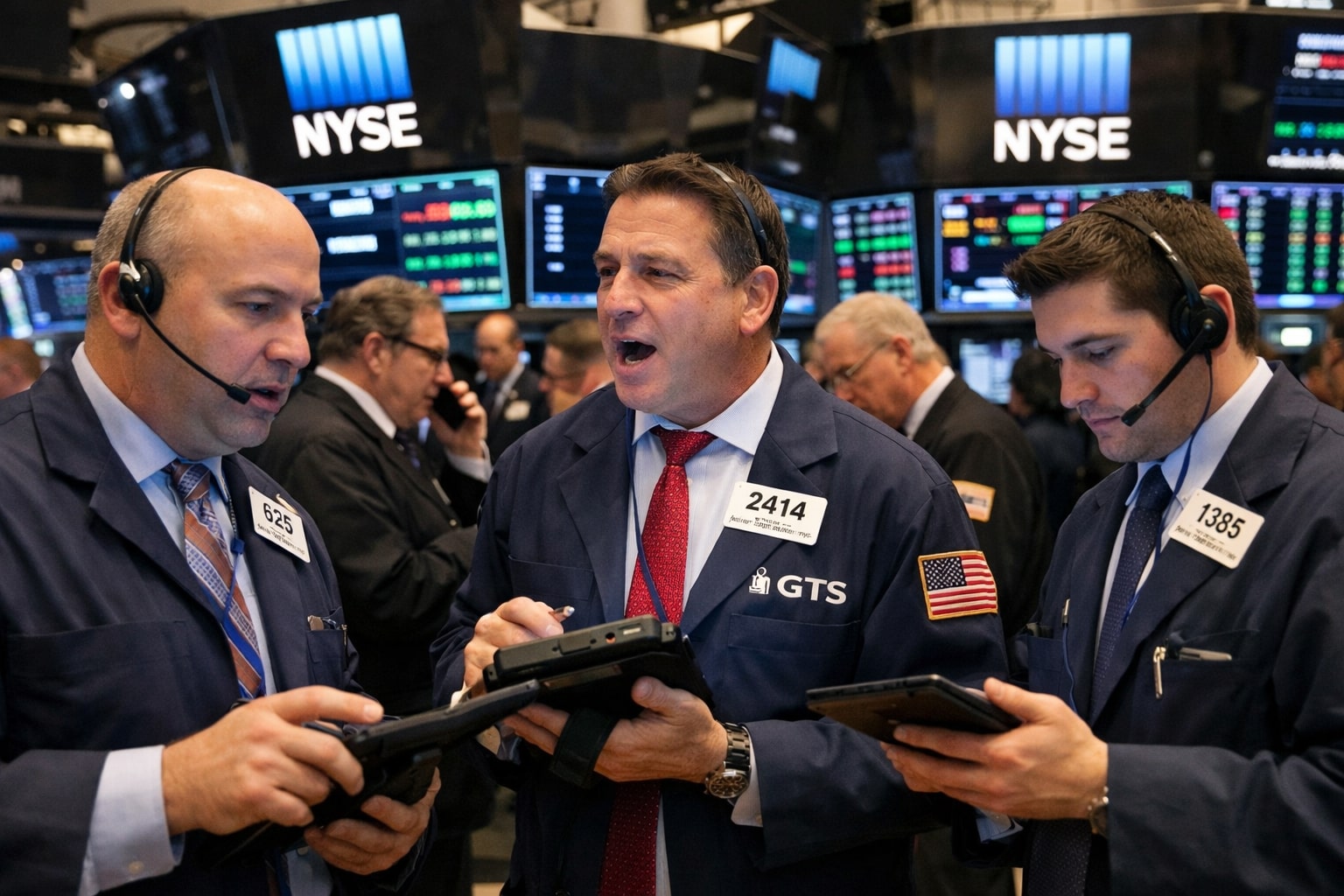
The last session of 2025 opens soft but not fragile. The S&P 500 (^GSPC) trades near 6,886, down about 0.1% intraday, yet still up roughly 17% for the year. The Nasdaq Composite (^IXIC) sits around 23,375, off about 0.2%, but closes 2025 with more than 20% upside. The Dow Jones Industrial Average (^DJI) hovers near 48,300, lower by about 0.2% on the day and ahead 13%–14% year to date. The Russell 2000 (^RUT) holds near 2,500 with a gain of roughly 12% in 2025, showing that small caps finally participated after two years of lag. A three-session pullback into year-end interrupts the usual “Santa Claus” pattern but follows a year in which the real shock came in April: President Trump’s broad tariff package briefly pushed the S&P 500 down almost 19% from its February peak and under the 5,000 level, and shoved the Nasdaq into bear-market territory before a sharp recovery. Despite that drawdown, the market finishes near record territory after AI, easing inflation and a softer dollar reasserted control over price action.
Major U.S. Indices And VOO: Three-Year Run And Current Stance
Over the last three years, the U.S. equity market produced one of its strongest streaks in decades. The S&P 500 posted about 24% in 2023, 23% in 2024, and roughly 17% in 2025, with the Vanguard S&P 500 ETF (VOO) mirroring that profile and trading near $630 today. The Nasdaq delivered another AI-driven year with gains north of 20%, while the Dow captured around 13%–14% despite its lower tech weight. The Russell 2000’s roughly 12% rise confirms that breadth is better than the 2023–2024 “mega-cap only” phase, even if large caps still dominate. After this run, the valuation picture is clear: the S&P 500 trades at a premium to long-term averages, pricing in a continuation of earnings growth and AI capex. That is enough to justify a Hold on ^GSPC and VOO rather than a fresh broad-market Buy. Upside remains, but the easy multiple expansion phase is over. The Nasdaq stays Hold with selective Buy in high-quality AI infrastructure. The Dow is a core Hold as a lower-beta, dividend-tilted sleeve. The Russell 2000 moves into Cautious Buy / Overweight vs large caps for investors who can tolerate more volatility, because a weaker dollar and lower rates favor domestically oriented small caps in 2026.
AI Complex: GOOGL, AMZN, NVDA, INTC And Storage Winners WDC, STX
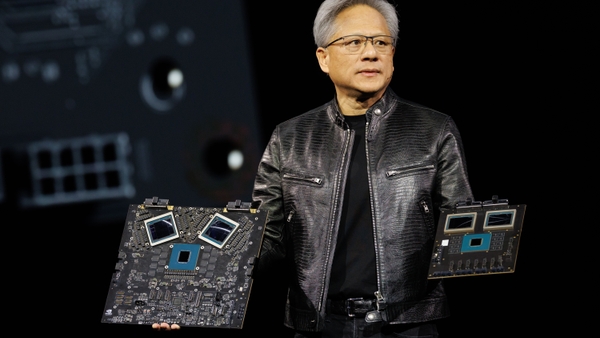
Artificial intelligence drove every year of this cycle but changed shape in 2025. The first AI wave in 2023–2024 centered on U.S. megacaps; 2025 pushed the trade into second-derivative plays like storage, foundry capacity and regional champions. Within the “Magnificent Seven”, Alphabet (GOOGL) is the standout, up around 66% this year as investors reward its AI search, cloud and model strategy and price it as a serious rival in the model race. Amazon (AMZN), on the other hand, gained only about 6% in 2025 as the market questioned how much more upside it wants to pay for heavy AI, logistics and streaming capex after prior years of outperformance. Storage became the cleanest AI infrastructure bet. Western Digital (WDC) is near the top of the entire S&P 500, rallying close to 300% in 2025, while Seagate Technology (STX) advanced about 225%. Both re-rated on the thesis that AI workloads will consume extraordinary amounts of storage for years. The trade is now crowded and fully recognized; at these levels, WDC and STX move into Hold, not Sell, but the risk/reward does not justify aggressive new entries. In parallel, the semiconductor stack is evolving. Nvidia (NVDA) remains the core accelerator leader, but today’s driver is capital allocation into its ecosystem. Intel (INTC) trades higher after confirmation of a $5 billion equity investment from NVDA, a significant endorsement of Intel’s foundry and AI ambitions. Taiwan Semiconductor Manufacturing (TSM) climbs as reports show Nvidia asking it to increase H200 output for Chinese customers with orders above 2 million units for 2026. Structurally, TSM is a Buy on global capacity, pricing power and entrenched positioning, with geopolitical risk already partially reflected in its multiple. INTC becomes a speculative Buy on a multiyear restructuring and foundry pivot backed by external capital. NVDA is still core to AI but sits at a stretched valuation; it should be treated as Hold, not chased, with risk tightly managed. GOOGL is a Buy on AI monetization upside and still-reasonable relative valuation versus peers. AMZN is Hold to modest Buy: AWS, ads and logistics remain powerful, but the stock needs visible free cash flow acceleration to justify a larger premium.
Global Equities: Asia’s AI Exporters And Chinese Tech Proxies
Outside the U.S., 2025 finally delivered a decisive reset in Asia. Hong Kong’s Hang Seng Index finishes the year up about 28%, its best performance since 2017. Korea’s Kospi jumps more than 75%, the strongest year since 1999, and China’s Shanghai Composite advances roughly 18%, its best since 2019. The common thread is AI-related hardware and platform exposure plus improving sentiment after years of underperformance. Chinese and Hong Kong tech proxies to AI performed aggressively. Alibaba (BABA) rallied about 73%, Tencent (TCEHY) gained roughly 44%, Baidu (BIDU) climbed about 59%, and SMIC – China’s leading contract chip manufacturer – more than doubled. These moves show that AI capital has migrated from a narrow U.S. mega-cap trade to a global multi-region theme. For allocation, developed Asia exporters, especially in Korea and Taiwan, justify a Buy stance into 2026 because the AI capex cycle is still early and margins are improving. Chinese tech platforms are higher-risk Holds. Valuations have re-rated, and policy, regulation and geopolitical risk remain elevated. Upside remains, but position sizes must be controlled.
Single-Stock Tape: NKE, PLUG, Cyclicals, Defensives And Factor Signals
Single-name action on the final day of the year highlights where investors are willing to take idiosyncratic risk. Nike (NKE), down nearly 20% in 2025, trades about 1.7% higher near $62 after Apple (AAPL) CEO Tim Cook, who sits on Nike’s board, bought 50,000 shares and almost doubled his personal stake. That insider move is a clear vote of confidence in Nike’s ability to restore growth and margins and is more powerful than a standard analyst upgrade. With sentiment washed out and an insider signal this strong, NKE moves into speculative Buy territory for 2026, with the caveat that earnings must validate a turnaround in China and DTC momentum. Plug Power (PLUG), a volatile hydrogen and fuel-cell name, jumps more than 4% after an upgrade to Buy with a reduced $3 price target from $3.50, reflecting share dilution from a recent convertible issuance. The bullish case hinges on lower projected cash burn and better electrolyzer project visibility in European refineries. The company remains capital-intensive and execution-sensitive. That profile justifies a High-Risk Hold, not a core Buy. Among broader movers, gainers such as Molina Healthcare (MOH), TransDigm (TDG), Caesars (CZR) and Lamb Weston (LW), and losers such as Host Hotels (HST), Interpublic (IPG), Micron (MU), Mondelez (MDLZ) and AvalonBay (AVB) highlight that the year-end tape is more about stock-specific catalysts and valuation pressure than about a broad factor rotation. TDG remains a structural Buy on durable pricing power and aerospace exposure. MU shifts to Hold after a big run in memory; the risk now tilts toward volatility whenever AI hardware orders normalize.
Precious Metals: Silver’s 160% Moonshot And Gold’s Two-Thirds Surge
Precious metals delivered equity-style returns with commodity-level volatility. Silver (SI=F) is up around 160%–166% in 2025, more than 10× the S&P 500’s rise, after briefly trading above $80 per ounce this week. Gold (GC=F) climbed about 66%, marking its best year in decades and confirming its role as a hedge against policy risk, weaker dollar and geopolitical shocks. Into year-end, however, the trade turned dangerous. The CME raised margin requirements on gold, silver, palladium and platinum twice in one week. The first hike triggered an almost 9% slide in silver and sharp declines of roughly 4%–5% in gold and copper. A second hike announced for after today’s close has pushed silver down another mid-single to high-single-digit percentage and shaved about 0.5%–1% off gold, leaving silver around the low-$70s and gold near $4,350 per ounce. Miners like Hecla Mining (HL) on the silver side and Newmont (NEM) on the gold side have traded like leveraged options on those moves, with sharp swings around each margin announcement. After a 160%+ year driven partly by leverage and speculative flows, the probability of a deeper correction in silver is high. At current levels, silver is Sell / Underweight: upside exists but is dominated by forced deleveraging risk and margin-induced volatility. Gold is more balanced. It has rallied strongly, but the move is grounded in macro trends – a weaker dollar, Fed cuts, geopolitical tension and record real price levels. For gold, Hold is the right stance. New money can wait for better risk/reward rather than chase at peak euphoria.
Energy, Bitcoin And The Dollar: Repricing 2025 And Setting Up 2026
Energy tells a different story. WTI crude (CL=F) trades near $58 per barrel, down roughly 19% for 2025 despite production management by OPEC+. The market has focused more on sluggish demand, non-OPEC supply growth and tariff-driven global growth worries than on geopolitical supply shocks. This selloff has compressed valuations across integrated producers and refiners. Bitcoin had a volatile but net negative year. Bitcoin (BTC-USD) trades around the high-$80,000s, down about 6% for 2025 after printing new all-time highs earlier and then dropping more than 30% from the peak. Capital rotated through spot ETFs, stablecoins and speculative altcoins, but the most speculative corner – memecoins – has been crushed. The $TRUMP token is down about 93% from its peak, and aggregate memecoin market cap has collapsed from about $150.6 billion to under $42 billion. The message is clear: structurally relevant crypto assets still have a bid; pure hype does not. In FX, the U.S. Dollar Index (DXY) is on track for its worst year since 2017, falling around 7%–9% as Fed rate cuts and concerns over trade policy pressure the greenback. The euro gained about 13% against the dollar, and the British pound rose roughly 7%–8%, both posting their biggest annual advances in eight years. A weaker dollar supports non-U.S. equities, emerging markets and gold, and reduces the tailwind for U.S. multinationals’ earnings translation. For positioning, high-quality integrated oil majors and refiners move into Hold to selective Buy territory: they can benefit from eventual demand normalization and still-solid balance sheets without needing a full crude price recovery. BTC-USD is a speculative Hold after a choppy year; upside is possible, but the trade is no longer as obviously skewed in bulls’ favor with rate cuts and ETF news already priced. The dollar weakness supports an Underweight USD / Overweight non-USD assets tilt going into 2026.
Read More
-
GPIQ ETF Price Forecast: Can a 10% Yield at $52 Survive the Next Nasdaq Selloff?
09.02.2026 · TradingNEWS ArchiveStocks
-
XRP ETF Price Forecast: XRPI at $8.32, XRPR at $11.86 as $44.95M Inflows Defy BTC and ETH Outflows
09.02.2026 · TradingNEWS ArchiveCrypto
-
Natural Gas Futures Price Forecast: Will The $3.00 Floor Hold After The $7 Winter Spike?
09.02.2026 · TradingNEWS ArchiveCommodities
-
Stock Market Today: Dow Back Under 50K While S&P 500 and Nasdaq Push Higher as Gold Reclaims $5,000
09.02.2026 · TradingNEWS ArchiveMarkets
-
USD/JPY Price Forecast: Can Bulls Clear 157.5 Without Triggering a 160 Intervention Line?
09.02.2026 · TradingNEWS ArchiveForex
Macro Backdrop: Jobless Claims, Fed Cuts, Yields And Trump’s Tariffs
The final macro data point of the year underlines how tight the labor market remains. Initial jobless claims for the week ended Dec. 27 fell to about 199,000, down 16,000 from the prior week’s revised 215,000 and well below consensus around 218,000–220,000. Continuing claims slipped to roughly 1.86–1.87 million, versus expectations near 1.9 million, while the four-week average edged modestly higher to around 219,000. The picture is a “low-hire, low-fire” environment: hiring is not booming, but layoffs are scarce. For the Federal Reserve, that labor resilience sits alongside easing inflation and a rate path that already includes three cuts in the second half of 2025. Yields surged early in the year after Trump’s tariff announcement raised concerns about inflation and growth, then fell later as the Fed pivoted to cuts. Market pricing now implies roughly an 85% probability of no change at the January meeting. December minutes revealed a divided committee and a message that future cuts could be spaced out; the Fed is no longer on a pre-set path. Trump’s tariff agenda remains the major policy wild card. The April shock produced the worst weekly drop in the S&P 500 since the 2020 Covid crash and almost pushed the index into a formal bear market. That episode proved that even in an AI-driven expansion, policy headlines can erase months of gains in days. For 2026, the combination of modest growth, lower inflation, a softening dollar and a data-dependent Fed is supportive for risk assets but does not justify extrapolating another 20%+ annual equity return without selectivity.
U.S. Consumer And Restaurants: MCD, DPZ, WING, YUM, Turnarounds And Underperformance
Consumer-facing equities, especially restaurants, illustrate how macro headwinds and stock-level execution interact. 2025 was another tough year for many restaurant chains as inflation, wage pressure and discount wars hit traffic. Chains such as Starbucks (SBUX), Wendy’s (WEN) and Denny’s (DENN) closed weaker locations. A key 2026 framework focuses on three buckets: share gainers, turnaround stories and unit-growth machines. In the share-gainer camp, McDonald’s (MCD) and Domino’s (DPZ) stand out for brand strength, digital execution and pricing power. Among turnarounds, Chipotle (CMG) and Restaurant Brands (QSR) are working to improve operations, menu, and international expansion. On the unit-growth side, Wingstop (WING) and Yum Brands (YUM), with Taco Bell as a major driver, still see attractive new-store economics. All of these underperformed the S&P 500 in 2025, but YUM still returned about 13% and Brinker (EAT) roughly 8%, outperforming many peers. The macro setup in 2026 – slower inflation, gradual rate cuts, and a still-employed consumer – should favor asset-light, franchise-heavy concepts with strong unit-level returns. MCD, DPZ, WING and YUM fit that profile and deserve a Buy stance on a multi-year view. CMG and QSR remain Hold, as they already trade at premium multiples and now must prove that 2026 traffic and margins can justify those valuations.
Index-Level Buy/Sell/Hold Verdicts For 2026
After a three-year surge in equities, the key question is not whether the bull market is alive, but how to size index exposure relative to more targeted bets. The S&P 500 / VOO is a clear Hold. Valuations are elevated but not catastrophic; earnings growth, AI capex, a softer dollar and lower long-term yields still support positive returns, but the risk/reward is no longer attractive enough for a strong overweight. The Nasdaq remains Hold with selective Buy in structural AI winners such as TSM, core exposure to NVDA, and the strongest cloud and software platforms. Broad Nasdaq exposure should be moderated rather than chased after another 20%+ year. The Dow is a Hold as a more defensive, income-friendly allocation; investors should not expect it to lead in an AI-centric cycle, but it offers ballast if volatility returns. The Russell 2000 deserves an Overweight / Cautious Buy tag versus large caps: if the Fed cuts further, the dollar weakens and credit conditions remain orderly, small caps and domestic cyclicals have room to close part of the performance gap opened in 2023–2024. Silver, despite its spectacular 160%+ gain, is the clearest Sell / Underweight at current levels due to extreme positioning and margin-risk. Gold is Hold as a core hedge; BTC-USD is speculative Hold; AI storage leaders such as WDC and STX move from “must own” to “own but trim on strength.”
Cross-Asset View: Where Risk/Reward Looks Most Compelling Going Into 2026
Across assets, 2025’s final tape shows a maturing cycle, not a topping one. U.S. large-cap indices have priced in a lot of good news, and AI winners have rerated sharply. The best risk/reward combinations going into 2026 are selective rather than broad: structural AI infrastructure such as TSM and core NVDA exposure sized carefully; under-owned Asia exporters and indices that benefit from AI demand and a weak dollar; quality small caps within the Russell 2000 that are leveraged to lower rates; high-quality oil majors and refiners beaten down by sub-$60 crude; asset-light restaurant franchises like MCD, DPZ, WING and YUM; and gold as a steady hedge rather than a trading vehicle. On the other side, silver sits in clear Sell territory, overextended after a parabolic move and vulnerable to further CME margin hikes and position unwinds. Hyper-speculative crypto, especially memecoins such as $TRUMP, remains structurally unattractive after 90%+ drawdowns, while broad mega-cap tech index exposure looks less compelling than focused positions in the best operators. The bottom line into 2026: the bull market is still in force, but index-level buying is no longer a blunt instrument. Capital should rotate toward assets where the price has not already fully discounted three more years of perfection.