

Stock Market Today - Wall Street Closed for Christmas with S&P 500 at 6,932 and Dow 48,731 Record Highs
Nasdaq holds 23,613 as AI megacaps, Micron’s record $286.68 and Nike’s Tim Cook–driven surge set the tone for a potential Santa rally and 2026 earnings-driven upside | That's TradingNEWS
Stock Market Today - Wall Street locks in record highs as AI megacaps and selective cyclicals quietly outperform into the Christmas shutdown
S&P 500, Nasdaq and Dow at records: narrow AI leadership vs. broader 2026 earnings and rate-cut story
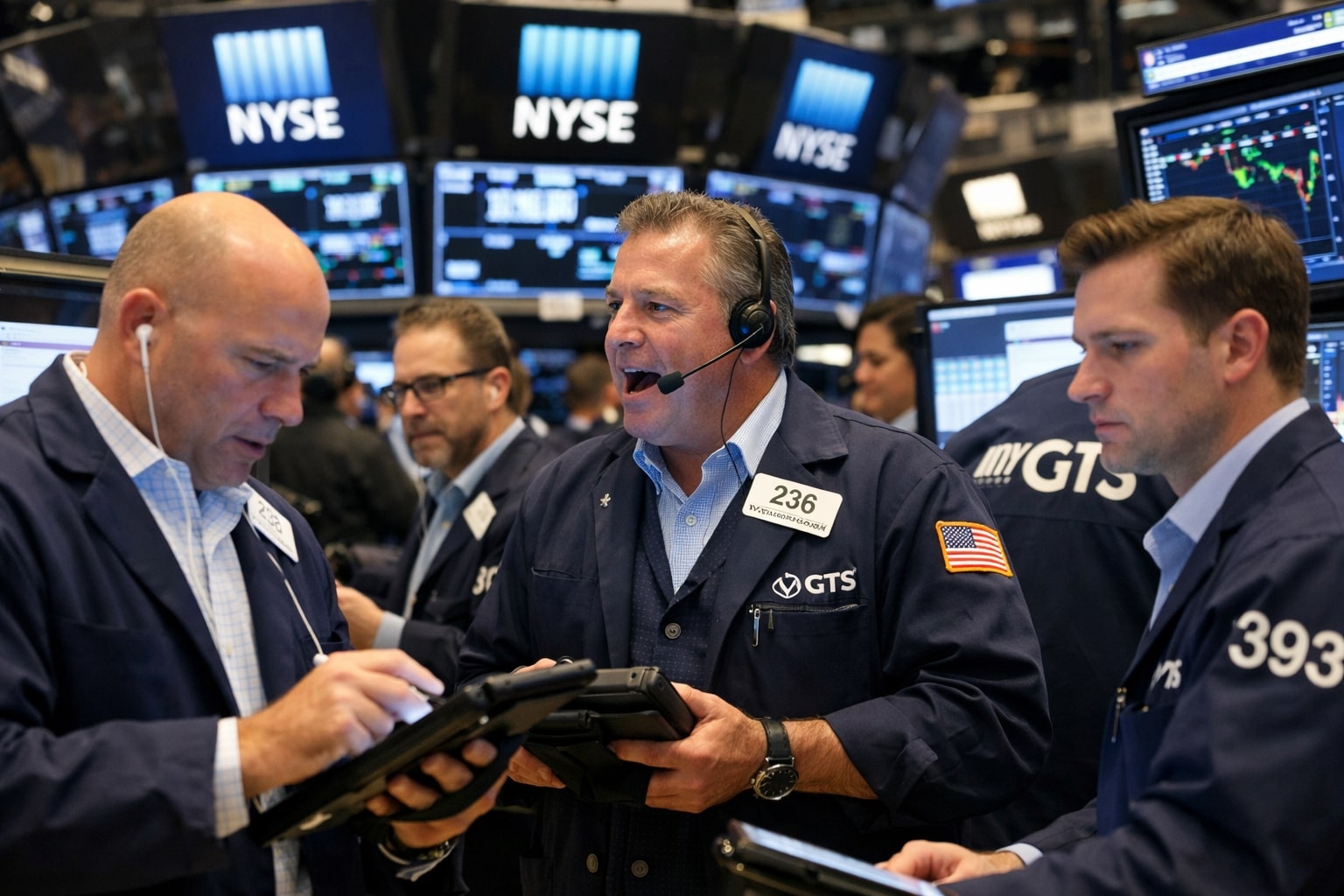
The U.S. stock market is closed today, 25 December 2025, but the tape going into Christmas Eve was anything but quiet. The S&P 500 (^GSPC) finished the early session at a record 6,932.05 (+0.32%), the Dow Jones Industrial Average (^DJI) closed at an all-time high of 48,731.16 (+0.60%), and the Nasdaq Composite (^IXIC) ended at 23,613.31 (+0.22%). Trading shut at 1:00 p.m. ET in a classic holiday half-day with volume collapsing to roughly 7.61 billion shares vs. a 20-day average near 16.21 billion, so the move was driven by institutional rebalancing and AI-led strength rather than broad retail participation. Futures into the holiday show modest upside, but real price discovery resumes only when full liquidity returns.
Holiday schedule, liquidity and what a closed cash market really means for price discovery
Today NYSE and Nasdaq are fully closed for Christmas after the early close on 24 December. U.S. dollar fixed-income markets followed the standard pattern, with a 2:00 p.m. ET close on the 24th and a full shutdown on the 25th. With cash equities offline, control shifts to index futures, options positioning and macro headlines. That means S&P 500, Nasdaq 100 and Dow futures plus yield moves and jobs data dictate sentiment, while the last cash prints from Wednesday remain the reference point for every portfolio marked to market over the holiday.
Index structure: how S&P 500, Dow and Nasdaq are really positioned going into year-end
At 6,932.05, the S&P 500 is up more than 17% year to date in 2025 and has added another record close to a long list this year. The Dow at 48,731.16 has pushed into new territory as well, while the Nasdaq at 23,613.31 remains heavily powered by AI, semiconductors and software. Underneath those headline levels, leadership is still narrow. A small cluster of mega-cap technology and communication-services names contributes a disproportionate share of index points, while equal-weighted versions of the S&P 500 and broader mid-cap benchmarks trade at clear valuation discounts. That skew makes the tape look stronger at the index level than it feels for a median stock.
Volatility, breadth and what VIX near 14 is really telling you about risk appetite
Implied volatility is muted. The VIX sits around the high-13s to low-14s, close to the lowest levels since late 2024. That pricing tells you two things at once: the market does not expect immediate stress and portfolio hedging is cheap and underused. Combined with record index levels and narrow leadership, that is a classic late-bull configuration: investors are long risk, light on protection and comfortable that central banks and earnings will stay supportive. Any negative surprise on growth, inflation or AI spending can reprice that complacency very quickly, but for now the volatility market confirms a strong risk-on stance.
AI leadership: Nvidia, Alphabet, Amazon and Microsoft no longer move in lockstep
The AI trade has evolved. It is no longer a uniform bid across every tech giant. Over 2025, Alphabet (GOOGL) and Nvidia (NVDA) have outpaced Amazon (AMZN) and Apple (AAPL), while capital has rotated toward infrastructure beneficiaries rather than just platform names. Nvidia remains the dominant AI infrastructure stock, with its market value around $4.6 trillion and a roughly thirteenfold gain since late 2022. That kind of repricing means every new announcement is judged against an extreme starting point. Alphabet has ridden the AI narrative through cloud, search and video monetization, while Amazon and Apple have lagged relative to the very top AI winners as the market demands clear incremental AI monetization rather than just promises.
Nvidia–Groq licensing and the new AI deal template on Wall Street
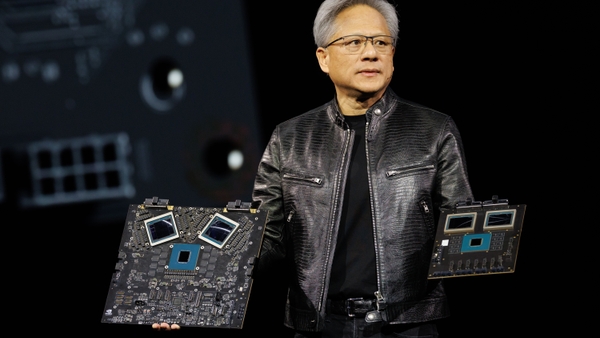
One of the latest catalysts for AI sentiment is Nvidia’s licensing deal around Groq’s inference chip technology combined with senior hires from Groq. This is not a classic full acquisition but a non-exclusive technology license plus executive and engineering absorption. That structure is becoming the blueprint for big AI players: secure access to IP and key talent, avoid protracted regulatory scrutiny that comes with large outright deals and keep capital focused on roadmaps for GPUs, networking and software ecosystems. For markets, the message is that Nvidia intends to dominate not just training but also inference, reinforcing its leverage over the entire AI stack and justifying, in investors’ eyes, a premium multiple for longer.
Micron (MU): memory and HBM as the cleanest second-derivative AI winner
While Nvidia takes most headlines, Micron Technology (MU) is quietly becoming one of the most powerful second-derivative winners of the AI capex wave. The stock closed at a record around $286.68 in the last session after another strong move of roughly +3.8%, extending a rally triggered by a bullish forecast on AI-driven demand for high-bandwidth memory. Markets are now treating HBM as a strategic choke-point, not a commodity, and are discounting several years of tight supply. That makes MU one of the highest-conviction plays on AI infrastructure beyond Nvidia, with earnings leverage driven by pricing power and mix rather than raw unit volume alone.
Nike (NKE): Tim Cook’s $3M buy turns a sluggish consumer name into a short-term outperformer
On the single-name side, Nike (NKE) delivered one of the clearest outperformance signals into Christmas Eve. The stock jumped about 4.6% after a filing showed Apple CEO Tim Cook, who sits on Nike’s board, bought nearly $3 million of NKE shares. This is a high-quality insider purchase from one of the most scrutinized executives in the world. Nike still faces structural headwinds from China demand, tariffs and brand reset issues, but a purchase of this size from Cook forces funds to reassess their underweights. For now, the market is reading it as a medium-term vote of confidence that Nike’s margin and demand story can improve from here, even if the macro narrative remains complicated.
Target (TGT), AST SpaceMobile (ASTS), Datadog (DDOG) and EXE: where the market is rotating capital
Beyond the mega-caps, the final pre-holiday tape showed rotation in both directions. Target (TGT) rose around 2.36% on evidence of solid holiday traffic and steady consumer demand, which dovetails with macro data showing a resilient U.S. consumer. At the other end of the spectrum, AST SpaceMobile (ASTS) fell roughly 8.9%, Datadog (DDOG) dropped about 2.3%, and Expand Energy (EXE) slid close to 1.8%. Those moves underline a persistent pattern: investors are using speculative or richly valued mid-cap growth stocks as a funding source to add to cash-flow-rich large caps and clear AI infrastructure winners. The risk budget is being concentrated where visibility is highest.
Labor market and GDP: hot jobs and 4.3% growth with a Fed already cutting rates
Macro data into Christmas confirms a still-strong U.S. economy. Initial jobless claims came in at 214,000, down from 224,000 and better than the expected 225,000, signaling that layoffs remain low and the job market is tight. At the same time, the third-quarter GDP reading printed at 4.3% annualized versus a 3.2% consensus. Despite that strength, the Federal Reserve has already cut the federal funds rate to a 3.50%–3.75% range, and markets are pricing only about 50 basis points of additional easing in 2026. This is rate cutting from a position of strength, not crisis. For equities, the combination of strong growth, moderating inflation and gradual cuts is close to the ideal environment for earnings and multiples, but it leaves little room for disappointment.
Rates, yields and the 10-year at 4.16%: how much valuation support is left for the S&P 500?
The 10-year U.S. Treasury yield around 4.16% matters as much as any earnings headline. Earlier in the cycle, yields were higher, compressing equity valuations and hurting growth stocks. The move down toward the low-4% area eases the discount rate used in cash-flow models and supports higher P/E multiples, especially for tech and other duration-heavy sectors. The problem is that the S&P 500 has already used that benefit: at roughly 22x forward earnings, the index discounts sustained double-digit EPS growth and an orderly, measured Fed. If yields rise again because growth and inflation surprise to the upside, multiple compression becomes a direct threat even if earnings hold up.
Cross-asset picture: VIX, oil, gold and silver show inflation contained but hedging demand alive
Cross-asset signals confirm a calm but hedged market. The VIX near 14 shows low implied equity volatility, consistent with the grind higher in indices. WTI crude trading around $58.35 and Brent roughly $61.80 keeps headline inflation pressure contained, which is good news for rate-sensitive sectors such as technology, housing and small caps, and bad news for pure energy earnings momentum. At the same time, gold futures hitting all-time intraday highs near $4,555 per ounce and silver near $72.75 per ounce tell you that demand for hard assets remains extremely strong. Record equities and record precious metals together are the market’s way of saying: risk appetite is high, but so is demand for protection against monetary and geopolitical shocks.
Read More
-
GPIQ ETF Price Forecast: Can a 10% Yield at $52 Survive the Next Nasdaq Selloff?
09.02.2026 · TradingNEWS ArchiveStocks
-
XRP ETF Price Forecast: XRPI at $8.32, XRPR at $11.86 as $44.95M Inflows Defy BTC and ETH Outflows
09.02.2026 · TradingNEWS ArchiveCrypto
-
Natural Gas Futures Price Forecast: Will The $3.00 Floor Hold After The $7 Winter Spike?
09.02.2026 · TradingNEWS ArchiveCommodities
-
Stock Market Today: Dow Back Under 50K While S&P 500 and Nasdaq Push Higher as Gold Reclaims $5,000
09.02.2026 · TradingNEWS ArchiveMarkets
-
USD/JPY Price Forecast: Can Bulls Clear 157.5 Without Triggering a 160 Intervention Line?
09.02.2026 · TradingNEWS ArchiveForex