



Stock Market Today - Wall Street Opens 2026; Dow 48,382, S&P 6,858 on Chip Rally, Gold Boom and Bitcoin $90K
Nasdaq slips as MSFT, TSLA lag while NVDA, AMD and MU surge, gold and silver extend record runs, Bitcoin hits $90,000 and Brent crude trades near $61 | That's TradingNEWS
Wall Street Opens 2026 With A Split Tape And Chip-Led Support
The first trading day of 2026 ended with a modestly positive but uneven session, reinforcing that the equity bull run is intact but becoming more selective. The S&P 500 (^GSPC) closed at 6,858.47, up 0.19%, while the Dow Jones Industrial Average (^DJI) climbed 0.66% to 48,382.39, powered by cyclicals and select tech hardware. The Nasdaq Composite (^IXIC) slipped 0.03% to 23,235.63, reflecting pressure in software and several of the “Magnificent 7” names despite ongoing leadership from semiconductors.
These moves follow a powerful 2025: the S&P 500 gained more than 16%, the Nasdaq jumped over 20%, and the Dow added roughly 13%, each hitting record highs during the year. The traditional “Santa Claus rally” failed to fire this time, with the S&P 500 down almost 1% across the last five sessions of 2025 plus the first two of 2026, underlining that investors are now more price-sensitive after three straight years of double-digit returns.
Index Scorecard: S&P 500, Nasdaq, Dow And Small Caps
The broad index picture shows a rotation under the surface. The S&P 500 (^GSPC) held green thanks to chips and select cyclicals, but the Nasdaq (^IXIC) finished fractionally red as software, megacap platforms and parts of cloud pulled back.
The real relative winner of the day was the small-cap complex. The Russell 2000 (^RUT) rose about 1.1%, sharply outperforming the S&P’s 0.2% gain. Small caps lagged badly in 2025, finishing up less than 12% versus over 16% for the S&P 500. The first session of 2026 therefore starts with a classic “catch-up” move: investors rotating from crowded megacap AI plays into domestically focused cyclicals that still trade at discounts.
Outside the US, the FTSE 100 in the UK briefly touched the 10,000 level for the first time, after a 21.5% gain in 2025 that actually beat the S&P 500’s performance. Valuation remains a key driver here; UK equities are still priced below US peers on most multiples, which keeps global asset allocators overweight.
For Trading News readers, the message is clear: the index story is no longer just “buy anything with a tech ticker.” Index leadership is widening, and under-owned parts of the market are starting to matter again.
Semiconductor Surge: NVDA, AMD, MU, TSM And AI Infrastructure
The most important support for S&P 500 and Dow came from semiconductors and AI infrastructure. Nvidia (NVDA) added more than 1% on the day, trading near $188.85, while Micron Technology (MU) exploded higher by over 10%, hitting fresh all-time highs since its 1984 IPO.
Advanced Micro Devices (AMD) also rallied more than 4%, contributing to a strong first-day signal for the chip complex. All three now sit at the heart of the AI capex cycle, supplying GPUs, memory and adjacent silicon that power data centers behind every large language model, including the systems that drive Trading News analytics.
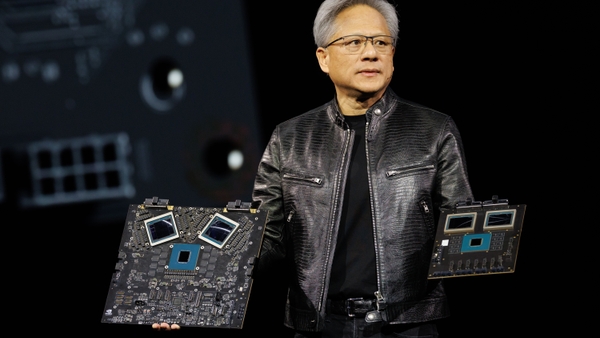
In the background, Taiwan Semiconductor (TSM) is flagged as a key name to watch into upcoming events such as CES 2026, where both NVDA CEO Jensen Huang and AMD CEO Lisa Su will put AI roadmaps back on center stage. The XLK technology sector ETF returned more than 13.5% over the last six months of 2025, and early 2026 flows show investors are still willing to pay for proven AI capacity rather than speculative ideas.
At the same time, infrastructure plays around data centers remain in focus. Vertiv (VRT) was upgraded to overweight with a new $200 price target, implying over 23% upside from recent levels after a period of volatility. The argument is simple: as long as AI capex remains robust, the ecosystem of cooling, power and rack infrastructure should outgrow consensus.
Verdict on the AI hardware complex – Buy, bullish. Valuations are rich and volatility will stay high, but earnings revisions remain positive, and capital spending plans from hyperscalers still point upward. Pullbacks in NVDA, AMD, MU and TSM continue to look like opportunities rather than exit points.
Big Tech Rotation: ‘Magnificent 7’ Lose Steam As AI Leaders Hold
Underneath the flat Nasdaq, the “Magnificent 7” showed classic late-cycle rotation. Microsoft (MSFT) dropped more than 2%, while Amazon (AMZN), Meta Platforms (META) and Tesla (TSLA) each lost more than 1%. Alphabet (GOOG) and Apple (AAPL) slipped less than 1%, while Nvidia (NVDA) was the sole gainer among the group, up more than 1.6% at midday and still positive at the close.
In 2025, most of these names actually underperformed the S&P 500. Only Alphabet and Nvidia beat the roughly 17% S&P advance, gaining about 66% and 39%, respectively. Amazon was the laggard with roughly 5% upside over the year. That history matters: the market is no longer blindly rewarding the full basket. Investors are paying for profit growth and clear AI monetization, not just size.
Strategists still forecast another year of double-digit gains for US equities in 2026, with one survey putting the average S&P 500 year-end target at 7,629, about 11.4% above current levels. But there is more caution around over-concentrated AI stories and valuation risk. Big Tech is now a market of stock pickers rather than a single momentum trade.
Verdict on broad megacap platforms – Hold, constructive but selective. Core names with clear AI monetization and strong balance sheets remain central to any portfolio, but index-beating performance from the whole “Mag 7” is no longer guaranteed. Stock selection inside the group will matter more than the label.
Tesla Hit By Second Year Of Delivery Declines And A Crowded EV Field
The market’s patience with Tesla (TSLA) was tested again. The company reported 418,227 vehicle deliveries in Q4 2025, down about 15% from the 495,570 delivered in the same period a year earlier and slightly below the roughly 422,000 Wall Street expectation. That shortfall marks Tesla’s second consecutive year of annual delivery declines, with 1.64 million vehicles shipped in 2025, down 8% from 2024.
The demand backdrop is tougher. Subsidy support from EV tax credits has faded, competition from BYD, Kia, Hyundai and Volkswagen is intense, and Europe remains a drag. Tesla has shifted its narrative toward robotaxis and humanoid robots, suggesting that the real growth option now lies in autonomy and robotics rather than pure EV volume.
Some analysts still see these numbers as “better than feared,” especially versus whisper expectations of around 410,000 deliveries, and one high-profile target even pins a $600 12-month price target on the stock with a path to $2–3 trillion market cap by the end of 2026 in a bull case. That is pure optionality on full-scale autonomy, and investors must treat it as such.
Verdict on TSLA – Hold, highly speculative. The stock still commands enormous optionality, but the core auto business is shrinking in unit terms, and competition is escalating. At current valuations, the risk/reward is balanced and reliant on successful execution in autonomy, which remains unproven at commercial scale.
Furniture And Housing-Linked Retailers: Tariff Reprieve Lifts RH, W, WSM
One of the clearest sector winners of the day came from furniture and home goods. RH (RH) jumped about 8% to roughly $193.41, with after-hours trading nudging it above $194. Wayfair (W) gained around 4–6% intraday, and Williams-Sonoma (WSM) climbed roughly 3%.
The driver is policy, not earnings. The US administration delayed a planned tariff escalation on upholstered furniture, kitchen cabinets and vanities. Duties that were set to jump from 25% to 30% on upholstery and to 50% on cabinets will instead stay at 25% through January 1, 2027. This effectively removes a major margin headwind for retailers that already face uneven consumer demand and elevated promotional activity.
Brokers argue that the decision “gives breathing room” to the sector and especially to asset-light marketplaces like Wayfair, which can flex sourcing and pricing. The macro backdrop for high-ticket home goods is still soft, but the tariff overhang is gone for the next year, allowing investors to refocus on execution, cost discipline and any demand recovery if rates stabilize or fall.
Verdict on furniture and home-goods names – Tactical Buy. The tariff pause is a clear fundamental positive, and valuations still reflect skepticism about housing-related spending. For Trading News readers, RH, W and WSM now offer leveraged upside to any improvement in housing turnover and consumer confidence in 2026.
Small Caps, UK Equities And Global Value Pockets
The strong showing from the Russell 2000 and the milestone in the FTSE 100 at 10,000 reinforce a broader theme: global capital is slowly migrating from stretched US megacaps to cheaper markets and segments. UK equities gained 21.5% in 2025, beating the S&P 500’s 16.4%, yet they still trade on lower multiples.
In the US, many small-cap names remain priced as if the economy is one shock away from a hard landing, even as macro data show resilience. The S&P Global US manufacturing PMI came in at 51.8 for December, only slightly down from 52.2 in November and still in expansion territory, with job creation at its highest level since August and input prices rising at the slowest pace in eleven months.
Verdict on small caps and UK – Buy, value-tilted bullish. The combination of reasonable valuations, improving breadth and decent macro supports a gradual re-rating, especially if rate cuts begin in 2026.
Rates, Fed Transition And The End Of The Powell Era
On the macro side, US Treasuries started 2026 under pressure. The 30-year yield (^TYX) climbed to about 4.88%, up four basis points intraday and at its highest since early September, while the 10-year moved to around 4.19%. The move reflects optimism about US growth rather than inflation panic; unemployment claims recently fell to one of the lowest levels of the year, pointing to a still-firm labor market.
At the policy level, this year also brings the end of Jerome Powell’s tenure as Fed Chair. Markets expect a successor such as Kevin Hassett or another policy insider to take over, but the transition will be politically charged. The current chair’s stated goal is to leave an economy in “good shape” with inflation on a clear path back to 2%, yet he will likely step down before that process is complete.
Strategists still expect rate cuts in 2026, but the path will depend on growth, inflation and the new chair’s credibility. For risk assets, the combination of steady growth, slightly easier policy and contained inflation remains a powerful support, but higher-for-longer yields at the long end will continue to discipline valuations.
Verdict on US rates backdrop – Constructive for equities, neutral for long bonds. Equities can live with 4–5% long yields when growth is solid; long-duration bonds, however, still face asymmetric risk if growth surprises on the upside.
Read More
-
GPIQ ETF Price Forecast: Can a 10% Yield at $52 Survive the Next Nasdaq Selloff?
09.02.2026 · TradingNEWS ArchiveStocks
-
XRP ETF Price Forecast: XRPI at $8.32, XRPR at $11.86 as $44.95M Inflows Defy BTC and ETH Outflows
09.02.2026 · TradingNEWS ArchiveCrypto
-
Natural Gas Futures Price Forecast: Will The $3.00 Floor Hold After The $7 Winter Spike?
09.02.2026 · TradingNEWS ArchiveCommodities
-
Stock Market Today: Dow Back Under 50K While S&P 500 and Nasdaq Push Higher as Gold Reclaims $5,000
09.02.2026 · TradingNEWS ArchiveMarkets
-
USD/JPY Price Forecast: Can Bulls Clear 157.5 Without Triggering a 160 Intervention Line?
09.02.2026 · TradingNEWS ArchiveForex
Gold, Silver And Industrial Metals: Best Year Since 1979 Sets Up A Volatile 2026
Precious metals extended their remarkable run into the first session of 2026. Gold (GC=F) traded near $4,330–4,375 per ounce during the day, up as much as 1.9% before fading slightly, while silver (SI=F) rose about 1.4–2% and hovered just under $72 per ounce. Both logged their strongest annual gains since 1979 in 2025.
However, this strength now collides with index mechanics. Some commodity strategists estimate that as much as 13% of aggregate open interest in COMEX silver may need to be sold over the next two weeks as passive funds rebalance and trim overweight positions. With post-holiday liquidity thin, that selling could trigger sharp swings lower even if the fundamental case remains intact.
Industrial metals joined the rally. Aluminum (ALI=F) futures crossed $3,000 per ton for the first time since 2022, up about 1% on the session and roughly 17% in 2025, helped by Chinese capacity caps, European energy constraints and strong demand from construction and renewables. Copper (HG=F) resumed gains after posting its biggest annual rise since 2009, while nickel spiked following operational delays at PT Vale Indonesia.
Verdict on metals – Gold and silver: Hold; base metals: Buy on structural demand. Precious metals are extended after a historic year and vulnerable to mechanical selling. Industrial metals still benefit from supply constraints and decarbonization-linked demand, offering better risk/reward into 2026.
Oil, Venezuela Shock And Geopolitical Risk Premium
Crude began 2026 trying to stabilize after its worst annual performance since the pandemic. Brent (BZ=F) traded just above $61 a barrel, while West Texas Intermediate (CL=F) hovered near $58.
The supply narrative is dominated by the upcoming OPEC+ meeting on January 4, where Saudi Arabia and Russia are expected to maintain a pause on further supply hikes. The demand picture is mixed, but the geopolitical side escalated sharply: the US executed a pre-dawn operation in Venezuela, capturing President Nicolás Maduro and removing him from the country.
That strike adds a significant new layer of risk around Venezuelan exports, already under heavy sanctions. The US has sanctioned shippers and vessels in Hong Kong and mainland China linked to sanctions evasion. Airlines have cancelled Caribbean flights, and global leaders are denouncing the action as an “act of armed aggression.” The net effect is renewed uncertainty over regional stability and medium-term oil supply, even if short-term flows are manageable.
Verdict on oil – Hold with upside skew. Prices are depressed after a poor 2025, OPEC+ is still acting as a floor, and geopolitical risk has clearly risen. However, lackluster demand and high non-OPEC supply cap the near-term upside.
Crypto, Fintech And The ARK ARKF Outlier
In digital assets, Bitcoin (BTC-USD) reclaimed the $90,000 level, last trading around $90,109, roughly 28% below its early-October all-time high but back above a key psychological threshold. The token still finished 2025 about 6% lower despite that record, hurt by repeated liquidations of leveraged positions and bouts of rotation into safe havens such as gold and silver.
The broader crypto complex has fragmented. Miners that pivoted toward AI computing, such as Hut 8 (HUT) and Riot Platforms (RIOT), gained about 124% and 24% in 2025 as they repurposed GPU infrastructure for AI workloads. ETFs focused on digital transformation and blockchain posted double-digit gains in many cases. Yet core payment and pure-play crypto names lagged: Bitcoin itself fell 7% over the year, and Coinbase (COIN) declined about 9%.
Against that backdrop, Cathie Wood’s ARK Blockchain & Fintech Innovation ETF (ARKF) delivered a standout 29% return in 2025 by stretching the traditional definition of “fintech.” Holdings like Palantir Technologies (PLTR), up 135%, and Roku (ROKU), up 46%, did much of the heavy lifting while classic payment stocks lagged. The message for 2026 is straightforward: crypto-adjacent AI winners can outperform even when tokens struggle.
Prediction markets are another emerging theme. Robinhood (HOOD) and Coinbase (COIN) are partnering with platforms such as Kalshi to let users trade outcomes of real-world events, from elections to macro data. That trend could deepen retail engagement but will also attract regulatory scrutiny, as the line between speculation and gambling blurs further.
Verdict on Bitcoin and crypto – Hold, extremely high risk. The asset class still trades as leveraged risk sentiment. Structural adoption is improving, but volatility, regulatory risk and concentration remain extreme. Fintech-plus-AI plays like PLTR offer a cleaner equity expression of similar themes.
Asia Tech, China AI And BIDU Spin-Off Catalyst
Asian technology stocks opened 2026 with a strong tone. South Korea’s Kospi (^KS11) hit record highs as Samsung Electronics (005930.KS) jumped about 7.2% to an all-time high. A gauge of Chinese tech listings in Hong Kong surged roughly 4.3%, fueled by enthusiasm over AI-related listings and progress at firms such as DeepSeek.
In the US, Baidu (BIDU) became a standout single-name story. The company announced that its AI chip unit, Kunlunxin, has confidentially filed to list in Hong Kong, paving the way for a spin-off valued around 21 billion yuan (approximately $3 billion). BIDU’s US-listed shares jumped about 12–15%, closing near $150.30.
China’s drive to build domestic alternatives to US semiconductors under escalating export restrictions gives Kunlunxin a strategic role that extends beyond simple earnings contribution. A successful listing and independent access to capital could unlock value at Baidu and support a broader re-rating of Chinese AI hardware names.
Verdict on BIDU and Asia AI – Buy with volatility. Policy risk is permanent, but the structural need for domestic AI hardware and the new listing path for Kunlunxin create a clear medium-term growth story.
Healthcare, GLP-1 Wave And Consumer Spending Shifts
The 2026 consumer story will also be shaped by medicine cabinets, not just wallets. GLP-1 obesity drugs such as Wegovy and Zepbound, once constrained by manufacturing bottlenecks and weak insurance coverage, are now scaling. Supply is improving, prices are easing from peak levels, and oral formulations are expected to hit the market, removing the psychological barrier for patients who dislike injections.
As more people adopt GLP-1 treatments, spending patterns will shift in ways that matter for equities held by Trading News readers. Demand for fast food, sugary beverages and some snack categories may stagnate, while athletic apparel, fitness hardware and health-oriented food brands could see incremental tailwinds. Insurers will face higher near-term drug bills but potentially lower long-term costs if obesity-linked comorbidities decline.
Verdict on GLP-1 complex – Buy for leaders, cautious on obvious losers. Large pharma with strong GLP-1 franchises remain well-positioned, while consumer names exposed to unhealthy consumption trends face a gradual but real headwind over the next decade.
Berkshire, Durability And The 100-Year Question
Long-duration investors are also watching succession stories. Warren Buffett has formally handed the Berkshire Hathaway (BRK.A / BRK.B) CEO reins to Greg Abel, while stating that Berkshire has “a better chance of being here in 100 years than any company” he can think of.
In a market dominated by AI hype and short-term flows, that assertion matters. Berkshire remains a benchmark for durable cash-flow compounding, diversified exposure and conservative balance-sheet management. As many speculative stories now trade at lofty valuations, a subset of investors is likely to rotate part of their equity exposure back toward stable compounders with clear governance transitions.
Verdict on Berkshire – Hold to Buy for long-term capital. It is not a high-beta AI play, but its risk-adjusted return profile remains attractive, especially if late-cycle volatility increases.
New Highs, New Lows And Internal Market Texture
Market breadth metrics show that beneath modest index moves, dispersion is high. On the upside, Micron (MU), Ulta Beauty (ULTA), Jabil (JBL), Lam Research (LRCX) and Teradyne (TER) are all trading at or near all-time highs, reflecting strong demand in memory, beauty, electronics manufacturing and test equipment.
On the downside, Campbell Soup (CPB), Pool Corp (POOL), Copart (CPRT), Paycom (PAYC), CDW (CDW), GoDaddy (GDDY), Roper Technologies (ROP), Tyler Technologies (TYL) and Workday (WDAY) are printing fresh 52-week lows or multi-year troughs. That mix captures several trends: pressure on rate-sensitive or valuation-heavy software, rotation away from stalling growth stories, and selective appetite for secular winners with clear visibility.
Verdict on breadth – Neutral, but improving. The days of a narrow AI-only market are fading; more sectors are participating, but dispersion inside each sector is rising. Stock picking will drive returns more than simple factor exposure.
2026 Outlook For Equities: Trading News Stance – Buy, But Not Blindly
After integrating the full set of moves, flows, macro signals and thematic shifts from the first trading day and the latest weekend newsflow, the Trading News view is straightforward.
US equities remain in a bull market, supported by a resilient economy, still-strong earnings, an upcoming Fed transition that likely tilts toward gradual easing, and massive capital spending in AI, energy transition and healthcare. At the same time, valuations in core megacap tech are elevated, geopolitical risk has increased with the Venezuela operation, and some crowded trades show clear fatigue.
Final stance:
• US equities overall – Buy with a bullish bias, but at reduced beta. Favor quality, cash-generative names across AI hardware, selective megacap platforms, industrials and small caps over the most speculative growth stories.
• AI semiconductors – Clear Buy. NVDA, AMD, MU and TSM remain the backbone of the AI cycle.
• Gold and silver – Hold. Outstanding 2025 performance is in the price; index rebalancing risk is real.
• Bitcoin and high-beta crypto – Hold only for risk-tolerant capital. Upside is large, but drawdowns will be brutal.
• Tesla – Hold, speculative. Wait for clearer evidence that robotaxis and autonomy can offset declining EV volumes.
• Value pockets (small caps, UK, select cyclicals) – Buy. This is where risk/reward looks best at current levels.
From a Trading News perspective, 2026 is not the year to exit equities. It is the year to stop treating the market as a single trade and start treating each sector, and each symbol, as a separate decision backed by hard numbers.