JEPQ ETF Price: 10% Nasdaq Yield From Volatility – But At What Cost?
JEPQ ETF around $57.51 with a 10%+ monthly yield turns Nasdaq-100 swings into cash, but rich 26x earnings, muted volatility and underperformance vs QQQI, GPIQ and QDVO raise hard questions on total return | That's TradingNEWS
JEPQ ETF – volatility, yield and where JPMorgan’s Nasdaq income engine really stands now
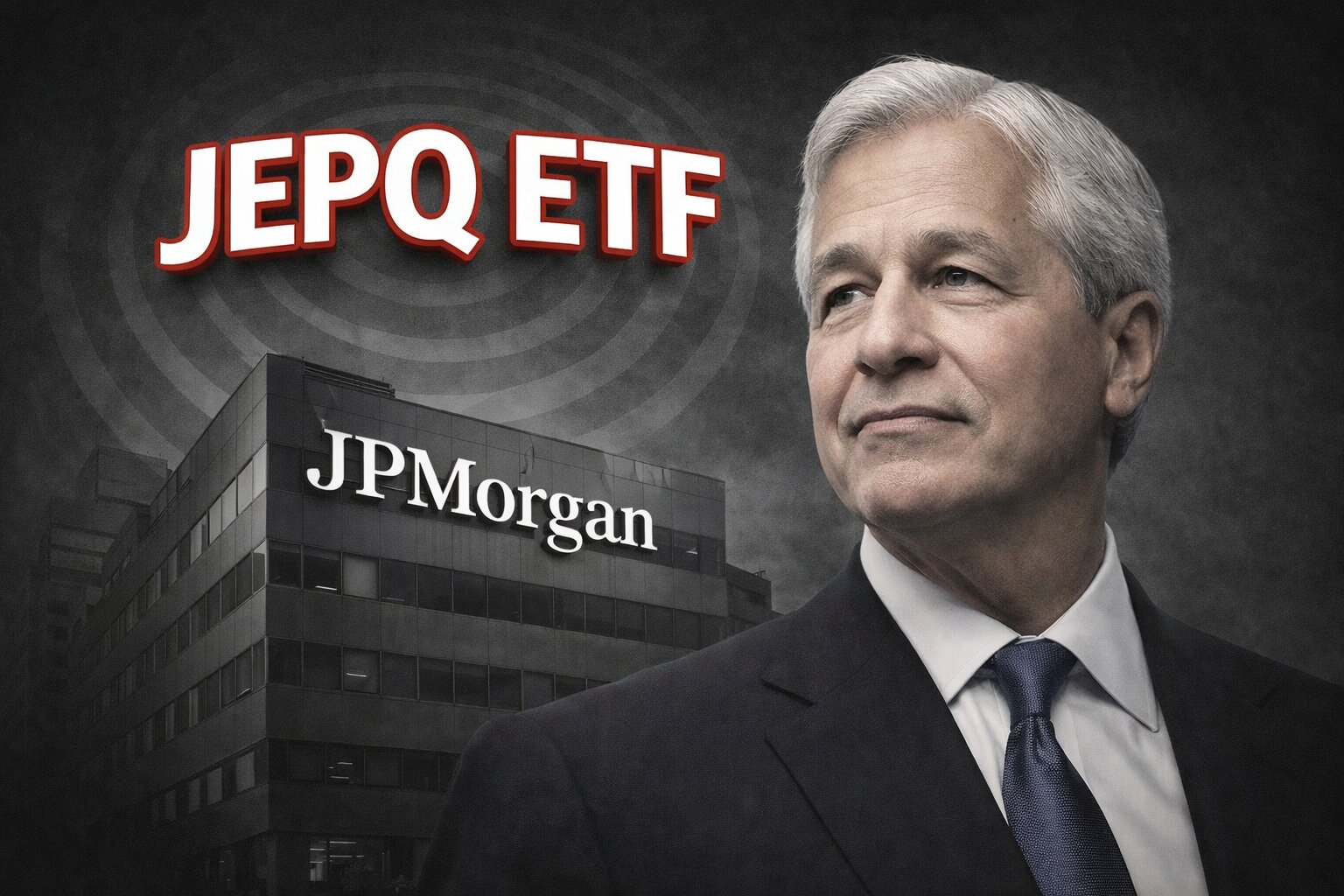
JEPQ ETF (NYSEARCA:JEPQ) price, yield and scale right now
JEPQ ETF closed around $57.51, fractionally higher on the day after trading between roughly $57.02 and $57.91 inside a 52-week band of $44.31 to $60.14. At this level the fund sits a few dollars below its recent high, with assets under management of about $33–34 billion and average daily volume near 6.3 million shares, which makes it one of the largest options-overlay income products tied to the Nasdaq-100. The trailing distribution is about $6.14 per share, implying a double-digit yield in the 10.5%–10.8% range on the current price, paid monthly. The stated expense ratio is 0.35%, meaning roughly $0.20 per share per year is consumed by fees at today’s price, a meaningful but not extreme drag in exchange for the structure.
How JEPQ ETF actually generates that 10%+ income
The portfolio of JEPQ ETF is built as an actively-managed version of the Nasdaq-100. It holds a basket that looks broadly similar to QQQ, anchored in mega-cap technology and growth names, but with tactical tilts and slightly different weights. A key structural lever is the use of equity-linked notes and covered calls. Up to about 20% of net assets can sit in ELNs that combine exposure to the Nasdaq-100 with written call options inside a single note. On top of that, JEPQ systematically sells out-of-the-money call options on the index with typical maturities around thirty days, harvesting option premium as recurring income. Because the calls are OTM rather than at-the-money, the fund retains some upside if the index drifts higher, but that upside is capped once the strike is reached and the overlay bites. The monthly distributions investors see are largely the cash flow from these premiums layered over whatever ordinary dividends the underlying stocks pay, so the 10%+ yield is structurally tied to the volatility and skew of Nasdaq-100 options.
Positioning versus the Nasdaq-100 – conservative tech exposure and lower mega-cap concentration
While JEPQ ETF references the Nasdaq-100, it doesn’t simply clone the index. In the current positioning the fund’s top holdings include the usual giants but with softer weights in the most volatile AI leaders. Exposure to names like Nvidia, Microsoft, and other richly-valued software or chip leaders is trimmed versus pure QQQ, while the roster still leans heavily on large U.S. technology and tech-adjacent businesses. That security selection is deliberately conservative. When AI-linked stocks such as Oracle, Nvidia and Microsoft sold off sharply, the reduced concentration helped cushion the blow relative to a fully-replicated index. In other words, JEPQ is not just a call-writing wrapper on QQQ; it is a somewhat lower-beta, actively-curated slice of the same ecosystem, engineered to complement the income overlay rather than maximize raw growth exposure at any price.
Macro backdrop – rotation out of growth, AI fatigue and why this matters to JEPQ ETF
The landscape around JEPQ ETF is defined by a broad “risk-off” tilt. After roughly three consecutive years in which growth indices delivered near-20% annual returns, the market has become more cautious on stretched technology valuations. Capital has rotated from growth funds such as VUG into value vehicles like VTV as investors question how much AI-driven upside remains already priced in. Concerns range from whether generative AI will cannibalize traditional SaaS business models to whether slowing global growth and shakier labor data can justify premium multiples. Rising geopolitical risk and domestic political noise add another layer of uncertainty. For JEPQ this is a double-edged environment. On one side, pressure on expensive AI names and the Nasdaq-100 limits pure price appreciation, which reduces the opportunity cost of capping upside through calls. On the other side, if risk-off extends too far and turns into an outright tech bear market, the equity leg suffers and the income stream is forced to work harder just to offset mark-to-market losses.
Volatility regimes – when JEPQ ETF thrives and why February is awkward
Covered-call funds like JEPQ ETF are volatility trades as much as equity trades. Option premium is fat when implied volatility is high and cheap when markets are calm. Historically, October has been the most volatile month in U.S. equities, while February sits at the opposite end of the spectrum with some of the lowest realized vol of the year. Recent data for QQQ’s 30-day realized volatility show a spike toward roughly 50% in April 2025 during tariff stress, followed by a grind lower to the mid-teens, around 15%–16%, versus a one-year average near 20%. Implied volatility tells a similar story: current QQQ IV around 20–21 is only modestly above its 52-week average near 20, far below its peak close to 47–48. This muted volatility is problematic for JEPQ’s income engine. With calmer markets, covered calls command smaller premiums, so each contract written brings in less cash. The fund can respond by writing more notional or adjusting strikes, but that raises the risk of capping more upside for less compensation. In this February-style regime, the trade-off shifts toward favoring a plain growth tracker like QQQ that can fully participate in any rebound, while JEPQ’s structural yield advantage is compressed.
Recent performance – strong cash flow, but lagging smarter competitors
Over its life since launching in May 2022, JEPQ ETF has delivered exactly what it advertised on income, but its total return story is more nuanced. From inception the price is up about 13.6%, and the fund has paid 45 consecutive monthly distributions totaling roughly $20.89 per share. An investor who committed $100,000 at launch could have bought around 1,957 shares and collected about $40,879 in distributions, or 40.9% of the initial capital, plus the 13.6% unrealized price gain for a total economic return near 54.5%. That compares very favorably with a four-year ladder in 12-month U.S. bills rolling from yields near 2% up through the 5% area and back to just over 4%, which would have produced roughly $15,960 of interest, or 16% on the same capital. However, when you widen the lens to include competing Nasdaq covered-call products, JEPQ has been the underperformer recently. Over the last twelve months JEPQ’s price is up about 1.5% and it has distributed about $6.14 in income, for a total return around 12.3%. NEOS Nasdaq-100 High Income ETF QQQI actually saw a slight price decline, roughly –0.5%, but paid about 14% yield, generating total return around 13.6%. Goldman Sachs Nasdaq-100 Premium Income ETF GPIQ combined nearly 4% price appreciation with around 10.5% yield for total return near 14.5%. Amplify’s QDVO led the group with roughly 5% capital gain plus about 10.8% yield, summing to close to 15.8%. The pattern is clear: JEPQ has delivered solid double-digit income, yet investors willing to hold peers with more tactical option overlays or different risk profiles have captured 1–3 percentage points more total return over the same window.
Yield profile and distribution dynamics of JEPQ ETF
At today’s price near $57.50, JEPQ ETF offers a trailing yield a little above 10.5%. Since inception it has paid out just under $21 per share across 45 monthly checks. On trailing twelve-month numbers the fund’s yield near 10.5%–10.8% is higher than its young four-year average around 9.2%, which superficially suggests a discount. But the history is short and skewed by the ramp-up period. In addition, monthly distributions are inherently linked to option cycles. Premiums collected in one month show up as cash flows the next, lagging realized volatility and market moves by roughly thirty days. That explains why the latest distribution did not explode despite volatility jumping around late 2025; December and early January were actually relatively calm compared to the April tariff shock, and seasonally January checks tend to be the smallest of the year. The more important structural point is that JEPQ’s distribution is variable, not fixed: in high-volatility stretches when the Nasdaq-100 swings violently and option markets reprice risk, the fund can likely push yield well above 11% on spot prices, while in quiet stretches it may have to accept mid-single-digit call premiums and see the trailing yield drift lower unless managers take more aggressive overwrite.
Read More
-
Adobe Stock Price Forecast - ADBE at $264: Market Punishes ADBE, Cash Flows Say Otherwise
15.02.2026 · TradingNEWS ArchiveStocks
-
XRP ETF XRPI and XRPR: Pricing the Next Big Move with XRP Around $1.46
15.02.2026 · TradingNEWS ArchiveCrypto
-
Natural Gas Futures Price Forecast: NG=F Tests $3.24 as Tight Storage Clashes With Mild Weather
15.02.2026 · TradingNEWS ArchiveCommodities
-
Stock Market Weekly Forecast: AI Shock, Gold Near $5,000 And Dow Around 50,400
15.02.2026 · TradingNEWS ArchiveMarkets
-
USD/JPY Price Forecast: From 157 Peak to 152 Support as BoJ Hawk Turn Threatens Carry Trade
15.02.2026 · TradingNEWS ArchiveForex
Valuation, fee drag and hidden opportunity cost
Under the surface, JEPQ ETF does not look cheap on fundamentals. The latest portfolio fact sheet shows the underlying basket trading around 26.5 times earnings, a richer multiple than the Nasdaq-100 itself which sits closer to 24.5 times. That premium exists even as investors are increasingly sensitive to AI-related hype and elevated growth valuations. On yield metrics, JEPQ appears attractive because its double-digit distribution dwarfs the 0.4%–0.5% cash yield of QQQ, but the comparison is apples to oranges: JEPQ is monetizing volatility, not just dividends. Costs also matter. The 0.35% expense ratio is almost double QQQ’s 0.18%, and more than double lower-cost Nasdaq trackers like QQQM at 0.15%. The portfolio turnover rate around 168% reflects heavy trading and options activity, which can introduce additional friction and potential tax inefficiencies for taxable investors. Taken together, investors are paying higher fees for a basket that is actually more expensive on P/E than the index, in exchange for the covered-call overlay and the monthly income. When volatility is high that trade-off works; when volatility is muted and growth resumes, a low-fee index fund can leave JEPQ behind on total return.
Risk profile – what JEPQ ETF does and does not protect you from
The risk characteristics of JEPQ ETF are hybrid. On the one hand, the covered-call overlay and somewhat more conservative stock selection reduce effective beta to the Nasdaq-100. The fund typically won’t drop as far as pure QQQ in a sharp tech drawdown because the options premium cushions downside and the most speculative names carry smaller weights. The income stream itself also softens drawdowns if distributions are reinvested. On the other hand, JEPQ is not a bond substitute or a full replacement for owning the index. In a strong bull market, it will systematically give up upside once the index rallies past the call strikes; you simply cannot earn call premium and keep 100% of every explosive leg higher. Over a long horizon this structural cap is why SPY and QQQ have outperformed, and why even within the covered-call segment more tactical strategies like QDVO and GPIQ have managed to extract more alpha by adjusting exposure and option positioning dynamically. There is also the behavioral risk that investors chase the 10% headline yield without appreciating that a large part of their return is just their own volatility sold back to the market.
Relative positioning versus peers and the Nasdaq – who should actually hold JEPQ ETF
Measured purely against its peers, JEPQ ETF now sits in the middle of the pack: neither the highest yielder nor the strongest total-return engine. Its main competitive advantages are brand strength from JPMorgan, massive AUM, deep liquidity and a simple structure that many advisors and retail investors can understand. For a retiree or income-focused account that wants Nasdaq exposure but cannot tolerate the full whipsaw of QQQ, JEPQ offers a straightforward way to convert growth volatility into monthly cash at a high single-digit or low double-digit rate. For investors obsessed with squeezing every basis point of total return out of a covered-call strategy, alternatives like QQQI, GPIQ or QDVO have, on the latest numbers, done a better job exploiting volatility without sacrificing as much upside. And for those who primarily believe in the long-term compounding of mega-cap tech, a low-cost growth tracker remains the cleaner expression.
Final stance on JEPQ ETF price – high income HOLD, not a tactical BUY
At a price around $57.50 with a trailing yield north of 10% and a 52-week range of roughly $44–$60, JEPQ ETF continues to be a powerful income tool but an imperfect vehicle for maximizing Nasdaq-linked total return. The macro backdrop of AI valuation fatigue, growth-to-value rotation and intermittent volatility justifies using a covered-call product, yet the current muted vol regime and JEPQ’s persistent underperformance versus smarter peers argue against calling it a clear BUY. The underlying portfolio trades at a premium to the index, fees and turnover are relatively high, and the opportunity cost versus holding QQQ or more tactical call-writers is real. Netting everything, the fund deserves a firm HOLD rating: suitable for investors prioritizing stable monthly cash flow from Nasdaq-100 names who accept capped upside and peer underperformance, but not compelling enough at today’s price and volatility to justify fresh aggressive buying purely on a risk-reward basis.