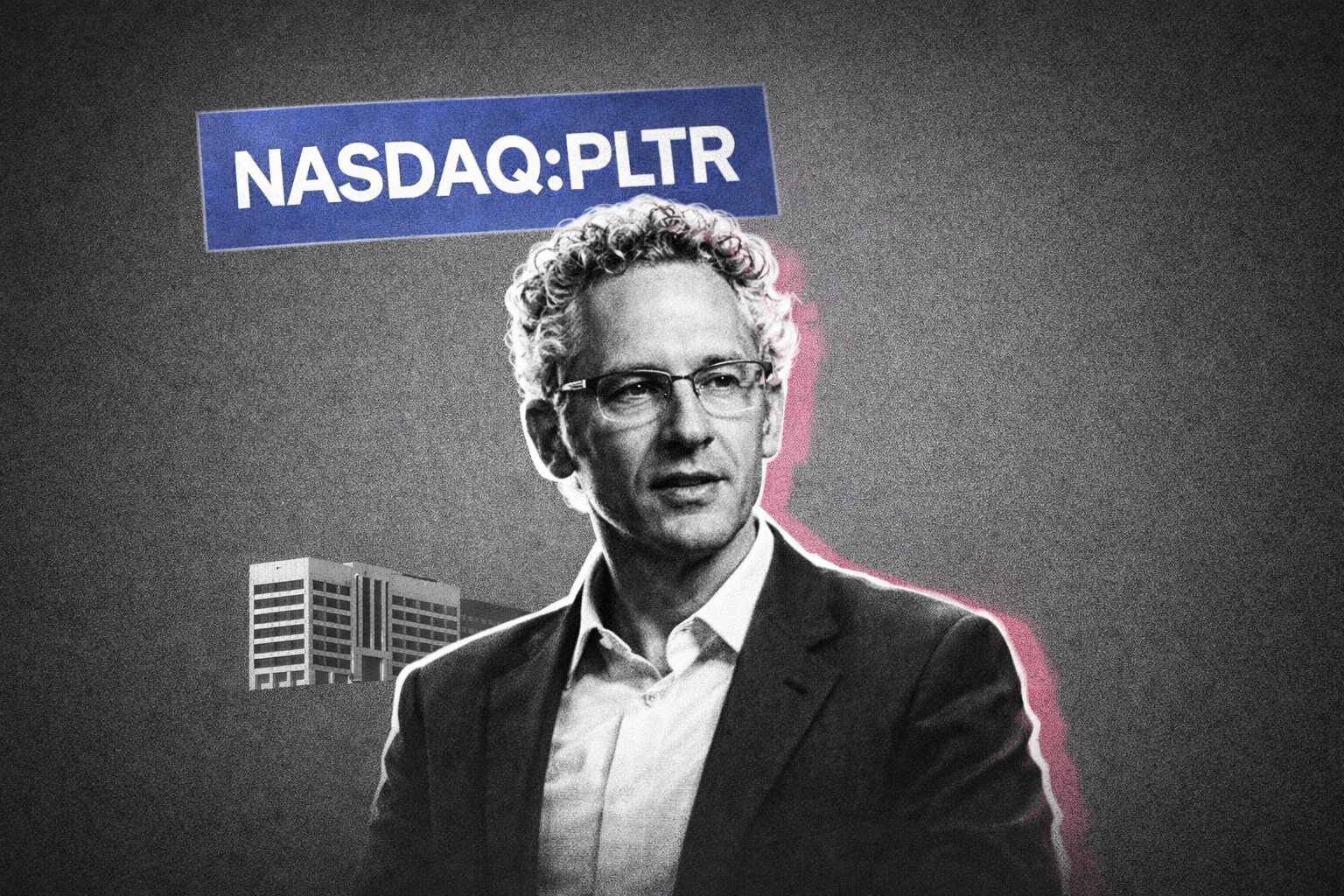
Palantir Stock Price Forecast - PLTR at $131: Can AIP Growth Justify a 200x P/E?
Revenue up 70%, US commercial up 137% and Rule-of-127 margins push Palantir toward a $313B AI giant, but the valuation now demands a hard Buy/Sell/Hold decision | That's TradingNEWS
Palantir stock (NASDAQ:PLTR) – AI infra name trading at perfection multiples
Palantir stock – price, trading range and valuation setup
Palantir stock (NASDAQ:PLTR) trades around $131.41, with after-hours indications near $131.72. The session range sits between $126.23 and $133.56, versus a 52-week band of $66.12–$207.52, so the stock is mid-range after a sharp pullback from the highs above $200. Market value is roughly $313–324 billion, depending on timestamp, and the stock changes hands at a trailing P/E near 200x+ and forward multiples still far above classical software peers. Average daily volume around 50 million shares underlines how crowded this trade is. There is no dividend; this is a pure growth and multiple story, fully dependent on execution and sentiment around AI infrastructure.
Palantir – AIP at the center of a multi-trillion AI capex cycle
Global AI spending is projected at roughly $2.52–$2.53 trillion in 2026, up about 44% year over year, and heading toward around $3.33 trillion in 2027 as AI becomes the dominant line inside IT budgets. By 2030, most enterprise technology capex is expected to be AI-linked. Within that wave, Palantir’s Artificial Intelligence Platform (AIP) is positioned as an operating system layer that actually turns AI into workflows rather than slideware. Tasks that can be automated or augmented by AI are already valued near $4.5 trillion, but only about 12% of professionals in finance, education and tech use AI every day to produce real work. Companies are expanding AI access from around 40% of employees to roughly 50%, with targets near 60% by 2026. Around 30% of firms have already rebuilt key processes with AI, and about 74% plan to roll out agentic AI within two years. The economics are not theoretical: AI is expected to cut cost bases by up to 65% versus about 40% today, lift data-driven analytics impact from 54% to 61%, and drive revenue contribution from roughly 20% to around 74%. AIP is designed to capture exactly that spread. Large customers such as Lowe’s are already using AIP to accelerate decisions by roughly 30%, still below the 60%+ decision-speed targets implied by broader AI benefit projections, which leaves meaningful upside inside existing deployments.
Palantir – business mix between commercial and government contracts
Palantir runs three core platforms – Gotham, AIP and Apollo – and splits revenue between commercial and government customers. On recent figures, quarterly commercial revenue is around $677 million, up from roughly $548 million, while government revenue is near $730 million, versus about $633 million in the prior period. In another disclosed split, commercial revenue was $507 million and government $570 million, but the message is the same: public-sector work still accounts for roughly two-thirds of total revenue, making government contracts a concentration point even as commercial becomes the growth engine. US commercial is the standout: revenue there surged about 137% year over year in Q4 2025, while US revenue overall expanded around 93% and international commercial managed only about 8%. The positive angle is that Palantir is gaining deep traction with high-budget, AI-mature customers; the risk is that large federal and defense contracts still anchor the P&L and any political or budget rotation on the government side would hit the income statement quickly.
Palantir – revenue trajectory, EPS expansion and growth quality
Over the last few years Palantir (NASDAQ:PLTR) has moved from high-teens/low-20s growth into genuine hyper-growth. Annual revenue growth accelerated from roughly 24% in 2024 to above 47%, and most recently to about 70% in Q4 2025. In that same quarter, EPS grew even faster, up around 79%, from about $0.14 to $0.25, which shows real operating leverage rather than growth bought with marketing spend. For Q1 2026, management guides revenue between $1.532–$1.536 billion; the midpoint of $1.534 billion implies roughly 73.6% growth, slightly above the 70% just reported. Street expectations sit near $1.54 billion, so consensus already prices in that acceleration. On a full-year basis, 2026 revenue guidance of $7.182–$7.198 billion represents about 62.3% YoY growth. Palantir has beaten quarterly revenue forecasts four straight quarters and outperformed annual estimates four years in a row, so the burden is now keeping that beat-and-raise cadence intact at a much larger scale. On profitability, FY2025 net income reached around $1.625 billion, versus roughly $467.9 million in 2024. EPS climbed to about $1.30, from $0.75, a jump near 76%, which confirms that growth is converting into earnings and not being diluted away.
Palantir – margin structure, Rule of 127 and free cash flow power
Gross margin has moved sharply higher and now sits close to 85%, well above most large software peers and even above Microsoft on some measures. The cost base is decoupling from revenue; in the latest quarter, revenue grew around 70%, while adjusted operating expenses climbed only about 34%. The result is a blended “Rule of 40” score of 127% – roughly 70% growth plus about 57% adjusted operating margin – a figure that almost no other scaled software name is printing. Free cash flow backs the P&L story. Palantir generated about $0.5 billion in FCF in Q4 alone. For FY2026, management guides adjusted FCF between $3.9–$4.1 billion, midpoint $4.0 billion. With more than $7 billion in cash and only about $230 million in total debt, the balance sheet is effectively net-cash and gives the company room to keep funding R&D, bootcamps and AI infra build-out even through a macro or AI-sentiment reversal. This FCF and margin profile is the core justification for valuations that look extreme on a simple P/E chart.
Palantir – deal count, Remaining Deal Value and RPO visibility
The revenue ramp is backed by hard contract data, not only narrative. By Q4, Palantir had more than 180 deals above $1 million in value, including 84 contracts over $5 million and 61 over $10 million. In the US commercial segment, Remaining Deal Value (RDV) was up about 145%, showing that once Palantir lands a customer, it tends to expand into larger footprints rather than stagnate. Even more important, Remaining Performance Obligation (RPO) surged roughly 143% year over year and 62% quarter over quarter. RPO is contractual, not aspirational; it effectively pre-loads a large portion of future revenue. Given Palantir’s track record of converting backlog into recognized sales while expanding margins, this RPO profile gives solid visibility that high growth can persist for several more years, as long as execution on deployment and upsell remains tight.
Palantir – competitive position vs Microsoft and Oracle and why the premium exists
On absolute scale, Microsoft generates around $305.5 billion in trailing revenue, Oracle about $61 billion, while Palantir is closer to $4.5 billion. On growth, the picture flips: Microsoft and Oracle sit in the 10–20% range, while Palantir has moved from roughly 24% into the 40–70% band. Valuation mirrors that divergence. Palantir trades on a trailing P/E around 207x–216x, versus Oracle at roughly 26.8x and Microsoft near 25.1x. On forward EBITDA growth, though, Palantir is projected around 71–74%, far ahead of Oracle at around 20.4% and Microsoft near 20.8%. So the market is not paying a 5–8x earnings multiple premium for the same thing; it is paying for hyper-growth, expanding margins, and a differentiated position as an AI “operating system” for complex organizations. The problem is not whether a premium is justified; the problem is how long the company can sustain growth and margin levels that keep that premium rational. If growth slows sharply from the current 60–70% zone toward 30–40% without another narrative upgrade, multiple compression will be violent.
Palantir – AI FDEs, zero-marginal-cost integration and the Jevons paradox angle
The key structural driver is the shift from human-heavy Forward Deployed Engineers to AI Forward Deployed Engineers (AI FDEs). Palantir is proving that complex SAP ECC-to-S/4 migrations, which would historically take years and armies of consultants, can now be compressed to a window as short as two weeks. Architectures like the “Octopus Model” – multiple specialized agents controlled by a central brain – allow code interpretation, data mapping and process orchestration with minimal incremental human labor. That converts what used to be low-margin services into high-margin software and agent runtime revenue. If integration costs collapse, demand for complex cross-system orchestration typically explodes – the Jevons paradox effect – and the addressable pool of enterprise complexity spend is measured in trillions tied to AI ops, CapEx and labor, not just software budgets. This is the logic behind the “N of 1” view: Palantir (NASDAQ:PLTR) is not just another SaaS vendor; it is positioning to tax AI-driven industrial output as an operating system fee.
Read More
-
JEPQ ETF Price: 10% Nasdaq Yield From Volatility – But At What Cost?
15.02.2026 · TradingNEWS ArchiveStocks
-
XRP ETF XRPI and XRPR: Pricing the Next Big Move with XRP Around $1.46
15.02.2026 · TradingNEWS ArchiveCrypto
-
Natural Gas Futures Price Forecast: NG=F Tests $3.24 as Tight Storage Clashes With Mild Weather
15.02.2026 · TradingNEWS ArchiveCommodities
-
USD/JPY Price Forecast: From 157 Peak to 152 Support as BoJ Hawk Turn Threatens Carry Trade
15.02.2026 · TradingNEWS ArchiveForex
Palantir – competence ceiling, international lag and what can break the bull case
The biggest structural risk is the “Competence Ceiling”. The US commercial business is growing triple digits – around 137% YoY – but international commercial revenue is only up about 8%. That divergence says something uncomfortable: Palantir’s ontology-driven platforms require a level of data maturity, organizational will and technical competence that many global enterprises do not yet have. The early adopters – AI “haves” – are a finite pool. As Palantir moves from that early cohort into the broader enterprise universe, it will face legacy data fragmentation, internal politics and talent gaps. If AI FDEs cannot fully automate onboarding for that lower-competence base, sales cycles lengthen, professional services creep back in, and the 127% Rule-of-40 profile will start to erode as customer acquisition costs rise. Management guides full-year 2026 growth around 61–62%, down from 70% in Q4; that deceleration is mathematically normal, but for a stock priced for perfection it is also the first derivative the market will attack if anything slips. In parallel, reasoning models themselves are commoditizing. Open-source agent frameworks could enable advanced, tech-native firms to build “good enough” ontologies internally, shrinking the buy-vs-build spread. If that happens at scale, Palantir’s premium positioning narrows.
Palantir – insider selling, stock-based comp and valuation through FCF lens
Palantir still carries aggressive valuation metrics almost across the board versus the software sector. However, the forward non-GAAP PEG ratio has compressed to around 2.2, roughly 50% above sector medians but far below the roughly 8.0 level seen in late 2025 when the stock traded near $200. That PEG compression came from a combination of a ~30% share price pullback and significant upgrades to long-term EPS growth expectations. Management guides $3.9–$4.1 billion of adjusted FCF for 2026, and using a midpoint $4.0 billion on a long-term P/FCF multiple near 154x yields a theoretical market cap around $616 billion – roughly 90% upside from the current $313–324 billion range. That is the bullish math the market is reacting to. Against that, insider behavior and dilution matter. There are around 178 million insider shares inside a total share count of about 2.38 billion, and stock-based compensation was about $196 million in Q4 alone. Persistent insider selling at lower prices than prior peaks signals that management is happy to monetize this valuation regime, which will cap upside if growth or sentiment wobble.
Palantir – technical setup and what the chart is really signaling
Technically, Palantir stock (NASDAQ:PLTR) is in a corrective phase inside a broader uptrend. Price around $131–132 is trading below both the 5-week EMA near $151 and the 13-week EMA around $163, confirming that the intermediate trend has rolled over but has not broken the multi-year bull structure. A prior accumulation zone sits near $126–130, where the stock previously bounced with a roughly 5% relief rally. Indicators such as RSI and stochastic oscillators have slipped toward levels historically associated with accumulation rather than distribution; RSI in the low-40s and Full Stochastic near 11–12 suggest that forced selling may be close to exhausted. MACD remains negative, so momentum has not yet flipped, but the set-up is typical of a high-beta growth name resetting after a parabolic run. For long-duration capital, that kind of reset near prior support is usually where positions are built, not chased.
Palantir – buy, sell or hold at $130+ with 60%+ growth and 200x earnings
Taking the data together – 70% recent revenue growth, ~57% adjusted operating margin, $4 billion guided FCF, 143% RPO growth, US commercial up 137%, and a clean balance sheet – the fundamental case is still aggressive and intact. The risks are clear: government concentration around 66% of revenue, heavy dependence on US AI-ready institutions, international underperformance around 8% growth, valuation at 200x+ trailing earnings, insider selling and the real possibility of multiple compression if growth dips meaningfully below guidance. With that said, as long as Palantir continues to execute near the guided 60%+ top-line, holds operating margins near the mid-50s, and continues expanding RDV and RPO at double- to triple-digit rates, the current pullback looks more like a high-risk entry than an exit trigger. On the numbers and trajectory described, Palantir (NASDAQ:PLTR) at about $131 is a **high-volatility, high-multiple Buy, not a value play and not a neutral hold – a name that can double over a multi-year horizon if AI FDEs and AIP scale globally, but that will punish any investor who underestimates how quickly the market will slash the multiple if growth slips or the competence ceiling proves tighter than the bull case assumes.